Baghaei: Activation of the snapback mechanism creates no obligation for countries to enforce sanctions
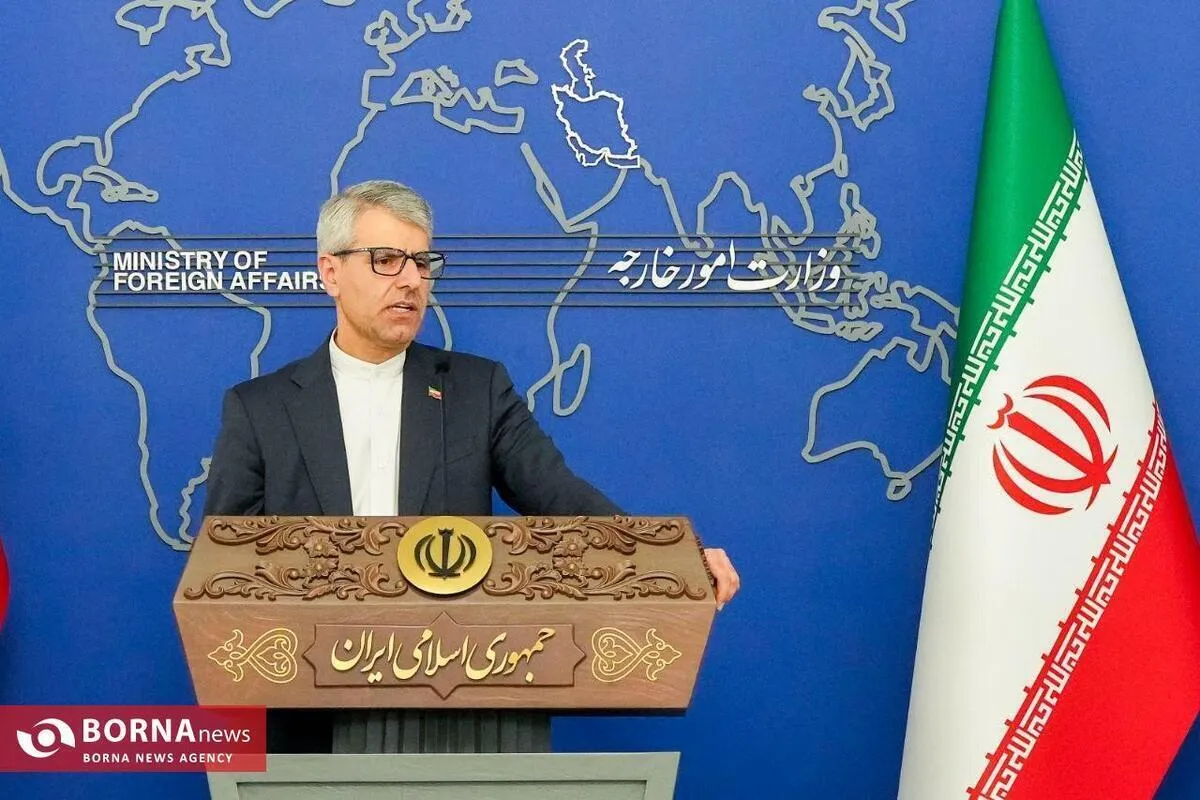
Tehran - BORNA - Baghaei made the remarks during his weekly press briefing on Monday, where he discussed Iran’s recent diplomatic engagements, the situation in Gaza, and the implications of the Western move at the UN Security Council.
Continued genocide in Gaza
Baghaei said that despite proposals for peace in Gaza and related efforts, “we continue to witness the ongoing crimes of the Zionist regime in Gaza.”
“Over the past two years, nearly 80,000 Palestinians have been martyred by the Zionist regime,” he stated, adding that the crimes “constitute clear acts of genocide.”
He further condemned the inaction of international bodies, saying: “Unfortunately, during this entire period, international organizations — including the United Nations and the Security Council — have proven unable to take even minimal steps to stop these atrocities.”
The spokesman also denounced Israel’s mistreatment of the Global Sumud Flotilla and the arrest of human rights activists aboard the aid convoy, calling it “a blatant violation of international law and human dignity.”
Diplomacy remains open if it serves Iran’s interests
Commenting on the recent decision by the UK, France, and Germany to invoke the snapback mechanism, Baghaei said: “They claim the diplomatic path remains open, but this is merely a general statement. We, too, believe diplomacy never truly ends — and whenever we see it serving Iran’s national interests, we will not hesitate to use it. However, these three European countries have proven that diplomacy, in its current form with them, is unproductive.”
He added that the European move was not only procedurally flawed but also legally destabilizing: “Their action has created legal confusion within the UN Security Council. It is unclear what, in practical terms, has been restored. This was not a rational, calculated move — rather, it was an act of obstinacy, carried out to appease the United States without regard for their own national interests.”
The UN Secretariat’s notices on sanctions lack legal validity
Baghaei strongly rejected the UN Secretariat’s role in issuing notices related to the so-called reimposition of sanctions, saying: “We stress that the UN Secretariat’s action in issuing statements about the return of sanctions against Iran has no legal validity and lacks logic.”
He emphasized once again: “The activation of the snapback mechanism by the three European countries does not create any obligation for UN member states to enforce sanctions.”
No current plan for talks with the three European states
When asked whether Iran plans to hold talks with the three European countries, Baghaei replied: “At the moment, we have no plans for negotiations.”
He continued: “We are currently focused on assessing the consequences and implications of the actions taken by the three European countries and the United States.”
However, Baghaei clarified that Tehran has not abandoned diplomacy entirely: “Diplomacy, in essence, means maintaining channels of contact. Whenever we determine that diplomacy can be effective, we will act accordingly, based on our national interests.”
The arrest of Iranian national in France is illegal
Baghaei said that the arrest of Iranian citizen Mahdieh Esfandiari in France was “illegal,” stressing that Iran continues to closely follow her case.
In response to a question regarding the latest developments in Esfandiari’s case and the possible prisoner exchange between Iran and France, Baghaei stated: “The charges against the two French nationals detained in Iran are clear. However, the detention of the Iranian citizen in France is illegal.”
He added that Iran is actively pursuing Esfandiari’s legal situation: “About 10 days ago, Iran’s ambassador to France met with Ms. Esfandiari for the third time. We are continuously following up on her consular and legal status. We are committed to securing her release.”
Baghaei noted that her case is still under investigation in France. Regarding a possible prisoner exchange, he explained: “All the necessary procedures at the Foreign Ministry have been carried out. The decision-making process is now underway in the relevant authorities of both countries, and we hope that, given the groundwork laid, this issue will be resolved soon.”
We will not allow illegal precedents at the UN Security Council to gain legitimacy
Referring to the recent Security Council vote on the European trio’s move to trigger the snapback mechanism, Baghaei said: “The action by the three European countries was not only unjustified from our perspective but was also rejected by six of the fifteen Council members. Four members voted against it twice, and two others—including the Council President—abstained. Notably, the very country that drafted the initial resolution abstained from voting for it. This division clearly demonstrates the deep disagreement within the Council regarding the legality and logic of the Europeans’ move.”
He elaborated: “To understand the illegality of this action, one must look at the record of these countries and the United States. From the adoption of the JCPOA and UNSCR 2231 in 2015 until 2019, Iran fully complied with its commitments. Only after the U.S. withdrew illegally from the JCPOA did Iran, under paragraph 36 of the agreement, lawfully reduce its obligations in a stepwise manner.”
The spokesman stressed: “Since 2019, the three European countries have committed serious breaches of their commitments and violated the JCPOA. The United States, as the primary cause of the current crisis, has no standing to invoke the dispute resolution mechanism. Thus, the actions of these four parties are fundamentally illegal.”
Baghaei concluded: “The Islamic Republic of Iran will use every available means—especially diplomatic instruments—to assert its legal position and convince the international community to reject the consequences of this unlawful action. We firmly adhere to our legal stance and will not allow such illegal precedents to gain legitimacy in the Security Council.”
No IAEA inspectors currently present in Iran
Responding to a question about the presence of IAEA inspectors and the future of Iran’s cooperation with the Agency, Baghaei said: “Currently, no IAEA inspectors are in Iran. The last inspection took place around ten days ago at the Bushehr nuclear power plant under the framework of our cooperation agreement with Russia.”
He added: “Future steps will be decided by the relevant authorities — particularly the Supreme National Security Council.”
The spokesman emphasized: “Given recent developments, the Cairo Agreement is undoubtedly no longer functional or implementable.”
Iran urges neighboring and friendly states not to implement the illegal snapback
Addressing Turkey’s reported decision to implement the UN Security Council’s sanctions following the European trio’s snapback attempt, Baghaei said: “Turkey’s action is considered unnecessary and illegal because the foundations and assumptions behind the European move are themselves illegal.”
He urged all countries—especially neighbors and friends—“to refrain from implementing or giving effect to this unlawful decision, which was taken in violation of established procedures.”
Baghaei also noted that: “The entities and individuals named in the Turkish government’s directive have no assets or accounts in Turkey. As Mr. Kamalvandi, the AEOI spokesperson, has also stated, these measures have no practical effect.”
Western indecision the main obstacle to a diplomatic settlement
Baghaei also elaborated on Iran’s diplomatic efforts in New York to prevent the illegal move by the three European states and the United States, saying: “The Iranian delegation made every effort to prevent the European trio’s unlawful action. We came forward with specific initiatives and showed logical flexibility in response to other proposals.”
He continued: “On several occasions—at least three times—the Europeans initially accepted the exchanged proposals but failed to persuade others to finalize an agreement. This shows that from the very beginning—since February 4, 2025, when the U.S. presidential statement tasked the State Department with pursuing the reimposition of UN resolutions—the Western track was predetermined. None of the subsequent proposals were taken seriously.”
Baghaei added: “There were multiple occasions when the other side suggested holding a multilateral meeting involving the U.S. to review initiatives. We agreed in good faith and even declared readiness before leaving for New York, but every time, they evaded implementation.”
He stated: “I can confidently say that every reasonable, dignified, and logical proposal was either presented or considered by Iran. The obstacle was never Tehran’s unwillingness but rather the West’s lack of political will and inability to form internal consensus for a realistic solution. This clearly proves that the main barrier to any agreement was not Iran’s proposals — it was the Western parties’ indecision and political paralysis.”
In response to a question about the recent statements of Rafael Grossi, Director General of the International Atomic Energy Agency stating that his report was not the cause of the attack on Iran, that he did not give the green light in this regard, and that Iran is not seeking to acquire nuclear weapons, the spokesman for the Ministry of Foreign Affairs of the Islamic Republic of Iran said: We definitely hold the Zionist regime and the United States guilty and responsible for the illegal attacks on Iran's peaceful nuclear facilities, as well as the violation of the country's territorial integrity and national sovereignty.
He added: "However, what we have always emphasized is that the IAEA report and the subsequent misuse of this report by three European countries and the United States to issue a resolution in the Board of Governors provided an excuse and a space for the Zionist regime and the United States to misuse it."
The Foreign Ministry spokesman continued: “The Director General of the IAEA has rightly pointed out that none of the Agency’s reports so far has contained any evidence or indication that Iran’s nuclear program has deviated from its peaceful path; this statement is completely accurate. In this context, our natural expectation from the International Atomic Energy Agency was to quickly condemn the action of the Zionist regime and the United States against Iran’s nuclear facilities; not only because such an action is illegal according to the UN Charter and international law, but also because, according to the Agency’s resolutions and the resolutions of the UN General Assembly, any attack on peaceful nuclear facilities of countries is prohibited.”
Baghaei noted: “Our expectation from the IAEA has always been that, as a specialized and technical institution, it should remain focused on its duties and technical competencies and avoid statements that raise suspicions of infiltration by the US and some Western countries.”
He emphasized: "We hope that what has happened in the last two to three months will be a lesson for all relevant parties, including the Director General and Agency officials, to be careful in their statements on issues under their jurisdiction and not allow the Agency's technical competences and responsibilities to be abused by countries that have repeatedly shown that they have no commitment to international law and safeguards obligations."
Iran has presented its reasons in detail to the UN Secretary-General regarding the illegality of the three European countries' actions
The Spokesperson for the Ministry of Foreign Affairs of the Islamic Republic of Iran also said in response to a question describing the recent meeting between Araqchi and the Iranian delegation with the UN Secretary-General on the sidelines of the UN General Assembly in New York: "We had an important and detailed meeting with the UN Secretary-General and frank discussions were held."
He continued: "One of the main themes of these discussions was the actions of the three European countries in abusing the Security Council and the JCPOA dispute resolution mechanism." We have presented our reasons in detail regarding the illegality of the actions of the three European countries.
Baghaei added: It should be noted that the resolutions passed from 2006 to 2010 under the pretext of the Iranian nuclear issue were generally passed with consensus or without opposition by the members of the Security Council, and all five permanent members of the Council voted for them. However, today, at least two permanent members of the Security Council have opposed this process on two occasions; this shows that there is no consensus even among the permanent members of the Council on the return of these resolutions.
The spokesperson for the Ministry of Foreign Affairs emphasized: We fundamentally do not believe that the Security Council has made a decision. In fact, what has happened is the action of three European countries, namely France, England and Germany, to return the sanctions resolutions, not the decision of the Security Council. We reminded the Secretary-General of this issue in detail.
Baghaei noted: "We believe that the provisions of Resolution 2231 should be terminated on the due date, October 18, and the Iranian nuclear issue should be removed from the Security Council's agenda altogether." The action of the three European countries, in addition to procedural and legal objections, has also caused a kind of confusion in the Security Council and the UN from a legal perspective, because it is not clear exactly what they have returned.
He added: "It seems that this action is more of a stubborn move in line with the US's wishes than based on rational calculation and legal considerations, and without considering the interests, concerns, and reputation of the European countries that are parties to the JCPOA." Accordingly, we consider the UN Secretariat's action in issuing announcements related to sanctions to be without legal validity and illogical.
We have expressed our protest and criticism of the performance of the Security Council Secretariat
The spokesman also emphasized the views of China and Russia on this issue: Iran's position in this regard is also supported by China and Russia. Russia, as a permanent member of the Security Council, has explicitly pointed out the illegality of this action. We have expressed our protest and criticism of the performance of the Security Council Secretariat and believe that the action of the three European countries does not create any obligations for other UN member states.
Baghaei said: We expect UN member states to refrain from complying with this illegal action of the three European countries, which is actually an imposition on the Security Council structure, in order to protect the principles of the UN Charter.
The Islamic Republic of Iran never begs for negotiations
The spokesman for the Ministry of Foreign Affairs of the Islamic Republic of Iran, in response to another question explaining the process of negotiations and Iran's recent diplomatic initiatives, stated: I repeat that the Islamic Republic of Iran never begs for negotiations. Negotiation is a bilateral matter that must be decided with the assurance of securing national interests. Just as protecting national security and interests is important, protecting national dignity is also vital for us. A dignified approach in foreign policy requires that we ensure that the diplomatic process proceeds in a manner that protects the rights and interests of the Iranian people.
He added: Before the Iranian delegation left for New York, proposals were made by the UN Secretary-General and the Director General of the International Atomic Energy Agency to hold joint meetings with the presence of a US representative to prevent the other parties from illegally reinstating the repealed resolutions. In return, we also made proposals, and it was ultimately agreed that a multilateral meeting, similar to the meetings of the Joint Commission of the JCPOA in the period before the US withdrawal, would be held. We did not object and showed our goodwill.
In all three cases where meetings were to be held with the presence of a US representative, the Western parties themselves refused to do so
The Foreign Ministry spokesman continued: "However, the opposing parties evaded the implementation of this agreement for various reasons. Some of them said that the three European countries were unable to convince the US, and others claimed that the US side had some reservations. These differences can be examined among themselves, but the clear fact is that in all three cases where meetings were to be held with the presence of a US representative, the Western parties themselves refused to do so."
Baghaei noted: "The Islamic Republic of Iran entered into dialogue with good faith and an active approach throughout this process. We had both numerous bilateral meetings with the three European countries and joint meetings with the presence of the EU foreign policy representative." These are the field and documented realities of the New York process and clearly show that Iran has never been an obstacle to dialogue, but rather it was the other parties who evaded the agreed commitments and initiatives.
We have serious concerns about some aspects of the so-called ceasefire plan in Gaza
He said about the so-called ceasefire plan in Gaza: We issued a clear statement on this matter last night. The position of the Islamic Republic of Iran is quite clear; we welcome any practical initiative that at this stage leads to stopping the genocide in Gaza and providing the opportunity to provide assistance to the oppressed Palestinian people in the occupied territories.
He added: This position is in line with the views of the Palestinian resistance groups, which announced their position a few days ago. In our opinion, any plan that includes recognizing the right of the Palestinian people to determine their own destiny and ensuring that the occupation and crimes of the Zionist regime in occupied Palestine do not continue is worthy of consideration. However, we have serious concerns about some aspects of the recent plan, and in our official statement we have also warned about the dangers and possible consequences of this plan for the Palestinian people and the entire region.
The spokesman for the diplomatic service noted: Past developments cannot be ignored. The experience of the last eight decades clearly shows that almost all the plans presented under the title of "solving the Palestinian issue" have in practice become a tool for further violating the rights of the Palestinian people. From the Balfour Declaration in 1917 to the Palestine Partition Plan in 1948 and the so-called Oslo peace process, the result of all of them is the current situation; namely, the continuation of occupation, killing, and genocide in occupied Palestine.
Baghaei emphasized: We call on all relevant parties to follow the developments related to this plan with open eyes and with complete accuracy and not to be deceived by seemingly peaceful titles. Experience has shown that many of these initiatives have in practice been a cover for consolidating the occupation.
Decisions about the future of Palestine should be made only by the Palestinian people and without pressure or interference from any foreign party
He said: It is the firm belief of the Islamic Republic of Iran that decisions about the future of Palestine should be made only by the Palestinian people and without pressure or interference from any foreign party, especially those who have always stood by the Zionist regime and have shown their obvious bias. Only this path can lead to the realization of justice and real peace in the region.
The issues between Iran and the United States are rooted in miscalculation and insistence on exaggeration on the part of the American side
In response to a question about the recent statements of Iraqi Prime Minister Mohammad Shia al-Sudani, regarding Baghdad's efforts to bring the views of Iran and the United States closer and to play the role of mediator, the Spokesperson for the Ministry of Foreign Affairs of the Islamic Republic of Iran said: In recent months, numerous countries, both in the region and outside it, have tried to use their capacities and connections to help resolve issues and prevent an increase in tension. From our perspective, these efforts are a sign of concern and goodwill from those countries, and we have always appreciated such initiatives.
He added: “However, the reality is that the issues between the Islamic Republic of Iran and the United States of America are mainly - and one could say in all cases - rooted in miscalculation and insistence on exaggeration on the part of the American side. In fact, the problem is not in the absence of a mediator or constructive proposals, but in Washington’s incorrect behavior and approach.”
The Foreign Ministry spokesperson went on to explain: “An example of this miscalculation can be seen in the recent negotiations, where the American side insisted on transferring part of Iran’s enriched materials, while in return they merely promised to delay the implementation of the illegal decision to restore the revoked resolutions by three or six months. Such an approach shows their misunderstanding of the realities of the Islamic Republic of Iran and of our completely legal and logical demands.”
Iran welcomes any initiative that is based on mutual respect and within the framework of principles and national interests
Baghaei emphasized: The Islamic Republic of Iran welcomes any initiative that is based on mutual respect and within the framework of principles and national interests, but any initiative or mediation can be effective only when the American side gains a correct understanding of the field realities, the JCPOA commitments, and Iran's position in the region, and distances itself from its past wrong policies.
The awakened conscience of the world has recognized the extent of Israeli atrocities
In response to a question regarding a recent poll in the United States indicating that even many Jewish Americans do not support the Israeli regime’s actions in Gaza, said this is a “clear sign” that despite all the efforts by the Zionist regime to distort the narrative of Gaza’s realities, “the awakened conscience of the global community has recognized the magnitude of the Israeli atrocities.”
He added that the Israeli regime remains the only regime that has been accused by the International Criminal Court, the International Court of Justice, and other international institutions of committing genocide. “The growing global protests across different regions show that public opinion can no longer tolerate the continuation of such crimes in Gaza,” he noted.
Baghaei continued, “This shift in U.S. public opinion is particularly meaningful, given that a significant part of the American media is controlled by the Israeli lobby and Zionist interests.”
He expressed hope that growing public pressure would compel Western governments to reconsider their stance toward Palestine and stop granting impunity to Israel for its crimes against humanity.
National sovereignty and territorial integrity of Yemen must be preserved
In response to a question regarding the recent attacks carried out by Saudi Arabia against Yemen, Baghaei stressed that “the national sovereignty and territorial integrity of Yemen must be preserved by all parties concerned.”
He also condemned the Israeli regime’s attacks on Yemen.
We hope the U.S. avoids politicization in sports
Commenting on Washington’s recent refusal to issue visas for a number of Iranian athletes and officials from the Iranian Football Federation, Baghaei said: “As a general rule, sports issues must be handled within the field of sports and in accordance with relevant legal and professional frameworks. We hope the U.S. government will refrain from politicizing sports. As the host of international tournaments, including the upcoming FIFA World Cup, the United States has specific obligations.”
He added that relevant Iranian institutions are following up on the matter and expressed hope that the visa process would be completed on time, emphasizing that “the Foreign Ministry will spare no effort to facilitate this issue.”
Baghaei also criticized the U.S. for “abusing its hosting privileges in both sports and political affairs,” noting that even during the recent UN General Assembly session, Washington exploited its position as host to deny visas to several members of Iran’s delegation.
Iranians returning from the U.S. did so voluntarily
In response to reports that around 100 Iranians were “extradited” from the United States, Baghaei said he disagreed with the use of the term “extradition.”
“What occurred was a discriminatory act by the U.S. administration toward Iranian citizens,” he said. “For various reasons and pretexts, a number of Iranians—some of whom had lived in the United States for decades—were forced to leave.”
He added: “The Islamic Republic of Iran has always welcomed the voluntary return of its citizens. Every Iranian has the right to return home whenever they wish, and their entry into their own country is fully free and natural. Therefore, no specific agreement was made on this matter.”
Baghaei noted that Washington had imposed restrictions and committed “highly inappropriate and inhumane behavior,” which constitutes a clear violation of its international obligations.
“So far, about 53 of those affected have returned to Iran,” he said, adding that the Foreign Ministry’s Consular Affairs Department had publicly condemned the U.S. behavior as “inhuman and discriminatory.”
He concluded: “The arms of the homeland are always open to all Iranians living abroad.”
Silence in the face of Israeli crimes is complicity in crimes against humanity
The Foreign Ministry spokesperson condemned the detention of nearly 500 members of the international solidarity flotilla for Gaza, calling the action “terroristic and a war crime.”
He stressed: “The humanitarian and international campaign to support the oppressed people of Gaza and to break the illegal blockade continues. The detention of peace activists and humanitarian volunteers who sought only to deliver aid is an inhumane act and a blatant violation of international law.”
Baghaei said the arrests aim to perpetuate starvation and deprivation among Palestinians, describing them as part of Israel’s systematic genocide campaign over the past two years.
He urged international organizations, human rights institutions, and independent governments to respond immediately, warning: “The world must break its silence in the face of these crimes; silence amounts to complicity in crimes against humanity.”
The Cairo understanding can no longer serve as a framework for cooperation with the IAEA
Responding to another question about the future of Iran’s cooperation with the International Atomic Energy Agency (IAEA), Baghaei said: “We are a member of the NPT and have a safeguards agreement. However, regarding the understanding reached with the IAEA, our Foreign Minister made it clear at the time that any hostile action—including the use of the snapback mechanism—would render the understanding inapplicable.”
He added, “We are now precisely in that situation. Therefore, the Cairo understanding can no longer serve as a basis for cooperation between Iran and the Agency. The responsibility for this situation lies squarely with the three European countries that disregarded the agreement and failed to implement it.”
Baghaei noted that Iran’s next steps would be decided by higher authorities, including the Supreme National Security Council, while the Foreign Ministry would continue to offer its diplomatic perspective in defense of national interests.
He reiterated: “Diplomacy is a continuous process. Whenever we determine that diplomatic tools can serve Iran’s national interests, the necessary decisions and measures will certainly be taken.”
End Article