Iran never negotiates under pressure, envoy tells UN Security Council
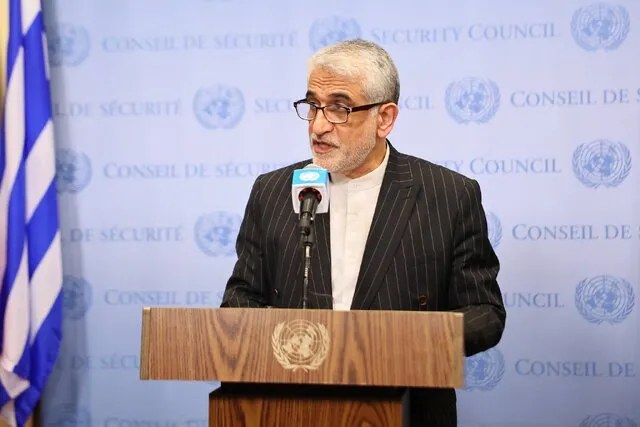
Tehran - BORNA - Speaking at the session titled "Advancing Political Solutions in the Middle East Through Mediation and Dialogue," Iravani addressed the recent rhetoric from Washington: "The President of the United States must refrain from his repeated threats against Iran, including today's renewed threat of resorting to the use of force."
The Iranian envoy emphasized that Iran has never negotiated under pressure and will never submit to coercion or intimidation.
"The United States has repeatedly pursued this failed policy and should have realized by now that military threats and intimidation yield counterproductive results," Iravani said. "If Washington truly seeks a diplomatic solution, it must abandon the language of threats and engage with Iran based on mutual respect, sovereign equality, and full adherence to international law."
He pointed out that the United States and the Israeli regime have repeatedly violated the comprehensive April 8 ceasefire. "In the face of these violations and continuous armed attacks, Iran has exercised—and will continue to exercise—its inherent right to self-defense, as recognized under Article 51 of the UN Charter, in response to any act of aggression."
Iravani stated that Iran remains determined to defend its sovereignty, territorial integrity, national security, and its people, adding that the United States and the Israeli regime, as the aggressors, bear full responsibility for all consequences arising from their unlawful actions and any subsequent escalation of tensions.
The Iranian diplomat further noted that to advance peace, stability, and security in the Middle East, the Security Council must address the root causes of conflict and instability. He identified these causes as the ongoing occupation of Palestinian territories, Lebanon, and Syria, the repeated aggressive acts of the Israeli regime across the region, and the long-standing US military presence coupled with its destructive, hegemonic policies that have fueled confrontation, insecurity, and mistrust for decades.
Emphasizing that resistance will persist as long as occupation and aggression continue, Iravani added: "No political or diplomatic process can legitimize or justify occupation or aggression, and no sustainable solution can be achieved without addressing this fundamental reality."
He argued that enduring collective peace and security in the region require an end to occupation, respect for the sovereignty and territorial integrity of states, accountability for aggressive actions, and the implementation of international law without discrimination or double standards.
Commenting on the structural security of the region, the Iranian UN representative noted that recent developments—particularly the unjustified war initiated by the United States against Iran—demonstrate that a continued foreign military presence in the Persian Gulf cannot bring sustainable security.
"Lasting peace, stability, and security can only be achieved through dialogue, cooperation, and confidence-building among regional countries," Iravani concluded. "This framework must be based on mutual respect, sovereign equality, good neighborliness, and full adherence to international law and the principles of the UN Charter, entirely free from foreign intervention and coercion."
End Article