The Untold Story of Iran's F-5 Penetration Strike on US Base in Kuwait: 'We Flew So Low Sailors Watched Us From the Deck
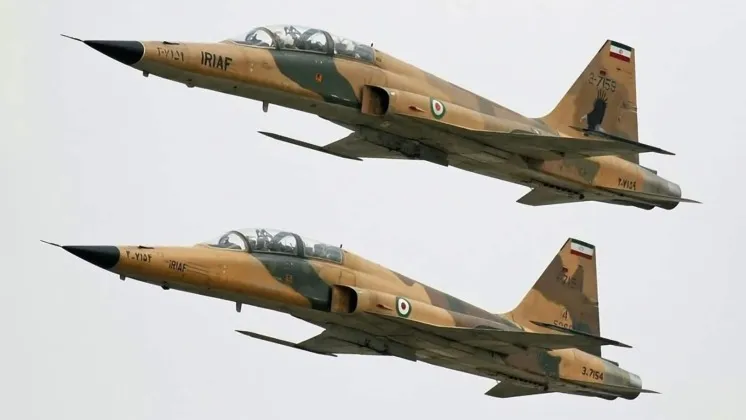
Tehran - BORNA - On the second day of the Ramadan War (March 1/Esfand 10), Iranian Air Force F-5E/F fighter pilots launched a high-stakes penetration strike against Camp Buehring, a major U.S. military facility in Kuwait. Given the density of local and American air defenses, the chances of the pilots returning alive were virtually non-existent.
"The Deck Was Higher Than Us"
The flight commander of this extraordinary operation recalled the rapid deployment in a recent television interview: "On the first day of the war (February 28/Esfand 9), I was on a test flight. Shortly after landing, we learned that our country had been attacked again. We wanted to launch an immediate retaliatory strike, and the mission was quickly put on the agenda."
The target chosen was of immense strategic value. "The site was the largest concentration of American troops in the region in terms of importance—highly strategic and heavily manned," the commander noted.
Describing the tactical execution on the second day of the war, he explained how the three-man formation evaded modern radar: "We took off and maintained an altitude of less than 50 feet (under 15 meters) in close formation. Standard military protocol dictates flying at 500 feet, but we flew at high speed below 50 feet because we knew Patriot missile systems and multi-layered air defenses were active. Any higher, and we would have been tracked instantly."
To maintain complete surprise, the aircraft bypassed alternative targets, such as Kuwaiti power lines and oil refineries, moving in total radio silence despite knowing that American AWACS and listening posts were active in the airspace.
"We entered the waters of neighboring territories," the commander added. "There were two or three ships in our path. We were flying so low that we passed right between two vessels. Their decks were higher than our aircraft—the sailors were literally looking down from the deck at us."
Upon identifying the American-built facility, the formation launched a heavy bombing run. "The base was clearly visible on our charts. We struck it immediately, triggering massive fires and secondary explosions that obliterated numerous advanced helicopters parked on the tarmac." The pilots remarked that the sheer scale of the destruction felt divinely amplified, sending a clear message regarding their destructive capability.
Friendly Fire and Confusion Over Kuwait
The penetration flight sowed immense confusion among allied forces. According to the second pilot in the formation, Kuwaiti Air Force fighter units misidentified three U.S. Air Force F-15E Strike Eagles that were intercepting or preparing to launch attacks against Iran.
"It was a divine intervention that they made a mistake," the pilot stated. "Kuilti aircraft mistakenly targeted and shot down three American fighters instead of us."
The following day, intelligence confirmed the incident when a photograph emerged of a Kuwaiti pilot who had ejected. It was revealed that he was one of the pilots involved in the friendly-fire engagement, an incident that reportedly sparked severe anger from Donald Trump. While military analysts initially questioned the veracity of friendly-fire claims regarding the lost F-15Es, the presence of low-flying Iranian assets inside Kuwaiti airspace explains the complete breakdown of situational awareness.
Bound for Minab: "We Never Expected to Return"
The third pilot spoke of the deep emotional weight carrying the squadron forward: "We were grieving for the children of Minab who had perished in the opening attacks. Our sole intent was to complete the mission. We were told we might not return, but we remained completely resolute."
The entire operation, including a highly calculated diversionary flight path, lasted approximately 50 minutes. The pilot noted that only a select handful of high-ranking commanders were aware of the mission before takeoff.
The back-seat pilot of the formation explained why no cockpit footage exists of the historic raid: "We didn’t take any photos or videos. A person records a video when they have hope of returning. We honestly never thought we would make it back alive."
He recalled his mindset on the morning of the strike: "Before the mission, I looked at my children, thinking it would be our final goodbye. My parents were on my mind. I was an only child, and we had just recently lost my sister. I didn’t want to inflict another heartbreak on my family, but I was completely determined to fulfill my duty for the country."
The penetration strikes carried out by Iran's Vietnam-War-era F-4s and F-5s—aircraft considered generations behind cutting-edge Western assets—have raised serious questions among global military analysts. Despite hundreds of billions of dollars concentrated in air defense equipment around the Persian Gulf, the U.S. and its partners failed to intercept these low-altitude runs. Similar strikes were reported elsewhere, including an Iranian F-4E that successfully penetrated Saudi airspace and safely returned after evading a U.S. Air Force F-16CJ.
The fragility of Western defenses in the region was further underscored by media reports, including NBC News, indicating that damage to U.S. infrastructure across seven Middle Eastern nations—including command centers, satellite communications, advanced radars, and hangars—was far more severe than publicly acknowledged. While drones and missiles comprised the bulk of the attacks, the penetration strikes by Iranian fighter jets represent some of the only successful hostile fighter runs against U.S. military bases since the Second World War. Analysts note that if legacy aircraft like the F-5 can breach these networks, the arrival of modern Su-35 and Su-30SM2 fighters to Iran could drastically alter the regional balance of power.
End Article