Baghaei: Funeral of martyred leader a 'historic and important event' for Iran, Muslims worldwide
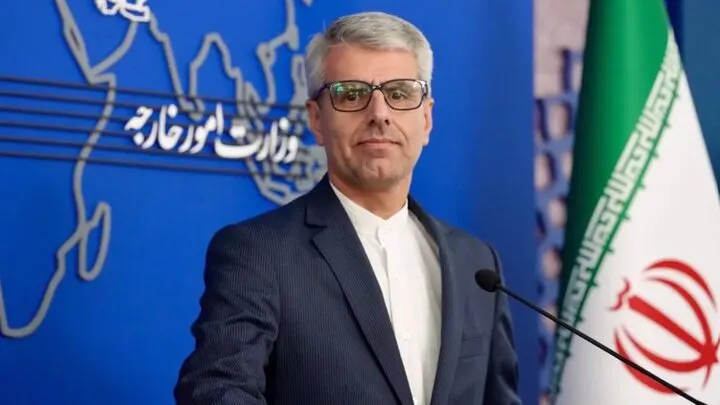
Tehran - BORNA - In his weekly press briefing, Esmail Baghaei commemorated Judiciary Week and the anniversary of the Sardasht chemical disaster, stating: "Our demand in this regard is the discovery of truth and progress toward the implementation of justice. All countries and individuals who played a role in this tragedy must be held accountable, and this is our serious demand."
The spokesman also noted the upcoming anniversary of the US downing of an Iranian passenger plane on July 3, 1988, stating: "This is another example of US actions against the Iranian nation."
Baghaei described the upcoming funeral of the martyred leader of the Islamic Revolution as a "historic and important event" for Iran, Muslims worldwide, and the people of the region.
Iraq's position during the war was responsible
Regarding Araghchi's visit to Iraq, Baghaei said: "This was the first visit by Iran's Foreign Minister after the formation of Iraq's new government. Iran-Iraq relations are deeply rooted and based on cultural, religious, and neighborly ties. Government changes certainly do not affect these relations, and we use every opportunity to deepen our ties."
He added: "Iraq's position during the war was responsible, and the Iraqi people expressed solidarity with the Iranian people. This solidarity is very valuable to us, and the Iranian delegation carried a message of gratitude."
Baghaei noted that coordination for the funeral ceremony in Iraq was a significant part of the visit, saying: "The Iraqi people are counting down the moments to participate in the farewell ceremony. Iraq's Prime Minister has formed a committee for this purpose, and the Prime Minister's chief of staff is responsible. A meeting was held, and consultations on how to conduct the ceremony are ongoing."
The spokesman emphasized: "The message of this ceremony is the depth of affection and friendship between the Iranian and Iraqi nations, and that the Iraqi people, like Iranians, mourn the martyred leader and his companions."
US must force Zionist regime to implement commitments
In response to a question about reports regarding the disarmament of resistance groups in Iraq and Lebanon and the cessation of war in Lebanon, Baghaei said: "Our position on Lebanon is clear. America's commitment to ending the war on all fronts is explicit. It is important for us that the US adheres to its commitments and forces the Zionist regime to implement its obligations."
He added: "The Lebanese people, with their valuable experiences in recent years, can certainly handle this matter in the best way."
Regarding Iraq, Baghaei said: "We have always said that Iraqis themselves are best suited to handle their internal affairs. The Iraqi government is well aware of the important and essential services rendered by the people and resistance groups in protecting the country against terrorism."
No high-level meeting with US planned
In response to a question about Trump's tweet claiming a high-level meeting would take place on Tuesday, Baghaei said: "The correct narrative is what your spokesman has said. We had no plan for a meeting with US officials. What will likely take place tomorrow in Doha is discussions with Qatari officials about implementing clauses of the memorandum of understanding, including the release of Iran's assets. We have not planned any meeting with Americans in the coming days."
He added: "Implementation of the memorandum's clauses, including the release of assets, is underway. All necessary preparations have been made, and we hope the process proceeds well and reaches a favorable conclusion."
NATO's active participation in war against Iran is clear to us
Iran's Foreign Ministry spokesman said that NATO's active participation in the war against Iran was clear to Tehran, adding that the NATO Secretary-General's admission is a explicit confession of the crime of aggression that can be cited in any court.
Baghaei, commenting on the NATO Secretary-General's admission regarding the participation of some member states in the war against Iran, said: "The issue of NATO's active participation in the war against Iran was clear to us. What the NATO Secretary-General has said has two aspects. First, it is an explicit confession to the crime of aggression against Iran, and this confession can be cited in any court. Both the NATO Secretary-General himself and all member states that participated in this decision and its implementation will bear international responsibility. On a personal level, this matter is also prosecutable. On the other hand, this confession reveals another dimension of the plan that the US and the Zionist regime had, and it also demonstrates the greatness and resilience of the Iranians, who did not resist only two evil regimes."
The Foreign Ministry spokesman stated: "Efforts by some European countries to justify and absolve themselves of these crimes are also underway. Claiming that their involvement was merely logistical does not reduce their criminal responsibility. It is natural that Iran will seriously continue to demand accountability from all parties that directly or indirectly played a role in the aggressive operations of the US and the regime against Iran."
No formal request received for reopening Canada's embassy in Tehran
Regarding signals from the Canadian government about resuming relations with Iran, Baghaei said: "It has been over 10 years since Canada, without any reason, decided to suspend relations with Iran. Since then, Iranians residing in Canada have been among those who suffered greatly due to lack of consular services. This also showed that the Canadian government does not place much value on humanitarian issues. At the same time, we have not received a formal request in this regard. The suspension of relations was a unilateral decision by Canada. If we receive a request, we will review it."
France raising the issue of mine-clearing will only complicate the situation
In response to a question about French President Emmanuel Macron's remarks that France has decided to take action on mine-clearing in the Strait of Hormuz in cooperation with Oman and other partners, Baghaei said: "Raising such statements is neither a sign of responsibility nor will it bring credibility to that country. It is necessary for all countries to strive for accurate recognition of boundaries and to understand that in many cases, the most responsible and constructive approach is to allow matters to proceed logically and normally."
He added: "We have repeatedly said that Iran's commitment under the memorandum of understanding regarding the Strait of Hormuz is clear. Iran is more aware than any other party of its responsibilities and has the ability to fulfill them, and there is no need for others' intervention. Such intervention is certainly not carried out with good and positive intentions and will only lead to further complications."
Zionist regime's attacks on Syria are violation of its territorial integrity
Regarding the Zionist regime's attacks on southern Syria, Baghaei said: "We are dealing with an entity in the region that cannot remain calm for a moment. Over these eight decades, it has continuously encroached on neighboring countries and is committing crimes."
He added: "The actions taking place in Syria are another chapter in the Zionist regime's display. The occupation of Palestine, attacks on Lebanon, and continued strikes on Syria are all ongoing. We condemn these attacks and express solidarity with the Syrian people. These actions violate Syria's territorial integrity and threaten regional peace and security."
Baghaei emphasized: "It is regrettable that the UN takes no serious action or measure against a party that has committed aggression against several countries, and this situation allows crimes to continue in the region. The United States must also be held accountable for the consequences of this situation."
Iran's Foreign Ministry spokesman said that any decision regarding negotiations is made through the country's established process, with all branches of the system involved, and the ministry is ultimately obligated to implement directives issued by higher authorities, including the Supreme National Security Council.
In response to some criticisms of the Foreign Ministry regarding negotiations, Baghaei said: "This is one of the blessings of the Revolution that our people think about issues related to their destiny and express their opinions. Where explanations are needed, they will certainly be provided. Every decision regarding our duties as the diplomatic apparatus is made based on a process that has been established in the country over several decades. All branches of the system have a role in decisions related to war and peace, negotiations, and dialogues that are fundamental to the country's current and future situation. It is not the case that a single ministry or specific body makes decisions alone."
The Foreign Ministry spokesman said: "Every decision is certainly made after careful assessment of its pros and cons, and the Foreign Ministry is ultimately obligated to implement the directives issued to it by higher authorities, including the Supreme National Security Council."
He added: "What matters is that in these circumstances, we do not withhold any statement that strengthens national cohesion, and on the other hand, we avoid fueling discussions that are not based on reality and not only do not help but can create division among the people."
We will not leave any action unanswered
In response to a question about recent US attacks on targets in Iran and whether this would affect the negotiation process, Baghaei said: "It is natural that America's failure to adhere to its commitments under the Islamabad Memorandum of Understanding will have a negative impact on the continuation of the process. At the same time, we will not leave any action unanswered. As the country's armed forces have shown, any aggressive action will be met with our decisive and immediate response."
He added: "These actions by the US constitute a violation of Clause 1 of the memorandum of understanding, and if such violations are repeated, the process will face difficulties. Clause 13 of the memorandum emphasizes that final negotiations are contingent on the implementation and continued execution of certain clauses. However, in some areas, the situation is favorable, including the lifting of the naval blockade and sanctions waivers regarding Iran's oil and petrochemical sales."
Baghaei emphasized: "Iran has been fully committed to its obligations regarding the Strait of Hormuz. However, we face serious challenges in some areas, and in this regard, the other side must implement its commitments seriously and responsibly."
All neighboring countries to attend martyred leader's funeral ceremony
Iran's Foreign Ministry spokesman said that a large number of officials from various countries have announced their readiness to participate in the funeral ceremony of the martyred leader, with all neighboring countries represented, alongside a significant number from outside the region.
Speaking at his weekly press briefing, Esmail Baghaei stated: "A large number of officials from various countries at different levels have announced their readiness to participate in the funeral ceremony of the martyred leader. All neighboring countries will be represented at this ceremony, and a significant number will also participate from outside the region."
He added that detailed information about the timing and specifics of the visits will be announced in the coming days.
Ghalibaf's visit to China
In response to a question about Mohammad Bagher Ghalibaf's visit to China, Baghaei said: "As you know, Mr. Ghalibaf has been appointed as Iran's special representative for China affairs, and this visit is taking place within that framework and format. Details of this visit and its composition will be announced by our colleagues in the Parliament."
Timing of future Iran-US talks
In response to a question about when future Iran-US talks would take place, Baghaei said: "A meeting must have a purpose and necessity. The precondition for a meeting is that the clauses related to the implementation of the understanding begin and continue. We must assess the current process in the coming days and see when and how we will start negotiations for a final agreement."
Israel's attempts to rebrand Palestinian expulsion
In response to a question about Israeli media reports that the Zionist regime plans to change the title of its plan to expel Palestinians from Gaza from "voluntary migration" to "freedom of movement," Baghaei said: "This is a play on words. Using the term 'freedom of movement' does not mean that Palestinians in Gaza or the West Bank are free to leave their homeland. This is not freedom; it is forced displacement."
He added: "The world is well aware of the nature of the genocide and the Zionist regime's efforts to completely change the demographic fabric of occupied Palestine and displace the Palestinian people from their land. The crimes they have committed over the past two and a half to three years are a true example of genocide. Unfortunately, due to a kind of absolute immunity in committing these crimes, they continue to do so."
As long as US continues all-out support, no change in regime behavior
Baghaei emphasized: "As long as the United States continues its all-out support for the Zionist regime, we will not see any change in this process. This situation places a heavier responsibility on the UN, the Security Council, and regional and international bodies, especially the Organization of Islamic Cooperation, to take serious action to prevent the continuation of genocide and to prosecute and punish the criminals."
Ghalibaf's visit to Baku
Regarding Ghalibaf's recent visit to Baku to attend the Union of Parliaments of Islamic Countries conference last week, Baghaei said: "This was a multilateral visit to participate in an international meeting, which I believe was a successful trip. For us, utilizing parliamentary diplomacy capacities to explain positions and strengthen relations with other countries is important. We always use these opportunities, especially now that our region faces unprecedented insecurity due to the provocative actions of the US and the Zionist regime."
Regarding alternative corridors in the region concerning the Strait of Hormuz, Baghaei said: "Regarding this waterway, both according to existing procedures and under Clause 5 of the memorandum of understanding, Iran will do whatever is necessary to protect its interests and implement this clause."
Most politicized World Cup treatment of Iran's national team
Regarding the treatment of Iran's national team during the World Cup in the US, Baghaei said: "The most politicized treatment of Iran's national team took place at this World Cup. A large number of team personnel were denied visas, and the team's accommodation away from the match venues created difficulties. Iran's national team represented Iranians and was a symbol of seriousness, patience, and perseverance. This is valuable to us. We congratulate all coaches, players, and team personnel."
He added: "This action showed the peak of America's animosity, and that a US official danced with joy over Iran's elimination is contrary to all hosting standards. Discussions about the host's conduct and FIFA are a technical matter. I have been informed that our federation has filed a complaint with FIFA regarding the last match and is pursuing it."
Baghaei emphasized that Iran will take any necessary action to support its athletes.
Iran welcomes joint meeting with PGCC plus Iran and Iraq
In response to a question about regional consultations during Araghchi's visit to Iraq and the proposal for a meeting with Persian Gulf Cooperation Council members plus Iran and Iraq, Baghaei said: "We welcome any initiative and opportunity that serves the collective interests of regional countries. This initiative had been previously proposed, and our Iraqi friends raised it again during the recent visit. Holding such meetings is in line with Iran's principled policy of ensuring regional security without destructive military intervention by foreign parties."
He added: "Now may be one of the best times for dialogue on this issue, because regional countries have seen firsthand the results of US military presence in the region and have observed that such presence not only does not serve their national and security interests but is itself a source of division and insecurity."
Communication channel on Hormuz is political, not military
In response to a question about the communication channel between Iran and the US on the Strait of Hormuz, Baghaei said: "This is not a military communication channel. It is a political channel between the two countries' political sectors. On Iran's side, the Foreign Ministry is responsible, and on the US side, one of the relevant officials in their political structure is responsible. This was one of the understandings reached during the Switzerland meeting and reflects Iran's responsible approach to implementing various parts of the memorandum of understanding."
He added: "We hope this set of measures and arrangements will help facilitate the smooth implementation of various sections of the memorandum of understanding."
End Article