Gharibabadi: New route for vessels proposed to Oman; Iran will never accept southern route
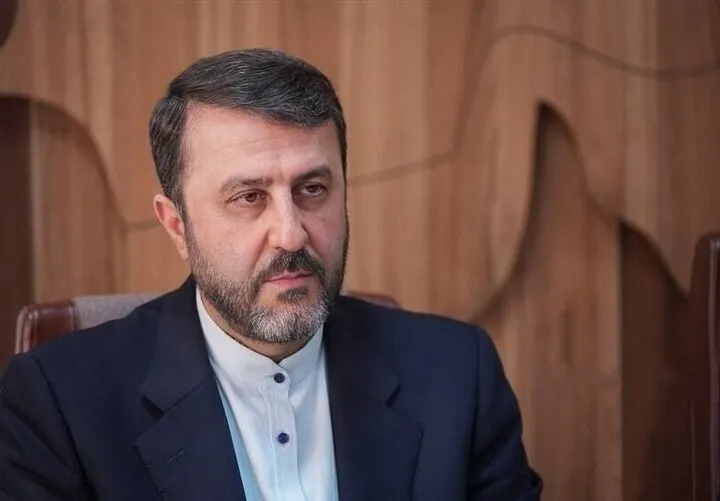
Tehran - BORNA - Kazem Gharibabadi rejected claims of negotiations with the US in Oman, stating: "Our last talks were with Oman. We have not had any negotiations with the US, and no discussions have taken place that would suggest 11 hours of talks with America."
He stressed that the Iranian delegation went to Oman with principled positions to discuss Iran's views on the Strait of Hormuz. "No agreement was reached," he said.
No negotiations with the US under the Islamabad Understanding
Gharibabadi explained that nearly one month has passed since the signing of the memorandum, and no negotiations have taken place with the US under its framework. He noted that working groups to finalize the agreement were never launched due to US violations, particularly regarding Lebanon.
Iran's sovereignty over the strait
He said that in times of war, when national security is threatened, one cannot solely rely on international legal norms. "If we only control our territorial waters while the other part of the strait remains uncontrolled, our national security remains at risk," he said.
Gharibabadi stressed that Iran has no intention of violating Oman's sovereignty, but the strait must not become a tool to threaten Iran's security. He noted that under the 1982 Law of the Sea Convention, the use of such waterways should not endanger the security and sovereignty of littoral states.
Clause 5 of the Islamabad Understanding
Gharibabadi explained that Clause 5 requires Iran to arrange safe passage for commercial vessels, not military ones, free of charge for 60 days. "This means determining traffic routes and ensuring security on these routes is Iran's responsibility," he said.
He added that mine-clearing is also Iran's responsibility and applies to the entire strait, not just Iranian territorial waters. He clarified that Oman, while not a party to the understanding, has historically had shipping routes in its territorial waters, and Iran never objected until the recent war when the strait was used to attack Iran.
The new northern route and US interference
Gharibabadi said Iran opened and cleared a new northern route near Iranian territorial waters and informed Oman, regional countries, and the IMO. However, the US pressured Oman to open a southern route, leading to the current tensions.
"The US pushed for this southern route, and whenever Iranian naval forces warned vessels to use the northern route, US drones forced them back south," he said. "The Americans did this to violate the understanding and create friction between Iran and Oman."
Iran's proposal and US violations
Gharibabadi said Iran proposed a new route to Oman to avoid conflict, but the US refused to accept the northern route. He emphasized that the issue for the US is not commercial shipping, as the northern route was fully operational and safe. "The US opposes Iran's effective sovereignty over the Strait," he said.
He noted that Iran has documented 42 clear US violations of the memorandum and stated: "The US has destroyed the Islamabad Understanding by resuming military operations and the naval blockade."
Response must be proportionate
Gharibabadi said Iran's response should not be limited to proportionate action, but must be a "regret-inducing" response to US aggression. He noted that the US, under the pretext of damage to a few commercial vessels, attacked hundreds of Iranian targets. He added: "These brutal and criminal US actions should serve as a lesson for us to calibrate our responses."
Iran will enforce sovereignty at any cost
He reiterated that Iran will enforce its sovereignty over the strait at any cost. "The strait has become part of Iran's national security," he said, adding that Iran will use its capabilities to advance its regional and international interests. "We must be grateful to God for this new capability. Other countries use their capabilities to secure their interests, and Iran has the right to do the same."
No request for negotiations
Gharibabadi said Iran will not be the first to request negotiations after US criminal actions. "If the US thinks it can pressure Iran into requesting talks, it is mistaken. The Iranian nation is a nation of resistance."
He also stated that the US is mistaken if it thinks Iran will back down on the Strait of Hormuz.
Diplomacy aligned with the battlefield
He stressed that Iran's diplomatic team is fully aligned with the armed forces and that no foreign policy decision is made without consultation with military commanders. "Diplomacy must adjust itself to the battlefield during wartime."
Warning to Gulf countries
Gharibabadi warned that some regional countries have once again allowed their territory to be used for US attacks against Iran. "These countries are our brothers, but we cannot compromise on our national security."
He added that during the 40-day war, almost all Gulf countries, with the exception of Oman, allowed the US to use their territory for attacks against Iran.
The naval blockade
Gharibabadi noted that the US naval blockade lasted about 40 days, but Iran did not back down. "Iran exercised effective control over the strait, and the US was forced to move toward a ceasefire and the memorandum. This tool is not effective for them."
He added that Trump has announced a combined approach of military strikes and economic blockade. "But the US has already tried both tools in the 40-day war and failed."
Economic blockade is an act of war
Gharibabadi said an economic blockade is different from sanctions and constitutes an act of war. "Even if the memorandum were still in place, reinstating the economic blockade would constitute a violation of Clause 1 and an act of war. But this tool will not achieve the US's strategic objectives."
No return to the negotiating table
Gharibabadi said that in a phone call with a European official, he was asked to return to the negotiating table. "I told him it seems he doesn't know what is happening. It was not Iran that left the table, but the US that destroyed the memorandum. Iran has taken no action to withdraw from negotiations."
He added: "The Islamic Republic of Iran will not be the first country to request negotiations after America's criminal actions. We will make no request for negotiations."
Full coordination with military commanders
Gharibabadi emphasized that the negotiating team moves alongside the armed forces, and there is full coordination between the diplomatic apparatus and the military. He said a three-hour meeting with senior military commanders was held before the trip to Oman to set the delegation's working instructions.
Objective of the Oman visit
He said the mission was to tell Omani officials that Iran does not intend to violate Oman's sovereignty, but that Iran is in a war situation and actions that threaten Iran's national security must be avoided. He said Iran requested the suspension and closure of the southern route, but also offered an alternative route.
Gharibabadi added: "If the decision-making were solely up to our Omani friends, we would likely have reached an understanding. This is my personal assessment from the atmosphere of the talks. Oman has always had a proper approach to relations with Iran, but for whatever reason, due to pressures, it was not possible."
End Article