U.S. Will Face Consequences of Any Attack on Kharg Island: Spox
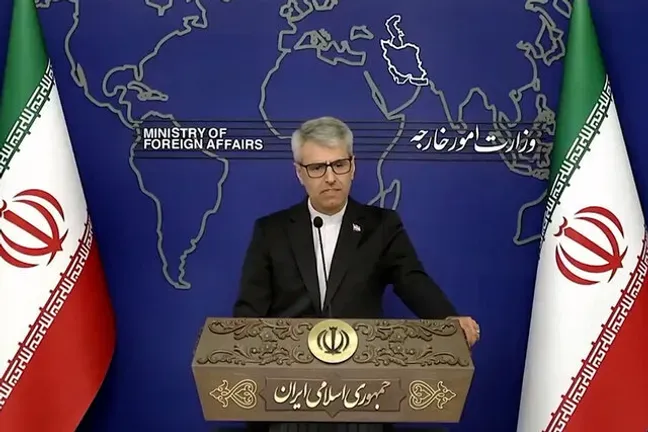
Tehran - BORNA - Speaking during his weekly press conference in Tehran on July 20, Baghaei stressed that the strikes targeted the essential means of daily survival for the local population.
Iranian Foreign Ministry Spokesman Esmaeil Baghaei strongly condemned the U.S. military strikes targeting civilian infrastructure and medical facilities in southern Iran. "U.S. attacks on infrastructure, medical facilities, and the resources that people rely on for their daily survival are not just strikes on a few points on a map; they are an explicit assault on life and human dignity," Baghaei stated.
Paying special tribute to the resilience of the population in the south, the spokesman added, "The south is Iran itself, and the entire nation stands unified as one single body."
World Cup 2026: The Most Politicized Sporting Event Globally
In response to a query regarding Spain’s victory in the 2026 World Cup final against Argentina, and the political atmosphere generated by U.S. political figures like Donald Trump supporting Argentina, Baghaei congratulated the Spanish national team while slamming the weaponization of sports. "This year’s World Cup was perhaps the most politicized sporting event in global history, and the final match was a clear manifestation of the host country’s—the United States—efforts to inject politics into sports," he remarked, pointing directly to Washington's poor treatment of the Iranian national football team.
"For the Iranian people, who traditionally measure championship through the lenses of sportsmanship, chivalry, and heroic virtue, Spain's stance over the past year in opposing aggression, occupation, and tyranny was deeply valuable. This principled stance was one of the primary reasons why the people of Iran and the world closely followed these matches and genuinely wished for Spain's victory," Baghaei elaborated.
He clarified that Tehran bears no hostility toward the Argentine people, revealing: "Earlier today, a former Argentine diplomat sent me a message stating, 'Our team lost, and we are deeply saddened, but I believe a primary reason for our defeat was the collective negative energy generated by those whose hands are stained with the blood of the people of Lebanon, Gaza, and Iran.'"
Dismissing U.S. 'AI-Generated' Claims on Minab War Crimes
Answering a question regarding the U.S. president's claims that the widely circulated images of the U.S. military strike on a school in Minab were fabricated using Artificial Intelligence (AI), Baghaei urged Washington to overhaul its intelligence reporting. "I believe American officials seriously need to review the intelligence and reports they provide and receive. It appears that whenever these officials are confronted with facts they dislike, the information is labeled as 'fake news.' This is identical to their previous absurd claims that the images of the massive, historic funeral procession for Iran's martyred Leader were AI-generated," the spokesman noted.
Baghaei firmly reiterated the deliberate nature of the attack on the Shajareh-ye Tayyeba school in Minab. "The Minab atrocity is merely one out of thousands of war crimes committed by the United States against the Iranian nation over the past year. We are actively and meticulously documenting these war crimes, and the United States will ultimately be held accountable for them," he asserted.
Rejecting the Harmful Dichotomy of 'Diplomacy vs. War'
When asked about internal domestic criticisms labeling diplomatic negotiations a "deception" and what Iran’s response would be if Trump requests new talks—specifically whether Iran would return to the Islamabad MoU or reset to prior positions—Baghaei warned against artificial dualisms. "Insisting on a rigid dichotomy between diplomacy and war is not beneficial to our national interests. The notion that diplomacy negates defense, or that defensive military action is incompatible with diplomacy, possesses absolutely no sound logic," he argued.
The spokesman emphasized the institutional unity of Iran's governance, stating, "We must keep in mind that the efforts carried out by 'Seyed Abbas' [Foreign Minister Araghchi] and the actions taken by 'Seyed Majid' serve the exact same purpose. Negotiation and war are merely instrumental pathways; we must never lose sight of the ultimate objective, which is the absolute protection of Iran's national interests. This goal is pursued at times through military defense, at times through diplomacy, and at times via both channels simultaneously."
Addressing the "deception" rhetoric, Baghaei asked: "When people call negotiations a trick, do they mean your diplomats were fooled, or placed under duress and intimidation? Which party was it that actually walked away from the memorandum of understanding? Did that party exit the MoU because it favored Iran, or because it realized the document successfully secured Iranian rights and thus felt shortchanged?"
He firmly added: "I had doubts about addressing certain points publicly, but given recent debates, it must be said: If anyone expects your diplomats to abandon the diplomatic arena out of fear of a deceitful enemy, they will absolutely not do so. Yes, the enemy is deceitful and savage. But suggesting diplomats should leave the table is equivalent to demanding that the military personnel operating our missile launchers abandon their defensive trenches simply because the enemy possesses higher technology. Despite being locked in an asymmetrical conflict, just as our military forces remain determined and duty-bound to defend Iran, your diplomats are equally obligated to stand firm against the enemy's malice and fiercely protect Iran's national interests."
Baghaei concluded this point by stating, "Diplomacy and defense are two interconnected wings. If either fails to execute its duties in safeguarding the realm of Iran and protecting national interests, our governance system will not function correctly. Therefore, just as you take pride in, defend, and support our homeland's defenders at the missile launchers, your diplomats deserve the exact same level of defense and support, for they are fighting alongside the defenders of the nation for the very same goal."
Reciprocity and the Future of the Islamabad MoU
Pressed by a reporter on whether the Islamabad Memorandum of Understanding has been officially suspended and if "all options are on the table," Baghaei turned to the journalist and remarked: "I do not quite understand what you mean by 'all options are on the table,' because those options are currently being actively applied on the ground."
He underscored that the foundational core of the Islamabad MoU is reciprocity—obligation for obligation. "As long as the opposing party remained committed to its obligations, we fully implemented ours. Iran has never been the initiator of a breach of faith; this is a fundamental principle of Iran's international behavior. The moment the other side violated its commitments, we explicitly warned that we would halt our implementation. The equation is straightforward: an agreement holds value only when its signatories remain committed to its terms; otherwise, it is merely ink on a piece of paper."
Breaking the Cruel Aerial Blockade on Yemen
Answering a specific question regarding the recent Mahan Air flight to Yemen, which effectively broke the aerial blockade, and subsequent Saudi airstrikes on Sana'a International Airport while the aircraft was operating, Baghaei noted: "We do not recognize the existence of any aerial blockade against Yemen. Such a restrictive interpretation of the UN Security Council resolution is legally flawed. On a broader note, we view the collective sanctioning and blockading of an entire nation as fundamentally unjust and oppressive."
He detailed the humanitarian nature of the mission, explaining that the aircraft flew to Sana'a to return a visiting Yemeni delegation that had traveled to Tehran to attend the funeral of the martyred Leader, alongside repatriating a group of wounded Yemeni civilians who had successfully completed their medical treatment in Iran. He strongly condemned the military strikes targeting the Sana'a airport, adding that the Foreign Ministry had already issued an official statement outlining its firm stance.
Denying Textual Ambiguities in the Swiss-Brokered MoU
Baghaei flatly rejected analytical narratives suggesting that structural ambiguities within the text of the agreement led to the breakdown of the MoU. "This claim is absolutely false. I will not delve into the underlying intentions of those propagating such analyses, but in practice, this narrative merely serves to excuse and justify American bad faith. The memorandum of understanding is a concise document consisting of only 14 clauses. I urge people to actually read the text; which specific clause contains ambiguity? Where exactly does Clause 5 imply any interpretation different from what we have stated from the very beginning—namely, Iran's sovereign responsibility to oversee and manage the future maritime operations of the Strait of Hormuz in consultation with Oman and through dialogue with regional states? The text is crystal clear, leaving no pretext for America's breach of faith. Furthermore, we have seen no indication from the Americans stating they resumed attacks against Iran due to a disagreement over textual interpretation; they simply violated the accord."
Participation in the SCO Ministerial Meeting in Kyrgyzstan
The spokesman announced that the Shanghai Cooperation Organization (SCO) Council of Foreign Ministers is scheduled to meet this coming Thursday and Friday in Kyrgyzstan, and Iran fully intends to participate. "This summit features specific agendas focused on economic integration, regional security, and counter-terrorism, offering an excellent opportunity for our foreign minister to hold bilateral consultations with his participating counterparts."
Hosting a High-Level Iraqi Delegation
Baghaei added that prior to departing for Kyrgyzstan, Tehran will host a high-ranking Iraqi delegation on Thursday. "Our plan is to complete our high-level engagements with the visiting Iraqi delegation before heading to the Kyrgyzstan summit."
Inherent Sovereign Rights Over the Strait of Hormuz
Returning to the topic of the Strait of Hormuz, Baghaei underscored: "Completely independent of Clause 5 of the MoU, Iran possesses historical and inherent rights as the primary coastal state of the Strait of Hormuz. We have extracted vital lessons from the history of U.S. and Zionist military aggressions, and regrettably, from the active complicity of certain regional states. We will never allow this strategic waterway to be exploited again as a staging ground to threaten Iran's security and national interests. The littoral states of the Strait of Hormuz are clearly defined: Iran and Oman. We are fully determined to enforce necessary measures to exercise our sovereignty and ensure that no actor can abuse this strait to inflict harm upon our national interests."
He added, "Since the early days following the declaration of the ceasefires on April 8 and 9, we have maintained continuous consultations with Muscat. Our primary effort, in close collaboration with Oman as the two littoral states, has been to formulate the necessary maritime mechanisms and enforce critical security measures."
Warning Trump Over Kharg Island Threats
In response to provocative threats made by Donald Trump regarding a potential military occupation of Kharg Island, Baghaei delivered a stern warning: "They will swiftly witness the severe consequences of such an action. I believe that within those very coastal regions, there are a substantial number of individuals who are literally counting down the minutes to 'welcome' these forces."
Commenting on statements from the U.S. Secretary of State regarding Washington's readiness to advance diplomacy with Tehran, Baghaei remarked: "We have witnessed and tested their 'readiness' numerous times. When the United States speaks of diplomacy, its actual definition translates to the imposition of intimidation, military threats, and economic sanctions. Rest assured, as long as they remain confined to this aggressive paradigm and attempt to dictate their demands to the Iranian nation, our response will remain a robust, reciprocal defense of Iran’s dignity and national sovereignty."
When asked whether the internal domestic perception of a division between "warmongers" and "peacemakers" inside Iran is accurate and how harmful such dualities are to national interests, Baghaei stated: "It offers absolutely no benefit. I do not recognize a single Iranian who is a warmonger. Our people are globally renowned for their peaceful nature and love of harmony. Did we initiate this war? Were we not the party that exhausted every diplomatic avenue until the absolute last moment? We must never lose sight of these fundamental facts."
The spokesperson added, "No rational or pure-hearted individual welcomes war, except for those devoid of reason and decency whose actions directly brought about this conflict."
'Peace Is Not Handed Out on a Silver Platter'
Baghaei emphasized the high cost of regional stability: "Peace is not a luxury commodity sitting on the shelves of international relations waiting to be handed to you. Peace is never presented to a nation on a silver platter; one must fight to achieve it. In our region, where aggressive forces have made war cheap and routine, peace is an extraordinarily expensive commodity. We must recognize that to establish stability, we have paid immense prices and sacrificed our greatest human souls. These sacrifices were not made for the sake of war, but to secure a dignified, lasting peace for the Iranian nation."
Urging observers to abandon "romanticized and fantasy-driven notions regarding war and peace," Baghaei noted: "War is a brutal reality. We did not invite war; it was forcefully imposed upon us under various fabricated pretexts. At the onset of the conflict in June, they claimed they attacked to eliminate Iran's nuclear threat; later, they cited an 'imminent danger' posed by Iran; then, they claimed it was in direct defense of Israel. Now, they point to two or three damaged commercial vessels in the Strait of Hormuz. These are all empty excuses. Under these conditions, anyone genuinely seeking an honorable, lasting peace must throw their full weight behind supporting the country's defenders. Every single step taken—whether by the diplomatic apparatus or the armed forces—is aimed squarely at defending the nation and achieving a dignified peace."
U.S. Terror Tactics and the Strike on Darkhovin Nuclear Site
Baghaei compared recent U.S. operations to the methods of terrorist organizations. "No amount of wounds will ever cause Iran to compromise on its national sovereignty or the dignity of its people. The strikes carried out by the U.S. have utilized the worst methods, highly reminiscent of terrorist groups like ISIS. Targeting a lone watchtower in Chabahar and subsequently bragging about it by releasing footage, or explicitly threatening to destroy Iranian bridges and power grids, violates every single standard of international law—even the benchmarks they themselves define for civilized human behavior."
He noted that infrastructure attacks would never break Iranian resolve. "If they imagine that by striking our infrastructure, killing Iranian citizens, or damaging our hospitals, they can sow a single shred of doubt or hesitation in Iran's determination to defend itself, they are profoundly mistaken. As we have proven over the last year and a half, every wound inflicted upon us only renders us more determined to defend the framework of Iran."
He specifically highlighted the U.S. attack on the under-construction Darkhovin nuclear site: "The U.S. strike on the peaceful, IAEA-monitored Darkhovin site completely exposes the fraudulent nature of Washington's alleged concerns regarding nuclear non-proliferation. This facility was entirely under the oversight of the agency and intended exclusively for civilian energy production. Striking such a center demonstrates that America’s true issue is with the industrial advancement, economic prosperity, and basic welfare of the Iranian people, and all other claims are mere pretexts."
Baghaei warned that the IAEA’s absolute silence and indifference toward this aggression severely undermines Tehran’s trust in the organization. "The targeting of a civilian nuclear site under construction is a flagrant violation of all international norms. Iran, as an NPT signatory, fully expects the IAEA Board of Governors and the Director-General—who frequently issues politically charged statements regarding Iran's nuclear file—to explicitly state their positions and formally condemn this American war crime."
Categorically Denying U.S. Prisoner Release Claims
Responding to claims made by Trump regarding the alleged release of an American citizen from Iran, Baghaei stated: "The judiciary has explicitly confirmed that no American prisoner matching the descriptions provided by the U.S. president has been released from Iranian prisons. The individual they named was neither a prisoner nor held on espionage charges. I refer you entirely to the official, specialized statements issued by the judiciary on this matter."
He also confirmed that Iran’s Interior Minister traveled to Islamabad on Monday for a reciprocal bilateral visit following a prior visit by the Pakistani interior minister to Tehran, while officially denying rumors that Foreign Minister Araghchi had any planned trip to Pakistan.
Legal Prosecution for the Assassination of the Leader
Regarding the latest legal actions surrounding the assassination of the Leader of the Islamic Revolution, Baghaei termed the act an unforgivable international crime. "The crime committed against Iran—specifically the martyrdom of the Leader of the Islamic Republic and numerous high-ranking political and military officials—is an unprecedented and completely unforgivable atrocity. Seeking blood-wealth and demanding absolute justice is a sacred national duty; every organ of governance and every single Iranian citizen holds themselves responsible. Furthermore, regional nations, Muslims, and freedom-loving people worldwide share this profound obligation."
He asserted: "The diplomatic apparatus will relentlessly exploit every single tool at its disposal—whether in terms of meticulously documenting the crime or engaging any international judicial body or forum that possesses the jurisdiction to prosecute this matter. Any political or legal mechanism that offers an avenue to pursue this case will be utilized. This atrocity transcends the limitations of any standard international forum. The judiciary has clear, designated responsibilities, and the Ministry of Foreign Affairs will spare no effort in defending the rights of the Iranian nation."
Iraqi Prime Minister's High-Level Visit to Tehran
Confirming reports that Iraqi Prime Minister Al-Zaidi is scheduled to arrive in Tehran on Thursday heading a high-ranking delegation, Baghaei noted the visit comes immediately after Al-Zaidi's trips to the U.S. and Qatar, and may carry diplomatic messages. "This is an important bilateral visit. We all know how profoundly critical our relationship with Iraq is. Iran has consistently placed premium value on the stability, prosperity, independence, and territorial sovereignty of Iraq, sparing no effort to elevate bilateral ties while fully respecting Baghdad's internal political processes."
He contrasted Iran's behavior with that of the U.S.: "This respect has never been the policy of others. The Americans have consistently based their interactions with regional states, including Iraq, on open interference, intimidation, and dictation. We warmly welcome Prime Minister Al-Zaidi and his delegation in advance, and we are confident this visit will serve as a major turning point in the growing relations between our two neighboring Muslim nations. The talks will cover a comprehensive spectrum of economic, commercial, border security, and mutual defense cooperation. We anticipate the signing of several bilateral agreements and MoUs during the visit."
Refuting U.S. Allegations Regarding Cuba and Pakistan
Baghaei dismissed recent U.S. intelligence claims alleging the presence of Iranian military advisors and drones in Cuba. "You know, we know, and they know that they are lying. Cuba has endured over 70 years of brutal American embargoes, sanctions, and intimidation. The Cuban people are fiercely independent and freedom-loving. The aggressive, unilateralist trend unleashed by the U.S. in Latin America over the past two years is highly dangerous, aiming to subjugate independent nations. We strongly condemn the economic blockade against Cuba and assert that these fabrications regarding Iran-Cuba military ties are merely pretexts to escalate pressure on Havana. Our relations with Cuba are completely legitimate, conducted in strict accordance with international law and the UN Charter, and we will proudly maintain them. The international community must wake up, as the continuation of this lawless American trend will completely dismantle the foundations of international law."
He also explicitly denied media reports published by Reuters claiming that Pakistani authorities had officially warned Iran that any military strike against Saudi Arabia constitutes a red line for Islamabad. "No, no such message has ever been conveyed to Iran," he confirmed.
Defensive Strikes in Iraqi Kurdistan
Addressing Iranian military operations in the Kurdistan Region of Iraq, Baghaei clarified the legal framework of the actions: "We do not attack any sovereign party. Iran’s military strikes are strictly defensive operations targeting either U.S. military bases used to tatar and launch aggressions against Iran, or the active bases and assembly points of anti-Iran armed terrorist groups entrenched on neighboring soil. These actions are fully aligned with safeguarding Iran's national security and the joint security of Iran and Iraq. We maintain an active bilateral security agreement with Baghdad and remain in constant contact with our friends in the Kurdistan Region to ensure Iraqi soil is never utilized to organize armed provocations against the Islamic Republic. We expect the implementation of the security pact to proceed in a manner that removes any necessity for Iran to resort to such defensive military operations to protect its borders."
Sabotage Campaigns Directed by Israel
When asked to comment on statements by the U.S. Vice President acknowledging that a heavily funded campaign, actively backed by Israel, was working to derail negotiations and destroy the Islamabad MoU, Baghaei stated: "We leave the internal political feuds of the United States to the Americans themselves. What remains relevant to us is the objective performance of the U.S. government, which in this specific case, utterly failed to show the necessary willpower to fulfill its legal commitments. That being said, there is absolutely no doubt regarding the malicious intent of the Zionist regime. This regime has consistently opposed and actively sabotaged any diplomatic process that could bring a shred of stability and security to our region. This is a clear reality recognized by both regional states and the American public. However, every sovereign government remains legally responsible for its own conduct and must possess the internal strength to implement its international agreements regardless of external disruptive forces."
The North-South Transport Corridor
Concluding his press briefing, Baghaei addressed the development of the rail corridor linking Iran, Russia, and Azerbaijan, and whether the North-South Transport Corridor serves as a strategic alternative to the Strait of Hormuz amid regional volatility.
"Our relationship with the Russian Federation is comprehensive, institutionalized, and governed by a comprehensive strategic partnership agreement covering diverse sectors, including transit, transport, and macro-economics. Regarding corridor development and the reinforcement of railway connectivity, we possess detailed, long-term operational plans. Both Tehran and Moscow are completely serious about accelerating and expanding these strategic transit projects," the spokesman concluded.
End Article