Baghaei: We will not allow US to dictate when war and peace occur
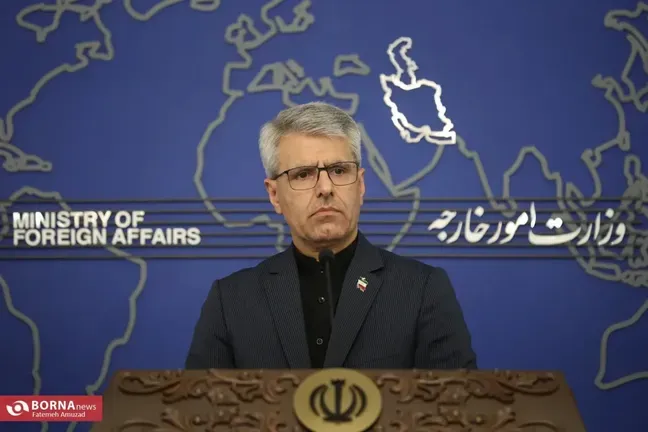
Tehran - BORNA - Esmail Baghaei began his weekly press briefing by honoring three martyred students from the Minab school attack, whose remains were recently identified and reburied. He said: "Today we begin our session in the presence of three martyrs from the Shajareh Tayyebeh school in Minab — Amir Ali Jedavi, Masiha Salari, who have been added to Makan Nasiri, who until today we thought was the only missing martyr of America's war crime in Minab."
He described the recent reburial: "Last week, Iran became Minab once again. A scene rarely seen in history. The reburial of angels — the pieces of the bodies of Iranian girls and boys. We buried their hands, feet, and fingers — the body parts of our children. With such anguish. Once again, with all our being, we felt the touch of American 'aid.'"
Baghaei described the image of a white-haired mother writhing in pain and grief, refusing to let go of the last remaining piece of her child, saying it would be forever recorded in the memory of Iranians. "You saw how she smelled her child's severed arm, placed it on her forehead and face, and how she retrieved it from the grave and begged for more," he said.
He questioned: "How can a child be separated from a mother and buried, even if only a small piece of a crushed finger or hand remains?"
Baghaei directly addressed EU foreign policy chief Kaja Kallas: "I ask Ms. Kallas, who claims to be concerned about the human rights of the Iranian people and occasionally issues statements against Iran under this pretext and places individuals on human rights sanctions lists — are these not Iranian? Were these not innocent human beings?"
He also questioned the French government, which last week claimed to support Iranians and Iranian civil society while protesting Iran's action against two diplomats engaged in interventionist activities under diplomatic cover. "Which Iranian civil society are you talking about? How is it that the pain and suffering of Iranians subjected to US and Zionist regime military aggression does not stir your humanitarian sentiment, but when Iran confronts your interventionist actions, you hide behind beautiful slogans like human rights and civil society?"
Iran will not allow US to dictate war and peace
In response to a question about the US using oil prices as leverage to push Iran toward negotiations, Baghaei said: "I don't know how you think they are managing the war. A war that was supposed to collapse Iran within three days and force it to surrender, and now after five months they are trapped in their own self-made quagmire — that is not managing war. That they occasionally commit war crimes and take pride in it is just flailing in the disgrace they created with their own hands and the temptation of the Zionist regime, and they must pay the price for it. As a principle, we are neither dependent on oil nor concerned about US worries. What matters to us is national interests and expediency."
He added: "Decision-making about national interests is not a single-variable equation; it has many variables, and ultimately what is decisive for us is national security and interests. Decisions are made in a completely transparent and clear process with the participation of all decision-making bodies in the Islamic Republic, and the Foreign Ministry is one of them. We have never allowed and will not allow the US to determine when war and peace occur. We will defend ourselves as long as our interests require, and whenever we feel we can use diplomacy to preserve national interests, we will certainly use it as a tool."
Peaceful nuclear energy is the right of all NPT members
In response to a question about Trump's reported offer to allow Saudi Arabia to enrich uranium under the Abraham Accords, Baghaei said: "There is no doubt that the Zionist regime has a problem with any technology transfer and endogenous progress to regional countries and will not hesitate to take any action to prevent it."
He said Iran had also heard about this agreement from the media, noting that the understanding reportedly did not last more than 24 hours before the US raised conditions for its implementation. "The use of peaceful nuclear energy is the right of all NPT member states," he said.
Baghaei criticized US selective behavior and its obstruction of Iran's right to use nuclear energy. "The pretext for US actions against Iran has been Iran's insistence on exercising this right. We leave the judgment of this contradiction to global public opinion. Our position is that any country that is an NPT member should benefit from its rights in this field. The peaceful use of nuclear energy is the right of all countries."
France should apologize, not Iran
In response to French claims about the treatment of two diplomats in Tehran, Baghaei said: "The French side is the one that should apologize. They engaged in interventionist activities under the cover of diplomatic affairs, which is not justified under international conventions."
He added that France's ambassador was summoned to the Foreign Ministry on Sunday and was told to refrain from such interference in Iran's internal affairs.
Ukraine's action will not go unanswered
On Ukraine's attack on an Iranian commercial vessel, Baghaei said: "All parties that consider themselves supporters of the Ukrainian regime must be held accountable in this regard."
He added: "The behavior of Ukraine's president resembles that of anarchists who carried out dangerous acts on the eve of World War I. You cannot be sure that a dramatic act to attract attention will remain at that level. Such an act will certainly have unpredictable consequences for yourself and will affect the region you have involved."
Baghaei said: "The Ukrainian regime has turned its country into a tool in geopolitical conflicts for four years. Instead of focusing on resolving the crisis and saving the country and the region, it has always blamed others."
He added: "We have said from the beginning that we have no involvement in the Ukraine-Russia conflict. Ukraine's recent action was completely illegal, unjustified, and contrary to the UN Charter, and it was also a dangerous adventure that will certainly not go unanswered."
Baghaei said: "Zelensky's superiors must both control him and be careful. The actions of the Ukrainian regime could have consequences that involve various parts of the world. We are aware that the Caspian Sea littoral states are deeply concerned and dissatisfied with this action, and Ukraine will certainly be held accountable."
Regional countries' cooperation with US aggression will not be ignored
Baghaei said Iran considers the US responsible for military aggression but does not ignore the participation of some regional countries. "We seek good relations with regional countries and have no hostility toward any of them. We have many ties with them that can be the basis for mutual cooperation. Unfortunately, these countries have placed their territory at the disposal of the aggressor and in some cases have independently participated in military aggression."
He described the recent statement by the US Secretary of State and Gulf Cooperation Council ministers as destructive, saying: "Knowing the provisions of the memorandum and that Iran will never negotiate its defense capabilities under any circumstances, they aligned with the US Secretary of State on this issue, which contradicts their claims of supporting the dialogue process. This is an issue that must be explained. We have clearly stated these matters, and our clear expectation from them is not to continue such complicity against Iran."
Bulgaria's decision constitutes an aggressive act
Baghaei said Bulgaria's decision to allow US aerial refueling aircraft to use its air base constitutes an aggressive act and a violation of international law. "We are aware that Bulgaria had previously allowed the use of Sofia airport for US aircraft to support military aggression against Iran."
He added: "This action is contrary to the fundamental principles of the UN Charter and international law and can be considered an aggressive act under UN General Assembly Resolution 3314. We have clearly stated this."
Baghaei said: "We are also aware that the Bulgarian people, public opinion, and a significant portion of Bulgarian parliamentarians oppose this decision. Bulgarian decision-makers must be held accountable for this unjustified and dangerous decision."
UK interference in Strait of Hormuz will complicate matters
On the UK's agreement to allow US use of its bases against Iran and the upcoming US-UK meeting on the Strait of Hormuz, Baghaei said: "We expected the new UK government to act more wisely than the previous one, but unfortunately we saw it followed the same path, even worse. We were and are aware that during the 40-day US aggression against Iran, the US used UK military bases to support its aggressive operations. This action violates international law by any standard. The new UK Prime Minister's explicit statement is an admission of complicity in an unlawful international act, and London must be held accountable."
He added: "Experience has shown that appeasement toward an aggressor and attempts to please a party that openly violates international law do not secure international peace and security, and will further undermine the credibility of those supporting this process."
Baghaei said: "The UK knows that any interference in the Strait of Hormuz will only complicate matters and will not help resolve the issue. If the UK is sincere and concerned about the strait, it should address the root cause. UK officials should look at the Luxembourg Foreign Minister's speech at the ASEAN summit and, for once, honestly admit that the US is the cause and instigator of the current situation in the Strait of Hormuz."
He added: "The Strait of Hormuz was open before February 28. The current situation has no reason other than the aggressive actions of the US and the Zionist regime against Iran."
No talks with US; negotiations with Oman continue
Regarding technical talks on the strait, Baghaei said: "Several rounds of useful talks were held with the Omanis on Friday and Saturday regarding the management of shipping in the Strait of Hormuz. The goal is for Iran and Oman, as the two littoral states of the strait, to develop mechanisms to ensure safe shipping. The situation in the strait has not changed and remains closed due to US aggressive actions and the insecurity the US has imposed on the region. These talks are bilateral and have no connection to the US, and they continue."
Baghaei dismissed reports of a 10-day ceasefire, saying: "No. Don't pay much attention to these media speculations. We have no negotiations with the US. The talks we currently have are with Oman regarding necessary arrangements for the strait."
Reports on embassy activities part of psychological warfare
Baghaei dismissed reports about foreign embassy activities, saying: "I don't know how important this question is. It's August, and many people may travel during this month. Embassies more or less continue their activities."
He added: "In one case, an atmosphere was created that we believe was deliberate and part of the psychological warfare by the US and some of its allies. Rumors were spread about the UK, and about other embassies as well, which they themselves denied — including France, whose ambassador was summoned to the Foreign Ministry yesterday."
Baghaei concluded: "Consider most of these reports as psychological warfare, in which the US is an expert."
Iran will not compromise on national interests
In response to a question about the status of the Islamabad Memorandum, Baghaei said: "The situation is clear. We had a memorandum that specified the obligations of both sides. The commitments provided for in this memorandum were violated. No agreement can be one-sided, and we also stopped implementing our commitments. As for the future direction, we will have to see. But one thing is clear: we will under no circumstances compromise on the principles and foundations we have defined as our national interests and security."
US continuously uses Kuwaiti bases against Iran
In response to Kuwait's ambassador's claims about non-participation in military operations against Iran, Baghaei said: "These statements are good, if they are reflected in practice. Unfortunately, in practice this is not the case. In practice, the US continuously uses military bases in Kuwait and uses the facilities there to continue its war crimes against Iran."
He added: "What is stated as the declared position of regional countries is mostly focused on blaming Iran for responding to US military actions. We need to see these in practice. In practice, they should not allow the US to exploit their sovereignty and violate it to attack a neighboring Muslim country."
Border security and counter-terrorism were focus of talks with Iraqi PM
Regarding the visit of Iraq's Prime Minister to Tehran, Baghaei said: "The Iraqi Prime Minister and his office have taken a position on this, and our position is the same. He responded very clearly to this issue."
He added: "Regarding security issues, yes, during this visit, talks were held about Iran-Iraq cooperation in strengthening border security, counter-terrorism and terrorist groups, based on an agreement that has existed between the two countries for several years. Our effort is to ensure that, with the cooperation of the Iraqi government and relevant authorities in the Kurdistan Region, the shared borders become secure borders free from terrorist group activities."
Resistance weapons are for defending Lebanon's sovereignty
In response to a question about the Lebanese President's visit to the US and request for help with disarmament, Baghaei said: "Resistance weapons have been for defending Lebanon's national sovereignty and territorial integrity. Lebanon still faces occupation. How the Lebanese, including the resistance, decide to defend their national sovereignty, territorial integrity, and dignity against a regime that knows no limits in crime and aggression is an issue that concerns the Lebanese themselves. But experience has shown that in the face of those who recognize only the language of force, one cannot be unarmed and defenseless."
Only the US is responsible for the current situation
Baghaei rejected claims that Iran's actions provided a pretext for US aggression, saying: "I ask that we not blame ourselves for the enemy's malice. We were in no way responsible for the current situation. The only culprit is the US, which, whatever analysis you may have — whether it fell into the Zionist regime's trap or acted for its own interests — the US and the Zionist regime committed aggression against Iran once in June, once in February, and once again 22 days after signing a memorandum of understanding."
He added: "The pretext they raised was that Iran had taken actions in the Strait of Hormuz. But we must consider a few points. Clause 5 of the memorandum clearly states our obligations and emphasizes that Iran will arrange safe passage for commercial vessels. But what did the US do? Before the 30-day deadline for Iran's obligations, in response to a few alleged incidents, it launched extensive attacks against Iran. We had said from the beginning that the southern route that the US had set up with some regional countries was unsafe. We had committed to arranging the safe route, and we did so, and we would have completed it within the 30-day deadline. But the Americans, thinking that Iran was occupied with the funeral ceremony of the martyred leader and would be lenient about the southern route, began a coordinated action with some regional countries to divert ships from the northern route to the southern route."
US action was a trap for ships and a pretext for arson
Baghaei said: "This unsafe route is contrary to Clause 5 of the memorandum. I don't think anyone would accept that the three Saudi, Qatari, and Emirati ships, which were claimed to have had incidents, coincidentally turned off their transponders and used that route. Turning off transponders while knowing that the safe route was available, and the US actively diverting ships from the northern to the southern route through threats and inducements, and worse — our commitment under Clause 5 was to facilitate safe passage for commercial vessels. The US and some regional countries must answer for how they used commercial vessels as a cover to transport military equipment and some warships through the southern route. The provocative action that the US took with the cooperation of some regional countries was a kind of trap for ships, to make the Strait of Hormuz appear unsafe, and a pretext for arson."
Baghaei added: "Do you think if a party placed any value on its signature, it would have such a disproportionate reaction to a violation, assuming the violation was committed by Iran, and commit war crimes for several days? All evidence indicates that this was a calculated action to create pretexts and breach the agreement."
As long as US behavior continues, there is no hope for a rational process
In response to a question about Iran's conditions for starting talks with the US, Baghaei said: "The US must learn to act like a responsible government. US behavior over the past year or two has been like a mafia that adheres to no rules or laws, and in words and actions it has violated all international norms. As long as such behavior continues from the US, we cannot hope for a rational process to take shape."
He added: "What currently exists cannot be called a ceasefire. The relative calm in the past few days is the result of the prudence of Iran's armed forces, who are always vigilant and will certainly respond decisively to any US action, as we have seen in recent times."
Attack on Shalamcheh and Mashhad route shows US animosity toward sacred values
In response to a question about US attacks on Arbaeen pilgrims at the Shalamcheh border, Baghaei said: "In recent days, the US, out of desperation, has carried out many attacks on our civilian infrastructure. It is significant that in the first days they targeted the route to Mashhad, and in recent days the Arbaeen walking route. These actions demonstrate America's animosity toward all the values that are sacred to us Iranians. Attacking these infrastructures constitutes a war crime."
GCC states must reconsider their approach
In response to a question about the joint statement of the Gulf Cooperation Council and Jordan regarding recent developments, Baghaei said: "That they have declared Iran's strikes as a clear violation of the memorandum and aggression is one of the wonders of the age. If the Gulf countries and Jordan are concerned about the memorandum, they should logically have condemned the US for violating it."
He added: "Such inversion of reality does not solve the problem. The Gulf Cooperation Council, especially those countries that have consciously lowered themselves to the level of accomplices and collaborators with the US for military aggression against Iran over these months, must truly reconsider their methods and approach."
Baghaei emphasized: "Jordan cannot deny that its territory has been used by the US to attack Iran. Under these circumstances, they cannot give us solutions. If a third party used another country's territory to attack them, what would their reaction be?"
He said: "They must stop political rhetoric, decide to stop this behavior, and prevent US exploitation of their territory for attacks against Iran."
UK's action against IRGC is hostile and contrary to international law
Baghaei said: "For the UK to label a part of the sovereignty, an institution that is part of the Islamic Republic of Iran and an integral part of Iran's armed forces, and a defender of Iran and the region against ISIS terrorism, is an action contrary to international law and hostile, and is completely unacceptable."
He added: "This is a political action aimed at putting pressure on Iran and has no legal or international law basis, and the consequences of such an action rest with the UK. Iran will certainly take measures to confront this illegal UK action."
Iran has responded to mediators' proposals
In response to a question about whether Iran has responded to mediators' proposals, Baghaei said: "The pretext for the US to start a new fire was the incidents that occurred for several ships in the Strait of Hormuz. Parties that have been trying to prevent escalation over these months have made proposals focused on this issue, but the talks we have had in recent days have been exclusively with Oman. We are trying to adopt mechanisms for shipping transit, and these consultations continue."
Iran and China share serious concerns about US unilateralism
In response to a question about Netanyahu's visit to the US and Araghchi's meeting with China's Foreign Minister, Baghaei said: "Araghchi's meeting with his Chinese counterpart took place on the sidelines of the Shanghai summit. China is Iran's strategic partner, an effective member of the Shanghai Cooperation Organization and BRICS, and a permanent member of the UN Security Council."
He added: "Iran-China bilateral relations are good and continuously developing. We share mutual interests with China and also share common concerns. China, like us, is concerned about the state of peace and security in the region and internationally. Both countries have serious concerns about the continuation of very destructive unilateralism by the US."
Trump-Netanyahu-Zelensky can be called a 'triangle of evil'
In response to a question about the attack on an Iranian vessel in the Caspian Sea and the upcoming meeting between Zelensky and Trump, Baghaei said: "You may interpret this action as a kind of dancing for those they consider their real masters. But in any case, this gathering can only be interpreted as forming a triangle of evil."
Baghaei added: "Such triangles have never had a beneficial effect on international peace and security; they have always been destructive and disruptive."
Islamabad Memorandum was drafted based on national interests
In response to criticism of the Foreign Ministry and Araghchi regarding the memorandum, Baghaei said: "As you know, every decision regarding the use of diplomacy to secure national interests has been a decision of the entire establishment — a decision that was the product of consensus in higher bodies and competent authorities. Do not doubt this."
He added: "I repeat this phrase: the enemy's treachery and malice should not cause us to blame each other. The Islamabad Memorandum was drafted based on national interests. Regarding the issue you mentioned, Clause 5 of the memorandum — where in this content is it contrary to the decisions and directives issued to the Foreign Ministry?"
Baghaei said: "That the US violated its commitment should not cause us to blame ourselves. We must accept that the US is a party that breaks its promises. At the same time, we live in the real world. Every negotiation and every understanding has two or more sides. So to reach a result, you must consider all considerations and ultimately reach a decision whose outcome secures the country's national interests."
Claims of Iran requesting talks are fabrication
In response to a question about whether Iran has requested direct talks, Baghaei said: "Such a thing is not in our nature. Claims of Iran requesting talks are fabrication that the other side repeats every now and then. While we have always said we have never avoided using diplomacy to protect our national interests, we consider diplomacy as a tool to protect Iran's national interests. At the same time, we will not take any action that the other side might misinterpret. As I said, when the other side is engaged in hostile actions and aggression against Iran, our focus is on defense. Regarding what has been mentioned, yes, mediators may convey messages from the American side to us about current regional developments, but at present we have no negotiations with the American side."
End Article