Iran will never surrender; Trump’s threats over Hormuz and Kharg are empty rhetoric, Rouhani says
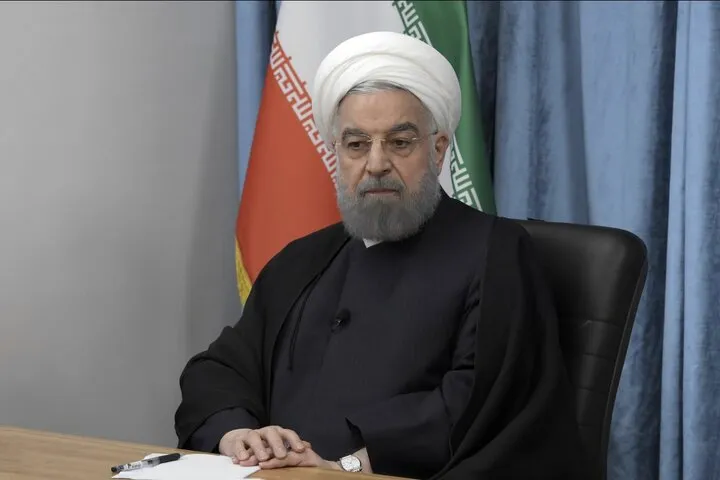
Tehran - BORNA - Speaking on Sunday, August 2, during a meeting with former ministers and vice presidents from the 11th and 12th administrations, Rouhani reviewed the geopolitical developments of the past 14 months, addressing U.S. policy, regional security dynamics, and the principles governing Iran’s foreign policy and national decision-making.
Below are the key thematic axes from his address, formatted for international reporting:
Rejection of U.S. threats over Kharg Island and the Strait of Hormuz
Rouhani strongly criticized President Donald Trump’s statements regarding potential U.S. control over Iranian energy hubs and strategic maritime passages, describing such plans as unrealizable and historically scandalous if attempted.
"All the claims currently being put forward by Trump—that we will eventually take Kharg, or that one day we will take the Strait of Hormuz—are, in my view, nothing more than baseless and worthless assertions," Rouhani said. "They are empty boasts and hollow words. If they were to commit such a folly and attempt to seize the Strait of Hormuz, Kharg Island, or other islands, it would remain a massive historical scandal for the U.S. government."
Rouhani emphasized that Washington and the Israeli regime severely miscalculated the endurance of the Iranian public, noting that while defense against aerial and naval power requires significant resources, ground-level resistance remains a far more decisive factor in which the Iranian populace demonstrated unmatched resilience despite severe civilian casualties and infrastructure damage.
The legacy of resistance: Iran’s refusal to capitulate
Addressing the overarching objective of U.S. and Israeli military and economic pressures, Rouhani asserted that the primary goal has consistently been to force Tehran into submission, an outcome that Iran's leadership firmly prevented.
"Their main goal was to ensure that whatever needed to be executed in Tehran was decided in Washington—in other words, the surrender of Iran," Rouhani explained. "They thought they could bring about regime change through economic pressure and an economic war. When they realized that economic pressure failed, they sought to achieve this through military power and war, which also failed and will fail in the future."
He added: "Our martyred leader left a legacy for the history of Iran, and that legacy is that Iran will never surrender. They wanted Iran to capitulate, but the leadership stood firm and demonstrated that Iran will not surrender, even if he gave his own life in this path and achieved martyrdom."
Strategic restraint: Defense vs. the avoidance of war
Detailing Iran’s historical posture toward conflict, Rouhani stressed that Iran has never initiated a war in modern history, emphasizing that defense and deterrence are necessary duties, while ending conflict and lifting sanctions remain primary objectives.
"In the past 200 years, Iran has never initiated a war, nor have we initiated any war following the revolution," Rouhani noted, recalling multiple instances in 1990, 1998, 1999, 2003, 2013, and 2019 where Iran's leadership deliberately prevented escalation into broader military confrontations.
"War was imposed upon us," he stated. "When war is imposed, one must stand firm and resist. Resistance and defense are necessary and good; deterrence is necessary and good; standing against an aggressor is a duty. However, if we can end a war even one day earlier, it is better—just as the leadership once stated regarding sanctions: if we can end sanctions one day earlier, we must do so."
Call for regional cooperation and warning to Gulf neighbors
Rouhani addressed the southern Persian Gulf states, reminding them of Iran’s historical role in safeguarding the region against external threats—specifically citing Iran’s immediate condemnation of Saddam Hussein’s invasion of Kuwait—and calling for a return to neighborhood diplomacy.
"We condemned Saddam on the very day of the invasion of Kuwait, before the southern Persian Gulf states themselves condemned him," Rouhani recalled. "They must not forget those historical days. Throughout history, we stood by their side. If they wanted to appreciate our actions, they should have stood up to the U.S. and prevented American bases on their soil from being used against us. They had told us hundreds of times across different administrations that they would not allow the U.S. to use those bases against Iran. Why did they allow it?"
Rouhani reaffirmed the validity of the Hormuz Peace Endeavor (HOPE) initiative, which Iran presented to the UN General Assembly in 2019, advocating for mutual non-aggression, economic and security cooperation, and regional stability. "We want the Strait of Hormuz not to be a strait of war, but a strait for establishing total security in the Persian Gulf region," he added.
National sovereignty, public will, and rejection of extremism
Rejecting fringe internal viewpoints that advocate for endless escalation, Rouhani clarified that Iran's primary obligation is the preservation of its territorial integrity, national security, and the welfare of its citizens, rather than global confrontation.
"Our duty is to preserve the country, its territorial integrity, national security, and the livelihoods of the people," Rouhani stressed. "We do not have a duty to conquer the entire world or force everyone onto a path we prefer. For every major action, we must consult the people and act according to the opinion of the majority."
Rouhani concluded by highlighting that national governance in Iran is anchored in the popular will, noting that key decisions regarding the continuation or conclusion of conflicts ultimately rest with the Iranian public and constitutional bodies.
End Article