Seraj: Human rights must not become tool for political pressure, interference
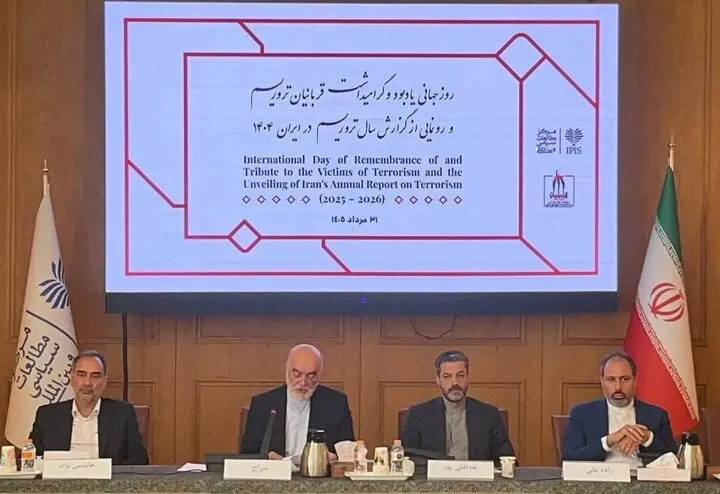
Tehran - BORNA - The event was held on Saturday, August 22, at the Foreign Ministry’s Institute for Political and International Studies, with Nasser Seraj, deputy chief of the Iranian Judiciary for international affairs and secretary of the Judiciary’s Human Rights Headquarters; Saeed Khatibzadeh, head of the Foreign Ministry’s Institute for Political and International Studies; Mohammad Javad Hasheminejad, director-general of the Habilian Foundation; and a number of families of those killed in Minab in attendance.
Addressing the ceremony, which was attended by families of victims of terrorism and those killed in the recent imposed war, Seraj spoke about what he described as the largely untold suffering endured by victims of terrorism.
Thanking the Habilian Foundation and the Foreign Ministry for organizing the event and creating an opportunity for the voices of victims and their families to be heard, Seraj said: “We have gathered today to remember those who are no longer among us. But the truth is that terrorism does not end when a person is killed. From the moment terrorism targets a human being, it enters the life of a family, and sometimes its consequences remain for several generations.”
He stressed that while a bullet may take a person away from their family within seconds, the suffering of that family may continue for years.
“A child who has lost their father, a mother who has lost her child, a spouse who has lost their life partner, and a family that every year feels the absence of a loved one at its table — all of them are victims of terrorism,” he said.
The Human Rights Headquarters secretary continued: “The victim of terrorism is not only the person who has lost their life. The victim is a family, a society and sometimes an entire generation.”
“That is why the International Day of Remembrance of and Tribute to the Victims of Terrorism is not merely a date on the calendar. By designating August 21 as the International Day of Remembrance of and Tribute to the Victims of Terrorism, the United Nations has also emphasized the need to support victims, preserve their dignity and guarantee their fundamental rights and freedoms.”
Seraj then raised several questions concerning victims of terrorism.
“Does the international community, in practice, treat all victims of terrorism equally? Is the blood of all victims regarded as having equal value? Are the voices of all bereaved families heard equally? And is our definition of terrorism independent of the power, wealth, nationality and political standing of its perpetrators?” he asked.
“Unfortunately, the answer to these questions is not always positive.”
Iran: A country that has been a victim of terrorism
Seraj said the Islamic Republic of Iran and the Iranian people are among those who have paid a heavy price as a result of numerous terrorist attacks over recent decades.
“Thousands of Iranian citizens — children, women, men and the elderly — have lost their lives in terrorist operations, ranging from ordinary people to officials, scientists, military and law-enforcement personnel, clerics, workers and students,” he said.
“Terrorism in Iran has taken different forms. Sometimes it has taken the form of explosions in public places, sometimes assassinations of political and scientific figures, sometimes attacks on defenseless people in streets and public gatherings, and sometimes operations intended to create fear, insecurity and distrust within society.”
“But alongside all of these incidents, one issue that must not be forgotten is the way the international community treats the perpetrators and supporters of terrorism.”
Seraj said that when a terrorist attack takes place in a European country, it immediately becomes a global issue, while reactions can be far more limited when the victim is Iranian.
“If a scientist or political official is assassinated somewhere in the world, it is described as a threat to international peace and security,” he said. “But when the victim is an Iranian citizen, the same incident is sometimes met with silence, justification or even politically motivated narrative-building.”
“This is precisely the double standard that must be discussed openly.”
He said that if human rights are universal, their observance must also be universal, and if human life has intrinsic value, that value must not depend on a person’s passport.
“An Iranian child, a Palestinian child, a European child, an African child and an Asian child are all children,” he said.
“An Iranian mother who loses her child experiences the same pain as a mother anywhere else in the world.”
State terrorism and the responsibility of governments
Seraj stressed that counterterrorism efforts should not focus solely on non-state groups.
“The international community must adopt a single position toward any organized use of violence against civilians, regardless of the identity of the perpetrator,” he said.
“If an armed group targets a civilian, the action must be condemned. Military power cannot provide a license to violate human rights. Membership in a political coalition cannot create immunity, and the claim of fighting terrorism cannot justify targeting ordinary people.”
War and civilian victims
Referring to recent wars, the Judiciary’s deputy chief for international affairs said ordinary people had once again been exposed directly to the consequences of military conflict.
“In the 12-day war and then the 40-day war, ordinary citizens, families, children, women and the elderly were exposed to terrorist attacks and insecurity,” he said.
“In such circumstances, the issue is not simply the number of victims. The fundamental issue is the need to observe the basic principles of international humanitarian law.”
Seraj said the principles of distinction between military and civilian targets, proportionality and the obligation to take necessary precautions to protect civilians could not simply be disregarded under any circumstances.
“A bitter and painful example of these incidents is the Shajareh Tayyebeh School in Minab,” he said.
“A school should be a place of education, hope and building the future — not a scene of children’s deaths.”
“When a child becomes a victim of violence at school, regardless of whatever political or military dispute is underway, humanity is confronted with a human tragedy.”
Seraj stressed that “no political cause, geopolitical dispute or military objective should destroy the dignity, security and lives of children.”
“The international community must investigate such incidents, establish the truth and, if violations of humanitarian law are proven, pursue accountability for those responsible,” he said.
Terror at the highest political level
Seraj said that during the recent attacks, even the highest political level of the Islamic Republic of Iran had not been spared the consequences of violence, referring to the death of Ayatollah Seyyed Ali Khamenei, Leader of the Islamic Republic of Iran, along with several members of his family.
“Regardless of any political differences concerning individuals, this incident carries a clear message: When assassination and political violence become tools, they recognize no boundaries,” he said.
“Today the target may be a political official; tomorrow it may be a family, a student, a patient or an ordinary citizen.”
“For this reason, the international community must take seriously the principle of civilian immunity and the need to prevent the cycle of violence from expanding.”
Hidden terrorism: Sanctions and pressure on people
Seraj then referred to another form of pressure on ordinary people.
“Allow me to point to another form of pressure against people — one that may not at first glance be regarded as identical to terrorism, but whose humanitarian consequences must be examined carefully,” he said.
“Comprehensive sanctions and unilateral coercive measures can have profound and sometimes irreversible effects on the lives of ordinary people.”
He stressed that when sanctions make it more difficult for people to gain access to medicines, medical equipment, banking services, raw materials and essential needs, governments are not ultimately the only entities placed under pressure.
“In many cases, it is ordinary people who come under pressure — people who possess the right to life, the right to health and the right to human dignity,” he said.
“We therefore believe that the humanitarian consequences of sanctions and unilateral coercive measures must be seriously addressed within the framework of human rights.”
Terrorism is not only what is seen through explosions and bullets
Concluding his remarks, Seraj directly addressed the families of victims.
“Perhaps no words can fill the absence of your lost loved ones,” he said. “No words can fully describe the suffering of a mother who has lost her child. But one promise can be made: Society must not forget you.”
“We have gathered here today to say that victims of terrorism are not merely part of the past; they are part of our conscience today.”
“Their memory reminds us that if we normalize violence, there will be another victim tomorrow. If we accept double standards, we have weakened justice.”
Seraj said the message was clear.
“Terrorism, wherever it occurs and whoever perpetrates it, is condemned. Human lives cannot be traded politically. The rights of victims cannot be subjected to discrimination. And no power should consider itself above accountability for human lives.”
He expressed hope for a day when no family would lose a loved one to terrorism and violence, no child would become a victim of war and political conflict, and no person would be targeted because of nationality, religion or political views.
He also called for justice to replace revenge and dialogue to replace violence.
“On such a day, the memory of victims of terrorism will no longer merely recall a tragedy; it will remind us of humanity’s victory over violence,” he said.
“We bow our heads before all victims of terrorism and before their patient and bereaved families.”
Khatibzadeh: Countries like Iran remain committed to shared human values
Saeed Khatibzadeh, head of the Foreign Ministry’s Institute for Political and International Studies, also addressed the ceremony.
“Never before has the front between right and wrong been drawn so clearly,” he said.
“Western countries have sold terrorism to the world at different times under deceptive names and concealed its criminal dimensions, but what happened against Iran over the past year exposed the front of terror, fear and killing.”
“We must establish a Museum of Terror in Tehran.”
Khatibzadeh said the victims of terrorism and of such crimes should be represented in such a museum both conceptually and thematically.
“With the help of the Habilian Foundation, important work can be done in this area,” he said.
“What has been done against our country in the field of terrorism will remain in history forever.”
He said the “terror front” had believed that resorting to terrorism inside Iran would allow it to achieve its objectives, but the Iranian people had stood firm.
“There are various documents concerning the atmosphere of terror created by the Western front of arrogance against Iran,” he said.
Khatibzadeh described the war and the series of wars against Iran, including what he called the latest form of “economic terrorism,” as criminal acts and war crimes whose victims are innocent people.
“Taking the wrong path a thousand times will still lead to the wrong result,” he said.
The head of the Foreign Ministry’s Institute for Political and International Studies said Iran must remain committed to its principles and continue on its course.
“The Foreign Ministry has instructions for pursuing the rights and protecting the interests of victims of terrorism in the international arena so that none of their rights are lost,” he said.
“The terror front has reached the point where it claims that power comes through force.”
“Countries such as Iran, which are committed to shared human values on the basis of their inherent commitments, act in order to fulfill their responsibilities.”
Habilian Foundation: Iranians have suffered terrorism for nearly half a century
Mohammad Javad Hasheminejad, director-general of the Habilian Foundation, also addressed the ceremony.
“For nearly a decade, August 21 has been commemorated every year by the United Nations and various countries as the International Day of Remembrance of and Tribute to the Victims of Terrorism,” he said.
“That is why we have gathered here, as victims of terrorism, to commemorate this day.”
“But the reality is that our country and Iranian citizens have endured the bitter experience of terrorism for many years. For nearly half a century, our people have been victims of terrorism and gross human rights violations committed by terrorists.”
Hasheminejad said that from the earliest days after the victory of the Islamic Revolution, terrorist, separatist and ethnic armed groups had carried out violent terrorist activities against Iranian citizens and officials in different parts of the country.
“More than 23,000 Iranians have been killed since then by groups that were supported by the West,” he said.
“After the country was cleared of their presence, these groups fled and, with the overt support of those countries, transferred their offices and bases to Europe and the United States, from where they planned killings and acts of destruction inside Iran.”
He said that in addition to such groups, what he described as state terrorism by the United States and the Israeli regime had simultaneously targeted Iran and Iranian citizens both inside and outside the country.
“The targeting of an Iranian passenger Airbus by the United States and the killing of dozens of citizens, as well as Washington’s unilateral and unjust sanctions, which can be categorized as economic terrorism against the Iranian people, are examples of US state terrorism,” he said.
“The assassination and killing of at least 50 Iranian citizens by the Israeli regime from the beginning of the Revolution until before the two recent imposed wars — documentation of which has also been submitted to international bodies — are evidence of these terrorist crimes.”
Hasheminejad said that despite the large number of Iranian victims of terrorism and Iran’s counterterrorism efforts domestically and across the region in cooperation with neighboring countries, Iran has consistently been portrayed as a supporter of terrorism by the same countries that support anti-Iranian groups.
“The painful and unprecedented crimes of the Israeli regime in the Gaza Strip, carried out with the support of the United States and the West and amid the regrettable silence of international institutions, demonstrated just how political, unethical and instrumentalized the standards relating to terrorism and human rights violations have become in the hands of certain countries seeking to impose their will and domination,” he said.
International institutions ‘failed the test’
The Habilian Foundation director-general said the two recent imposed wars, during which Iranian political, military and scientific figures were assassinated and killed, thousands of innocent people — including children, particularly in Minab — lost their lives, and vital national infrastructure was attacked and destroyed, had clearly shown the world who the violators of human rights, terrorists, perpetrators and supporters of terrorism were.
“But I must again point out that international institutions failed the test here as well and did not even condemn the killing of people and children in Iran,” he said.
Hasheminejad cited the conduct of the UN office toward Saturday’s ceremony as an example of what he called the politicization of human rights and disregard for human lives.
“Although today’s occasion is a global United Nations observance, despite the invitation extended to the organization’s representative in Iran, none of its officials or representatives attended this ceremony to honor victims of terrorism in their host country,” he said.
“Naturally, expectations that such institutions will take action speak for themselves.”
More than 50 killed in terrorist incidents in Iran in 1404
Hasheminejad said the annual report on terrorism in Iran, compiled and published by the Habilian Foundation in recent years and unveiled at the ceremony, demonstrates that the country continues to be targeted by terrorist groups supported by some foreign states.
“The killing of more than 50 citizens in various terrorist incidents in the country during the Iranian year 1404 clearly demonstrates this point,” he said.
He noted, however, that both the number of victims and the number of terrorist operations in 1404 had declined significantly compared with the previous year, with further details presented in a report screened during the meeting.
“Although the reasons and factors behind this decline can be studied and examined, more than 50 deaths and 26 terrorist operations must still receive the attention of officials and policymakers so that last year’s downward trend can continue this year,” he said.
Hasheminejad said government bodies could benefit from such reports as well as from the capacity of families of victims of terrorism, particularly in the human rights field, both domestically and internationally.
He thanked the Foreign Ministry’s Institute for Political and International Studies, Khatibzadeh and his colleagues for cooperating with the Habilian Foundation in organizing and hosting the event.
He said families of Iranian victims of terrorism once again expressed their readiness to cooperate and build greater coordination with the country’s diplomatic apparatus and other institutions responsible for human rights and victims of terrorism.
“They believe that the human rights capacities associated with victims of terrorism in Iran, if accompanied by determination and will on the part of various institutions, can produce effective and proactive achievements for the country,” Hasheminejad said.
Representatives of families of victims of terrorism also delivered remarks during the ceremony.
At the conclusion of the event, the Habilian Foundation’s report on terrorism in Iran during the Iranian year 1404 was officially unveiled.
End Article