Iran says France’s expulsion of Iranian diplomats ‘unjustifiable’
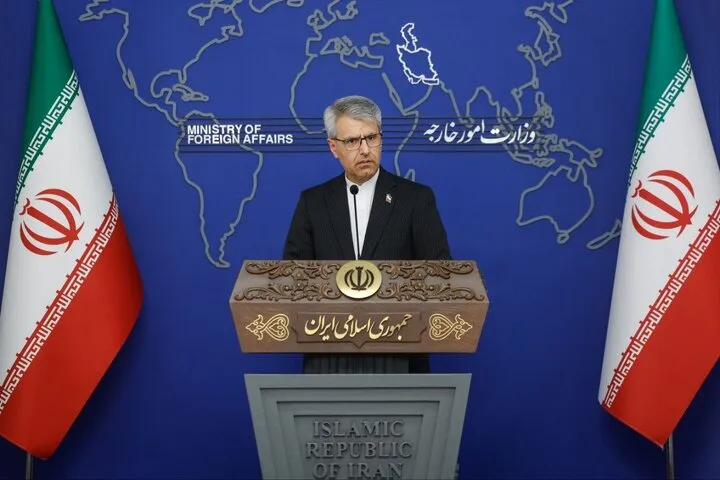
Tehran - BORNA - Speaking at a joint press conference with the head of Iran’s Social Affairs Organization, Baghaei was asked about Iran-France relations and Paris’ retaliatory decision to expel two Iranian diplomats.
“As soon as we concluded that the French Embassy in Tehran had acted beyond its responsibilities and beyond what is stipulated under the Vienna Convention on Diplomatic Relations, and that its actions constituted interference in Iran’s internal affairs, we took action,” he said.
Baghaei said Tehran officially informed Paris that two French diplomats involved in the activities in question had to leave Iran and would not be permitted to return.
“We formally announced that the two diplomats who committed these violations had to leave Iran and would not be allowed to return to the country. I announced this last week during the spokesperson’s briefing,” he said.
The Foreign Ministry spokesperson stressed that Iran believes relations between countries, including relations with France, should be based on mutual respect and full observance of international law, including the principle of non-interference in the internal affairs of states.
“We regulate our relations with all countries on this basis, and whenever necessary, we both issue warnings and take the required action,” he said.
Baghaei described France’s expulsion of the two Iranian diplomats as “unjustifiable.”
“The action taken by the French in expelling two Iranian diplomats cannot be justified,” he said. “Their move was in fact a reaction to an entirely lawful measure by Iran that was consistent with international law.”
“We believe such actions are detrimental to the continuation of relations between Iran and France,” he added.
Speaking separately to reporters on the sidelines of a meeting marking Iran’s “National Week of Associations and Social Participation,” Baghaei said the holding of the event itself demonstrated the importance the Islamic Republic attaches to civil society and to strengthening non-governmental organizations and associations.
“The very fact that this meeting is being held demonstrates the importance the Islamic Republic of Iran attaches to civil society and to strengthening non-governmental organizations and associations as institutions that assist the government in advancing affairs in all fields,” he said.
Baghaei noted that Iran had marked Journalists’ Day the previous week and was observing a week dedicated to civil society organizations this week.
“I think this is very meaningful — drawing on everything regarded as an asset of civil society, whether in the media or among organizations, to advance affairs,” he said.
“One of the things we take pride in is that the governance of the Islamic Republic of Iran is institution-based, and it has demonstrated its effectiveness very well, particularly over the past year and a half to two years.”
The Foreign Ministry spokesperson said Iran’s adversaries had believed that taking the lives of Iranians could disrupt the country’s progress and resistance, but that this had not happened.
“Despite the fact that our enemies thought that by taking precious Iranian lives they could undermine the progress and resistance of the Iranian nation, that did not happen,” he said.
Foreign Ministry seeks to use civil society capacities in public diplomacy
Referring to the Foreign Ministry’s role in Iran’s public and international diplomacy, Baghaei said the ministry’s responsibilities in this field were clear.
“The Foreign Ministry, as the body responsible for the country’s international public diplomacy, has a very clear role,” he said.
“Our effort is to make increasing use of emerging capacities, as well as existing ones, to advance the country’s official diplomacy.”
Baghaei also discussed the ministry’s relations with friendship associations.
“We are regularly in contact with friendship associations and also assist them so that they can use their capacities to communicate with their audiences in target countries,” he said.
“We make use of their experience in diplomacy as well as public and cultural diplomacy.”
He said the ministry also cooperates with other NGOs and associations active in areas related to foreign policy and diplomacy, as well as on issues that are not inherently international or diplomatic but nevertheless need to be addressed internationally.
“One of the issues I mentioned concerns the impact of the unjust sanctions imposed by the United States and some Western countries on the livelihoods, medicines and medical treatment of the Iranian people,” he said.
“We help these NGOs both to make their voices heard and, wherever necessary, to participate at the level of international organizations and meetings, including sessions of the Human Rights Council.”
Baghaei referred to a special Human Rights Council meeting concerning Minab that was attended by NGOs.
“One example was mentioned by Dr. Bat’haei, head of the Social Affairs Organization, concerning Minab, where a special Human Rights Council session was held with the participation of NGOs,” he said.
“The crimes committed by the United States in Minab, Lamerd and Qeshm are only three examples. These crimes have been numerous and diverse.”
Baghaei stressed the need to use the capacities of NGOs to document such cases both for the historical record and for judicial bodies that he said should be established domestically and internationally.
“We must also use these capacities so that the world knows under what circumstances the Iranian people resisted, despite the most heinous international crimes being committed against them,” he said.
Baghaei: Sanctions and military aggression are familiar challenges for Iran
Baghaei also addressed the “National Week of Associations and Social Participation” meeting, saying that war, military aggression and sanctions were not unfamiliar issues for Iran.
“Friends at this meeting said we have been under sanctions for 20 or 30 years. In one sense, the history of sanctions goes back to the 1950s,” he said.
“Sanctions began at that time and, after an interruption, resumed in the 1980s and have continued until today.”
For that reason, Baghaei said the role of NGOs, associations and those working to provide medicines and medical treatment, as well as those working to convey what he described as the legitimate case and suffering of the Iranian people to international organizations, was particularly important.
“I listened carefully to the points raised,” he said. “It is my responsibility to ensure that issues related to the Foreign Ministry and public diplomacy are improved and that any shortcomings are addressed, but we should also look at the matter somewhat positively.”
Baghaei said friendship associations, NGOs and non-governmental organizations in general are both products of a capable civil society and contributors to its consolidation and development.
“They are both signs of growth and can themselves serve as engines driving the further development of civil society,” he said.
“Over the past year and a half, because our country has faced unprecedented pressures, we should in a sense assess civil society in the context of confronting the imposed war and evaluate its performance from that perspective.”
Baghaei said reports presented during the meeting showed that substantial activity had taken place.
“We pay particular attention to friendship associations and NGOs operating in areas that are in some way connected to the international sphere,” he said.
“Even organizations whose audiences and activities are exclusively domestic can play an important role if they are pursuing issues that need to be addressed internationally.”
He described friendship associations in particular as highly valuable partners for the Foreign Ministry in diplomacy generally and public diplomacy specifically.
Foreign Ministry plans working group with NGOs
Addressing calls at the meeting for greater interaction among NGOs and civil society groups, including training and the sharing of experience, Baghaei said the Foreign Ministry planned to organize a working group within the next two months.
“God willing, we will hold a working group within the next two months,” he said.
“What we believe would be useful is for friends to become familiar with various international fields. You yourselves possess expertise and knowledge, but, as one of the participants mentioned, it is also our responsibility to share our points with you, and we will certainly do so.”
The Foreign Ministry spokesperson also referred to environmental issues raised during the meeting.
“The colleague who raised environmental issues addressed an extremely important subject,” he said.
“The environmental crimes committed over the past six months during the military aggression by the United States and the Israeli regime require us both to document them internationally and to inform the world about them.”
He said environmental consequences were not confined to a single country or region and could have broader effects.
Baghaei concluded by saying the Foreign Ministry would also more seriously pursue issues relating to the ties and interactions of friendship associations with their foreign counterparts.
End Article