Eslami: Iran will never stop nuclear advances, new chapter opening in health applications
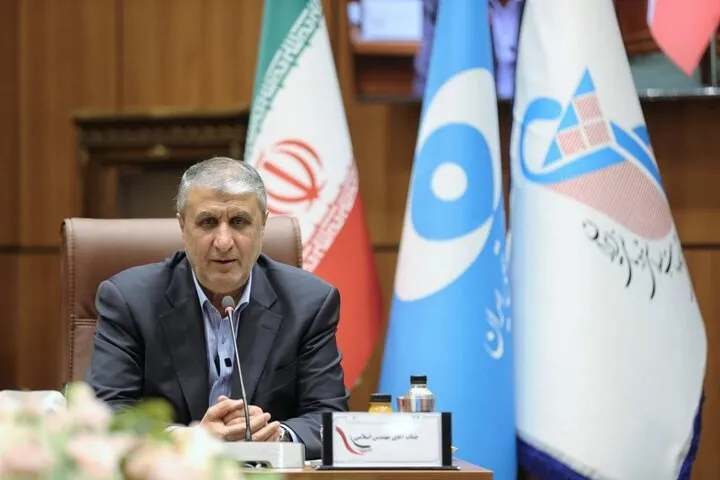
Tehran - BORNA - Eslami, vice president and head of the Atomic Energy Organization of Iran (AEOI), made the remarks at a ceremony marking National Doctors’ Day and the signing of an agreement to establish the Iran-Zamin Nuclear Health Research Center.
The ceremony was attended by Mehdi Pirsalehi, deputy health minister and head of Iran’s Food and Drug Administration, Nader Tavakoli, president of Iran University of Medical Sciences, as well as officials, researchers and specialists in health and nuclear technology.
Eslami congratulated Iran’s medical community on Doctors’ Day, saying physicians throughout the country’s history had demonstrated their commitment to humanitarian service.
He also marked Government Week and commemorated those killed in the recent wars and during the Iran-Iraq war.
Eslami criticizes ‘organized media campaigns’ against Iran
Eslami said Iran has faced what he described as an extensive and aggressive media campaign in recent years aimed at undermining public hope.
“No country in the world has faced an all-out media assault like ours,” he said, arguing that Iran’s adversaries had used organized media capabilities and psychological operations to weaken public confidence.
Referring to support for Iran’s nuclear industry by the late Leader of the Islamic Revolution, Ayatollah Seyed Ali Khamenei, Eslami said the country’s current achievements were rooted in that support and in his emphasis on developing nuclear science and technology.
“The nuclear industry is a legacy of the martyred Leader of the Islamic Revolution, who supported its development over the years,” Eslami said.
He said that during the recent wars, the plate-fuel production plant in Isfahan was struck despite producing fuel used in the Tehran Research Reactor and in the production of diagnostic, therapeutic and palliative radiopharmaceuticals.
Eslami added that Iran’s oxygen-18 production line had also been targeted, describing those attacks as evidence of the failure of efforts to halt Iran’s technological progress.
1.5 million patients use Iranian radiopharmaceuticals annually
Eslami said around 1.5 million patients each year use diagnostic, therapeutic and palliative radiopharmaceuticals produced by the AEOI, adding that the products are also exported to several countries.
He also pointed to advances in plasma technology, saying Iran had moved from the research stage toward industrial applications by relying on indigenous knowledge.
“This is a completely new and promising path,” Eslami said.
According to the AEOI chief, 20 wound-treatment clinics using cold plasma technology are currently operating across Iran.
He said the clinics have played an effective role in wound treatment and pain relief, with what he described as highly encouraging results.
Eslami said the main missing link is shortening the commercialization process and accelerating the transition from preclinical to clinical phases so that new treatments can reach the public more rapidly.
“With the investments that have been made and the cooperation agreement between the Atomic Energy Organization, the Health Ministry and Iran University of Medical Sciences, a new chapter has begun in technology development and the practical application of research,” he said.
New nuclear health research center to accelerate studies
Referring to the agreement to establish the Iran-Zamin Nuclear Health Research Center, Eslami said the initiative would create new capacity to accelerate research into nuclear technologies serving Iran’s healthcare system.
“Today, we exchanged an agreement with Iran University of Medical Sciences,” he said. “The purpose of this agreement is to create new capacity to accelerate research in nuclear technologies that can serve the country’s healthcare system.”
Eslami said one of the main areas of continuous cooperation with the Health Ministry concerns the transition of research from preclinical to clinical phases and the process required for a technology to become a routinely available medical product or service.
“With today’s agreement, we will address the existing gap by creating new capacity together with the ministry, and we hope this will accelerate the translation of medical research results into practical applications,” he said.
Eslami said more than 70 types of radiopharmaceuticals are currently supplied on a continuous basis to 230 medical centers across Iran in cooperation with the Health Ministry and the Food and Drug Administration.
“This is one of the AEOI’s fully active capacities, and this process did not stop even during the war,” he said.
“We will never stop,” Eslami stressed. “Even during the second and third imposed wars, our colleagues at the Atomic Energy Organization and across the nuclear industry did not abandon their work and production. They continued serving society around the clock and developed creative thinking based on new technologies.”
He added that research into plasma technology entered the clinical phase for wound treatment two years ago, while cancer-related research is currently undergoing clinical trials.
“With sustained attention and cooperation, we will expand modern treatment methods across the country for public use,” Eslami said.
Radiopharmaceutical capacity to meet Iran’s needs for 50 years
Eslami said maintaining research as a continuous and dynamic process remains a priority for Iran’s nuclear sector.
“What matters to us is that research never stops and that those responsible in affiliated companies preserve this process as a dynamic, active and efficient current so it can play a more effective role day by day,” he said.
He said Iran has initiated what he described as a broad transformation across several sectors, aimed at filling existing technological gaps through a systematic approach while simultaneously developing and updating technologies.
“In the radiopharmaceutical sector, with the capacities now being created, we can confidently say that the country’s needs will be met for the next 50 years,” Eslami said.
“In quantitative terms, our production capacity will also increase five- to seven-fold.”
The AEOI chief also highlighted Iran’s work on deuterated compounds and heavy-water derivatives.
He said one product whose production line was inaugurated in the Iranian year 1402 was a newborn screening kit capable of detecting 56 metabolic disorders using a single drop of an infant’s blood.
“This is a major and transformative achievement that can reduce both the suffering of families and the costs associated with these diseases,” Eslami said.
Iran expands agricultural irradiation capacity
Eslami also pointed to the use of irradiation technology for agricultural products, saying it can eliminate pests and extend shelf life.
“All of these technologies have been engineered, designed, built and produced,” he said. “But for them to become institutionalized within production processes, we need public awareness and non-financial support policies.”
Eslami said Iran has created capacity to irradiate 500,000 metric tons of agricultural products annually and that this capacity continues to expand.
The agreement establishing the Iran-Zamin Nuclear Health Research Center was signed between Iran University of Medical Sciences and the Iran-Zamin Health Pioneers Company at the Atomic Energy Organization of Iran.
The center is intended to promote advanced health technologies, conduct preclinical and clinical studies and facilitate the commercialization of research achievements.
One source inconsistency is worth checking before publication: one paragraph refers to cooperation with “Tehran University of Medical Sciences,” while the rest of the report — including the agreement itself and the officials present — identifies “Iran University of Medical Sciences.” I used the latter throughout because it is the institution repeatedly named in the report.
End Article