Iran's president: Return to pressure and threats could sink diplomacy
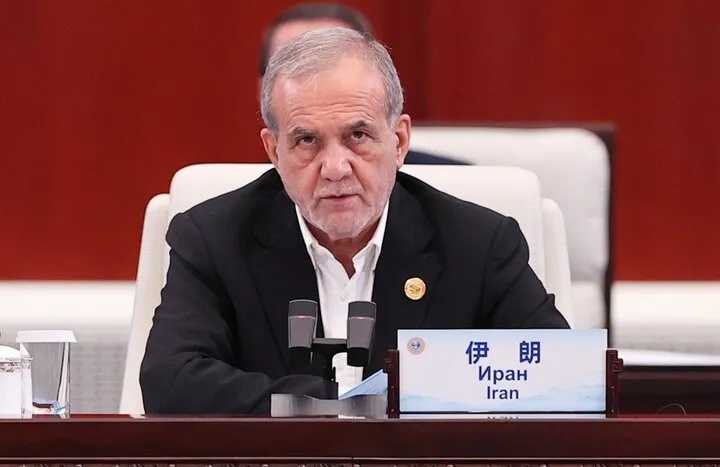
Tehran - BORNA - Speaking Wednesday at the summit of SCO member, observer and partner states — known as "SCO Plus" — Pezeshkian pointed to shifts underway in the international system and stressed the need for a multipolar world grounded in multilateralism, sovereign equality among states and the rule of law. Noting the growing desire of various countries to play a more effective role in international decision-making, he said the shifting balance of power must not simply replace one center of power with another or transfer hegemony from one power to the next.
Referring to US and Israeli attacks on Iran that targeted civilian sites, critical infrastructure and peaceful nuclear facilities, Pezeshkian described these actions as a clear violation of the UN Charter and the principles of international law, warning that continuing on this path could erode countries' trust in international mechanisms and the path of diplomacy.
At the same time, Pezeshkian described diplomacy and negotiation as the primary path to resolving disputes, stressing the need for good faith, respect for commitments and avoiding the use of force to achieve lasting peace.
The full text of Pezeshkian's speech at the SCO Plus summit is as follows:
"In the name of God, the Compassionate, the Merciful.
Your Excellency Mr. Japarov, President of the Kyrgyz Republic;
Mr. Secretary-General of the United Nations;
Mr. Secretary-General of the Shanghai Cooperation Organisation;
Excellencies, heads of government;
Ladies and gentlemen,
At the outset, I would like to congratulate the Kyrgyz Republic on its Independence Day and sincerely thank President Japarov, and the government and people of Kyrgyzstan, for their gracious hosting of this summit and their valuable efforts during their chairmanship of the SCO.
I also welcome the participation of the organization's member, observer and partner states in the SCO Plus format. Given its geographic reach and political and economic capacities, this format can become one of the important platforms for dialogue and cooperation among countries shaping the future international order.
Excellencies,
Today's discussion — the role of the United Nations as a fundamental pillar of a just world order, and the contribution of SCO Plus countries to building a multipolar world — confronts us with a fundamental question. The world is changing. The distribution of economic, political and technological power is shifting. More countries seek a more effective role in international decision-making, and the new realities of the international system no longer fully align with the structures shaped over past decades. The essential question is: how should this transformation be managed?
A multipolar world can lead to a just order
From the perspective of the Islamic Republic of Iran, the answer should not be sought in replacing one center of power with another. The goal should not be transferring hegemony from one power to another. A multipolar world can lead to a just order only when it is accompanied by effective multilateralism, sovereign equality among states, and the rule of law.
We do not view the United Nations as an institution belonging to a specific historical period that must be discarded as the balance of power shifts. On the contrary, the United Nations must become an institution that better represents the realities of the new world and can more effectively fulfill its core mission of maintaining international peace and security, preventing war, and resolving disputes peacefully.
The performance of the UN and Security Council on Gaza, Lebanon and the recent aggression against Iran has been deeply disappointing
To achieve this goal, the United Nations and its Security Council must respond to global developments more fairly and effectively. Today, the world faces military aggression, genocide, war crimes, terrorism and illegal sanctions. The performance of the United Nations and its Security Council in the face of these developments — including in Gaza, Lebanon and the recent aggression against Iran — has been deeply disappointing.
Excellencies,
Today, one of the most significant threats to the international order is the erosion of the principles underpinning the UN Charter.
The attack on Iran's peaceful nuclear facilities was a clear violation of the UN Charter and principles of international law
The military aggression by the United States and the Israeli regime against Iran — including the martyring of Iran's Supreme Leader, the attack on a school in Minab that martyred 168 students, the attack on the Lamerd stadium, attacks on medical and educational centers, the targeting of civilians and the country's critical infrastructure, including its financial, banking and transportation infrastructure, as well as the attack on peaceful nuclear facilities under the safeguards of the International Atomic Energy Agency and academic and research centers — constituted a clear violation of the UN Charter and the principles of international law.
The question is: if such actions become normalized without an effective response from the international community, which country can be confident that its sovereignty and security will be safe from the use of force tomorrow?
If military threats are pursued alongside negotiation, how can disputes be resolved peacefully?
If peaceful nuclear facilities under Agency safeguards can also be targeted in the course of a military conflict, what incentive will remain for countries to trust international monitoring and verification mechanisms? And if military threats and the use of force are pursued alongside negotiation and diplomacy, how can the trust necessary for the peaceful resolution of disputes be preserved?
These questions are not about Iran — they are about the future of the international order.
Iran continues to view diplomacy and negotiation as the primary path to resolving disputes
The Islamic Republic of Iran did not start the war. Rather, it defended itself. At the same time, Iran continues to view diplomacy and negotiation as the primary path to resolving disputes. But diplomacy without good faith, without respect for commitments, and without avoiding the use of force cannot produce lasting peace.
Recent experience, and the repeated violation by the United States of its commitments under the Islamabad memorandum of understanding, showed that even when parties reach a political framework to halt conflict and begin negotiations, the absence of an effective enforcement guarantee — and a return to a policy of pressure and threats — can cause diplomacy to fail.
Excellencies,
We stand at a historic crossroads. We can witness the emergence of a world in which competition among powers leads to greater fragmentation, conflict and instability. Or we can work toward a multipolar world in which a diversity of power centers is accompanied by multilateral cooperation, respect for the UN Charter, and sovereign equality among states. The Islamic Republic of Iran chooses the second path.
The SCO Plus countries, with their political, economic, demographic and geographic capacities, can play an important role in realizing such a world. Let us mark the 25th anniversary of the Shanghai Cooperation Organisation not only by honoring the past, but by committing to the future.
Thank you for your attention."
End Article