Mohseni-Ejei: BRICS members should stand with the law
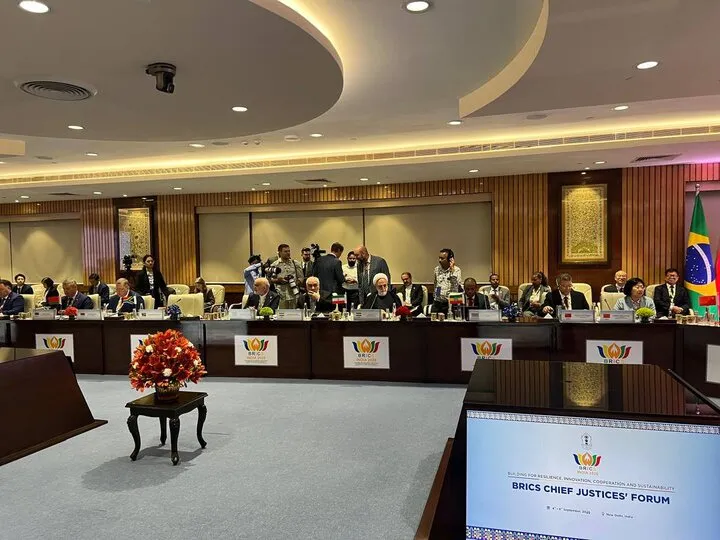
Tehran - BORNA - Speaking at the opening ceremony of a meeting of BRICS judiciary chiefs in New Delhi, Mohseni-Ejei stressed the role of the rule of law in shaping a just international system.
“The rule of law and adherence to law are among the most important foundations of order, justice and progress in every society,” he said.
“Adherence by governments and international institutions to principles and laws can prevent unilateralism, coercion and excessive demands. A just international system takes shape when all countries, regardless of their power, wealth and influence, enjoy equal rights and no power is able to impose its will and interests on others.”
Referring to BRICS’ role in shaping a new global order, Mohseni-Ejei said the group’s documents have repeatedly emphasized mutual respect, respect for the sovereignty and territorial integrity of states, peaceful settlement of disputes and adherence to the United Nations Charter.
“BRICS, as one of the most important economic and political groupings, is playing an increasingly important role in shaping the new global order,” he said.
“We seek an order in which no power considers itself above the law. We call on BRICS members to stand with the law.”
Mohseni-Ejei said the world, despite scientific and technological progress, is also witnessing increasing violations of national sovereignty, widespread breaches of human rights and humanitarian law, unlawful unilateral sanctions and growing pressure on independent nations by dominant powers.
He stressed that judicial systems and legal institutions should not remain indifferent to violations of fundamental human rights, the killing of civilians, forced displacement, damage to infrastructure and impunity for those responsible for international crimes.
Referring to Iran’s opposition to domination by foreign powers, Mohseni-Ejei said the Iranian people have paid a heavy price for their independence over many years.
“In the past year and this year, the Islamic Republic of Iran faced brutal aggression by the United States and the Israeli regime,” he said.
“These attacks and this illegal war, which violated all international norms, were not merely a limited military confrontation.”
Mohseni-Ejei said Iran’s Leader and large numbers of civilians, including 168 schoolchildren at a school in Minab, were killed on the first day of the 40-day war.
He added that hospitals, educational and cultural centers, residential areas and other infrastructure were also targeted, while large numbers of civilians, including women and children, lost their lives.
“These actions by the United States and the occupying regime in al-Quds constitute clear examples of war crimes, yet unfortunately we have witnessed indifference by international organizations toward these crimes,” he said.
The judiciary chief also pointed to US and Israeli military actions against other countries and peoples.
“Today, this may be Iran’s voice, but tomorrow it could be the voice of any country represented in this hall,” Mohseni-Ejei said.
He referred to past US military actions in Afghanistan and Iraq and more recently Venezuela, saying thousands of civilians had been killed, while the Israeli regime’s attacks on Gaza and Lebanon had killed more than 73,000 people, including women and children, and forced more than two million people from their homes.
Asking whether future generations would question “which side of history we stood on,” Mohseni-Ejei put forward several requests to BRICS members.
First, he called on them to condemn violations of Iran’s sovereignty and territorial integrity in accordance with international law, particularly the UN Charter, and to take necessary measures to prevent further unlawful actions by aggressors.
Second, he urged BRICS countries to apply the principle of universal jurisdiction to prosecute those responsible for war crimes and crimes against humanity committed during the two wars against Iran.
“Today, more than ever, we need justice — justice that is not selective, does not sacrifice the rule of law for political considerations, and does not measure the rights of nations according to their power,” Mohseni-Ejei concluded.
End Article