Baghaei: New wave of US coercive measures targets global community, free trade
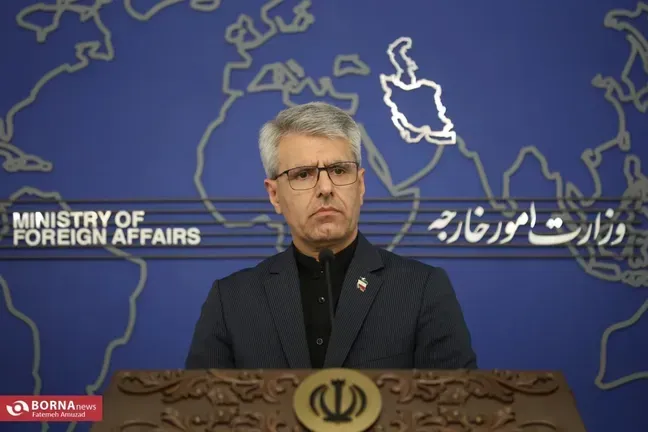
Tehran - BORNA - Speaking at his weekly press briefing, Baghaei also marked Sistan and Baluchestan Day, highlighting the province’s geographical, historical, civilizational and cultural significance.
He commemorated those killed in the recent US attacks on southern Iran, including children, and once again strongly condemned the attacks.
New US coercive measures target international community, free trade
Referring to Washington’s economic war against Iran, Baghaei said the latest wave of US coercive measures was not directed only at Iran.
“The new wave of US coercive measures against Iran is not directed only against Iran; it is directed against the entire international community, the United Nations Charter and free trade,” Baghaei said.
He also referred to continued Israeli attacks against Palestinians and Lebanese, saying the assaults were continuing without interruption.
Baghaei said the international community should understand that the issue was not merely the number of people killed.
“These were human beings like everyone else,” he said, adding that widespread human rights violations had taken place and that the international community’s silence in the face of the killings was “in no way acceptable.”
Negotiations are neither inherently good nor bad
Asked about negotiations, Baghaei said talks should be viewed as a tool for advancing national interests rather than something inherently positive or negative.
“Negotiations are neither inherently bad nor inherently good,” Baghaei said. “Negotiation is a tool for advancing the country’s interests and safeguarding national interests and security.”
He added that over the past six months, diplomacy had operated in coordination with other state institutions, supported the Armed Forces and acted in solidarity with the Iranian people to safeguard national interests.
Baghaei said the Foreign Ministry would continue to follow decisions adopted by the relevant authorities, including the Supreme National Security Council, and would pursue those decisions with its full capacity.
Iran-China contacts continue at various levels
Asked why the Iranian and Chinese presidents had not held a longer meeting on the sidelines of the Shanghai Cooperation Organization summit in Kyrgyzstan, Baghaei said President Masoud Pezeshkian had met a significant number of his counterparts, including the leaders of Tajikistan, India, Kyrgyzstan, Pakistan, Russia and Azerbaijan.
Baghaei stressed that Pezeshkian had also met the Chinese president.
“It was a brief meeting, but important issues were exchanged even during that short encounter,” Baghaei said.
He noted that such multilateral summits are held within tight schedules and said it is not always possible to arrange lengthy bilateral meetings with every participating leader.
“We have very good and cordial relations with China, and contacts at various levels continue on a regular basis,” Baghaei said.
He also announced that a BRICS meeting would be held in New Delhi next Saturday, providing another opportunity for consultations between Iran and fellow member states.
Baghaei said many SCO and BRICS members overlap and argued that the absence of a lengthy bilateral meeting at one event should not be regarded as particularly significant.
“We will certainly use the numerous opportunities available to continue contacts with China and our other friends,” he said.
Israeli attacks continue ‘without any limits’
Asked about Israeli attacks on southern Lebanon, Baghaei said the inaction of the international community and the UN Security Council had encouraged Israel to act as though it enjoyed immunity.
“The Israeli regime considers itself immune in committing its crimes and carries them out without any limits,” Baghaei said.
He described the attacks as violations of Lebanon’s sovereignty and territorial integrity, saying they further demonstrated the importance of resistance.
Baghaei said Israeli attacks offered important lessons for regional countries.
“Against a regime that recognizes no limits for itself, sovereignty cannot be preserved except through reliance on resistance,” he said.
Baghaei added that the Lebanese people would continue to stand against the attacks with all their strength.
Turning to Palestine, Baghaei said Israeli actions in Gaza and the West Bank were continuing unabated.
He referred to Wafa Yousef Aqila, whom he said was killed while returning from school on the first day of the academic year.
Baghaei also pointed to the recovery of bodies from beneath rubble left by the past two and a half years of fighting, saying that in one case around 100 Palestinians, including 70 children, had been recovered.
“The international community must understand that we are not simply speaking about numbers,” Baghaei said. “Every one of these victims was a human being like every other human being.”
He added that the stain left by what he described as grave human rights violations and crimes “will never be erased from human civilization.”
US action against Iran is ‘military aggression’
Asked about US President Donald Trump’s remarks denying that the confrontation with Iran constituted a war, Baghaei said Washington’s actions should instead be described as military aggression.
“This is not a war; it is clear military aggression against Iran’s national sovereignty and territorial integrity,” Baghaei said.
He said rhetoric could neither conceal military setbacks nor hide the scale and severity of the crimes committed.
Baghaei said the entire world had witnessed the United States and the Israeli regime impose a war on Iran, the region and the world in clear violation of the UN Charter.
“They cannot conceal the nature of their action through rhetoric,” Baghaei said. “This was clear military aggression in violation of all principles and norms of international law.”
He noted that US media themselves had referred to the conflict as a “war of choice.”
Baghaei said Washington must be held accountable both for imposing what he described as an unlawful war on Iran and for every war crime committed against the Iranian people during the past six months.
Iran warns countries against becoming instruments of US aggression
Asked about reports that South Korea could deploy military forces to the Persian Gulf and Strait of Hormuz, Baghaei referred to a Korean-language post he had published earlier in the day and said Iran’s position was clear.
Baghaei said Tehran valued its relations with South Korea but stressed that Seoul and other countries should understand the consequences of participating in US military actions.
“Any participation in US acts of aggression would amount to siding with the aggressor,” Baghaei said.
He added that such measures would complicate the situation rather than make maritime routes safer.
Baghaei said Tehran was in contact with relevant South Korean officials through the Iranian Embassy in Seoul.
“We are also issuing this warning publicly to all countries: they must be careful not to become instruments for US aggression against Iran,” he said.
Qatari delegation held talks with Araghchi
Asked about reports concerning a Qatari delegation’s visit to Tehran, Baghaei confirmed that the delegation had been in the Iranian capital on Sunday.
“The delegation was in Tehran yesterday and held good meetings with Dr. Araghchi,” Baghaei said.
He noted that delegations from Oman and Pakistan had also traveled to Tehran in recent weeks and met Iranian officials.
Baghaei said the Qatari delegation’s visit took place within the same framework of ongoing regional contacts aimed at reducing tensions.
“Contacts between Iran and some regional countries that have long been working to reduce tensions are continuing. This is an ongoing process,” he said.
Baghaei added that diplomacy is a dynamic and continuous process and said Tehran would continue using diplomatic tools to safeguard national interests.
Baghaei accuses IAEA chief of enabling Western pressure
Asked about efforts by the European troika and the United States to secure a new resolution against Iran at the IAEA Board of Governors, Baghaei said the draft was based on a report issued by the agency and its director general.
He said Tehran had encountered the same pattern before.
“At times, the conduct of the agency and the director general personally reminds me of the story of Hakim Adud al-Din Iji and the Mongol Khan,” Baghaei said.
He added that whenever Western parties “fall short in other areas,” they resort to the agency and its director general.
Baghaei also accused the IAEA chief of making himself available for use by the European parties and the United States to exert political pressure on Iran.
US, Israel responsible for IAEA’s lack of access to Iranian nuclear sites
Baghaei said the E3’s attempt to adopt another resolution was meaningless from several perspectives.
On the legal dimension, he said the three European countries and the United States had previously claimed that the so-called snapback mechanism had revived UN Security Council resolutions against Iran.
Baghaei argued that raising Iran’s nuclear issue at the Security Council again would contradict that claim and reinforce the position of Iran, China and Russia that the snapback process was unlawful and inapplicable.
“Second, the three European countries are discrediting themselves once again,” Baghaei said.
He said the Europeans had already pursued the same course and had seen how Washington rewarded them.
“They were humiliated and marginalized, while at the same time making the Iranian nuclear issue more complicated,” Baghaei said.
He added that their demand was unreasonable because, in Tehran’s view, the United States and Israel had themselves created the conditions preventing IAEA access.
“The reason the agency cannot access Iran’s nuclear facilities is the crime committed by the United States and the Israeli regime in attacking those facilities,” Baghaei said.
“They themselves blocked the path, and now they blame Iran for the agency’s inability to gain access. This is plainly self-contradictory.”
Baghaei warned that any resolution backed by the E3 and the United States would demonstrate “bad faith and a desire to escalate the situation.”
“The Islamic Republic of Iran will take the necessary measures in response to any ill-considered action by them,” Baghaei said.
He added that Tehran had repeatedly advised the three European countries to heed the Iranian saying that “testing what has already been tested is a mistake.”
Iran plans to attend UN General Assembly, subject to visas
Asked about President Pezeshkian’s possible trip to New York for the UN General Assembly, Baghaei said Tehran intended to use the gathering to explain Iran’s positions.
“As I have said in previous sessions, we will certainly use such opportunities to explain the positions of the Islamic Republic of Iran,” Baghaei said.
He said Iran planned to participate in the General Assembly as in previous years, provided that the host country fulfilled its obligations under international law and issued visas on time.
Asked about Iran’s UN mission following the return of Permanent Representative Amir Saeid Iravani to Tehran, Baghaei said the mission was functioning normally.
“With our permanent representative having returned to Tehran, our second ambassador at the United Nations will be responsible for the mission until a new ambassador is dispatched,” Baghaei said.
Asked whether a new permanent representative had been selected, Baghaei replied: “No. The matter is still under consideration.”
Iranian strikes on US bases, warships were in self-defense
Asked about US threats to target Iranian oil tankers, Baghaei said it was hardly a matter of pride for a country that describes itself as the greatest superpower in history to threaten commercial vessels.
He said Washington was threatening commercial shipping in retaliation for what US officials themselves had acknowledged was an Iranian attack on a US military vessel.
“For such a power to resort to attacks on civilians, or to killing children at a wedding, in order to pressure the Islamic Republic of Iran is nothing to be proud of,” Baghaei said.
He rejected the US account of developments and said Iran remained in a position of self-defense because of the continuing naval blockade and economic warfare.
“The defensive strikes Iran carried out against US military bases or its warships were unquestionably within the framework of the inherent right of self-defense, clearly recognized in Article 51 of the UN Charter,” Baghaei said.
Addressing US accusations against Iran over insecurity in the Strait of Hormuz, Baghaei said instability in the waterway was a direct consequence of US actions.
“Was there any problem in the Strait of Hormuz before Feb. 28, before the US and Israeli military aggression began?” Baghaei asked.
He described efforts to portray Iran as the source of insecurity in the strait as “an obvious lie.”
Baghaei said the Strait of Hormuz became unstable because of US and Israeli attacks on Iran and the use of territories belonging to states on the southern shores of the Persian Gulf.
“As long as this situation continues, it is fundamentally impossible to speak of restoring security to the Strait of Hormuz,” Baghaei said.
He stressed that, from Tehran’s perspective, the problem was not Iran’s actions but continuing US and Israeli military aggression in the form of a naval blockade, economic warfare and attacks on Iranian commercial vessels.
Regional states should recognize Israel as real threat to peace
Asked about threats by Naftali Bennett and Benjamin Netanyahu against Qatar, Baghaei said Israel seeks domination over the entire region and the humiliation of regional countries.
He noted that Israeli officials had openly threatened countries in the region, previously spoken of a “Greater Israel” and issued various threats against Turkey.
“This demonstrates the expansionist nature and outlook of the Israeli regime,” Baghaei said.
He said such statements should serve as a warning to regional countries to recognize what he described as the real enemy of peace and security in the region.
Baghaei added that focusing on other issues should not embolden what Tehran considers the principal threat to regional stability.
Recent defensive developments were ‘decisive’
Asked about what some media have described as a “tanker war” in the Strait of Hormuz, Baghaei said the term did not accurately describe the situation.
“‘Tanker war’ may not be an accurate term for what we are witnessing in the region,” Baghaei said.
He said the starting point remained the US-Israeli military aggression, after which the Persian Gulf and Strait of Hormuz became insecure.
According to Baghaei, that insecurity was not caused by Iran but by the actions of the United States and the Israeli regime, which had continued in different forms, including through the naval blockade.
Baghaei also said attacks on ships, both in the region and on the high seas, had been initiated by the United States.
“What happened over the past several days — and you can be certain it was a decisive development in terms of the Islamic Republic of Iran’s defensive measures against US warships — was then used as a pretext for US attacks on Iranian commercial vessels,” Baghaei said.
He described attacks on commercial vessels as both unlawful under international law and “terrorist.”
Baghaei said that for the US defense or war secretary to boast about such an action amounted to an admission of committing a war crime against commercial vessels.
He added that as long as economic warfare and the maritime blockade continued, Tehran would regard them as a continuation of US military aggression.
According to Baghaei, that situation entitles Iran both legally and operationally to take necessary measures in self-defense.
“Iran’s actions are entirely defensive in response to the continuation of US and Israeli military aggression,” he said.
US must remove insecurity it imposed on region
Asked about media reports that Washington was seeking a new agreement with Iran addressing the Strait of Hormuz and the nuclear program more explicitly, Baghaei said Iran’s position remained clear.
“The insecurity imposed on the region by the United States must be removed by the United States itself,” Baghaei said.
He said that required an end to what Tehran considers aggressive and interventionist actions, economic sanctions and the naval blockade.
Baghaei said Iran’s position had been clear from the beginning of the diplomatic process.
“When we reached an understanding on June 18, we very quickly and clearly included what we wanted in the memorandum of understanding,” Baghaei said.
He said the problem lay with the US side, which, according to Tehran, violated all of its commitments only 22 or 23 days after signing the understanding.
“If we want to use the familiar diplomatic expression, the ball has long been in America’s court,” Baghaei said, adding that Washington had initiated both the military aggression and the violation of the understanding it had signed.
Baghaei mocks abandoned ‘Epic Fury’ label
Asked about reports that the Pentagon had instructed military personnel to stop using the title “Operation Epic Fury,” Baghaei mocked the operation’s name.
“This was an operation that, from the beginning, the American press itself called ‘Operation Epstein Theory,’ and after some time it turned into ‘Operation Epic Failure,’” Baghaei said.
He argued that the military campaign had failed to achieve its objectives and had further damaged US credibility because of what he described as flagrant violations of humanitarian and international law.
“Any rational American would certainly be ashamed to use such expressions for an illegal war and military aggression,” Baghaei said.
Baghaei comments on Trump’s Moon, New Mexico posts
Asked about Trump’s controversial posts claiming US ownership of the Moon and proposing to rename New Mexico as “New America,” Baghaei said the issue had an international dimension.
“The whole world is facing such an abnormal situation, in which the governing establishment of a country does not adhere to fundamental international principles, particularly state sovereignty and respect for geographical borders,” Baghaei said.
He described such behavior as a new phenomenon at the international level.
Baghaei added that some actions by the current US administration that receive extensive media attention form part of its habit of keeping itself at the center of public discussion and advancing what he described as a broader cognitive confrontation.
Iran-Oman Hormuz talks reach final stage
Asked about the latest state of talks with Oman and reports that Muscat favors forming a regional consortium to manage the Strait of Hormuz, Baghaei said Tehran and Muscat, as the two coastal states, had begun serious negotiations on safe routes through the waterway.
“The negotiations have made very good progress,” Baghaei said.
He said some of the difficulties encountered during the talks could largely be attributed to interference by third parties, which had disrupted the negotiating process.
“We can now say that Iran-Oman negotiations have reached the final stage,” Baghaei said.
He added that the Iran-Oman understanding on establishing a temporary safe route through the Strait of Hormuz would probably be registered with the International Maritime Organization within the coming days.
Baghaei expressed hope that what he described as malicious third parties would not interfere again and would allow the process to proceed in a reasonable and logical manner.
Reports on Iranian advisers at Ali al-Taher Heights ‘psychological warfare’
Asked about claims in some Arab media that an agreement had been reached for Iranian advisers to leave the Ali al-Taher Heights in exchange for Israel declaring control over the area, Baghaei rejected the reports.
“Absolutely not. There is no truth to this,” Baghaei said. “These are media speculations and certainly part of the Israeli regime’s psychological warfare.”
Baghaei later said there should be no doubt that Israel regards its own existence as dependent on tensions, conflict and war across the region.
He said that since its creation in the 1940s, Israel had been in conflict with countries across the region and had expanded its operations beyond the region as well.
According to Baghaei, Israel continually seeks to widen the scope of war with support from the United States and some Western countries.
He said growing international awareness had exposed what he described as Israeli attempts to invoke accusations of antisemitism while continuing occupation and committing genocide.
Baghaei said the demand of the region and international community was for such actions to stop and for Israel’s supporters and accomplices to be held accountable.
Iran-India relationship developing positively
Asked about Chabahar Port, Baghaei referred to Pezeshkian’s meeting with the Indian prime minister on the sidelines of the SCO summit in Bishkek.
“Our relations with India are longstanding, historical and based on civilizational ties, and we attach great value to them,” Baghaei said.
He noted that India is a member of both the SCO and BRICS and said the two countries maintain good trade and economic relations.
Baghaei said Chabahar is among the important subjects regularly discussed between Tehran and New Delhi.
“We will certainly use the BRICS meeting as an opportunity to continue discussions and consultations with India on issues of mutual interest,” Baghaei said.
He described Iran’s relationship with India as developing, constructive and positive.
Hormuz agreement with Oman necessary but not sufficient
Asked whether Oman was coordinating with Washington over its talks with Tehran on the Strait of Hormuz, Baghaei said Iran assumes both coastal states are acting according to their own interests.
“Oman, as a coastal state, our good neighbor and a country with which we have longstanding and very good relations, has acted in good faith in this process,” Baghaei said.
He said Oman, like any other country, naturally prioritizes its own national interests.
Baghaei stressed that an Iran-Oman understanding is a necessary condition for making shipping routes through the strait secure, but not a sufficient one.
“The insecurity in the Strait of Hormuz is the product of US and Israeli military aggression,” Baghaei said.
“This US aggression is continuing, and as long as that situation persists, ships cannot feel secure while navigating through the strait.”
Baghaei mocks Peru over announcement on Iran ties
Asked about statements by Peru’s Foreign Ministry regarding Iran and its announcement that it was cutting diplomatic ties with Tehran, Baghaei dismissed the move.
“I have no recommendation because I think this was selling something that did not exist — it was not even overpricing; it was selling nothing,” Baghaei said.
“There was simply no relationship to sever.”
Baghaei suggested the move had been made ahead of an upcoming visit by the US secretary of state to the region.
He said the US secretary of state was apparently scheduled to visit the region from Sept. 8 to 10 and described Peru’s move as an attempt to present Washington with something that did not exist in the first place.
“We essentially had no relations with Peru,” Baghaei said. “We did not have an embassy there, and they did not have an embassy in Iran.”
He added that those who were supposed to be pleased by Peru’s move would eventually realize they had been misled.
Iranian military delegation followed up case of pilots in Qatar
Asked about three Iranian pilots stranded in Qatar and Iranian citizens detained in Kuwait, Baghaei said efforts concerning both cases were continuing.
“Our follow-up regarding our three brave pilots continues, and the issue is raised during every trip and every contact,” Baghaei said.
He said a technical delegation from the General Staff of the Iranian Armed Forces had visited Qatar in recent days and that technical discussions were continuing.
“We certainly will not abandon our efforts on this issue,” Baghaei said.
Regarding Iranian citizens detained in Kuwait, Baghaei said the Iranian Embassy was seriously pursuing their cases.
He said a consular meeting had been held the previous week and expressed hope that the Kuwaiti government would soon create the conditions necessary for their release.
Baghaei defends Islamabad understanding despite US breach
Asked about Tehran’s assessment of the Islamabad understanding and its relationship to developments in Lebanon and the Ali al-Taher issue, Baghaei again said negotiations should not be viewed in absolute terms.
“Negotiation is a tool, and as long as we can use negotiations and diplomacy to secure our national interests, we must certainly use that tool,” Baghaei said.
He acknowledged that assessments of the understanding vary but said Tehran believes the agreement served Iran’s national interests under the circumstances prevailing at the time.
Baghaei stressed that Washington’s subsequent breach should not lead Iran to question its own diplomatic achievement.
“We entered the diplomatic battle responsibly to secure Iran’s rights, and the result was the June 18 understanding,” Baghaei said.
He noted that the first paragraph of the understanding addressed the cessation of Israeli aggression against Lebanon and referred to Hezbollah’s position on that provision.
“The fact that the United States subsequently breached its commitments should not lead us to blame ourselves for an action taken to secure national interests,” Baghaei said.
“All criticism should be directed toward the party that breached its commitment, and that party is none other than the United States.”
Baghaei responds to Netanyahu with Quranic verse
Asked about another threat by Netanyahu against Iran and remarks suggesting Israel had sought Iran’s collapse from the outset, Baghaei responded by reciting Verse 8 of Surah As-Saff.
Baghaei quoted the verse as saying that they seek to extinguish the light of God with their mouths, but God will perfect His light even if the disbelievers dislike it.
He then cited a Persian verse roughly meaning that whoever tries to blow out a lamp lit by God will burn his own beard.
“Of course, these people do not have beards, so presumably what is meant is their roots,” Baghaei added.
Europe should not follow US economic war against Iran
Asked about European support for Washington’s new economic campaign against Iran, Baghaei said Tehran would judge European countries by their actions.
“Europe must make its own decision,” Baghaei said.
He said Europe had already tested the path of trying to satisfy Washington and follow US demands at both the UN Security Council and the IAEA Board of Governors.
According to Baghaei, the result had been the further marginalization of Europe’s role.
Baghaei also said EU regulations themselves prohibit compliance with US secondary sanctions.
“Under the so-called Blocking Statute, European companies are not permitted to comply with these sanctions, and European governments are obliged to protect their companies against US sanctions,” Baghaei said.
He argued that the EU statement at issue violated international law as well as Europe’s own sovereignty and independence.
“If the European Union values its credibility, sovereignty, independence, national interests and economic interests, it should not follow the US economic war against Iran,” Baghaei said.
‘US officials lie sincerely’
Asked about repeated US attacks on civilians and contradictory statements by American officials concerning the deadly strike on a wedding in southern Iran, Baghaei said: “US officials lie sincerely, and that itself is an art.”
He said US officials were well aware that attacks on civilian targets had been part of American military tactics for decades.
Baghaei argued that moving from what he called “dynamic operations” to blind and aimless attacks resembling those of Daesh reflected “the moral decline of a system.”
Kuhestak wedding strike was deliberate
Baghaei said the US strike on the wedding gathering was not an isolated incident and pointed to other attacks against civilians during the past six months.
“It is unfortunately clear that the United States is following Israel’s pattern of repeated and systematic attacks on civilians,” Baghaei said.
He said the pattern begins with denial, followed by claims that Iran itself may have been responsible, before evidence is later published by US media and the attack is characterized as possible “collateral damage.”
“This action was deliberate,” Baghaei said.
He questioned how US forces, if they possess weapons capable of striking targets with extreme precision, could have failed to identify the school in Minab, a stadium in Lamerd used by civilians or the wedding gathering in Sirik.
Baghaei said US explanations were therefore unacceptable.
He noted that Washington had repeatedly promised investigations into the Minab and Lamerd attacks.
“We know these investigations are intended to let time pass until the matter fades away,” Baghaei said.
“But we as Iranians, and the international community, must not allow these crimes simply to become part of history. The United States must continue to be held accountable.”
US was party that breached Iran-US understanding
Asked about the US secretary of state’s assertion that the Iran-US understanding had ended, Baghaei said Tehran had never initiated a breach of commitments.
“We have never been the party that started violating an agreement,” Baghaei said.
“The United States is the party that breached its commitments and failed to implement them.” he added.
He said internal disputes within the US administration had been one of the factors behind Washington’s breach.
Baghaei added that the international community, regional countries and the Iranian people had witnessed the United States violate the understanding and then openly declare it over.
“For us, names are not important,” Baghaei said. “Whether they call it an understanding or anything else is not important.”
He stressed that what mattered to Tehran was whether Iran’s interests were secured.
“As long as the interests of the Islamic Republic of Iran are not secured, there will be no return of security to the region,” Baghaei said.
“We will certainly not compromise on our national and vital interests.”
Iran will respond according to European actions
Asked whether Tehran would change its diplomatic approach toward Europe if European countries joined Washington’s latest pressure campaign, and whether Iran would respond if NATO facilities in southern or eastern Europe were used for attacks against Iran, Baghaei said Tehran would calibrate its response according to countries’ actual conduct.
“We will adjust our positions and behavior according to the practical behavior of countries,” Baghaei said.
He stressed that Iran’s position regarding participation in military aggression was unambiguous.
“No country tolerates the complicity or participation of others in an aggressive war against its national sovereignty and territorial integrity,” Baghaei said.
He added that Tehran had repeatedly made its position toward Europe clear.
“Our position regarding Europe is very clear and has been stated repeatedly,” Baghaei said. “We will take the necessary measures in proportion to their actions.”
End Article