Thai envoy: Technology can bring Iran, Thailand closer
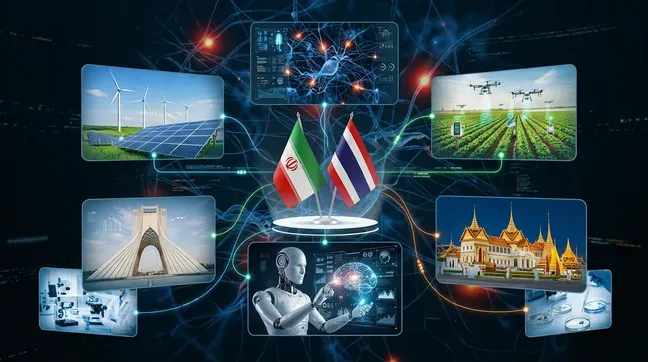
Tehran - BORNA - Sake Nopthaisong, Ambassador Extraordinary and Plenipotentiary of the Kingdom of Thailand to the Islamic Republic of Iran, has emphasized the potential for closer cooperation between Iran and Thailand in science, technology, innovation, tourism, trade and people-to-people exchanges, saying technological and innovative capabilities in both countries can help bring the two nations closer together.
Speaking to Borna News Agency’s science and technology reporter on the sidelines of INOTEX 2026, Nopthaisong said he had arrived in Iran a little more than two weeks earlier, but that his current mission was not his first experience of the country.
“I’m the ambassador of Thailand to Iran. I just arrived here a little over two weeks ago, but this is my second time in Iran. I was here four years ago,” he said.
The ambassador recalled that during his previous visit, he had visited Pardis Technology Park to learn more about Iran’s technological progress.
“During that last visit, I was here at Pardis Technology Park to experience the technological advancement of Iran. So, it’s great to be back,” he said.
Returning to Iran after four years: ‘There are some changes’
Asked whether he had noticed any changes in Iran’s science and technology ecosystem since his previous visit four years ago, Nopthaisong said he had observed developments while emphasizing that science, technology and innovation are rapidly evolving around the world.
“I think there are some changes until now because, you know, science, technology and innovation go rapidly,” he said.
According to the Thai ambassador, the rapid pace of technological development is not limited to Iran and is a global phenomenon.
“I think it’s the same thing going on all over the world, including Thailand and Iran,” he added.
His visit to INOTEX 2026 also gave him an opportunity to directly observe a range of Iranian startups and innovative products.
“On the way here, I walked through a lot of booths, and they offer various kinds of innovation. I walked through the startups that have various applications, so it looks quite impressive,” Nopthaisong said.
He particularly highlighted the role of incubation and support systems in helping young entrepreneurs develop their ideas.
“It’s quite wonderful that you have the incubation system to help young entrepreneurs come up with this new innovation,” he said.
INOTEX 2026: A platform for young and bright ideas
Discussing his overall impression of INOTEX 2026, the Thai ambassador said the exhibition had helped him gain a broader understanding of Iran’s technology and innovation ecosystem.
For Nopthaisong, innovation is not limited to a particular technology or sector. Rather, it encompasses a wide range of activities and ideas.
“You know, innovation can mean many things,” he said.
The ambassador explained that his participation in different technology-related events in Iran had allowed him to observe various aspects of the country’s technological landscape.
He referred to his recent participation in a conference involving hospitals, as well as his visit to ELECOM, where he encountered discussions and activities related to artificial intelligence and security.
“The other day, I was with the conference between the hospitals, and also I visited ELECOM. It’s for AI and also for security and for the future of Iran. And to be here at INOTEX, I think it completes the picture for me,” he said.
In his view, INOTEX provides an important platform for young people with new ideas to receive the support they need to turn those ideas into viable innovations.
“My vision about INOTEX is that the new generation, the young and the bright ideas, they need support,” Nopthaisong said.
“They need the related authorities. They need related incubators. They need good mentoring in order for them to succeed.”
He said INOTEX could serve as a platform for providing this type of support and interaction.
The ambassador also expressed his positive impression of the participation of young people in the event.
“I’m really happy that a lot of the young generation is there, and even at the opening ceremony, there was some interactive conversation. I think that’s very good,” he said.
Can Iranian startups and companies cooperate with Thailand?
One of the key questions raised during the interview concerned the potential for cooperation between Iranian startups and companies and their Thai counterparts.
Asked whether he saw opportunities for Iranian companies and startups to cooperate with Thailand, Nopthaisong responded positively.
“I see the opportunity, of course,” he said.
He explained that Thailand has consistently placed importance on science, technology and innovation, with a dedicated government ministry responsible for these areas.
“In Thailand, the Thai government has put importance on science, technology and innovation,” he said.
“We have one ministry for this thing — innovation and technology — specific areas.”
The ambassador pointed to several initiatives in Thailand aimed at encouraging people to make greater use of emerging technologies, particularly artificial intelligence.
“Just last month, we tried to encourage Thai people to use AI. We subscribed for them in order for them to use it at a low cost,” he said.
He also highlighted Thailand’s extensive 5G coverage as an important part of the country’s digital infrastructure.
“Of course, we have 5G coverage all over Thailand,” Nopthaisong said, adding that such infrastructure can support people who want to work remotely.
AI cooperation requires more than technology
Asked which specific areas could offer the greatest potential for cooperation between Iranian and Thai startups, the ambassador pointed first to artificial intelligence while emphasizing that technology alone is not enough.
“Nowadays, people always talk about AI. That’s one thing,” he said.
However, Nopthaisong stressed that people and startups must maintain their own ideas and vision rather than simply relying on artificial intelligence.
“But still, you have to have your idea. It’s like the startup. I mean, what vision? You have to have your own vision,” he said.
In his view, AI can be used as a tool to support entrepreneurs and innovators, but it should not replace human judgment.
“You can use AI to gather the information for you, but you have to be careful because sometimes the information that they get is not that accurate,” he said.
The ambassador summarized his view with a direct message: “So you have to be smarter than AI.”
He added that vision and the ability to articulate that vision remain essential even in an increasingly AI-driven environment.
“Still, the vision and also the articulation have to be there. And of course, you can use AI to support that,” he said.
Food security and energy security: Areas for cooperation
Beyond artificial intelligence, Nopthaisong identified food and energy as two areas in which Iran and Thailand possess complementary capabilities.
“Thailand is very strong in many sectors,” he said.
He pointed to Thailand’s agricultural capabilities and its position in terms of food security.
“We are quite self-sufficient in terms of food security. We grow a lot of rice, a lot of fruits and vegetables, and we are quite sustainable in terms of food security,” he said.
At the same time, he identified energy security as an area in which Iran has significant capabilities.
“But for Iran, I think Iran is quite self-sufficient in terms of energy security,” Nopthaisong said.
He suggested that these complementary strengths could create opportunities for cooperation.
“So these are something that we can, of course, cooperate on,” he said.
The ambassador emphasized that cooperation does not necessarily have to begin with highly complex technological projects. Instead, it can start with practical and fundamental areas and gradually develop.
“You have to start from the basic things before going on to, you know, what are the platforms and how to do it, what is the interface and how to do it,” he said.
Thailand’s digital economy and opportunities for Iranian professionals
The conversation also turned to Thailand’s efforts to attract people who can work remotely.
Nopthaisong explained that Thailand has developed infrastructure and policies designed to facilitate remote work and international mobility.
He specifically referred to Thailand’s Destination Thailand Visa, or DTV, which is intended for people who can work remotely.
“We have the special DTV visa for this. It’s called the Destination Thailand Visa,” he said.
According to the ambassador, the visa provides an opportunity for eligible individuals to stay in Thailand for an extended period while continuing to work remotely.
This policy, in his view, could also create an opportunity for international professionals, including Iranians, to engage with Thailand’s digital and economic environment.
People-to-people relations as the foundation of cooperation
For Nopthaisong, however, technological cooperation cannot be separated from broader relations between the people of the two countries.
He emphasized the importance of tourism, cultural exchange and direct interaction as a foundation for building stronger relations.
“For people-to-people ties, it is very important,” he said.
The ambassador noted that there are currently direct flights between Tehran and Bangkok twice a week, operated by Mahan Air.
He also stated that approximately 50,000 Iranian tourists visited Thailand during the previous year.
He stressed that Iran and Thailand have a long history of relations, saying their relationship dates back more than 400 years.
“We are proud because we have a long history of relations, more than 400 years,” he said.
For the ambassador, strengthening people-to-people ties is therefore an important objective.
“So I would like to encourage people-to-people ties, encourage tourism, encourage the exchange of people,” he said.
‘Iran is basically a civilization’
Nopthaisong also highlighted Iran’s cultural and historical potential, saying that greater familiarity between the people of the two countries could strengthen bilateral relations.
“It is incumbent upon the embassy to show the Thai people that Iran is rich with cultural heritage, rich with the culture and, you know, attractions,” he said.
He described Iran as a civilization with substantial cultural depth.
“So Iran is basically a civilization,” he said.
The ambassador argued that people-to-people contact could provide a foundation for developing cooperation in other fields.
“When people meet, then people get familiarized,” he said.
He emphasized that the two countries were not starting their relationship from zero.
“We are not starting from zero because we have the goodwill and we have full diplomatic relations, and people between the two countries have goodwill between us,” Nopthaisong said.
In his view, trust can serve as the starting point for expanding bilateral cooperation.
“So we start from trust, and then we can build on to other things like science, technology and AI,” he said.
Automotive manufacturing and digital services
Another area in which the ambassador identified Thailand as particularly strong is automobile manufacturing.
“Another sector that we are quite strong in is that we are the production base for automobiles in Southeast Asia, especially right-hand-drive vehicles,” he said.
The conversation then moved toward Thailand’s widespread use of motorcycles and the digital services built around them.
Nopthaisong acknowledged that motorcycles are widely used in Thailand, particularly as a way of navigating heavy traffic.
He compared traffic conditions in Thailand with those in Tehran, noting that motorcycles can provide an alternative means of transportation during rush hours.
He explained that in addition to Bangkok’s Skytrain and underground transportation systems, motorcycle taxis are another way people can move through congested areas.
These services can be accessed through applications.
“You can use the app and call the motorcycle. It will come and take you around,” Nopthaisong said.
He also pointed to the broader ecosystem of digital platforms for transportation and delivery services.
He noted that Thailand also has food delivery systems similar to those available in Iran.
Technology must ultimately improve people’s lives
Throughout the discussion, Nopthaisong repeatedly returned to the idea that technology should serve society rather than simply exist as an end in itself.
“Technology is for the people, of course. But the technology has to have a better effect for the people,” he said.
In his view, technological progress should ultimately contribute to improving people’s living standards.
“It has to lift up the living standard of the people,” he emphasized.
This approach, according to the ambassador, should be considered when evaluating technological innovation and cooperation between countries.
The objective should not simply be to develop new technologies, but to ensure that those technologies create tangible benefits for society.
‘The potential is there’: Thailand’s view of Iranian innovation
Asked directly whether he believed Iranian people were talented and had the potential to cooperate with Thailand, Nopthaisong said he had already encountered evidence of Iran’s technological capabilities during his previous visit.
“Four years ago, when I was here, I went to see some of the medical devices that you make, some medical machines that you have,” he said.
He was particularly impressed by the ability of Iranian manufacturers to produce equipment capable of performing similar functions to imported products but at a significantly lower cost.
“And the machine that can do the same thing, but at the cost of just a fraction if we import from some other countries,” he said.
For Nopthaisong, such examples demonstrate that Iran has substantial technological potential.
“So I think the potential is there,” he said.
He also pointed to Iran’s domestic incubation infrastructure and government support for innovation.
“You are quite self-sufficient in terms of having your own very strong incubation, and you have very strong government support,” he said.
In his view, these conditions can provide a strong foundation for younger generations to develop new technologies and businesses.
From agricultural trade to technology: Building on existing relations
The ambassador also referred to existing economic ties between Iran and Thailand, particularly in agricultural trade.
“Before coming here, I had my friend in the trade in agricultural products. They trade in rice,” he said.
He recalled that Iran had previously imported significant quantities of rice from Thailand.
“Iran used to import a lot of rice from Thailand,” Nopthaisong said.
In his view, these existing economic links could provide a foundation for expanding cooperation into new areas, particularly through the use of technology.
‘Science, technology and innovation can bring Iran and Thailand closer together’
At the conclusion of the interview, Nopthaisong emphasized that cooperation between Iran and Thailand should be viewed broadly, with technology acting as one of several instruments for strengthening bilateral relations.
He identified trade, tourism, people-to-people exchanges, artificial intelligence, agriculture, energy and other sectors as potential areas for deeper engagement.
“I think that science, technology and innovation can help us, can bring Iran and Thailand closer together,” Nopthaisong concluded.
About the journalist: Zahra Vejdani is a technology reporter at Borna News Agency, recognized as one of Iran’s leading journalists in the field of science and technology. With a focus on emerging innovations and their societal impact, she regularly covers developments in nanotechnology, digital transformation and global research collaborations.
End Article