Resumption of IAEA verifications in Iran requires US, Israeli guarantees: Ulyanov
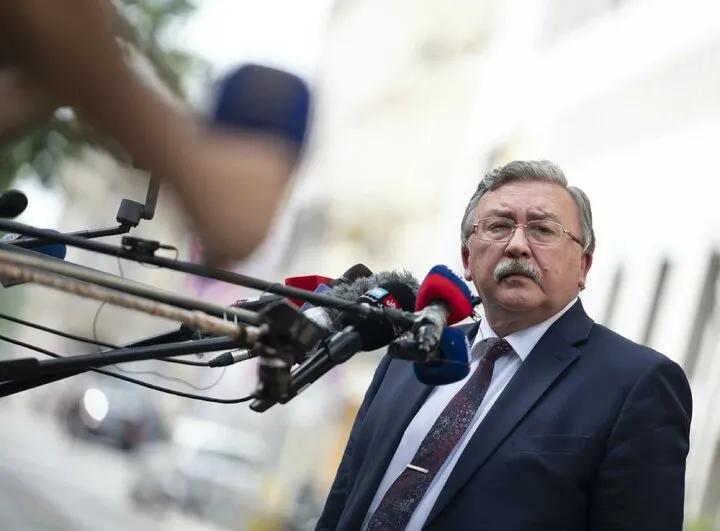
Tehran - BORNA - Addressing the IAEA Board of Governors, Ulyanov emphasized that truly reliable guarantees from Washington and Tel Aviv that they will not resume the use or threat of force are necessary to restore full verification measures in Iran. He suggested that IAEA Director General Rafael Grossi could play a constructive role in securing such guarantees during his engagements with relevant parties.
Later, taking to the social media platform X to condemn the anti-Iran resolution, Ulyanov wrote that it was not easy to control reactions to the completely shameful stance of the Western members of the Board of Governors and their supporters.
During Wednesday's session reviewing the implementation of the NPT Safeguards Agreement in Iran, Ulyanov supported the joint statement issued by Iran, China, and Russia. He noted that despite the prevailing security situation, Tehran has agreed to allow IAEA inspections across all three units of the Bushehr nuclear power plant in mid-September.
The Russian envoy expressed regret over the collapse of the Islamabad Memorandum of Understanding, signed between Tehran and Washington on June 17, citing renewed aggressive actions by the United States. He reiterated that diplomacy remains the only viable path forward, warning that attempting to impose peace in the Persian Gulf through force would yield disastrous consequences.
Addressing Grossi’s latest report, Ulyanov stressed that the current difficulties in implementing safeguards in Iran did not emerge in a vacuum. He attributed them directly to unprovoked and unjustified attacks by Israel and the US against Iran's safeguarded nuclear facilities in June 2025 and between March and April 2026.
He condemned the military strikes as direct violations of the UN and IAEA Charters, international law, and UN Security Council resolutions. Ulyanov noted that prior to the bombings, the IAEA routinely verified these facilities and recorded no signs of nuclear material being diverted for unauthorized purposes. He also expressed deep regret that the illegal actions by the US and Israel have not met with an appropriate collective response from IAEA member states or firm condemnation from the agency's leadership.
Criticizing a new anti-Iran draft resolution submitted by the US, UK, Germany, and France, Ulyanov questioned its procedural legitimacy. He cited Rule 33 of the Board's Rules of Procedure, which prohibits revisiting an adopted proposal within four months, noting the draft contains no fundamentally new elements compared to the June resolution.
The Russian diplomat strongly warned against referring Iran's alleged non-compliance to the UN Security Council, arguing that it defies basic diplomatic decency to penalize a country whose safeguarded nuclear facilities have just been bombed. Instead, he concluded, the UNSC should investigate the root causes of the current safeguard situation—a subject he said the Western draft resolution entirely ignores.
End Article