Pezeshkian: No country should use its territory to threaten or attack another
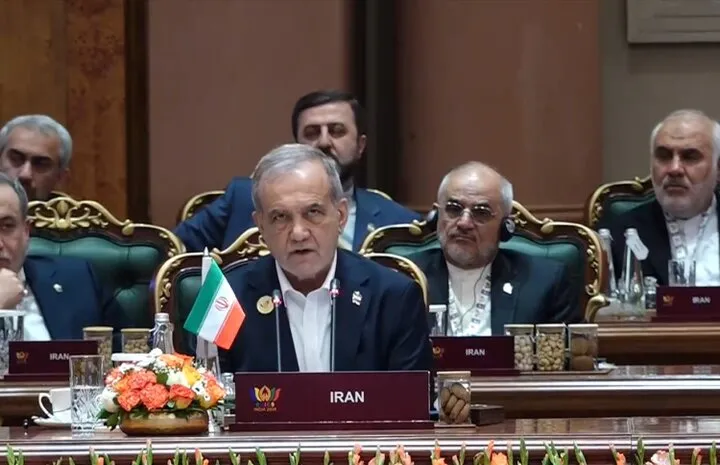
Tehran - BORNA - Masoud Pezeshkian said today, 21 Shahrivar, at the closed session of BRICS leaders held in New Delhi, stating that the credibility of any system of governance depends on its ability to protect the rights of all countries, small and large: If the United Nations Charter cannot protect nations against the unlawful resort to force, and if international rules are binding for some and open to interpretation for others, one cannot speak of genuine multilateralism.
The full text of the speech of the President of the Islamic Republic of Iran at this meeting is as follows:
"Your Excellency Mr. Chairman;
Distinguished Heads of State;
Ladies and Gentlemen;
It is a pleasure to be present alongside you at the 18th BRICS Summit in New Delhi. I sincerely thank the government and Prime Minister of India for the worthy hosting of this summit and for the efforts made to strengthen BRICS cooperation.
The subject of this meeting — 'inclusive global governance and strengthening multilateralism' — is today of twofold importance. Today we face a fundamental contradiction. On the one hand, the interdependence of countries in the face of common crises has increased more than ever, but on the other hand, we are simultaneously witnessing the return of unilateralism, pressure, and the instrumentalization of financial and technological systems. This trend is not merely a political challenge; it undermines the foundations of global governance.
Excellencies;
The credibility of any system of governance depends on its ability to protect the rights of all countries, small and large. If the United Nations Charter cannot protect nations against the unlawful resort to force, and if international rules are binding for some and open to interpretation for others, one cannot speak of genuine multilateralism.
The Islamic Republic of Iran has experienced this reality in practice. The military aggression of America and the Zionist regime against Iran took the lives of innocent people and damaged the country's vital, economic and civilian infrastructure. America and the occupying regime, on the very first day of this forty-day war, martyred the Supreme Leader of the Islamic Republic of Iran and 168 innocent children at the Minab school. The attack on the Minab school and the Lamerd stadium showed how the unilateralism, warmongering and savagery of America and the occupying regime — alongside the inaction of the United Nations and its Security Council — can directly threaten human life.
At the same time, what is happening to civilian people in Gaza and Lebanon has challenged the conscience of humanity. If the multilateral system cannot protect human lives and the sovereignty of countries against war, genocide and aggression, how can its legitimacy be trusted? Our response must not be limited to issuing statements. We need genuine reform of international mechanisms.
Dear colleagues;
From the perspective of the Islamic Republic of Iran, inclusive governance rests on four pillars:
First, equal respect for the sovereignty of countries and the non-discriminatory implementation of international law; no country should be exempted, due to its economic or military power, from rules that are binding on others.
Second, reform of global governance structures; the Security Council and international financial institutions must reflect the new realities of the world and the real role of Global South countries.
Third, turning multilateralism from slogan into action; through developing trade in national currencies, strengthening independent payment mechanisms, and strengthening the role of institutions such as the New Development Bank in the economic architecture of a more balanced global system.
Fourth, practical and serious confrontation with unilateral sanctions; sanctions that in practice target not only governments, but also people, patients, children and the development path of countries.
Excellencies;
The developments of recent years have shown that sustainable security can no longer be defined on the basis of security for some and insecurity for others. Sustainable security is achieved when the sovereignty of countries is respected and no country can use its territory to threaten or attack another. We in BRICS must stand against the normalization of attacks on civilian and critical infrastructure. This same principle applies to peaceful nuclear facilities; these facilities must remain immune from attack and threats of attack, because endangering them is not an issue limited to one country, but a threat related to international peace and security.
Ladies and Gentlemen;
The question of Palestine is another test for the credibility of global governance. The people of Palestine are entitled to the right of self-determination and to live in security, and no just solution will take shape without respect for their will. BRICS must be the voice of justice and play a more active role in ending the occupation and guaranteeing the legitimate rights of the Palestinian people.
Mr. Chairman;
The Islamic Republic of Iran supports three processes in BRICS: strengthening the political coordination of members in defense of the United Nations Charter and the sovereignty of countries; developing economic and financial cooperation independent of monopolistic instruments; and strengthening cooperation in the fields of science, technology, energy and food security to the benefit of all members, especially Global South countries.
Today's world needs cooperation more than ever, but sustainable cooperation is not possible without justice. Multilateralism is meaningful when all are equal before the law, and global governance will have legitimacy when the voice of developing countries is heard.
Dear colleagues;
BRICS will succeed in pursuing the set goals, especially the establishment of a justice-centered international order, if it can also overcome some intra-group challenges. Adherence to the fundamental principles and objectives of BRICS, avoiding being influenced by trends and pressures from outside the group, resistance to illegal and oppressive sanctions against members, turning areas of competition into cooperation, creating systems, and ultimately, to address administrative shortcomings, establishing a permanent secretariat and strengthening coordination mechanisms among members is essential, so that joint decisions are implemented with greater coherence, speed and efficiency.
The Islamic Republic of Iran is ready to cooperate within the framework of BRICS to realize these goals. We seek a world in which power does not take the place of law, sanctions do not take the place of cooperation, war does not take the place of dialogue, and monopoly does not take the place of participation. This is the true meaning of inclusive global governance and multilateralism."
End Article