BRICS leaders adopt New Delhi Declaration, condemn unilateral sanctions and nuclear risks
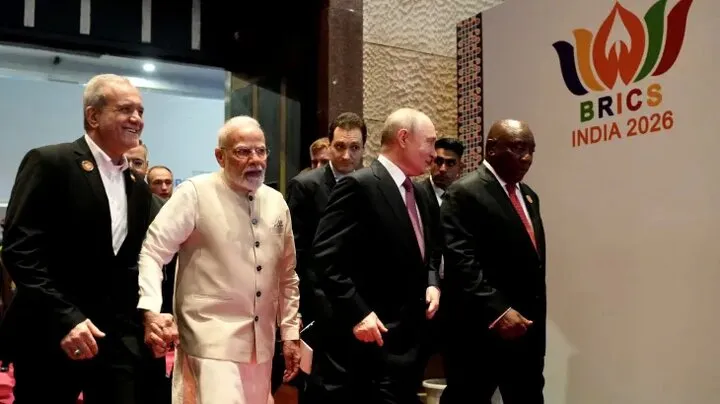
Tehran - BORNA - The declaration, announced by Indian Prime Minister Narendra Modi, covers the following main axes:
Global governance and multilateralism
The leaders expressed grave concern over rising unilateralism, polarization and fragmentation in the international order, calling for a reinvigorated and reformed multilateral system. They urged the international community to resolve disputes through dialogue, consultation and diplomacy, and to address the root causes of conflicts. The declaration called for a structural update of the United Nations Security Council and reform of the Bretton Woods institutions to make them more representative, inclusive and accountable, with greater representation for emerging markets and developing countries.
Unilateral sanctions and coercive measures
The leaders strongly condemned unilateral economic sanctions and secondary sanctions imposed outside the framework of the UN Security Council, stating that such measures violate international law and the UN Charter. They warned that these restrictions have far-reaching negative consequences on human rights, food security, healthcare and development. BRICS members agreed to oppose all unilateral, punitive and discriminatory measures not in accordance with international law.
Nuclear risks and disarmament
The declaration expressed serious concern over growing nuclear risks and the threat of nuclear war. It condemned deliberate attacks on civilian infrastructure and peaceful nuclear facilities operating under IAEA safeguards, warning that nuclear safety and security must always be upheld, including in armed conflicts. The leaders called for renewed efforts on disarmament, arms control and non-proliferation.
West Asia and regional conflicts
On West Asia, the leaders urged maximum restraint and called for the protection of civilians and civilian infrastructure in accordance with the UN Charter. They stressed the need to maintain the smooth flow of global trade, supply chains and energy. The declaration also addressed the conflict in Ukraine, calling for a peaceful resolution through dialogue and diplomacy.
Palestine and Gaza
The declaration expressed deep concern over continued violence in Gaza despite the October 2025 ceasefire agreement and called for halting any policies aimed at the forced displacement of Palestinians. It reaffirmed that a just and lasting solution to the Israeli-Palestinian conflict can only be achieved by peaceful means and depends on the fulfilment of the legitimate rights of the Palestinian people, including self-determination and return.
Trade and economic cooperation
BRICS leaders voiced serious concerns over rising protectionist policies, including arbitrary tariff hikes and green-labelled trade barriers that disrupt global supply chains and disproportionately harm developing countries. They agreed to collaborate on making the WTO more responsive to trade disruptions and called for the immediate restoration of a fully functioning two-tier dispute settlement mechanism.
Energy and food security
The leaders emphasized the need to strengthen energy security and ensure uninterrupted energy supplies amid global conflicts. They also stressed the importance of food security and sustainable agriculture, calling for cooperation among member states to enhance agricultural productivity and resilience.
Financial cooperation and local currencies
The declaration welcomed progress on the New Development Bank (NDB) and the Contingent Reserve Arrangement (CRA), and encouraged further use of national currencies in trade and financial transactions among BRICS members. It called for the development of independent payment mechanisms to reduce reliance on dominant global financial systems.
Technology, innovation and AI
The leaders emphasized the importance of cooperation in science, technology, innovation and artificial intelligence, calling for inclusive and equitable access to technology for developing countries. They agreed to strengthen collaboration on digital economy, cybersecurity and space cooperation.
Counter-terrorism and security
The declaration reaffirmed the commitment to combating terrorism in all its forms and manifestations, calling for comprehensive implementation of international counter-terrorism conventions. It stressed the need for enhanced cooperation on security matters, including cyber security and transnational organized crime.
Climate change and sustainable development
The leaders reaffirmed their commitment to the Paris Agreement and called for enhanced climate finance, technology transfer and capacity-building support for developing countries. They stressed the importance of sustainable development and the achievement of the SDGs, including poverty eradication, health, education and water security.
Health cooperation
The declaration emphasized the need to strengthen health systems and pandemic preparedness, and to ensure equitable access to vaccines, medicines and medical technologies for developing countries.
People-to-people and cultural ties
The leaders underscored the importance of cultural exchanges, education, tourism and people-to-people contacts in strengthening ties among BRICS nations.
Institutional development and expansion
The declaration welcomed the new members who joined BRICS from 2024 and emphasized the importance of strengthening coordination mechanisms among members. It called for the establishment of a permanent secretariat and enhancing the group's institutional capacity to implement decisions with greater coherence, speed and efficiency.
The 18th BRICS Summit is being held in New Delhi on September 12-13, 2026, under India's chairship, with the theme "Building for Resilience, Innovation, Cooperation and Sustainability."
End Artice