Pezeshkian calls on BRICS to strengthen defense of national sovereignty, oppose force
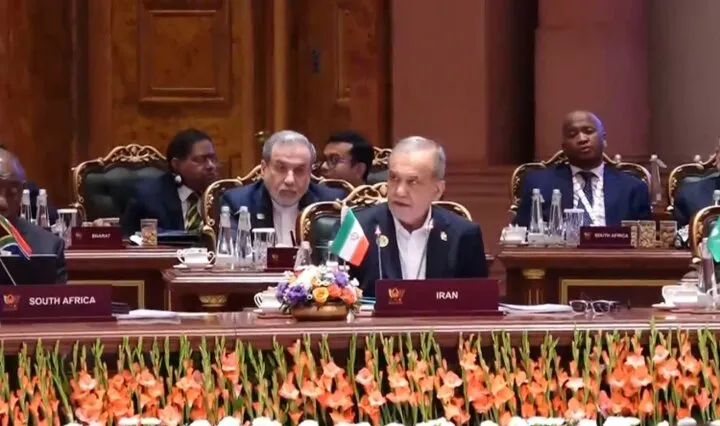
Tehran - BORNA - Addressing the 18th BRICS Plus Summit in New Delhi under the theme "Resilience, Cooperation and Sustainability: Shaping the Future for Inclusive Global Growth," the Iranian president stressed that no single nation can address contemporary global challenges in isolation.
The full text of President Pezeshkian’s address is as follows:
"In the Name of God, the Compassionate, the Merciful.
Mr. President, Honorable Heads of State, Ladies and Gentlemen,
It is a great pleasure to address you at the 18th BRICS Plus Summit at such a critical and decisive juncture for the international community. I extend my gratitude to the government and people of India, and to the honorable Prime Minister, for hosting this summit and for their dedicated efforts.
The theme of this summit, namely 'Resilience, Cooperation, and Sustainability,' is not merely a slogan. These three concepts represent the answers to three fundamental needs of a world where the destinies of its nations are intertwined more than ever before. Our challenge is not solely managing today's crises, but rather building a system that empowers nations against future crises and renders the coming world more just. BRICS must be a part of the world's answer to this imperative.
Mr. President,
Resilience means possessing the necessary capacity to maintain the path of development and independence in decision-making, even under pressure. Over-reliance on limited financial and commercial systems leaves economies vulnerable to political shocks. Today, unilateral sanctions are not merely an economic issue; they directly impact food security and public welfare. Therefore, BRICS must build a collective capacity for the economic resilience of its members by expanding trade in national currencies and strengthening the New Development Bank.
Economic resilience will not be sustainable without security. The developments in our region, particularly the military aggression by the United States and the Zionist regime against the Islamic Republic of Iran, have demonstrated that the impacts of targeting a country's economic, energy, and developmental infrastructure rapidly transcend its borders, resulting in regional and global consequences.
The Iranian people have paid a heavy price for these aggressions. Men, women, children, and civilians have lost their lives, and the infrastructure built over decades for the country's development has been damaged. These events serve as a stark reminder of the international community's heavy responsibility to protect civilians and prevent the normalization of attacks on civilian targets.
The people of Gaza and Lebanon also continue to face the consequences of atrocities and genocide. One cannot speak of international law if there is no effective international response to military aggression, the slaughter of human beings, and the destruction of their lives. Hence, BRICS must play a more effective role in defending national sovereignty, territorial integrity, and the prohibition of the use of force.
Ladies and Gentlemen,
The second pillar is 'Cooperation.' No single country can resolve today's global challenges alone. BRICS must transform the dispersed capacities of the Global South into a unified capability. In this context, the geopolitical position, energy resources, and transit capacity of the Islamic Republic of Iran can play an effective role in developing trade and energy routes among member states.
The third pillar is 'Sustainability.' Development that exacerbates inequality or shifts today's costs onto the shoulders of future generations will not be sustainable. We must not forget that war is one of the most severe drivers of environmental destruction. Iran's recent experience has shown that damage to energy and industrial infrastructure carries consequences far beyond economic losses, severely affecting the region's natural resources.
Alongside these three pillars, 'Knowledge and Innovation' is also a determining factor. BRICS must ensure that artificial intelligence and emerging technologies do not become instruments of hegemony, but rather tools for the empowerment of nations.
Esteemed Colleagues,
Today, BRICS is not merely a framework for cooperation among a few emerging economies; rather, it is a manifestation of an ever-growing demand for a more balanced and inclusive world, where no center of power holds the right to dictate the destinies of others.
The Islamic Republic of Iran is prepared to dedicate its capacities to BRICS cooperation along this path. Resilience will not endure without cooperation, cooperation is not sustainable without justice, and sustainability will be impossible without peace and security. Let us make BRICS a platform for translating these principles into practical action. A future in which growth, security, and development are possible for all is not only attainable, but it is a shared responsibility toward future generations.
Thank you for your attention."
End Article