Baghaei: Regional countries should face realities on Yemen, avoid blame-shifting
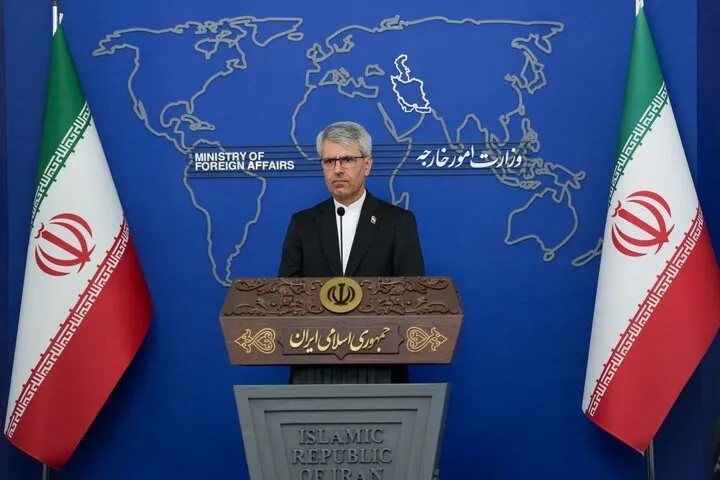
Tehran - BORNA - Iranian Foreign Ministry spokesperson Esmaeil Baghaei said on Monday that the opportunity to hold a regional meeting in Oman has for now been lost after Saudi Arabia requested its postponement, while stressing that an understanding reached between Iran and Oman on safe maritime routes has been finalized.
Baghaei also said a US underwater vehicle captured by Iran had not merely been seized but had been taken as “war booty.”
Speaking at his weekly press briefing attended by domestic and foreign journalists at the Foreign Ministry, Baghaei first referred to his recent visit to the city of Lamerd, which was targeted by the United States during the Ramadan War.
Baghaei said that during the visit, Iranian officials had witnessed firsthand what he described as the crime committed by US forces and “the extent of American brutality.”
“They committed this crime in a small city of 30,000 people, attacked the city center and turned the city into a testing ground for their newest weapon,” Baghaei said, adding that such an action was “incompatible with any standard.”
Referring to the characteristics of the weapon used in the attack, Baghaei said the strike took place near the city’s blood transfusion center and an educational facility.
Baghaei said the weapon used was a prohibited cluster weapon, adding that “what happened was unquestionably a war crime.”
The Foreign Ministry spokesperson said the objective of the US action was to spread fear, noting that the attack occurred on the same day that Tehran was struck in the morning and the Shajareh Tayyebeh school in Minab was attacked.
“Within a matter of seconds, 2,000 kilograms of explosives were dropped on the city,” Baghaei said.
Baghaei added that 21 innocent people, including an Afghan national, were killed in the attacks on Lamerd, while the pain and suffering endured by those injured and left with lasting disabilities was “indescribable.”
Regional countries should see realities on Yemen, avoid blame-shifting
Asked about allegations of Iranian involvement in Yemen, Baghaei said Iran had “no involvement in matters related to Yemen.”
Baghaei said developments in the region were important to Iran and stressed that Tehran was concerned about outside actors seeking to escalate tensions among Islamic countries and “fish in troubled waters.”
“It is within this framework that we clearly state our positions, and expressing those positions should not be interpreted as interference,” Baghaei said.
Baghaei described Yemen’s Ansarullah as an independent party that makes decisions based on its own interests.
“When we want to discuss developments in Yemen, we should also take past events into account,” Baghaei said. “Yemen is a country that has been subjected to aggression and blockade over the past 10 to 12 years, and Yemenis have made extensive efforts to secure their rights and dignity.”
Baghaei added that Yemenis had also come under attack by the Israeli regime and the United States over what he described as their principled support for the Palestinian people and opposition to the Israeli regime’s genocide.
“They have in fact shown that they are free people,” Baghaei said.
Referring to statements by some regional countries about Yemen and allegations made against Iran, Baghaei said, “My recommendation to all regional countries is to see the realities and refrain from blame-shifting.”
Baghaei also offered condolences to the family of what he described as the latest Iranian martyr of resistance against US actions.
“As you know, amid the effort to make navigation in the Persian Gulf and the Sea of Oman insecure, the American enemy attacked a vessel near Hengam Island,” Baghaei said.
Baghaei said an Iranian national named Jamshid Rajabi was killed in the attack and several people were injured, including two Pakistani nationals working aboard the vessel.
“We extend our condolences to the family of the martyr and wish the injured a speedy recovery,” Baghaei said.
The spokesperson said the incident was another sign that the United States had deployed forces thousands of kilometers away from its borders while claiming to be concerned about maritime safety and security.
“Yet next to our borders and off our shores, it attacks Iranian vessels and in this way undermines the security and safety of waterways,” Baghaei said.
Claims Iran knew of Saudi oil pipeline attack are false
Asked about US allegations that Iran had a role in an attack on a Saudi oil pipeline, Baghaei said, “The Americans are producing false reports at no cost.”
Baghaei said actors outside the region were seeking to increase tensions among regional states through fabricated reports and false allegations, adding that Islamic and regional countries should remain vigilant against such efforts.
“The allegations raised by the Americans are categorically rejected,” Baghaei said.
Austrian chargé d’affaires summoned over visa refusal
Reacting to Austria’s failure to issue entry visas to an Iranian delegation headed by Atomic Energy Organization of Iran chief Mohammad Eslami for participation in the IAEA General Conference, Baghaei said Vienna’s action as the host government was “absolutely unjustified.”
“The Austrian government was required under its obligations to issue visas to the Iranian delegation,” Baghaei said. “We clearly conveyed our protest to the Austrian government, and the Austrian chargé d’affaires was also summoned to the Foreign Ministry, where our objection was expressed.”
Referring to what he described as contradictions in Western countries’ approach, Baghaei said, “It is contradiction upon contradiction.”
“On the one hand, they accuse a country, adopt resolutions and prepare inaccurate reports, and then they also deprive that country’s representatives of the opportunity to attend and defend themselves,” Baghaei said.
Baghaei said the conflict initiated against Iran had not been limited to the military sphere but also extended into the diplomatic and legal arenas, with the aim of preventing Iran’s voice from reaching other countries.
“We will use all available tools to prevent such an objective from being achieved,” Baghaei said.
Addressing Austria’s explanation that it was under US pressure or responding to a US request not to issue the visas, Baghaei said such an explanation did not absolve Vienna of responsibility.
“If the Austrian government tells us that it acted under pressure or at the request of the United States — and it is clear to us that there was US pressure — that in no way removes the responsibility of the host government,” Baghaei said.
Baghaei added that any state hosting international organizations or meetings should above all safeguard its own credibility and standing and should not allow US pressure to cause it to incur international responsibility by failing to fulfill its obligations.
Foreign policy decisions cannot be based on oil prices alone
Asked about the Oman meeting and criticism of the Foreign Ministry for pursuing the initiative at a time of rising oil prices, Baghaei said decisions on foreign policy and national security are neither one-dimensional nor based on a single factor.
“One cannot make decisions on highly sensitive and complex national security issues solely on the basis of one component,” Baghaei said.
Baghaei said that an increase or decrease in oil prices could not by itself determine whether Iran should pursue a particular policy decision.
“We should not call our own logical and forward-looking actions into question because of ill-considered measures or breaches of commitments by others,” Baghaei said.
Baghaei said Iran and Oman, as two coastal states, had reached an understanding on an issue that exclusively concerned them and had then intended to present that understanding at a meeting with regional countries as part of what he called a responsible and forward-looking approach.
“In my view, this is in line with the wisdom of the decision-makers,” Baghaei said.
Regional states were expected to value opportunity presented by Iran, Oman
Baghaei explained that the understanding between Iran and Oman concerns the designation of safe maritime routes and directly relates to the two coastal states.
Baghaei said the sovereign rights of both countries had been taken into account and that the arrangement had been reached after weeks of negotiations.
“The plan was simply to present this issue at the meeting,” Baghaei said. “This was an opportunity provided by Iran and Oman, and regional countries were expected to recognize such opportunities and appreciate them.”
Baghaei said that if regional states genuinely believed permanent neighbors should sit together and discuss establishing a secure region free from the interference of destructive outside actors, the planned meeting had provided “a very good opportunity.”
“I do not think any responsible party could accept losing such an opportunity, whether because of influence by actors outside the region or because of excuses that genuinely have nothing to do with Iran,” Baghaei said.
Saudi Arabia requested postponement of Oman meeting
Asked about reports concerning Saudi Arabia’s role in the postponement, Baghaei confirmed that Riyadh had requested that the meeting not be held for the time being.
“The report that has been circulated is correct. Saudi Arabia requested that this meeting not be held for now,” Baghaei said.
Referring to attempts to attribute developments between Saudi Arabia and Yemen to Iran, Baghaei said such assertions amounted to “giving the wrong address.”
“Problems are not solved by giving the wrong address,” Baghaei said.
The spokesperson said Yemen’s problems had deep and longstanding roots and stressed that Iran had repeatedly expressed readiness to help resolve them.
“We have always said, and have tried and demonstrated in practice, that we are prepared to help resolve these issues,” Baghaei said.
Baghaei said Iran had encouraged the parties to use a roadmap they themselves had agreed upon as the basis for their negotiations.
“We have said that the roadmap you yourselves agreed upon — in which we had no role or involvement — should serve as the basis for your talks to resolve the issue,” Baghaei said.
Baghaei said continuation of war among Islamic countries in the region would have only one winner.
“That winner is none other than the Israeli regime, which seeks the continuation of tension and insecurity in our region and among Islamic countries,” Baghaei said.
Iran-Oman understanding finalized
Speaking about the next steps, Baghaei said the understanding between Iran and Oman as two coastal states had been finalized.
“In consultation with Oman, we will decide on the next step and on how this understanding should be announced or registered, and information will be provided accordingly,” Baghaei said.
‘Iran cannot be isolated’
Asked about US attempts to isolate Iran internationally and Tehran’s active participation in the BRICS Summit despite those efforts, Baghaei said, “Iran cannot be isolated.”
“A country that defends itself earns the admiration and praise of all countries, even if some do not express it because of considerations involving the United States,” Baghaei said.
Baghaei said attention should instead be paid to the state of US credibility.
“The United States committed a criminal mistake and a very grave crime by attacking the Islamic Republic of Iran and joining forces with a genocidal regime, and it continues to become further entangled in this course,” Baghaei said.
According to Baghaei, the international community, including countries in the region, had realized that US actions were undermining international norms that are necessary for the continuation of international peace and security.
Baghaei said Washington had turned the United Nations into a tool, reduced the International Atomic Energy Agency to a political instrument and violated one of the most fundamental principles of the UN Charter, namely the prohibition on the use of force.
“In such circumstances, countries use every opportunity, including multilateral arrangements such as the Shanghai Cooperation Organization and BRICS, both to demonstrate their opposition to this approach and trajectory and to devise ways of dealing with its consequences,” Baghaei said.
Baghaei also referred to US allies, including Canada and European countries, which he said had once believed that actions taken by the United States as the “leader of the free world” served their interests.
“We now see that these countries, too, have concluded that they need to find ways to restrain America’s confrontational and destructive unilateralism,” Baghaei said.
US underwater vehicle captured as war spoils of war
Asked whether the United States had held consultations or negotiations with Iran over the release or return of a US underwater vehicle captured by Iran, and whether the issue was being pursued through diplomatic channels, Baghaei rejected the characterization that the vehicle had merely been seized.
“It was not seized; it was captured as war spoils,” Baghaei said, adding, “And war booty is lawful.”
No update yet on visas for Iranian UNGA delegation
Asked about the latest status of visas for the Iranian delegation due to travel to New York for the UN General Assembly, Baghaei said Tehran had not yet received any information.
“So far, we have received no news regarding the visas,” Baghaei said. “As soon as there is any development in this regard, we will certainly provide information.”
Baghaei dismisses reports on Turkey’s payment for Iranian gas
Asked about reports that Turkey had said it could no longer pay Iran for imported gas because of US sanctions and would instead provide food and medicine, Baghaei said much of the media atmosphere surrounding Iran’s relations with other countries, particularly its neighbors, was aimed at creating tension.
“I am not saying the United States is not trying to enforce its unjust sanctions, including by pressuring Iran’s trading partners and regional countries,” Baghaei said.
However, Baghaei said there was also a broad media campaign aimed at multiplying the effects of what he described as the US economic war.
“We must therefore be careful not to be overwhelmed by media narratives and fabrications,” Baghaei said.
Baghaei stressed that Iran enjoys good relations with its neighbors, particularly Turkey.
“We will certainly use all diplomatic tools and consultations to prevent the realization of US measures and objectives, which are clearly contrary both to international law and to human rights,” Baghaei said.
No new mediator has entered Iran-US talks in technical sense
Asked about remarks by the Chinese president on the need to resolve crises in West Asia and the possibility of Beijing mediating between Iran and the United States, Baghaei said Tehran has consistently welcomed China’s principled and responsible stance on regional security issues.
“China has played a very constructive role at various times in helping strengthen security and stability in our region, and we have always expressed our readiness to cooperate with China in this regard,” Baghaei said.
Baghaei said Iran believed China expressed its principled position whenever opportunities arose and described that position as valuable.
“We also saw China’s principled positions at the BRICS Summit,” Baghaei said, adding that Beijing’s approach toward regional issues appeared to be welcomed by both Iran and other regional countries.
However, Baghaei said it would not be accurate to describe China as a new mediator in Iran-US talks in the precise and technical sense of the term.
“I do not think we are witnessing the entry of a new actor in the precise and technical sense, in the role and capacity of a mediator,” Baghaei said. “Pakistan is performing its role well.”
Baghaei stressed that Iran’s fundamental problem with the United States had never been the absence of a mediator.
“Our problem has never been the mediator,” Baghaei said. “The issue between Iran and the United States has never been a lack of mediation.”
Baghaei said the problem was the absence of genuine will and even a minimum degree of good faith on the US side to use diplomacy to resolve outstanding issues.
“As long as this approach exists on the American side, whatever mediator you use, they will in some way discredit the mediators as well,” Baghaei said.
Iran pursuing IAEA, Grossi responsibility over reports used against Tehran
Asked how Iran was pursuing the responsibility of the IAEA and its director general over reports that Tehran says paved the way for attacks against Iran, Baghaei said measures had already been taken.
“Responsibility for any form of participation or assistance in the commission of an internationally wrongful act is not something that disappears with the passage of time,” Baghaei said.
Baghaei described the issue as permanent and ongoing, saying Iran would use every opportunity to explain and formally record its position.
Baghaei said Iran regretted that despite what he called the same experience occurring twice, the IAEA and Director General Rafael Grossi had again allowed a report and the surrounding political atmosphere to be used to prepare a resolution against Iran.
Baghaei said the resolution was not even based on the report itself but rather on what he described as misuse of the report.
“The very act of presenting facts incompletely or in a completely reversed manner by the director general creates the conditions for abuse,” Baghaei said.
Baghaei said that if the director general intended to take a fair and technical approach, he should first have condemned what Iran considers the illegal actions of the United States and the Israeli regime.
“He should have condemned the attack on Iran’s nuclear facilities, which cannot be justified under any standard,” Baghaei said.
The spokesperson added that US officials’ statements threatening Iran, its nuclear facilities or construction activities each warranted a firm response from the IAEA director general, which he said had not occurred.
‘Pickaxe Mountain’ issue dates back six or seven years
Asked about recent remarks by IAEA Director General Rafael Grossi concerning nuclear-related activity at “Pickaxe Mountain” and his statement that there was no verified information about the nature of activity at the location, Baghaei dismissed the issue as “much ado about nothing.”
“This ‘Pickaxe Mountain’ has been discussed many times, yet they talk about it as though they have uncovered some secret and classified file,” Baghaei said.
Baghaei recalled that when negotiations between Iran’s 13th administration and the previous US administration were taking place under Ali Bagheri Kani, construction activity at the location had already been raised as an issue.
“One of the issues they raised at the time, around six or seven years ago, was precisely that construction was taking place at this location,” Baghaei said.
Baghaei noted that Iran was not then, and is not now, a party to the Additional Protocol.
“Under our safeguards obligations, whatever we were required, or may be required, to report to the agency has been reported,” Baghaei said.
Baghaei therefore described discussion surrounding the site as media-driven political pressure without substantive basis.
Baghaei said there had even been discussion at the time about the possibility of inspecting the location because it could not necessarily be characterized as a nuclear facility in the precise safeguards sense.
“At that time, there was discussion that such an inspection could be carried out once a year,” Baghaei said, stressing that he was referring to discussions from about six years ago.
Baghaei said he raised the history of the issue so that it would be clear “once and for all” that comments about the site were part of what he described as a US media and psychological campaign.
“Whenever they run out of other falsehoods, they raise a new issue simply to create an atmosphere and prolong a narrative that has become genuinely difficult for them to sustain,” Baghaei said.
Baghaei added that allegations that Iran was seeking a nuclear bomb had persisted for 30 years.
“Not even once has the agency, despite all of its bias and politicization, including in its latest report, said that Iran has committed non-compliance,” Baghaei said.
Baghaei said new issues were repeatedly introduced through media campaigns in order to justify what he described as a longstanding false allegation, often leading observers to mistakenly believe that a new development or unusual activity had occurred.
Iran-Turkey contacts cover far more than messages between Tehran, Washington
Asked whether recent telephone consultations between the Iranian and Turkish foreign ministers had only involved transmission of a US message to Iran or also included efforts to reduce tensions, Baghaei said Tehran and Ankara had “far more important matters” to address than simply exchanging messages between Iran and the United States.
“Iran-Turkey relations are excellent in all areas, and naturally communication between the two foreign ministers is continuous,” Baghaei said.
Baghaei said the two countries share both common interests rooted in longstanding ties between their peoples and similar concerns on a wide range of regional issues.
He particularly pointed to what he described as the Israeli regime’s expansionism and its actions against various countries in the region and the Levant.
“We always use conversations between the two foreign ministers as an opportunity to discuss a very broad range of issues,” Baghaei said.
Commercial traffic at Shalamcheh, Chazabeh crossings to normalize
Asked about the closure of the Shalamcheh and Chazabeh border crossings and media reports concerning the issue, Baghaei said the important point was that efforts to resolve the matter were underway.
Baghaei said discussions had taken place between the Iranian Embassy and relevant Iraqi authorities, alongside contacts at higher levels between the Iranian and Iraqi foreign ministers.
“These consultations have allowed traffic to resume,” Baghaei said.
Baghaei added that passenger and pilgrim crossings had already resumed and that commercial traffic was expected to return to normal within the next one or two days.
Addressing reports on possible change in Iran’s nuclear doctrine
Asked about Western media reports concerning a possible change in Iran’s nuclear doctrine and discussions about withdrawal from the Nuclear Non-Proliferation Treaty following remarks by some Iranian figures, Baghaei described the issue as another example of what he called contradictions by the opposing side.
“On the one hand, they themselves act in ways that call into question the very rationale of the NPT regime, and on the other hand they complain about why countries even discuss issues related to deterrence and nuclear matters,” Baghaei said.
Baghaei said those weakening the NPT were themselves the primary cause of such debates.
“The NPT has three fundamental pillars: nuclear disarmament, non-proliferation of nuclear weapons and, the part that is very important to us, access to nuclear energy for peaceful purposes,” Baghaei said.
Baghaei said nuclear-armed states had not only failed to make progress on disarmament but had intensified the opposite trend.
He added that non-proliferation efforts had also failed, accusing Western states of allowing their allies, including the Israeli regime, to possess nuclear weapons.
Baghaei also accused Western countries of obstructing developing states’ access to peaceful nuclear energy, particularly in Iran’s case.
“So they have only themselves to blame,” Baghaei said.
Baghaei stressed that the Islamic Republic’s policy was clear, while noting that Iran has an active civil society and parliamentarians who speak on various issues.
Baghaei said Iranian nuclear facilities had been subjected to acts of sabotage despite being under IAEA monitoring and despite Iran, as he put it, fully complying with its safeguards obligations under the NPT.
“In such an environment, I do not think it is unusual for our elites and officials to discuss these issues in the media and political sphere,” Baghaei said.
US preferences do not determine Iran’s priorities
Asked about a CNN report saying Washington had urged Persian Gulf officials to reduce their focus on the Strait of Hormuz and concentrate instead on nuclear issues, and whether this could have affected postponement of the planned meeting, Baghaei said he generally did not comment on media speculation and analysis.
However, Baghaei said Iran and Oman’s position was clear.
“Security in the Strait of Hormuz is an issue concerning the two coastal states, Iran and Oman,” Baghaei said.
Baghaei added that Iran was also aware of its responsibilities toward the region and international community.
“This is why we say regional countries and the international community must hold the United States accountable, because everything happening today in terms of insecurity in the Strait of Hormuz is the result of US actions,” Baghaei said.
Baghaei said the world should distinguish between what he described as the cause and the consequence of the current situation.
“You cannot focus only on the consequence — saying Iran has adopted certain measures regarding passage through the Strait of Hormuz — while ignoring the cause,” Baghaei said.
Baghaei said the main cause was the illegal actions of the United States and the Israeli regime that began on Feb. 28, 2026 and had continued since then.
“These illegal US actions are continuing, and they remain the main reason for the insecurity,” Baghaei said.
“As for whether the United States would prefer us or other countries to discuss one issue rather than another, that has no effect on our priorities or our will,” he added.
UAE side requested Pezeshkian meeting with Abu Dhabi crown prince
Asked about President Masoud Pezeshkian’s meeting with the Crown Prince of Abu Dhabi on the sidelines of the BRICS Summit in New Delhi and its significance for bilateral relations, Baghaei said one of the advantages of participating in multilateral meetings was the opportunity to hold consultations with a large number of countries.
“The meeting was arranged at the request of the Emirati side,” Baghaei said.
Baghaei said Iran accepted the request in line with its principled policy of strengthening trust and relations among neighboring and regional countries.
“Naturally, bilateral issues take priority in such meetings, and under present circumstances matters related to regional peace and security are certainly also discussed,” Baghaei said.
Opportunity for 6+2 Oman meeting lost for now
Asked whether the planned meeting with Persian Gulf countries was intended only to brief them on the outcome of Iran-Oman discussions or could also mark the beginning of a new phase following US-Israeli aggression against Iran, Baghaei said the meeting had been postponed and would not take place on Monday.
“Such a meeting could certainly have been a step, even a small one, toward reviving dialogue between Iran and the Persian Gulf countries,” Baghaei said.
Baghaei stressed that the need for dialogue was not limited to Iran’s relations with those countries.
“Those countries themselves also need to talk to one another,” Baghaei said.
The spokesperson pointed to serious disputes among some regional states that he said had contributed to several problems in the region, including developments in Yemen.
“This dialogue is not only a need between Iran and the countries on the southern shores of the Persian Gulf; it is a need shared among all of these countries,” Baghaei said.
“This opportunity has for now been lost,” he added.
Baghaei expressed hope that all sides would make serious efforts to revive the opportunity or create a similar one.
Baghaei said Iran would use every opportunity to remind regional countries of lessons from the past, particularly the previous six months, during which he said the security and sovereignty of regional states had been violated or used by the United States and the Israeli regime to attack a Muslim country.
“The first step toward establishing mutual understanding and trust is for regional countries to prevent their airspace, territory and facilities from being used for military aggression against Iran,” Baghaei said.
Asked about the UN Security Council’s consideration of Iran sanctions and adoption of the meeting’s agenda despite opposition from China and Russia, Baghaei said the situation should not be characterized in that way.
“Since last year, when the three European countries, under US pressure and encouragement, raised the so-called snapback mechanism and claimed that previously terminated Security Council resolutions had returned, a fundamental disagreement emerged within the Security Council,” Baghaei said.
Baghaei said China and Russia had maintained that the snapback process was illegal and ineffective and had continued to stand by that position.
“For this reason, consensus has not even been reached in the Security Council on the formation of the relevant committees,” Baghaei said.
Baghaei said the United States and European countries periodically hold meetings at the council level in an effort to give their position an appearance of continuity.
“At the same time, China, Russia and other countries that opposed this process state their own positions,” Baghaei said.
End Article