Salehi: Condemning an act without naming the aggressor is not neutrality
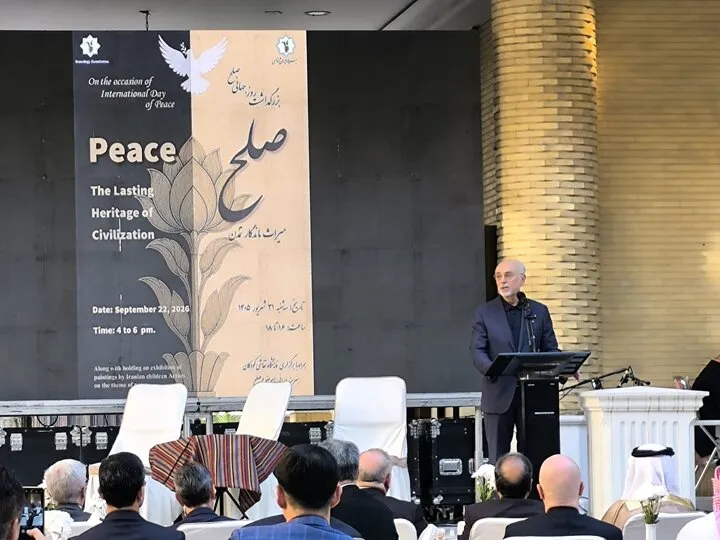
Tehran - BORNA - Salehi delivered the remarks Tuesday at a ceremony marking the International Day of Peace, held under the theme "Peace: The Lasting Heritage of Civilization" alongside an exhibition of paintings by Iranian children on the theme of peace.
Salehi opened by referring to the United Nations' annual call for a 24-hour global ceasefire on the Day of Peace, calling it a modest request that carries a profound truth. "If humanity can choose peace for a single day, then war on every other day is a choice too," he said, noting that even prominent American observers and analysts have called the current imposed war in Iran "a war of choice." He added that war, unfortunately, is never a fate, and that the day is not only one to honor peace but to ask what has become of the promise on which peace was meant to rest.
"We, the peoples" — not "we, the governments"
Salehi recalled a sentence written 81 years ago in San Francisco by people who had just lived through the most destructive war in human history, who set down as the UN Charter's first purpose: "to save succeeding generations from the scourge of war, which twice in our lifetime has brought untold sorrow to mankind."
He said the expectation at the time was that member states, and especially world powers, would no longer settle disputes by force or kill the innocent citizens of weaker states — that there would be rules, institutions to uphold them, and that those rules would apply to everyone equally.
He said that promise has not been loyally kept, noting that war continues on multiple continents, and recalled Iran's own experience of eight years of imposed war and the chemical weapons attack on Sardasht, "while much of the world, unfortunately, looked the other way."
Even so, Salehi said, the Charter's initial promise had loosely held enough to leave some room for optimism: even the world's most powerful states, when they chose to use force, felt compelled to present themselves as acting within the rules, going to the Security Council and manufacturing legal arguments to justify their actions. He cited the forged document claiming Niger had exported uranium to Iraq, which was later found to be fake — but only after the disaster had already taken place and people had suffered and been killed.
"I very much fear we are now witnessing the end of even that pretense," Salehi said. He said the prohibition on the use of force — the cornerstone of the UN Charter — was set aside this time in the name of "preventive self-defense," a concept the Charter does not recognize and that most member states have rejected for decades. He said the protection of nuclear facilities under international safeguards was treated as if it did not exist, and that international humanitarian law and the Geneva Conventions — ratified by every state represented at the ceremony — were violated based on unfounded justifications such as threats to annihilate a civilization, and the bombing of power plants, bridges and civilian objects that the law places beyond the reach of any army. "Each of these rules took generations to build. Each was paid for in blood," he said, "and in a few short months, each of them was mockingly treated as non-binding, as an option."
Salehi asked those present to keep two examples in mind for the rest of the gathering. He said that on the morning of Feb. 28, 2026 — a Saturday, the first day of the school week in Iran — missiles struck the Shajarah Tayyebah Elementary School in Minab, Hormozgan province, in the opening hours of the war, killing 168 children, most of them girls between seven and twelve years old. In some families, he said, more than one child was lost, and the hospital morgue was too small to hold the bodies, so refrigerated trucks were used. "The UN Charter promised to save succeeding generations from the scourge of war," he said. "In Minab, the succeeding generation was unfortunately robbed of that promise, and deprived of the privilege of life."
The second example, he said, was Lamerd, a city of about 30,000 people in southern Fars province. On the afternoon of that same first day of the war, a missile struck the city's sports hall while a girls' volleyball team was using it. Salehi said munitions experts consulted by the BBC and the New York Times have said the evidence points to a precision-strike missile — a type of ballistic missile the US military had never before used in combat — designed to explode just above its target and scatter tens of thousands of small tungsten pellets.
"When you stand in that hall — and I invite all of you to go and see that place, it's a beautiful city — you have to see it with your own eyes," Salehi said. "The walls are perforated with thousands of small holes, as though someone had fired gravel into them." He said the playground outside bore the same scars, and that every one of those holes marked the path of a piece of shrapnel moving through the air, through the volleyball net, or through whoever happened to be standing there. Twenty-one people were killed, he said, including a two-year-old named Avina Barzegar, and more than 170 were wounded, some of them young athletes who will carry disabilities for the rest of their lives.
Salehi said such events were possible because the institutions built to prevent them have been hobbled — they are not performing their responsibilities, not following their mission, and in some cases acting against their own purpose. He said the Security Council, despite bearing primary responsibility for international peace and security, has failed to act, or at least to act seriously. He acknowledged that some heads of international institutions and prominent figures have at times condemned what happened, and thanked them for it — but said they too often decline to say who did it, or to firmly reject the arguments used to justify such acts. "That is not neutrality," he said. "It is a great form of permissiveness — to condemn an act while remaining silent about its perpetrator."
Salehi said resorting to war has become far too simple and easy, and that sometimes a single word says more than many speeches. He recalled that before Iran's 1979 revolution, the country's government had a ministry titled the "Ministry of War," which was renamed the "Ministry of Defense" after the revolution. Today, he said, those who claim to safeguard the international order have taken the opposite approach: the United States has renamed its Department of Defense the "Department of War," a change the US Secretary of War justified by citing "maximum lethality" as the underlying principle. Salehi said he was astonished when he first saw the phrase and checked it again to make sure he had not misread it.
"This is more than a change of vocabulary," he said. "It vividly shows two distinct perceptions held by Iran and the United States toward peace and war. One name speaks of protecting one's own homeland; the other of carrying war to the homeland of others."
Salehi said economic sanctions have become a tool for paralyzing the economic backbone of countries and are now presented as a complement to war. "So we have war plus economic sanctions," he said. "Why? To make a country capitulate — to submit itself. Utter submission. Not half submission." He said: "A sanction with no exit is no longer a tool of policy. It is a siege, and siege is one of the oldest forms of war in history."
Turning to what could be done, Salehi recalled that the UN Charter does not begin with "we, the governments" or "we, the great powers, or we as permanent members of the Security Council," but with three words: "We, the peoples." Noting that he was expressing the Charter's spirit in his own words rather than quoting it exactly, he offered his own summary: that school playgrounds, hospitals, bridges, power plants and, above all, the common heritage of civilizations belong to all of humanity, and that protecting them is a duty shared by every nation; that nations should open their universities, libraries and theaters to one another, because it is far harder to bomb a city whose poets you have read; that children should be taught the histories, languages and faiths of other nations as chapters of one human story; and that food, medicine, climate and health are bound together and must build shared prosperity rather than be leveraged against one another.
"We, the peoples of the United Nations, reclaim the Charter's first words not as a memory, but as a mandate," Salehi said. "We pledge, with renewed determination, to save succeeding generations from the scourge of war, which — more than twice in our lifetime — has brought untold sorrow to mankind."
He closed by telling the ambassadors present that he hoped they would all remain true and faithful to their words, promises and commitments.
End Article