Iran's UNGA participation among its 'most successful' international appearances: Baghaei
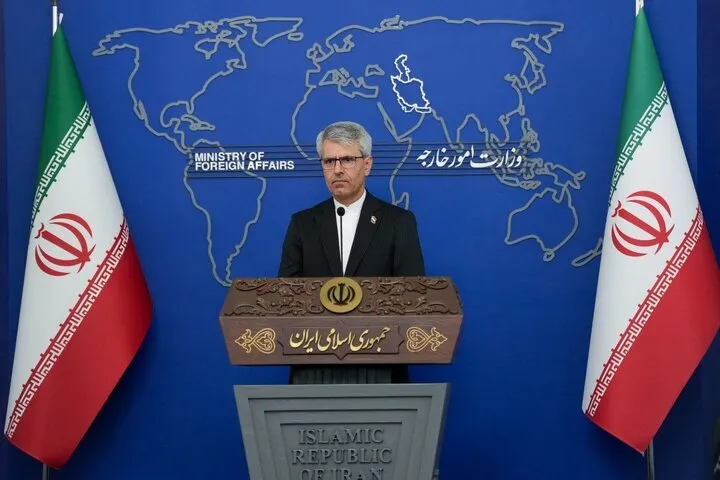
Tehran - BORNA - Opening his weekly press briefing with a brief overview of the most important foreign policy developments of recent days, Esmaeil Baghaei marked Sacred Defense Week and pointed to the Asian Games in Japan, saying Iranian athletes, particularly women and girls, performed brilliantly, which he called a sign of the self-confidence, growth and progress of Iranian women and girls in various fields, including sports.
Referring to the Iranian delegation's presence at this year's UN General Assembly, he said: "The members of Iran's delegation at the assembly were few, but their presence and activity were highly productive. It was important for us to use this opportunity to convey Iran's logic, strength and the injustice it has suffered, and I believe this was one of Iran's most successful appearances at international forums."
Ambassador issue with Lebanon must be resolved through dialogue
Responding to a question about the recent meeting between Iran's president and Lebanon's prime minister on the sidelines of the UN General Assembly in New York, and reports that the Lebanese prime minister had asked Tehran to send a new ambassador to Beirut, Baghaei said there had been "a good meeting" between the two. "Regarding Iran's ambassador in Beirut, as we have said before, the ambassador had already received his agrément from the Lebanese authorities," he said.
"One of the issues raised in the meeting between the president and the Lebanese prime minister concerned diplomatic matters and the activities of Iran's embassy in Lebanon, and we stated our positions on this," he said. "There is no consensus on this within Lebanon itself, and what matters is that the misunderstanding that has arisen be resolved through dialogue with Lebanese officials."
Neighbors must honor good-neighborliness
Asked about the Israeli prime minister's visit to the UAE and the Foreign Ministry's statement on the matter, Baghaei said Iran's advice to all neighboring countries is to honor the obligations of good-neighborliness. "We are committed to good-neighborliness, and in return we expect them to respect this principle and not allow their territory and facilities to be misused by parties that have shown they place no value on the security and prosperity of regional countries," he said. "We have stated our grievance very clearly and explicitly, particularly toward those parties that placed their territory and facilities at the enemy's disposal. This is a demand, and we use every opportunity to remind them of their international responsibility for participating in the aggressive actions of the United States and the Zionist regime."
He added that on the sidelines of the UN General Assembly session, good meetings and talks were held with nearly all the countries on the southern shores of the Persian Gulf.
Thanks to Emirati officials for release of Iranians
Baghaei said the release of a number of Iranian nationals in the UAE the previous night was valuable. "It is appropriate to thank the Emirati officials for this. This was one of the issues raised with the Emirati side on the sidelines of the General Assembly session. We hope all Iranians in detention will be released," he said. "But it must be stressed that the misuse of regional countries' facilities by the Zionist regime and the United States to destabilize the region and carry out military aggression against Iran must receive special attention from regional countries, and these countries must not allow it. This is both an international legal demand and an expectation we have of all of them as neighboring countries."
Foreign minister is a member of six-member committee
Asked about the six-member decision-making committee within the Supreme National Security Council and the president's remarks about its activities, Baghaei said the committee is part of the Supreme National Security Council and has, for several months, been responsible for the focused review and handling of issues related to the negotiations. The foreign minister is one of its members, he said.
No discussion of IAEA inspectors' return
Responding to Western media reports that Tehran had agreed to the return of IAEA inspectors in exchange for sanctions relief, Baghaei said: "No, no such discussion has taken place at all. We did not enter into the nuclear issue at all. Our task was to communicate our conditions. We conveyed these conditions to the mediators in the form of the so-called 'seven-day' plan, and they did their part in passing them on to the American side."
US focused on nuclear issues in response to Iran's proposal
Asked about the US response to Iran's proposal on negotiations and whether Iran had replied, Baghaei said: "Our positions were conveyed to the mediator during a brief stopover in Doha on our way back from New York. The proposals the Americans had were more or less in line with their previous positions, and specifically concerned nuclear issues. We stated explicitly that at this stage, our focus is on the Strait of Hormuz."
Iran will convey supplementary points to the other side
"Securing the Strait of Hormuz, or restoring security to this waterway, requires concrete steps by the American side," Baghaei said. "This has been discussed many times, including ending the disruption to Iran's commercial shipping and interventionist actions. All of this had already been included in the framework of the Islamabad memorandum of understanding, plus data-x-items added over these past few months. The sanctions the US has imposed during this period must be lifted."
"Regarding the considerations the Americans had, which were conveyed to us by the Qatari mediator, our own considerations were also given in response at that same meeting," he said. "On some details, we will carry out the necessary reviews and convey supplementary points to the other side."
US knows full well who its negotiating counterpart in Iran is
Asked about US President Donald Trump's claim that it is unclear who his negotiating counterpart inside Iran is, Baghaei said: "This claim has no basis whatsoever. You will not find any country as cohesive and orderly in its decision-making as Iran. The Americans know full well who their counterpart in Iran is, and they know full well how decisions are made in the Islamic Republic of Iran."
"The problem is actually the opposite: it lies in the erratic and incoherent statements of American officials," he said. "The various factions in the US often neutralize each other's roles, and their highly contradictory positions and frequent changes in demands and stances are a fundamental problem. This is not just something we say; every country that deals with the US in some way complains about it. So these kinds of remarks should be seen more as projection, and as a reflection of the ills that the American governance system itself is grappling with."
President to travel to Turkmenistan
Asked about the president's upcoming travel to Central Asia, Baghaei said: "Our nearest diplomatic event in the coming days will be the president's trip to the city of Avaza in Turkmenistan to attend two events: first, the 17th Conference of the Parties to the Convention on Biological Diversity, which will be held at the level of heads of state; and second, which I believe will take place next Thursday, the summit of the Commonwealth of Independent States (CIS), which the president is set to attend as a special guest. There will also be meetings in the following weeks, which the president's office will announce."
UK's positions on Iran amount to evasion
Responding to British accusations against Iran over the incident at the Fairford base, Baghaei said: "In this regard, the British ambassador was summoned and Iran's formal protest was conveyed. The UK's positions toward the Islamic Republic of Iran are entirely an attempt at evasion, because they know Iran has demanded, and will continue to demand, that the UK bear international responsibility for its participation and complicity in the military aggression against Iran. No one doubts that the UK directly participated in this illegal war by placing its military bases at the disposal of the military aggression against Iran."
He added: "The NATO secretary-general's admission that bases in Europe were used during the US and Zionist military aggression is also an explicit confession in this regard. In these cases, the British government must be held accountable. It cannot escape its responsibility through fabricated and false claims against Iran. Portraying Iran as a threat or as having hostile intentions can in no way set aside the fact that the UK has in practice participated in hostile action against Iran. These claims are therefore both utterly false and a form of projection and evasion of the British government's international responsibility for complicity in committing the crime of aggression against Iran."
Iranian diplomat left New York under US pressure
Asked about an American media outlet's claim that two members of the Iranian delegation to the UN General Assembly in New York had been "expelled" from the US on Saturday, whether that was true, and why the US circulates so many different scenarios about the travel of Iranian officials to the UN, Baghaei said: "I think they are seeking to manufacture achievements through lies, and what they claimed is completely false. Our trip, both our entry into and our departure from the US, was announced from the outset, and it was clear on what date the Iranian foreign minister's delegation would leave New York."
"Regarding the other two people they mentioned, one of our diplomats was supposed to stay in New York for a few more days to carry out his duties. Because of the pressure they applied, yes, that diplomat left New York. But in the other cases, we left New York according to the schedule that had been planned in advance," he said.
"These remarks by American officials are themselves an admission that the host government has violated its obligations," he continued. "There is nothing to be proud of in the US loudly announcing that it has violated its commitments and failed to honor them. This simply proves that they are not a fitting host for the United Nations. But the important point is that, apparently, after failing to prevent the Iranian delegation from attending the UN and failing to carry out its plan to project Iran's isolation, the US has resorted to such cheap fabrications, which I think are not even worth addressing."
US withdrawal from Iraq is an important and welcome development
Asked about the withdrawal of US military forces from Iraq, Baghaei said: "In our view, this is a very important and welcome development in terms of consolidating Iraq's sovereignty and national authority, and on the other hand, it marks America's failure after 23 years of occupying a country. We have seen the consequences of this occupation over these two decades, including the crimes committed during the occupation of Iraq by the US and its allies. We will never forget the crime of Abu Ghraib prison. The crimes of Daesh and takfiri terrorism were one of the products of the occupation of Iraq, because foreign occupation lays the groundwork for violence and insecurity, and terrorism is one of the biggest beneficiaries of foreign occupation and intervention. We hope this important step will lead to the further strengthening of relations between Iran and Iraq and to the protection of Iraq's national sovereignty and independence. This matter is very important for every country in the region."
NPT withdrawal being raised very seriously in Iran's political and elite circles
Asked whether the Foreign Ministry might support a parliamentary plan for Iran's possible withdrawal from the NPT, Baghaei said: "This debate is very serious in Iran's political and elite circles. Iran, as a member of the NPT since 1970 and as a party that has fully adhered to its obligations, has been subjected to military aggression in the worst possible way: its scientists have been assassinated and its nuclear facilities have been attacked. A serious question is being raised: if a country is party to the non-proliferation treaty, it must be able to benefit from its advantages and exercise its rights, not, on the contrary, be constantly subjected to pressure, threats and military attack. So this is a serious question."
"The Foreign Ministry also follows the decisions of the country's competent bodies," he stressed, "but for now we are a member of the treaty, and as long as we remain a member, we are naturally aware of our obligations."
We always consult with Russia
Asked about Russian President Vladimir Putin's remarks at the Valdai forum regarding Iran, sanctions and nuclear cooperation between Tehran and Moscow, Baghaei said: "Our relations with Russia are very good, both bilaterally and within international organizations, including the UN Security Council, BRICS and the Shanghai Cooperation Organisation. Iran and Russia also share common and identical views on many international issues, including opposition to the unilateralism and militarism the international community is now facing. Regarding the third imposed war, Russia took a valuable position and condemned the military aggression against Iran."
"On the nuclear issue as well, we and Russia always consult and talk with each other, and whatever development occurs, we consult and coordinate with two important members of the Security Council, namely China and Russia," he said.
Iran is following up on closure of cultural and health centers in Afghanistan
Asked about the Taliban's conduct in Afghanistan and the closure of some cultural and health centers linked to Iran, Baghaei said: "We have also received these reports and news. The matter is very important to us, and we have raised it in our engagement with the relevant officials in Kabul. We will certainly continue to raise and follow up on this matter seriously."
On Iran's negotiating initiatives, Baghaei said: "Iran's seven-day plan was the latest initiative put forward by the Islamic Republic of Iran, and I think the world also clearly saw that this approach by Iranian officials is based on good faith. We must see how the other side responds to Iran's approach. Previous experience, and the experience of the past two years, shows that the American side does not adhere to diplomatic approaches and has always refused to fulfill its obligations, with or without a pretext. That is why, even as we speak of diplomacy, we will firmly defend Iran's national interests and security, and our vigilant and powerful armed forces are ready to repel any foreign threat."
It is not up to the US to start and end a war
Asked about Trump's military threats and his remark that the war with Iran would end after the congressional midterm elections, Baghaei said: "It is not up to them to start and end something so easily. History shows that the Islamic Republic of Iran will act resolutely and with determination in its own defense. In these past few months, the world clearly saw that when it comes to defending national sovereignty, Iran's territorial integrity and their own dignity, Iranians use every means to repel the enemy's malice. These threats and threatening remarks therefore cannot affect Iranians. We are focused both on strengthening our defensive capabilities and on drawing on the experience of the past year and a half in confronting enemies."
Asked about the passage of Iraqi and Algerian oil tankers through the Strait of Hormuz, whether transit permits would extend to other countries friendly to Iran in the region, and whether Iran's seven-day plan could be considered the last chance for diplomacy before a possible renewed military confrontation with the US, Baghaei said: "The main question is what we should do to make the Strait of Hormuz and the entire Persian Gulf and Sea of Oman region secure. The key to this lies in ending America's aggressive and interventionist actions, because the insecurity in the Strait of Hormuz essentially arose after the attack by the United States and the Zionist regime."
"As for where Iran's plan currently stands, we have never turned away from diplomacy," he added. "Although Dr. Araghchi also noted that there may be no reason to try diplomacy again with parties that have shown no commitment to fulfilling their obligations, Iran's approach has always been to use every opportunity, even if we feel it has little chance, to use the tool of diplomacy to prevent escalation and achieve peace. That is our approach. But the reality is that previous experience and the approaches of the American side show that the other side is not serious about using the tool of diplomacy."
Asked about the contradictory positions of Arab countries toward Iran, Baghaei said: "What matters to us is respect for the principle of good-neighborliness in our relations with these countries. Arab countries, and better said, all of us in the region, have had a bitter experience of America's military presence and interventions. We must all keep in mind that we are eternal neighbors. Regional countries, particularly those that placed their facilities at the disposal of the US and the Zionist regime to be used for attacking Iran, must certainly reconsider this. If in the future we again witness aggression by the US and the Zionist regime and the territory of these countries is used to attack Iran, the response will certainly be different."
Disproportionate violence by French police cannot be justified
Asked about the French police's violent handling of student protests amid France's human rights claims, Baghaei said: "We have nothing to do with France's claims. What matters to us is that such disproportionate violence against demonstrators can in no way be justified. France, regardless of whether or not it claims to champion human rights, is obligated, as a state party to many human rights treaties, to respect the rights and fundamental freedoms of its people. The reports published about the French police's harsh treatment of demonstrators are very worrying. We call on French officials to respect their human rights obligations in managing the protests and to seriously investigate the reports of violent police treatment of demonstrators; particularly with regard to the detention of more than 3,000 people, human rights norms and regulations must certainly be observed."
Consultations underway with regional countries to restore air traffic with Iran
Asked about US measures against Iranian airlines and the latest status of flights between Iran and Iraq, Baghaei said: "All countries know that America's actions are contrary to international law. No country can apply its domestic laws to other countries. The extraterritorial application of domestic laws is contrary to the rules of international law. This US action disrupts good-neighborliness and friendly relations between the countries of the region and the countries with which we have relations. The Foreign Ministry, alongside other responsible bodies, is doing its work and consulting with various countries. In the case of Iraq, you have heard the news that flights resumed as of today. Regarding other countries, we are also very seriously engaged in consultations so as not to allow this illegal US action to have adverse effects on air traffic and connections between Iran and other countries."
Grossi unlikely to change his behavior as UN secretary-general
Asked about recent reports that IAEA Director-General Rafael Grossi is not a favored candidate of the Americans for UN secretary-general, and his pledge to act independently and in accordance with the UN Charter if elected, Baghaei said: "He has said he will act independently? Perhaps he is now assessing the flaws in his own conduct as IAEA director-general. He knows he has not acted that way, and he knows the international community's demand is that if such a person is to be elected UN secretary-general, he must certainly act independently. Of course, I think old habits die hard, and it is unlikely that will happen."
Solution to Yemen is not continued blockade and bombing
Asked whether Iran had put forward a proposal on Yemen, Baghaei said: "Our position on Yemen has been stated clearly many times. We have said that the solution to the Yemen issue is not the continuation and intensification of the economic blockade, and bombing Yemen is not the solution. Yemenis have been under economic sanctions and naval blockade for 10 to 12 years, and as a nation they have the right to live normally and enjoy the facilities and conditions that any other country can enjoy."
He added: "Holding dialogue based on the roadmap agreed between the Yemenis and Saudi Arabia several years ago could be a logical solution. In this regard, we have announced our readiness to provide any assistance needed to help advance this process."
NATO secretary-general's remarks show every country must strengthen itself
On the NATO secretary-general's recent remarks, Baghaei said: "That a European official, as NATO secretary-general, would wish to one day have destructive power like America's is telling. Such a statement shows that countries must strengthen themselves, given that such ambition has been expressed by this individual. The NATO secretary-general has admitted that NATO member states directly participated in the aggression against Iran. Mark Rutte personally bears responsibility because of his position as secretary-general, and must certainly be held accountable for the orders he issued in that capacity for the aggression against Iran."
All of Iran is ready to defend itself
Asked about possible US and British efforts to manipulate public opinion or plan a renewed attack on Iran, including the FlyDubai flight incident, Baghaei said: "All of Iran is ready to defend itself; have no doubt about that. This is not merely a statement of fact, but a reminder of an experience the world witnessed with its own eyes over these past six or seven months."
He added: "Regarding the multi-act shows we have faced over the past week, the world's attention should be drawn to the fact that the Zionist regime and some European countries have a long track record in what are known as 'false flag operations.' The UK's accusations against Iran fall within this same framework; based on claims that cannot possibly be verified, they accuse Iran of involvement in planning an operation that is itself questionable."
"Regarding the Fairford base, which was used by the US to attack Iran, or the FlyDubai flight, I think even preschool children could see how clumsily it was designed to project insecurity and level accusations against Iran or other actors," Baghaei said. "If you put these cases together, it appears that the Zionist regime and its supporters in Europe and America are seeking to sideline the issue of Palestine and Gaza, which remains the most important international issue, as well as the clear reality of the US and Zionist military aggression against Iran, and to suggest that a new threat is emanating from Iran toward the region or the international community."
"This is a worn-out and repetitive tactic, and the media's duty is to shed light on it and not allow the repetition of false flag operations to create an atmosphere of fear and insecurity at the regional and international levels," he stressed.
Asked about the Arab League secretary-general's remarks about Iran and the need for confidence-building, Baghaei said: "Confidence-building is a two-way street and cannot be one-sided. The Islamic Republic of Iran has proven its good faith many times. Over the past 47 years, the Islamic Republic of Iran has taken an approach of forbearance toward conduct by many countries on the southern shores of the Persian Gulf that ran counter to good-neighborliness. Last week was Sacred Defense Week, and we all know well that the countries of the region, unfortunately, supported Saddam Hussein. During the third imposed war as well, the participation of countries on the southern shores of the Persian Gulf in the US and Israeli military aggression against Iran was evident. Nevertheless, we have always declared our readiness for engagement and confidence-building, but we have not forgotten, and will not forget, the improper conduct of some countries in the region."
Regional countries must abandon anti-Iran rhetoric and territorial claims
"During the foreign minister's trip to New York and on the sidelines of the General Assembly, talks were held with regional countries based on this same view," Baghaei continued. "We are determined to continue these talks, but naturally we expect them to abandon anti-Iran rhetoric, and the repetition of territorial claims, such as the UAE's claims regarding Iranian islands, is in no way acceptable. If other regional countries are serious in this regard, as the Arab League secretary-general has said, Iran is ready. We must see the regional countries' good faith in practice, and its most important practical sign is ending the destructive US military presence in the region."
Hope reports of Pakistani troop deployment to Saudi Arabia are untrue
Asked about reports that Pakistan would deploy up to 40,000 troops to Saudi Arabia for the war in Yemen, Baghaei said: "We have also heard these reports and hope they are not true and are indeed just rumors, because both we and the countries of the region know that any new intervention in developments related to Yemen will only complicate the situation further. As for the tripartite pact between Pakistan, Turkey and Saudi Arabia, it was agreed, and God willing it remains the case, that it will in no way be used against the interests of the Islamic ummah."
Asked about Russia's offer to take Iran's uranium and why, given Iran's rejection, Tehran does not talk to Russia so that it stops repeating the offer, Baghaei said: "You cannot force a country to take or not take a position. Russia has very good relations with us and has always tried to put forward initiatives on the diplomatic track and help prevent escalation. We are in regular and continuous contact with Russia and hear various proposals, but in the end we must decide on these proposals and initiatives based on our own considerations."
End Article