Baghaei: Every single Iranian targeted by US malice
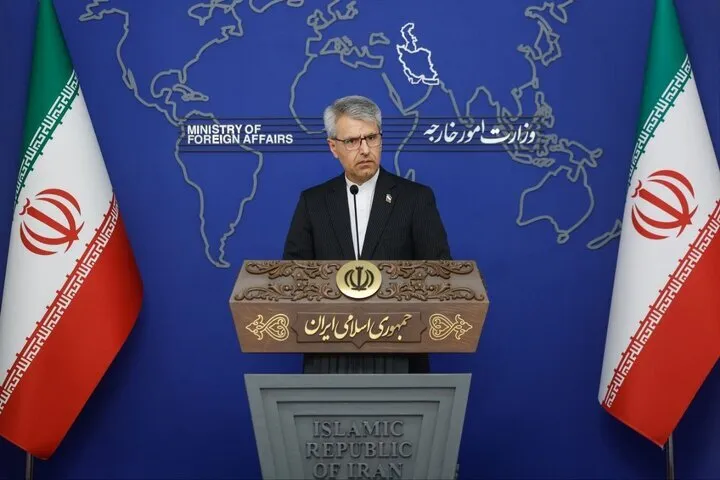
Tehran - BORNA - Responding to a question regarding American claims that Iran has lost its leverage over the Strait of Hormuz and that the US now controls the strategic waterway, the spokesperson said: "The Americans' claims in this regard bear no resemblance to what we are witnessing on the ground."
"They can say Iran has lost its leverage, but we continue our work. I do not think financial markets pay any attention or give any weight to such claims made by the Americans, as we see the Americans themselves resorting to other countries to secure fuel, which speaks volumes about the situation," he added.
Stating that the events unfolding in the Strait of Hormuz were not intended for creating leverage, Baghaei continued: "What we have been witnessing in the Strait of Hormuz since February 28 is the result of US and Israeli actions. As long as the US insists on making this waterway insecure through economic blockades and naval warfare, security will not return to this strait."
"We are not pleased with this situation, as the security of the Strait of Hormuz is necessary for us more than anything else. However, through its aggressive actions, the US has created trouble for itself, the region, and the world," he emphasized.
Responding to a question regarding Sunday night's phone conversation between the Iranian and Saudi foreign ministers amid escalating tensions between Yemen and Saudi Arabia—and a Wall Street Journal report claiming the Saudi Crown Prince supports maintaining diplomatic channels while backing increased economic pressure on Iran—Baghaei stated: "It is natural for the media to have their own analyses."
Readiness to resolve Saudi-Yemen tensions
"This conversation was part of the ongoing consultations Iran holds with regional countries," he noted. "We are deeply concerned about the events occurring in the Arabian Peninsula. We have repeatedly declared our readiness to assist, resolve this issue, and facilitate dialogue between the parties, as we believe the continuation and escalation of tensions between two Islamic countries solely benefits the Zionist regime. We do not accept the existence of conflict and tension between two Islamic nations; on the other hand, our region is already tense enough due to the actions of the Zionist regime and the US."
Baghaei stressed that the Yemeni people have the right to a dignified life free from siege and pressure.
"During last night's call, we announced our readiness to help resolve this tension through dialogue," the diplomat pointed out.
Rubio's Athens speech was a cognitive war against Iran
When asked about the controversial speech delivered by US Secretary of State Marco Rubio in Athens concerning the history of Iran and its contemporary significance, Baghaei described the speech and its setting as "part of a cognitive war against Iran and perhaps the world."
"Presenting a completely distorted and inverted interpretation of historical events to justify US warmongering is both dangerous and an injustice to Greek culture and civilization. Of course, inadvertently, the US Secretary of State confessed to certain realities; that Iran has endured for thousands of years not merely as a piece of land and geography, but as a character, concept, and idea. The continuity of a civilization and culture certainly cannot be achieved through geographical and military conquests. The secret to Iran's survival and continuity is nothing but its interactivity and mutual engagement," he elaborated.
"If you look at Pasargadae, the symbols of all the cultures and civilizations that were Iran's rivals at the time are visible," Baghaei added. "Iranians have always been competitive but through interaction. We have never sought our power and survival in the negation of others. We even interacted with our rivals. The West today would fundamentally and intellectually not exist if Iranian and Muslim scholars had not served as translators and interpreters of Greek ideas during the dark Middle Ages."
He questioned: "What connection does today's America have with Greece? A Greece that was not only about war and warfare but possessed philosophy and culture. Iranian civilization has always been established and sustained through connecting and building. Our Khwaja Hafez Shirazi is one of the civilizational honors of Iran. I ask Mr. Rubio's advisors to present him with a volume of Hafez's poetry—surely translated into Cuban Spanish—so he can become acquainted with the gentleness of Iranian civilization and culture."
Expressing hope that this narrative would not be repeated, Baghaei said: "In an era where the world is facing US belligerence, speaking of ideological and civilizational binaries is a sheer mistake. Framing ideas based on a clash of civilizations in another way certainly harbors no good intentions other than legitimizing war and aggression."
"America cannot present itself as the representative of Western and Greek civilization," he added. "Were the two World Wars that occurred among Europeans and engulfed the world the result of a clash between Eastern and Western civilizations? Was colonialism the result of a conflict between East and West? Are the crimes of the past three years the result of an Iran-US confrontation? Was America's own war of independence against Iranian and Persian civilization, or against Britain?"
The Foreign Ministry spokesperson clarified: "Those who wrote the US Secretary of State's speech were aware of these contradictions but deliberately ignored them, purely to justify aggression and violence. European countries and those who consider themselves the heirs to Western and Greek civilization certainly have a duty to clarify their positions. What does it mean when the US simultaneously gives its aggression against Iran a civilizational cover while launching an unprecedented assault on the institutional frameworks established after World War II? These are questions that everyone and Western parties must answer."
Still reviewing US points; message exchange via intermediaries continues
Regarding the latest status of message exchanges between Iran and the US, and recent remarks by SNSC Secretary Mohsen Rezaei stating that the US has accepted some of Iran's seven conditions but Tehran considers the response insufficient, Baghaei said: "The exchange of messages through intermediaries between Iran and the US continues. What was raised on the sidelines of the UN General Assembly and became known as 'Iran's seven-day plan' was a demand for Iran's legitimate rights. Much has been said about it. These seven points include lifting the naval blockade, halting the war on all fronts, releasing Iran's assets, and, in short, everything we had agreed upon in the memorandum of understanding."
"These are issues that will be raised as Iran's rights in any negotiation," Baghaei asserted. "Circumstances have not changed for us to show flexibility regarding our rights. Moreover, during this time, the US has imposed new sanctions, and naturally, all these sanctions must be lifted. The American side has also previously stated its demands. Their claim is that their main concern remains Iran's nuclear issue. Setting aside the massive contradiction—since they have announced several times that they have completely destroyed Iran's nuclear program yet still raise the illusory threat of an Iranian nuclear weapon—they have expressed their considerations in this regard. The point raised that their response was insufficient or that we have declared our positions is a correct observation."
The spokesperson elaborated: "Our stance, that in the current situation we must prioritize ending the interventionist and aggressive actions of the US, is focused and nothing new. We have said this before; the American parties were informed through intermediaries, and we explicitly stated it. However, we are currently reviewing the points they have raised, and as soon as our reviews are complete, we will reflect them back to the intermediaries."
Answering a question about Saudi attacks on Yemen, Baghaei reminded: "The Yemen issue should have been resolved much earlier through the very agreement reached between the Yemenis and Saudi Arabia. You know a roadmap between Yemen and Saudi Arabia had been agreed upon, and we had emphasized to the parties that we support whatever was mutually agreed between you and stress its implementation, but this did not happen."
He continued: "If you recall, an attack on Sanaa airport took place on July 13 of this year, and at that time we expressed our deep concern that this incident might escalate the situation, and now we are unfortunately witnessing this reality. Our request is that this situation truly be resolved through dialogue and interaction, as such a situation is certainly not in the best interest of the Islamic Ummah and our region."
Regarding the phone call between Putin and Trump following the meeting between the Iranian and Russian presidents, and speculations about Russian mediation between Iran and the US, the spokesman noted: "Our consultations with Russia on various issues, including the nuclear issue, are not new. Russia played a very positive and effective role during the 2015 nuclear understanding and maintains its interest in resolving the issue. The relationship based on mutual trust is also one of the existing assets between the two countries, and both sides insist on preserving this good relationship. During the conversation between the two presidents on the sidelines of the summit in Ashgabat, Turkmenistan, our president clearly articulated our positions and once again explained Iran's seven-day plan as well as the considerations and points regarding the entirety of the issue. Given that the Russian president was apparently scheduled to have a phone call with his American counterpart, this conversation took place beforehand, but it was solely an expression of positions."
Pakistan and Qatar continue to act as mediators
"We have always welcomed the good offices of friendly countries, but technically and in the strict sense of the word, Pakistan and Qatar continue to act as mediators between Iran and the US," he added.
If the Strait of Hormuz issue is solved, why did the US reach out to Russia?
Asked about Iran's stance on Putin's stated readiness to supply oil and petroleum products to global markets, particularly the US market, Baghaei replied: "Every country can make decisions based on its own issues and interests. Naturally, we too, as the Islamic Republic of Iran, make decisions on any subject based on our own priorities and interests."
"However, this issue is interesting to me," he pointed out. "If, according to the Americans, there is no problem in the Strait of Hormuz and the issue has been resolved, how is it that the American side has to reach out to Russia to solve part of its problems?"
Land lease to Afghanistan for trade access under review
Addressing rumors regarding the allocation of 110 hectares of Iranian land to Afghanistan, Baghaei clarified: "It was an obvious misunderstanding derived from the remarks of a respected Member of Parliament. It is very clear that ceding territory and land is impossible. What was discussed is a practice utilized all over the world. We have utilized this option and will do so in the future; namely, providing facilities in the form of a lease to landlocked countries without access to open waters, aiming to help enhance trade between the two countries and assist those nations in accessing ports and open waters for commercial exchanges within the framework of good neighborliness."
"This is actually a positive initiative. Regarding Afghanistan, of course, this issue has not been officially raised; it was mentioned on the margins of an official meeting during a minister's visit to Afghanistan, and we said we would review it. I emphasize that the debates and controversies raised about ceding territory have no basis whatsoever," he affirmed.
Responding to a question about Trump's behavior towards Ukrainian President Volodymyr Zelensky, the diplomat said: "I will answer this question with a quote from an American thinker named Henry Kissinger. I believe he said in the late 1960s: 'To be an enemy of America can be dangerous, but to be a friend is fatal.' You can see for yourselves what America's friendship and enmity with its friends looks like. The late Jafar Shahri [author of 'Old Tehran'] has a phrase that the kids of Naziabad [a neighborhood in Tehran] are familiar with, meaning 'some are like the dog of Naziabad'; now see what that implies."
We support strengthening ties with regional countries
On the Iraqi Prime Minister's visit to Saudi Arabia and its role in de-escalating regional tensions, Baghaei asserted: "We have always supported strengthening interaction and cooperation among regional countries. If you recall, a long time ago, we even proposed a joint meeting of Persian Gulf littoral states with the presence of Iran and Iraq, and I think one of them was held a year or two ago. We recently proposed a similar meeting, and arrangements were made for it to be held in Oman; but ultimately, others did not agree. We definitely support strengthening relations among regional countries."
"Strengthening relations and trust among regional countries is the foundation and prerequisite for creating a secure region, free from the destructive interference of foreign actors," he emphasized.
Every single Iranian is targeted by US malice
When asked about claims by US officials that sanctions do not target the Iranian people, the spokesperson stated: "If the Iranian people are not the target of the sanctions, then what is the target? Of course, the American parties even consider the soil, mountains, natural resources, and environment of Iran as their legitimate targets. I think it is blatant hypocrisy to say we have imposed the severest sanctions against Iran, but the target of these sanctions is not the Iranian people. Isn't depriving Iranians of medicine, of education, even of taking IELTS and TOEFL exams, against Iranians? Depriving Iranians of access to civil aviation facilities, which even contradicts the provisional order of the International Court of Justice in 2018, is against whom? These are justifications that American parties repeat, knowing they are lies. But the Iranian people themselves see that these sanctions, promoted under the watch of their Secretary of State 'Rubio', are certainly against them. A Secretary of State whose remarks in Greece are clear, introducing not just today's Iran, but civilizational Iran and the multi-millennial Iran as his adversary."
"Every single Iranian is certainly the target and subject of the American side's malice," Baghaei stressed.
Dismissing speculations surrounding the appointment of Iranian ambassadors and the UN representative, Baghaei announced: "This is not an issue that requires speculation. Very transparently, whenever we select new ambassadors, we announce it. Mr. Hamid Moradkhani has been appointed as Iran's new ambassador to Senegal; Mr. Reza Nourian to Uganda; Mr. Mahmoud Heidari, our Director General for Eastern Europe, to Greece; Mr. Ali Akbar Rezaei, our Director General for Strategic Affairs, to Rome, Italy; and Mr. Hamidreza Dehghani has been appointed as our new ambassador to the UAE."
When asked about his quick-witted response to a group of disruptors who tried to shout him down during his brief speech at the "Arash" play, Baghaei briefly deflected: "My quick wit is directed against Iran's enemies, not my compatriots. Let us move past this question."
Addressing Western concerns over the possibility of Iran leaving the Non-Proliferation Treaty (NPT), Baghaei remarked: "Why are they concerned? Their concern is meaningless; they created this concern themselves; 'you reap what you sow.' When you attack the peaceful nuclear facilities of a country that has been an NPT member since 1970 in less than nine months, the International Atomic Energy Agency shows no appropriate reaction, and the Security Council takes no action, and conversely, European countries and European members of the Board of Governors somehow endorse these actions—what concern is there left to have!"
"This logical question is raised in Iran, among elites, the people, and parliamentarians: what is the benefit of membership in such a document? This should be answered by those who themselves caused the foundations of the non-proliferation regime to weaken; not just in Iran, but what they have done has raised the debate in the whole region and globally as to whether the non-proliferation regime truly guarantees nuclear non-proliferation. The non-proliferation regime had three philosophies: nuclear disarmament, preventing proliferation, and, what is important to us, guaranteeing countries' enjoyment of nuclear energy for peaceful purposes. This regime has faced problems in all three areas, and not by us, but by those who were the custodians of this institution. Consider the remarks of French officials. They proudly test a new nuclear weapon and say if you want to keep your freedom, you must be frightening. You cannot send such a message to the world on the one hand and then be concerned that the usefulness of continuing in the NPT is being debated in Iran."
He added: "Certainly, in our society, as a pluralistic society with a free press and an intelligent population that has closely monitored the developments of the past two years, these issues are discussed. These facts must really be rubbed in their faces: the crime that occurred, a Leader who held a fatwa banning nuclear weapons—and this was not just a political official's fatwa, it was the fatwa of a high-ranking religious authority. You assassinated the author of the fatwa, and then you say you are concerned why the topic of nuclear weapons is being discussed in Iran? 'We are concerned.' Well, their concern is unwarranted, because they themselves caused it."
We will never run away from the negotiation table
Asked whether the Americans have returned to square one by raising nuclear issues, Baghaei stated: "We will never return to square one. Is it possible to ignore the experiences of the past two years and then say we have returned to square one? With every passing day, we certainly utilize its experience; both in terms of strengthening our own capabilities and learning from the broken promises of the other side. We have enough self-confidence that we will never run away from the negotiation and diplomacy table. For us, diplomacy is as important as the battlefield and war. We will certainly use the tool of diplomacy, wherever necessary and appropriate, to secure our interests. But let us not forget that Iran by no means deserves blame. Let us not forget that Iran participated in all diplomatic processes in good faith. The party that should be exclusively blamed for this situation and must be held accountable is the party that destroyed the negotiation table in the middle of talks and still insists on its previous excessive demands. How can they claim to seek negotiation and diplomacy while intensifying the economic war, effectively maintaining a state of war, and then claiming they seek negotiation? Therefore, we must truly analyze these claims within the practical conditions and the reality we find ourselves in."
Responding to a question regarding the UN Secretary-General and European double standards—condemning an attack on a Saudi airport while ignoring the destruction in Gaza and the targeting of Iranian infrastructure—Baghaei expressed regret: "This is not the first time we are witnessing double standards regarding international issues, especially concerning violations of international humanitarian law and human rights. It is regrettable that international officials, particularly the UN Secretary-General or senior officials of other international bodies—who themselves believe that the minimum tool they possess is their voice—use this voice selectively. But its consequences will entangle everyone. If you act unilaterally and selectively against lawbreaking and violations of international law, you have merely encouraged lawlessness. Just as we have witnessed an overt genocide in Gaza over the past three years that was ignored by European parties and the UN. The result has been the spread of fire and warmongering in the world. Even those observing the fire from afar will not be warmed by it, but will have their hands burned."
Addressing the violent treatment of students by French police, Baghaei confirmed that Tehran had conveyed its concerns to Paris: "We stated our positions very explicitly. Through the French Embassy in Tehran, via a summoning session conducted by our human rights department, the Islamic Republic of Iran's deep concern over the gross and widespread human rights violations by the French government was communicated to them. The French government must seriously address the issue of the 5,000 to 6,000 individuals it has detained, as well as the disproportionate force used against its citizens, students, and the presence of armed police forces in classrooms. Human rights institutions have also explicitly stated their positions on this matter."
Commenting on reported tensions between the UK and the Zionist regime over Gaza and West Bank settlements, Baghaei said: "They are not old allies; they are more like a father and child. Of course, it is good that sometimes a father has the audacity to discipline a spoiled child, but the reality is that British support for the regime over the past 80 years has been one of the factors emboldening this regime to commit crimes. Some seemingly symbolic actions cannot be very effective in holding the regime accountable and preventing crimes. However, we hope European governments will pay more attention to public and popular demands."
Refuting the media narrative that portrays Iran as the cause of global economic escalation and commodity shortages, the spokesperson noted: "We realize an active media campaign is underway trying to reverse cause and effect. The reality is completely clear. Before February 28, the Strait of Hormuz was open. Everything we are witnessing today in the region regarding maritime insecurity in the Strait of Hormuz and its economic consequences for the region and the world stems from the actions of the US and the Zionist regime. If the concerned governments are truly serious in their concern, they must address the party responsible for this situation and use every opportunity to force the US to stop its ongoing aggressive actions."
Highlighting the recent Iranian Cultural Week in Russia, Baghaei stated: "Cultural cooperation between Iran and Russia is both a sign of the depth and breadth of good relations between the two countries and can mutually pave the way for strengthening relations in all areas, including political, economic, and commercial sectors."
He described it as one of the most magnificent Iranian cultural events in recent years, held across four Russian cities. Baghaei thanked the Russian hosts in Moscow, St. Petersburg, Kazan, and Astrakhan for facilitating the events.
Terrorist movements on eastern borders closely monitored
When asked about reports suggesting the UAE is supporting terrorist groups in eastern Iran to destabilize the borders, Baghaei asserted: "Certainly, the movements carried out by terrorist groups in the east of the country and elsewhere are carefully monitored by our security, military, and law enforcement authorities, and these terrorist acts are dealt with authoritatively."
"Destabilizing the country's borders is part of the evil US and Israeli plot against Iran, and this is no secret; they themselves have admitted to it," he added. "We are in continuous consultation with regional countries, and they know very well that any insecurity in one region causes insecurity to spill over into other areas. I do not have any specific country in mind here, but as I said, we interact with neighboring countries, both maritime and land-based, to prevent the activities of terrorist groups following the situation the US and Israel have created in the region."
On President Pezeshkian's participation in the CIS Summit, the diplomat noted it was the first time the Iranian president attended as a special guest. "This opportunity was used to present Iran's proposed plan to hold meetings in a 'CIS plus one' format—meaning Iran. This proposal aligns with the Islamic Republic of Iran's efforts to strengthen relations with this bloc."
Responding to US Treasury remarks about seeking a land blockade on Iran's borders following an aerial blockade, Baghaei remarked: "Their malice in trying to harm the Iranian people is nothing new. It has been 47 years; they themselves say 51 years, adding four more. Mr. Rubio even announced the conflict goes back 2,500 years. What do you expect from an enemy? We expect from ourselves. One of the dialogues in the 'Arash' play says, 'We will defeat defeat.' And somewhere Piran advises Afrasiab that Iranians cannot be defeated in times of hardship, because Iranians become more united and cohesive. This is the Iranian spirit. Aside from the fact that they were not successful in advancing their evil goals, one clear reason is that countries have rightly realized that US actions and demands are both illegal and disrupt the fundamental principles of international relations. They know America has no rules or laws in its relations with countries. The recent treatment of Ukraine is our case in point."
Addressing remarks by the SNSC Secretary that US CENTCOM, accompanied by the UAE, is smuggling fuel in the Strait of Hormuz, Baghaei confirmed: "There is no doubt that the US has abused the Strait of Hormuz both to plan and prepare military actions against Iran and for what is termed illegal passage or fuel smuggling. Fundamentally, one of the reasons the June 18 memorandum encountered problems was America's breach of promise. From the very first days, the Americans started using insecure routes, and the situation we face is the result of US treaty violations. The Strait of Hormuz is under the surveillance of Iran's powerful armed forces, and whenever necessary, they will take the required actions to protect Iran's national interests and security."
Cairo agreement is currently part of history
Regarding reports that the "Cairo agreement" is being floated to break the diplomatic deadlock, the spokesman clarified: "The Cairo agreement is currently part of history. The opposing sides truly did not appreciate that opportunity. That agreement was aimed at preventing the snapback, and prior to that, an understanding had been reached among the three European countries that this would not happen, but they ruined this opportunity themselves. Regarding the details of the negotiations, we are not currently at a stage where we want to discuss those debates."
Asked about the US launching a new campaign against the International Criminal Court (ICC) and threatening to destroy it just hours after Navi Pillay was awarded the Nobel Prize, Baghaei stated: "The Islamic Republic of Iran is not a member of the International Criminal Court; we have signed the statute of this court and, as a signatory, we adhere to it within the scope of our obligations."
"Member states of the court must also answer this question: Are they truly aligning themselves with a party that only two days ago in Greece presented itself as the representative of Western civilization, and hours later threatened to destroy the very international institution that safeguards international norms and law and seeks to prosecute international crimes, including genocide? If such institutions are destroyed, nothing will remain but naked, irresponsible power. Indeed, the central concept of what the US Secretary of State promoted in Greece is this irresponsible power; a power with no constraints, able to commit and continue committing crimes without fear of international prosecution or global demands for justice."
Finally, reacting to the French Embassy claiming the Iranian Foreign Ministry's accounts publish fake news about French student protests, and the French envoy referring him to Hafez's Sonnet 378, Baghaei once again consulted Hafez, reciting Sonnet 159 to the applause of the audience:
"Not every Sufi's coin is pure and unalloyed; / Many a cloak is worthy of the fire. / Happy is the day when the touchstone of experience is applied / So that whoever has an alloy will be disgraced."
End Article