Baghaei: US maximalism is the main obstacle to Iran-US talks
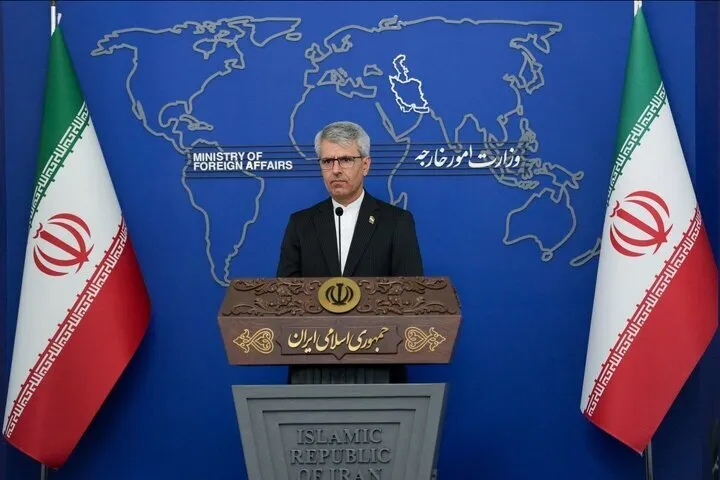
Tehran - BORNA - Speaking at his weekly press conference attended by domestic and foreign reporters, Baghaei began by honoring Afsaneh Aghila and Nosrat Eftekhari, the two martyrs of recent terrorist incidents in Sistan and Baluchestan.
Referring to diplomatic consultations over the past two weeks, including the president's trips, Baghaei addressed regional issues: "The crimes of the Israeli regime in Palestine continue, genocide in Gaza has not stopped, and the main cause of problems in our region is the occupation of Palestine and the expansionism of the Israeli regime, which is accompanied by US support."
He also noted the annual meeting of the Organization of Islamic Cooperation (OIC) in Baghdad and Araghchi's participation, saying: "The basis for the formation of this organization was the defense of Palestine, and the recent meeting was important in the same framework."
'We have fundamentally not had nuclear negotiations with America'
Asked about the goals of Lavrov's visit to Tehran and rumors that enrichment and enriched material would be discussed — and whether Iran had retreated from its principled position on the nuclear issue — Baghaei said: "No. We have certainly not moved past our principled positions, because these positions are in line with Iran's national interests."
Baghaei said Lavrov's visit took place within the framework of continuous consultations between the two countries and had been on the agenda for a long time.
He said Iran-Russia relations are at a good level across various fields, adding that in the meeting "our focus was on all issues that serve the national interests of both countries, and naturally we discussed regional issues — the Caucasus, Ukraine, the Persian Gulf and the Strait of Hormuz — and the nuclear issue was naturally one of these topics."
He continued: "All the speculation that had been raised beforehand about nuclear details being discussed was not correct and has no basis, because we have fundamentally not entered nuclear negotiations with the Americans for us to discuss their details with other parties."
The spokesman said: "Russia played an important role in the JCPOA negotiations and has always stated that it will do whatever it can to reduce tension, and we have thanked and appreciated this position."
New Foreign Ministry initiative for public questions at briefings
At the press conference, the Foreign Ministry unveiled a new initiative for the public to submit questions to the spokesman. Under the initiative, the ministry's Public Diplomacy Center announced the launch of "Ask the Spokesman" on the Rubika messaging app, saying the most frequently asked questions would be put to the spokesman.
For today's session, Baghaei answered the public question: "Given America's treaty-breaking, why insist on negotiating with this country, and what is the benefit of negotiation? What path is the Foreign Ministry pursuing in parallel to end the war and bring calm to the region?"
He said: "We insist on nothing except securing Iran's national interests. What is fundamental for us is safeguarding Iran's interests and national security. Our concern is Iran — whether through diplomacy or defense. America's record of treaty-breaking is clear; both in the past two years and since 2018, they constantly violated their commitments. But we, as the diplomatic apparatus, are not permitted to fall short in our duties merely because of past bitter experiences. We are obliged to use every tool to secure national interests. In this sense, diplomacy is part of defense and struggle. A distinction must be made between the battlefield and the diplomatic arena for realizing the rights of the Iranian nation. If we are negligent in advancing diplomacy, our people and public opinion will say you were not serious and you chose war. Therefore, if we see the slightest possibility that diplomacy can prevent an escalation of tension, we must certainly take that path."
'We do not leave any blow unanswered'
Asked about reports claiming the Americans said they would strike Kuh-e Kolang and that Iran should not respond, Baghaei said: "Do you believe it? That the other side attacks and we stay silent and do not respond? Much earlier, the martyred Leader said, 'The era of hit-and-run is over.' If that was a declaration of position then, in these two years we have shown in practice that we absolutely do not leave any blow unanswered. If our blow is not harder, they will certainly be struck to the same extent. So this is among the fantasies they raised — nothing but a claim."
Iran-Pakistan border closure
An reporter asked: Several days ago, news spread of the suspension of activity at border crossings with Pakistan, but both Iran and the Pakistani side said the situation was due to technical and tactical issues and would soon be resolved. Several days later, the border has still not reopened. We know Iran-Pakistan political and diplomatic relations are at their peak, and Iran has accepted Pakistan as a mediator in the most important negotiations of its contemporary history. Despite some doubts raised about Pakistan's neutrality, the Iranian government has always defended Pakistan's mediating role. The question now is whether Pakistan is playing multiple games at once — on one hand seeking to enforce illegal and unjust US sanctions against a Muslim neighboring country, and on the other not wanting to be criticized by the Muslim people of Pakistan or by the Iranian government and people, and therefore saying the border is temporarily closed for technical reasons. What is the reality? Why is the border closed? Are you raising this in today's talks with Asim Munir?
The spokesman replied: "Let us not enter into judgment and intention-reading. What the Pakistani side has told us regarding the borders is that there are technical problems they are seeking to resolve. Of course, exports from our side continue; it was cut off unilaterally by them."
Baghaei said Iran-Pakistan relations are "distinguished" and both countries are determined to uphold this friendship, and that expanding relations in political and commercial fields serves both nations. "The leaders of both countries are steadfast in expanding relations. God willing, we will resolve this issue. Our Pakistani friends said from the beginning that there are technical issues they must resolve, and some technical delays are underway. We are following up through telephone contacts, and if Pakistani officials travel to Iran or we travel there, this will be among the priorities."
Good neighborliness with Persian Gulf states, on condition their territory is not used for aggression
On claims against Iran in the final statement of the Persian Gulf Cooperation Council meeting in Manama, Baghaei said: "Our expectation is that Persian Gulf officials reflect a little more on their remarks. We have been through a very bitter experience. Repeating propositions they have stated many times, and which they know reflect neither good will nor good neighborliness, does not help build trust between Iran and the Persian Gulf states. Iran has acted magnanimously regarding what happened."
He added: "We know, and they know, that their territory and facilities were used or misused for military aggression against Iran. This is a confession by the aggressor — America — at the highest level, naming the Persian Gulf states and praising them for playing a fundamental role in the US and Israeli military aggression against Iran. Conceptualizing Iran's defense and defensive strikes against bases and facilities used against our country as 'Iranian military aggression' will have no effect in reality. We repeat that we believe in good neighborliness with the Persian Gulf states, but its condition is that their facilities and territory not be used for aggression against a Muslim neighboring country."
Regional states must reach a reliable security mechanism away from foreign pressure
Asked about Russia's idea regarding the participation of regional states, and even the Security Council, in securing the Persian Gulf and the Strait of Hormuz, Baghaei said: "This discussion was cut up in the media. What Russia raised was that Iran, Russia and China proposed plans for collective and endogenous security in the Persian Gulf region, and Russia is pursuing the matter. Russia had previously proposed ideas on strengthening mechanisms for collective security in the region. The principle that the region must rely on regional states to secure itself — and not on actors that have shown they place no value on the real security of regional states and whose only concern is securing the security of an aggressor and expansionist party — is something we endorse. But realizing this requires that regional states begin a confidence-building process and, away from foreign pressure and foreign influence, reach a reliable mechanism themselves."
He continued: "Our demand from regional states is that if they are serious about creating a regional security mechanism, the first step is to prevent parties outside their territory from misusing it to threaten and attack other countries. They must prevent misuse by parties outside the region. This is the key principle. The requirement of the principle of good neighborliness among states is respect for each other's sovereignty and territorial integrity. In a situation where these states host an aggressor, where they host a party that has practically misused their soil and military bases against another country, we cannot speak of good neighborliness."
'We blocked two paragraphs on Yemen in the Baghdad final statement'
Asked about the OIC foreign ministers' resolution titled solidarity with Saudi Arabia against Houthi attacks, and Iran's position given Araghchi's remarks on the sidelines of the Baghdad meeting emphasizing reservation and even opposition, Baghaei said: "A resolution must be distinguished from the Baghdad statement."
He continued: "The most important outcome of the OIC Council of Foreign Ministers meeting in Baghdad is the final statement, which is usually adopted by consensus. What was raised about an hour or two before the statement's adoption was that nothing should be included in the text that would cause division among Islamic countries. Specifically, this meant the Yemen issue."
He added: "Labeling part of the Islamic community in an Islamic meeting contradicts the philosophy of the OIC's establishment and the ideal of Islamic unity and cohesion. We emphasized this repeatedly, and in the end we blocked the inclusion of two specific paragraphs on Yemen — paragraphs whose language we believed was absolutely not in the interests of the Islamic ummah."
Baghaei noted: "We have repeatedly emphasized that the Yemen issue must be resolved through dialogue and reconciliation between Saudi Arabia and Yemen. The Yemeni people have been under an illegal and inhumane blockade for more than a decade, and the Yemen issue cannot be resolved by resorting to force and military means."
He continued: "Regarding the resolution you mentioned, we declared our opposition, because its content, as I explained, was absolutely not in the interests of the Islamic ummah. Moreover, the organization's procedures and rules of procedure were not observed. Such resolutions must be discussed in advance, but this was raised on the second day during the meeting."
He added: "They expected it to be adopted by consensus, which was not possible. We declared our opposition, and in our view this resolution is not considered an outcome of the organization, because the OIC's rules of procedure were not observed regarding it."
Republishing Qatar's position on Iran's strikes 'no cause for complaint'
Asked about Qatar's position on Iran's defensive strikes against US bases, and Doha's accusation that Iran acted "selectively," Baghaei said: "We have good dealings with Qatar. Our acting selectively is itself a sign of good will. We did nothing wrong by highlighting a position the Qataris stated honestly. The Qataris had stated in an official document that Iran's defensive strikes were solely against military targets and US military bases. They should be pleased that they themselves stated this, and that instead of highlighting some unfair accusations, we selected and presented an honest and true statement. I do not think this is cause for complaint."
Hope hijab issue in Azerbaijan resolved with respect for fundamental rights
Asked about Iran's position on hijab restrictions imposed in Azerbaijan and why Tehran has not announced an official stance, Baghaei said: "The people of Azerbaijan are a dignified and perceptive people, and regarding the protection of their beliefs and convictions — including the hijab, which matters both to us and to the people of Azerbaijan and other Muslims — they themselves determine how best to convey their voice to their government, taking their country's interests into account."
He added: "We hope that in a country with which we have good relations, and where the bonds of brotherhood and affection between the two countries need no explanation, this issue will be resolved in an atmosphere based on understanding, with consideration for shared values and respect for the fundamental rights of the people."
'We have supported Iraq's proposal for a joint meeting'
Asked about Iraq's initiative to hold a joint meeting between Iran and Persian Gulf states, and Tehran's readiness to operationalize it, Baghaei said: "We have always been ready for dialogue and engagement with regional countries. The latest case was the proposal to hold a meeting in Salalah, Oman, which others prevented at the last moment. We have been steadfast in our position. The proposal to hold a joint meeting of Persian Gulf states plus Iran and Iraq has been on the table for a long time. One instance was held on the sidelines of a UN General Assembly meeting. Our Iraqi friends have always pursued this idea and we have supported it. We still believe it is a good proposal and, in general, we support any step or proposal that strengthens trust among regional countries."
Yemen must be resolved through dialogue and a roadmap
Asked about reports that Egypt might provide military support to Saudi Arabia in the Yemen war, and whether this was discussed in the Baghdad talks between Iranian and Egyptian foreign ministers and whether Iran's views were conveyed to Cairo, Baghaei said: "The Yemen issue was among the topics raised in discussions with the foreign ministers of Islamic countries and the new OIC secretary-general in Baghdad."
He added: "Security and stability in the Arabian Peninsula are important to us and naturally to regional countries, and we do not consider any further intervention to be in the interest of security and stability in the region; it only complicates the situation further."
Baghaei continued: "We emphasize that the Yemen issue must be resolved through dialogue and the implementation of a roadmap."
He added: "In the conversation Mr. Araghchi had with his Egyptian counterpart, he presented Iran's positions, and we emphasized that any further intervention by Islamic countries in this crisis will not only fail to improve the situation but will make it more difficult."
US maximalism is the main obstacle to Iran-US talks
Asked "What is the main obstacle to progress in Iran-US negotiations?" Baghaei said: "America's maximalism."
Asked about Hebrew-language reports that Israeli officials have discussed the possibility of war against Iran in meetings with regional parties, and Iran's position, Baghaei said: "We live with this possibility and face it day and night. Right now, as I speak with you, we are not in a state of peace. When our naval blockade continues and the Iranian nation is threatened, naturally we are obliged to consider every possibility at every moment. But we are at ease that Iran's defenders, having learned from the experiences of the past two years, relying on God and on popular support, are ready to repel any mischief by aggressors."
'We will not participate in the upcoming Asia-Pacific cooperation summit'
Asked whether Iran will participate in the upcoming Asia-Pacific cooperation summit and whether talks with the American side will be held on its sidelines, Baghaei said: "Why should we participate in this summit? As far as I know, we are not a member of this organization at all."
'We are rooted in the region; we do not need force for dominance'
Asked whether Iran seeks hegemony in the region, and if not, how to answer some Arab countries' claims that Iran would attack them if not weakened, Baghaei said: "It is as clear as day that Iran has never sought dominance in the region. Look at where the word hegemony entered the region's discourse. As a country rooted here, we have no need to use force to dominate other countries. Iran's approach has always been based on cooperation and engagement. We believe that no party in the region can or should move toward becoming a hegemon — meaning dominating other countries through bullying. We do not endorse such a path at all. If Iran is determined in defending itself and acts seriously in responding to foreign military aggression, this does not mean Iran dreams of dominating the region."
He added: "The only party in our region seeking expansionism and not even hiding it, speaking of a 'Greater Israel,' is the Israeli regime — and the reason is fear. A party with no roots here that seeks, through force, genocide and killing, to make the entire region submit to it. We advise regional countries not to be overwhelmed or defeated by false addresses. Iran is a friend to all countries in the region."
'Macron is projecting; we have not forgotten the famous US-French presidents' text'
Asked about Macron's statement that the main cause of French protests is the war against Iran and the Strait of Hormuz situation, Baghaei said: "This appears to be a kind of projection. In any case, they must manage their own affairs. But one reality is embedded in this statement: 'This world is a mountain, and our deeds are the echo.' What they have done, or failed to do, they must accept the consequences of. France, as a permanent member of the Security Council and a UN member, was obligated under international law to take a position against the overt US and Israeli military aggression against Iran, but unfortunately we saw this country and some other European countries openly or implicitly support this action. We have not forgotten the famous message or text exchanged between the US and French presidents — that we can do great things regarding Iran. From that time, it was interpreted that France was aware of the American and Israeli design to attack Iran. If they are sincere in saying that France's and other European countries' internal problems stem from fuel price increases, and the reason for fuel price increases is the crisis in the Persian Gulf and the Strait of Hormuz, then they bear responsibility to solve the problem at its root."
He continued: "The problem is the US and Israeli military aggression against Iran and the continuation of the naval blockade against Iran. You must see cause and effect precisely. Let us know that this is part of the law of creation: you cannot be indifferent to an injustice and an oppression, or help it, and remain safe from its consequences."
Russia's meeting with the GCC had no joint statement
Asked about negative points against Iran in the final statement of the meeting of Russian and GCC foreign ministers, and whether Iran raised an objection in yesterday's meetings with Russian counterparts, Baghaei said: "This was one of the news fabrications. Fundamentally, the meeting of the Russian foreign minister with GCC ministers had no joint statement. The statement being discussed is the GCC countries' own statement, in which points about Iran were raised, and I have responded to them here."
UN must act to prevent US destabilizing behavior in the region
Asked about UN officials' calls for Iran to avoid disrupting agricultural inputs and the food production chain, and to allow ships carrying such data-x-items to pass through the Strait of Hormuz — and whether Iran agrees — Baghaei said: "Such discussions have been raised for a long time. We have always supported humanitarian issues and have tried to help with the transfer of cargo that is humanitarian in nature."
He added: "But the problem must be solved at its root. The problem of insecurity in the Strait of Hormuz has a clear cause: the continuation of America's interventionist and aggressive actions. The UN, as an organization with a very clear responsibility to safeguard international peace and security and its various components, must — if it wants the matter resolved fundamentally — help deter America from continuing its destabilizing actions in the Strait of Hormuz and the Persian Gulf."
European countries now see the consequences of appeasing America in their streets
Asked about growing differences between Trump and Zelensky, the state of US relations with allies, and developments in the Ukraine war, Baghaei said: "America seems to have really fallen into a kind of confusion. America has entangled itself in military aggression in our region, while its interventions in other parts of the world have reached their highest level in decades. What America is doing in Latin America is by no means in line with international peace and security."
Baghaei added: "European countries now see the consequences of the policy of appeasing America — appeasement — in their own streets and are paying the price. What is happening in European capitals, by their own account, stems from public dissatisfaction with the fuel situation and daily problems. One reason for this situation is these very American policies at the global level."
He expressed hope that these developments would awaken countries to realize that by accompanying and colluding with a party that places no value on international norms, they cannot secure even peace and security in their own home.
America is a threat to the UN and all institutions created after World War II
Asked about recent remarks by US Secretary of State Marco Rubio that American interests take priority over UN interests and the global order in the Trump administration's foreign policy, and how sincere he is about the interests of the American people given that a significant part of US public opinion opposes the war against Iran, Baghaei said: "I think the American people expressed their views very quickly."
He added: "In the marches they hold under the title 'No to the King,' they declared that they are by no means satisfied that American money, resources and lives be spent on an aggressive war that serves solely the ambitions and expansionism of a genocidal regime in our region."
Referring to US officials' remarks dismissing international norms and institutions, Baghaei said: "These remarks are another example of the threat America poses to the United Nations and all mechanisms created after World War II."
The spokesman continued: "The sanctions on international judges of criminal courts and the actions America has taken regarding many international organizations, including the United Nations, clearly show this country's highly destructive approach to issues of international peace and security."
He stressed: "This very fact requires that countries work within multilateral frameworks to confront a trend that was also raised yesterday in the foreign minister's remarks — namely, America's aggressive or belligerent unilateralism, which threatens the entirety of international peace and security."
We have had engagement on eastern border security with Afghanistan and Pakistan
Asked whether continued clashes between the Taliban and Pakistan could lead to other dimensions, including spillover insecurity and new migration waves toward Iran, and given recent insecurity in Sistan and Baluchestan, what steps Iran will take to prevent the crisis spilling into the country's east and to address possible migration, Baghaei said: "This is a somewhat long-standing issue. The question of eastern border security is not a matter of yesterday and today; it has always been one of the data-x-items on our agenda — both in engagement with Afghanistan and in our engagement with Pakistan."
He added: "All three countries know well that security is a shared and at the same time precious commodity, and that any laxity or complacency in dealing with security problems on either side of the border can cause insecurity to spread to the other side. This shared understanding, in my view, is very important."
Baghaei stressed that Iran pays attention to this in every conversation with Pakistani or Afghan officials, and that good measures have been devised.
He added: "We hope that joint cooperation on counter-terrorism will, God willing, prevent any destabilizing and terrorist actions in each country."
'If your rivals are busy making a mistake, do not stop them'
Asked about Qatar's Foreign Ministry spokesman recently saying the world may now be in the first year of a third world war, and the Emir of Qatar earlier saying Qataris should prepare for any scenario — and whether, given Qatar's role as a mediator between Iran and the US, these remarks might stem from Qatari knowledge of failed negotiations — Baghaei said: "I admit I do not possess the power of prophecy, but we have passed at least eight months of this third imposed war with pride and steadfastness, and we have past experiences before our eyes."
He said Iran is ready for any eventuality and must be: "Regardless of the guesses anyone may make about future developments, what matters is that we be ready in all dimensions to defend our country."
Asked about a prevailing analysis that China and, secondarily, Russia are the main winners of the two years of imposed wars against Iran, since Middle East wars have drained US energy and capacity, while China carefully observes US strengths and weaknesses and is more ready than ever to challenge the US over Taiwan — and that as America rapidly loses credibility as a treaty-breaker, China gains credibility as a responsible country in the Global South — and whether this was discussed in consultations with China and whether China has a serious motive and drive to reduce tension in the region, Baghaei said: "It is natural for countries to pursue their own interests. There is a piece of advice that says: 'If your rivals are busy making a mistake, do not stop them at all.'"
We are looking into 19 Iranian tankers stuck in Sri Lankan waters
Asked about reports that 19 Iranian tankers are stuck in waters near Sri Lanka due to the naval blockade, and claims that the Sri Lankan government has refused to help them, Baghaei said: "I need to look into this matter."
He added: "Regarding Sri Lanka, our relations with this country are good. Regarding matters related to the Dena destroyer, they cooperated appropriately; let us not forget this."
Baghaei told the reporter: "But regarding your specific question, I must look into it and see what the story was."
Asim Munir's visit to Iran is planned
Asked about Pakistani army chief Asim Munir's visit to Iran and whether he is coming with a political proposal or carrying a threat of military action, Baghaei said: "He must come and we will speak with him to see what topic is going to be discussed."
He added: "Overall, a visit is planned; of course, as of this moment that I am speaking with you, I do not think he is in Iran."
Baghaei noted the exchanges between Iran and Pakistan at various levels: "We have very many exchanges with Pakistan at different levels. I said earlier that our relations with Pakistan are very important and distinguished."
The spokesman continued: "Part of these exchanges is devoted to negotiation-related matters, but they are mainly focused on bilateral relations and strengthening interactions and cooperation."
Washington's message on Iran's 7-day plan was insufficient and incomplete
Asked about Araghchi's remarks to reporters at the OIC that Iran's seven-day plan previously sent to America is still on the table and Tehran awaits Washington's response, while Trump continues to support Netanyahu and has shown no clear reaction to the plan — whether Iran-US talks are still ongoing and what Washington's latest official response has been, Baghaei said: "Contradictory statements by American officials are nothing new. What matters to us is that both the world and our own people saw that we, in good faith, conveyed what was necessary and what we believed served the country's interests, in very clear formats, through the Qatari mediator to the American side."
He said "the limits of our positions, demands and requests are clear," adding: "The message received from the other side was insufficient and incomplete. We stated our positions. We continue on this same basis and on the basis of these seven demands, sometimes referred to as seven conditions."
He stressed: "These seven demands are nothing strange or extraordinary; they are data-x-items already included in the 28 Khordad understanding, and by any reckoning and calculation, they are Iran's legitimate and rightful demands. For example, lifting the naval blockade and stopping the war on all fronts is entirely logical and legitimate, and the American side must really decide on this."
Baghaei stated: "Various authorities have repeatedly emphasized that the Islamic Republic of Iran, while serious in advancing diplomacy to secure the country's interests and safeguard regional peace and security, is at the same time determined and steadfast in defending Iran's existence."
Iran's relations with Russia and China are based on mutual interests
Asked about Trump's remarks that Russia and China do not help Iran much and that their support is merely verbal, Baghaei said: "I am not going to comment here on the rhetoric of American officials regarding Iran's bilateral relations with its friends."
He added: "You cannot prevent American officials from talking about any subject; that is up to them. Sometimes let us leave them in their own illusions."
Baghaei stressed that Iran's relations with Russia and China are based on mutual interests: "What is certain is that Iran's relations with Russia and China are based on mutual interests. We are not naive and we know that all countries have their own interests. At the same time, we have defined our mutual interests with both Russia and China."
The spokesman continued: "The contracts and agreements we have with them are clear. Regardless of others' rhetoric, we are determined to advance our relations, God willing."
The perpetrator of a crime should not be the standard for describing it
Asked about the Pentagon's delay in releasing its internal report on the US crime in Minab, Baghaei said: "Investigations and delayed results should not be taken very seriously. Is the standard for describing a crime supposed to be the party that committed it? America did not commit crimes only in Minab, Lamerd and Sirik; all its military actions and attacks on Iran, in our view and under international law, are considered crimes, because they committed the crime of 'aggression.' But from an international perspective, the fact that they are not even willing to acknowledge, even verbally, that a specific crime — undoubtedly deliberate, calculated and aimed at creating maximum shock and terror in Iranians in the first hours of the war, to weaken our firm will to defend Iran — was a crime, shows that the other side is a law-breaker and places no value or dignity on the most elementary norms of international law."
He added: "Refraining from attacking civilians is a fundamental principle that the Westerners themselves emphasized, although the root of this principle goes back to Iranian and Islamic culture, in which respect for civilians in wartime is a given. But they codified these laws after the savagery witnessed during two imposed world wars. Yet the fact that they do not even submit to these laws is meaningful."
US military presence has caused insecurity and division in the region
Asked whether, given the US failure to support Arab states in the recent war, there is hope that regional countries will move toward Iran for regional convergence, Baghaei said: "We shall see."
He added: "We and the regional countries witnessed the reality that the US military presence in the region does not create security; on the contrary, it causes insecurity and division among regional countries."
Baghaei expressed hope that regional countries have learned a lesson in this regard.
The key indicator of good neighborliness is respect for sovereignty and territorial integrity
Asked about Iran's position on initiatives and proposals for new security arrangements in the region, and the Qatari Foreign Ministry's statement on the need to address the security concerns of all parties, especially Persian Gulf states, Baghaei said: "I think I have answered most of your question."
He added: "Incidentally, this is exactly our demand from regional states: if they are serious about creating a regional security mechanism, the first step is to prevent parties outside the region from misusing their territory to threaten and attack other countries."
Baghaei stressed the principle of good neighborliness among states: "The key principle is good neighborliness among states. The requirement of this principle is respect for each other's sovereignty and territorial integrity."
The spokesman continued: "In a situation where these states host an aggressor and host a party that has practically misused their soil and military bases against another country, we cannot truly speak of good neighborliness."
End Article