Araghchi: Ramadan War is a turning point in region's history
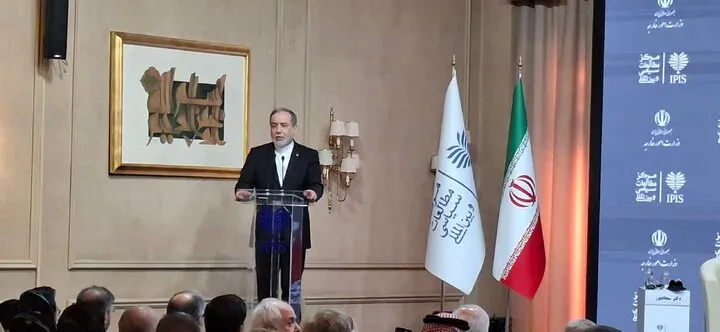
Tehran - BORNA - Iran's Foreign Minister Seyyed Abbas Araghchi, speaking at the opening ceremony of the Documents Center and Museum of Martyr Seyyed Kamal Kharrazi (a specialized meeting on Kharrazi's role in foreign policy consensus-building) and the reopening of the Ministry of Foreign Affairs' specialized library, referred to Martyr Kamal Kharrazi's adherence and commitment to the ideals and values of the Islamic Revolution and said: "He was, in the true sense of the word, a revolutionary diplomat."
Araghchi stated regarding Martyr Kharrazi: "His prominent characteristic was rationality; revolutionary rationality. He was a man of thought, intellect, consultation, and dialogue, and as I mentioned, he was a man of dialogue and diplomacy."
He added: "He was wholeheartedly committed and loyal to the ideals of the Islamic Revolution. He was committed to the Resistance movement and the Palestinian cause."
Iran's Foreign Minister, stating that the term "revolutionary diplomat" befits Martyr Kharrazi, said: "He adhered to all diplomatic principles and rules, possessed diplomatic rationality, and remained committed to his revolutionary ideals."
He added: "The last time I attended his speech was during the Iranian-Arab Dialogue conference in May of last year, one month before the US-Zionist aggression against Iran in Doha. In that speech, which focused on the region and Iran-Arab relations, he read some parts, which I will quote."
Araghchi, quoting Martyr Kharrazi from that meeting, said: "The prosperity of a region first and foremost requires the collective commitment of its members to peace and stability, and the future of any region must be realized by the countries of that region, based on mutual respect, sovereign equality, and a sense of shared responsibility. Because collective security is not an imported matter; rather, it must be created from within and without foreign interference. The Islamic Republic of Iran supports the creation of inclusive and sustainable platforms for dialogue among regional countries to develop peace, stability, and prosperity. We emphasize active diplomacy and the peaceful resolution of disputes. In our view, neighbors are not competitors; rather, they are our main partners in achieving a peaceful future. Iran is ready for bilateral and multilateral talks to strengthen transparency and trust and reduce misunderstandings."
He added: "These were the statements Mr. Dr. Kharrazi expressed about our regional policies at the Iranian-Arab Dialogue forum about a year and a half ago."
Araghchi said: "A year and a half after these remarks, and following two great wars in the region and the conflicts that are still ongoing, our policy remains exactly what Dr. Kharrazi stated, and our policy has not changed. We still believe that our region must enjoy endogenous peace and stability, provided by the countries of the region, without foreign interference."
He added: "The recent wars, especially the Ramadan War, are a turning point in the history of the region; it disrupted all existing security structures, and everything in the region has changed. Nothing will be as it was before. The security structure for some regional countries that relied on foreign presence and interference has now collapsed, and it became clear that US bases do not bring peace and security to anyone. For the countries hosting these bases, they did not bring peace and security; on the contrary, these very bases were the reason for their insecurity."
He emphasized: "These bases participated in the attack against the Islamic Republic of Iran and received an appropriate response. The presence of these bases caused insecurity, not security, and this is a concept now being discussed in the region."
Araghchi also emphasized: "The role of the Israeli regime has become evident to all. This regime is the sole factor of instability and warmongering in our region, which has never allowed security and stability to be established and has always sought war, warmongering, and the weakening of regional countries."
Stating that the region is now seeking to revise its security outlook and approaches, he said: "We fundamentally welcome any movement that seeks to establish endogenous security in the region and strengthens the reliance of regional countries on themselves. Countries that are now seeking to ensure their security through cooperation and agreement among themselves have, in our view, started a correct path, although there are questions, ambiguities, and concerns that must be addressed."
Iran's Foreign Minister emphasized: "Our region must move toward a point where the presence of foreign forces is reduced to zero for its peace and stability. These forces have come to this region for their own interests and primarily to protect the security of Israel, and the continuation of their presence will bring nothing but insecurity for the entire region. Interestingly, in practice, it has been proven that these forces are incapable of protecting Israel, their host countries, or even themselves."
He continued: "The statistics provided by the Pentagon and related institutions are clear; almost all US bases in the region were destroyed. In their own words, hundreds of buildings in these bases were destroyed, and the Americans lost more than 80 aircraft and fighter jets in this war, the vast majority of which were targeted on the ground by our missiles."
Araghchi emphasized: "Therefore, the very policy that Dr. Kharrazi expressed before the war and during the last two wars remains our principled policy: that security in the region must be established by the regional countries themselves, without reliance on and without the presence of foreign forces, and the Islamic Republic of Iran is ready for this and for dialogue in this regard."
Araghchi, emphasizing that Iran's neighborhood policy is a policy of peaceful coexistence with our neighbors and there will be no other way, said: "We have been, are, and will be neighbors of one another, and we must reach a joint solution for our security and the security of the region, in which all countries of the region participate, without the presence and interference of any foreign force."
Araghchi continued: "The important point is that, in our belief, all issues in the region are intertwined. One cannot have war and conflict in one corner of the region and expect peace and tranquility in another. For this reason, in all our negotiations with the American side through Pakistan, Qatar, or other friends, we have emphasized that the end of this war must be on all fronts."
End Article