Iran firmly rejects US demands for 'total surrender', slams EU appeasement
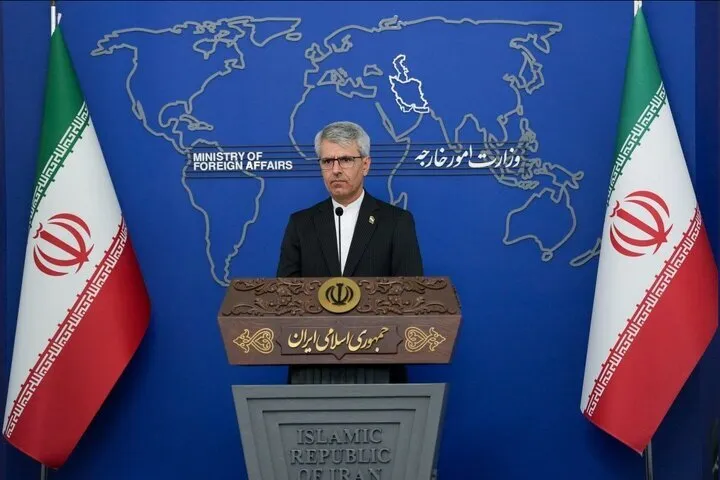
Tehran - BORNA - In an exclusive interview with Germany’s ARD network, Baghaei dismissed recent remarks by the US president suggesting Washington would delay further attacks on Iran until after the midterm elections. He argued that the statement inherently proves that launching aggressive acts against Iran remains a core US strategy.
"Iranians do not trust what US officials say," Baghaei stated, noting that the US launched military strikes on Iran in June of last year and February of this year while diplomatic negotiations were actively underway and making significant progress. "The US president and other officials frequently use the phrase 'total surrender.' This is something no Iranian will accept."
European appeasement and the 'snapback' mechanism
Turning to Europe's role in the ongoing tensions, the spokesman expressed regret over the European Union's failure to maintain an independent political stance, accusing the bloc of continually choosing to appease Washington.
He pointed to the European trio's decision last October to invoke the snapback mechanism as an illegal move, recalling that the US was the first to unilaterally withdraw from the 2015 nuclear deal (JCPOA) in 2018.
"The cost of this appeasement for the region and for Iran-EU relations was very high because the Europeans decided to deprive themselves of the necessary leverage and at least the minimum trust we had," Baghaei said, adding that the EU's failure to counter US treaty violations paved the way for Washington's illegal wars of choice.
Relations with Germany and human rights double standards
Addressing bilateral ties with Germany, Baghaei acknowledged the historically strong economic and cultural relations between the two nations, noting the successful integration of nearly half a million Iranians in Germany. However, he heavily criticized Berlin’s recent antagonistic policies, including the closure of Iranian consulates general, which primarily harms Iranian expatriates.
Baghaei slammed Germany's support for military actions against Iran in 2025 and 2026, while reminding ARD of Berlin's unaddressed history of supplying chemical weapons to former Iraqi dictator Saddam Hussein during the 1980s imposed war.
When pressed on human rights issues, the spokesman condemned European double standards, highlighting their silence on the ongoing Israeli genocide in Gaza and their failure to condemn war crimes committed during strikes on Iranian cities like Minab and Lamerd.
"As long as human rights are reduced to a foreign policy tool to pressure countries they don't like, the victim will be human rights itself," he noted.
Strait of Hormuz and false flag allegations
Baghaei categorically denied allegations of Iranian involvement in plots against a UK military airbase, describing the claims as a "false flag" operation. He characterized the accusations as an attempt by London to deflect public scrutiny and answer for its own participation in aggressive, UN Charter-violating wars against Iran from that very same base.
Regarding maritime security in the Strait of Hormuz, the spokesman defended Iran's measures to secure the strategic waterway, explaining that the US and the Israeli regime severely abused the route on February 28 to launch attacks on Iranian soil.
Baghaei revealed that despite a subsequent agreement—the Islamabad Memorandum of Understanding—where both sides agreed on principles to secure commercial shipping in the strait, the US backtracked in less than three weeks. According to Baghaei, the US president abruptly terminated the 14-clause deal and resumed strikes on Iranian ports and cities.
"The Strait of Hormuz is not safe, not because Iran made it unsafe, but because the US and Israel abused this waterway," Baghaei concluded, stressing that Iran's military responses and route enforcements are legitimate acts of self-defense under international law to protect its territorial integrity against an ongoing military and economic blockade.
End Article