Iranian Foreign Ministry Spokesman: Israeli Crimes Must Not Become Normalized
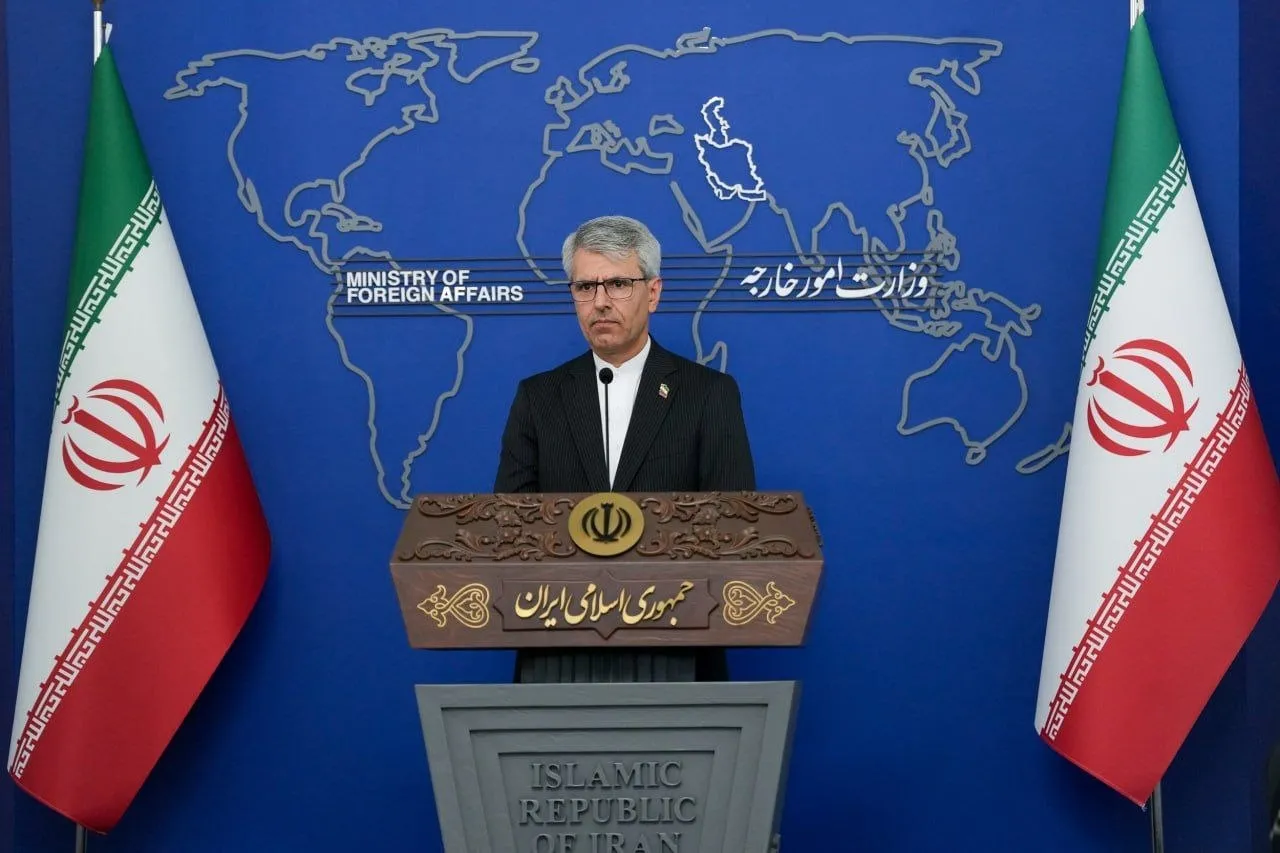
Tehran - BORNA - Iranian Foreign Ministry Spokesman Esmaeil Baghaei, referring to photographs of two martyrs, Ilya Sharafi and Amirhossein Sharafi, who were martyred near Shiraz, said that honoring the martyrs and defenders of the homeland is a duty as Iran approaches Student Day.
"On the eve of Student Day, we consider it our duty to honor the martyrs and defenders of the homeland, and we pay tribute to the pure souls of these two martyrs and all those who were martyred in defense of the homeland," Baghaei said.
The Foreign Ministry spokesman subsequently addressed developments in West Asia and the continuing insecurity across the region, identifying the Zionist regime as the principal source of instability and insecurity in the region. Referring to the continued attacks against Palestinians, he said that 10 Palestinians had been martyred in the previous day alone.
Referring to the difficult humanitarian conditions in Gaza, particularly as temperatures decline and restrictions remain in place on the entry of prefabricated housing units and shelters, Baghaei emphasized that Palestinians are enduring extremely difficult conditions and have even been deprived of the possibility of obtaining adequate shelter.
Warning against the normalization of crimes against Palestinians, Baghaei said: "We are facing a dangerous phenomenon in which crimes are gradually normalized and human beings and victims are reduced to numbers and statistics. We must not allow the suffering and killing of the Palestinian people to become repetitive and routine news."
He also referred to United Nations reports and positions regarding developments in Gaza and other Palestinian territories, emphasizing that some aspects of these crimes have been reflected in reports issued by international institutions.
The Foreign Ministry spokesman also referred to international legal efforts concerning the crimes committed, noting that officials of the Zionist regime are facing judicial proceedings and international prosecution.
United States Must Decide on Continuation of Negotiations
Iranian Foreign Ministry Spokesman Esmaeil Baghaei, referring to the deputy foreign minister's visit to Doha, said the trip was undertaken to accelerate interactions between Iran and the mediators, adding that discussions are continuing.
Noting the complexity of the issues under discussion, Baghaei said: "Given the conduct of the United States, the negotiation process has become prolonged, and the United States must now decide on the path forward. We have conveyed all the demands and positions of the Islamic Republic of Iran to the relevant parties."
Referring to the Strait of Hormuz and the simultaneous presentation of demands concerning the waterway while maintaining the blockade against Iran, Baghaei emphasized: "One cannot, on the one hand, discuss the Strait of Hormuz and, on the other, continue the blockade and expect Iran to accept such an approach."
The Foreign Ministry spokesman stressed that adopting a reasonable and realistic approach could help advance negotiations and restore security to the region.
In another part of his remarks, Baghaei addressed the management of the diplomatic process, saying that the Supreme National Security Council is responsible for directing the process and that no changes have been made to the existing mechanism.
Emphasizing that Mr. Ghalibaf is Iran's negotiator, Baghaei noted that cohesion and mutual understanding exist among the country's decision-makers and that the current level of coordination and cooperation is truly unprecedented.
Different Tone of US Letter Not a Basis for Assessing Negotiations
Iranian Foreign Ministry Spokesman Esmaeil Baghaei, addressing the letter sent by the US Vice President to the Secretary of Iran's Supreme National Security Council and references to its "different tone," said that differences in individuals' writing styles are natural, but what matters to Iran is the conduct of the US government.
According to Baghaei, the United States has repeatedly disrupted diplomatic processes over the past two years and has even moved to undermine them after understandings were reached. Therefore, any diplomatic initiative must be assessed with caution.
Referring to Iran's seven-stage initiative, which was discussed during the Iranian delegation's visit to New York, Baghaei emphasized that the other side's views and considerations had been received through mediators and that Iran's proposal remains in place.
He added that Tehran's demands are clear and reasonable and that, before any final agreement, the US maritime blockade must end and Iran's legitimate demands must be addressed.
Regarding Iran's response to the letter, the Foreign Ministry spokesman said the decision on how to respond rests with the Secretary of the Supreme National Security Council.
He emphasized that the letter does not signify the beginning of a new initiative and that the basis for Iran-US discussions through mediators remains Iran's seven-stage plan, which has now been condensed and could be implemented within two days.
Baghaei noted that if Iran's demands are fulfilled, security could return to the Strait of Hormuz and negotiations could resume within a short period. He emphasized that the decision regarding the future of this process depends on the approach adopted by the American side.
Iranians Have Always Been Among the Kindest Peoples in Their Treatment of Jews
Iranian Foreign Ministry Spokesman Esmaeil Baghaei, responding to recent accusations by certain European countries, including Germany and Britain, as well as Australia, concerning Iran's alleged involvement in planning antisemitic activities, said that accusations of antisemitism do not apply to Iran or the Iranian people.
"Antisemitism has European roots and is entirely incompatible with Iranian religion, traditions, culture and civilization," he said.
Criticizing the repetition of these accusations in certain media outlets, Baghaei emphasized that consideration of historical and social realities demonstrates that Iranians have always been among the kindest peoples in their treatment of Jews.
According to Baghaei, the existence of approximately 100 synagogues across Iran, including 13 to 14 synagogues in the city of Yazd, as well as the tombs of Jewish prophets and prominent Jewish figures in various parts of the country, testifies to this historical coexistence.
The Foreign Ministry spokesman noted that despite Iran facing an all-out war waged by a regime that falsely presents itself as the representative of Jews, only a very limited number of incidents involving attacks on Jewish holy sites have occurred in Iran.
He added that appropriate measures had been taken in those rare cases.
Criticizing the situation of Jews in certain European countries, Baghaei asked: "Do incidents such as attacks on Jewish cemeteries, the protection of synagogues with barbed wire, and the removal of their signs to prevent attacks have anything to do with Iran? Why do some governments attempt to attribute their own problems to others instead of examining the roots of these incidents?"
He emphasized that the Iranian people are sufficiently aware and civilized not to attribute the actions of a regime to followers of the Jewish faith and that they distinguish between Judaism and the conduct of the Zionist regime.
US Threats Against Iran's Nuclear Facilities Violate UN Charter
Iranian Foreign Ministry Spokesman Esmaeil Baghaei, responding to threatening remarks by the US President concerning Iran's nuclear facilities, said that the Islamic Republic of Iran will document and pursue cases involving flagrant violations of international law and the United Nations Charter.
Criticizing the silence of the United Nations, the UN Security Council and the Board of Governors of the International Atomic Energy Agency (IAEA) in the face of such threats, Baghaei said: "Unfortunately, experience has shown that these institutions do not respond effectively to clear violations of the fundamental principles of international law."
Describing the United States as the greatest threat to the nuclear non-proliferation regime, Baghaei emphasized that even an implicit threat by a country to use nuclear weapons could encourage other countries to violate their international obligations.
According to the spokesman, other nuclear-armed states are also closely monitoring US conduct, and such an approach establishes a dangerous precedent for international peace and security.
The Foreign Ministry spokesman stressed that US threats will not weaken Iran's determination but will instead strengthen the country's resolve to enhance its defensive capabilities and protect itself.
Iran Will Not Be Deceived by US Double Standards
Iranian Foreign Ministry Spokesman Esmaeil Baghaei, responding to contradictory positions adopted by American officials toward Iran and the simultaneous issuance of military threats and dispatch of a letter to the Secretary of Iran's Supreme National Security Council, said the Islamic Republic is closely monitoring developments in light of its previous experiences.
Referring to negotiations in 2015 and 2018, as well as developments over the past two years, Baghaei emphasized that Iran is following events with full awareness and will not allow such conduct to deceive the country.
Referring to the US military attack on June 13, 2025, Baghaei said that only half an hour before that act of aggression, the US President had issued a message stating that negotiations with Iran were still ongoing.
He emphasized that Tehran is therefore thoroughly familiar with Washington's history of contradictory behavior.
Baghaei noted that different views regarding regional developments may exist within the US governing structure.
He added that some of these differences could reflect dissatisfaction among the American public with the US government's support for the actions of the Zionist regime, a trend also reflected in opinion polls and protest gatherings in the United States.
The Foreign Ministry spokesman stressed that Iran can take different perspectives within the American political establishment into consideration, but what matters to Tehran is the actual conduct of the US government.
He described the contradictory positions of American officials as an indication of confusion within the country's decision-making structure, saying that this situation has even created uncertainty within the international community over who the principal decision-maker in the United States actually is.
Referring to the impact of US support for the policies of the Zionist regime on Washington's international credibility, Baghaei emphasized that the United States must make a clear decision as soon as possible regarding its approach and its position in regional developments.
Iran Has Not Undermined Trust of Regional Countries
Iranian Foreign Ministry Spokesman Esmaeil Baghaei, responding to remarks by an adviser to the President of the United Arab Emirates concerning the loss of the UAE's trust in Iran, said that Iran has not undermined the trust of regional countries.
He added that these countries can create conditions for repairing relations by abandoning their previous misguided approaches.
Referring to the use of the territory and facilities of certain regional countries for military operations against Iran, Baghaei emphasized that Tehran cannot remain silent in the face of violations of its national sovereignty and threats to the security of its people.
Baghaei added that the excessive reliance of certain regional countries on the American military presence and their permission to use their facilities for operations against Iran have damaged regional relations and trust.
Emphasizing that confidence-building requires reciprocal action, the Foreign Ministry spokesman said that Iran bears no hostility toward any country in the region and believes that lasting security can be achieved through cooperation and confidence-building among regional countries.
Iran Is Prepared for All Scenarios
Iranian Foreign Ministry Spokesman Esmaeil Baghaei, responding to a question about the possibility of renewed hostilities between Iran and the United States, said that the war is already underway.
"The war is continuing even now. The economic blockade and threats against Iran are part of a war that has continued over the past eight months," he said.
Baghaei emphasized that Iran is prepared for any eventuality because the issue concerns defending the homeland, territorial integrity and the dignity of a country with a civilization spanning thousands of years.
He added that preparedness for all scenarios is essential, whether diplomatic consultations and discussions with mediators are underway or diplomacy is not taking place.
Iran Will Fulfill NPT Obligations as Long as It Remains a Member
Iranian Foreign Ministry Spokesman Esmaeil Baghaei, addressing growing public demands for a change in Iran's nuclear doctrine, said the issue is being discussed in the media and among the public and intellectuals.
He added that the other side is also following developments and the views expressed within Iranian society.
Baghaei said developments in recent years and the conduct of the United States and the Zionist regime, despite Iran's repeated emphasis on the peaceful nature of its nuclear program, have raised questions within Iranian society about why Tehran's efforts to demonstrate the peaceful nature of its nuclear activities have not received a positive response.
Referring to the assassination of the religious authority who issued the fatwa prohibiting the production and use of nuclear weapons, Baghaei emphasized that the conduct of the United States and the Zionist regime has been responsible for the emergence and expansion of this debate within Iranian society.
The Foreign Ministry spokesman noted that despite these demands being raised within society, Iran remains a member of the Treaty on the Non-Proliferation of Nuclear Weapons (NPT).
He emphasized that as long as Iran remains a party to the treaty, it considers itself obligated to comply with its commitments under the NPT.
Iran Seriously Pursuing Regional Diplomatic Initiatives on Afghanistan
Iranian Foreign Ministry Spokesman Esmaeil Baghaei, referring to Tehran's efforts to strengthen regional cooperation, said Iran used the opportunity provided by a Shanghai Cooperation Organization meeting last year to organize a quadrilateral meeting.
He explained that Tehran regarded the meeting as a preliminary step toward holding a new round of discussions in the coming months.
Baghaei added that Foreign Ministry officials have also held consultations with regional countries, including Türkiye and Pakistan, in recent months and that these efforts are being pursued seriously.
Referring to the Moscow Format meeting held in the Iranian month of Mehr and the consultations conducted on its sidelines, Baghaei emphasized that regional developments have not caused Iran to overlook the importance of diplomatic initiatives concerning Afghanistan and regional security.
Iran to Expand Economic Cooperation with Turkmenistan
Iranian Foreign Ministry Spokesman Esmaeil Baghaei, referring to the Iranian foreign minister's visit to Turkmenistan, said the Foreign Ministry's deputy for economic affairs and representatives of relevant institutions, including the Ministry of Petroleum, are accompanying him on the trip.
Describing relations with neighboring countries as strategic, Baghaei said ties between Iran and Turkmenistan have expanded in recent years within the framework of Tehran's neighborhood policy.
Referring to the agenda of the visit, Baghaei said bilateral cooperation in economic, commercial and energy sectors would be discussed.
"We expect the results of these consultations to contribute to expanding economic exchanges between the two countries," he added.
Surrender to United States Has No Place in Iranian Vocabulary
Iranian Foreign Ministry Spokesman Esmaeil Baghaei, responding to remarks by American officials concerning Iran's surrender, said: "The concept of surrender has no place in the vocabulary of Iranians."
He emphasized that Iranians submit and humble themselves only before God and will not bow before any power.
Transfer of 60% Enriched Uranium to Third Country Not Under Consideration
Iranian Foreign Ministry Spokesman Esmaeil Baghaei, responding to a question about the possibility of transferring uranium enriched to 60 percent to a third country under a potential agreement, said: "No such proposal is under consideration."
Iran's Demands Remain the Conditions of Islamabad Agreement
Iranian Foreign Ministry Spokesman Esmaeil Baghaei, emphasizing that negotiations must not be separated from the Islamabad agreement, said Iran's demands remain the same conditions presented in Islamabad, which the United States subsequently violated.
He added that lifting sanctions imposed after the Islamabad agreement and implementing commitments, including the release of Iran's assets, are among Tehran's principal conditions.
According to Baghaei, these demands are prerequisites for restoring security to the Strait of Hormuz and continuing discussions on subsequent stages.
Iran's Policy Will Not Change with Changes in US Administrations
Iranian Foreign Ministry Spokesman Esmaeil Baghaei, addressing the possible impact of the US midterm elections on tensions between Tehran and Washington, said Iran follows developments concerning American elections through the media, but its primary concerns remain national security and the country's interests.
He added that elections do not produce a new America and that Washington's hostile approach toward Iran has a history spanning more than 70 years, dating back to the August 19, 1953, coup.
Baghaei emphasized that rather than focusing on political developments in the United States, Iran is concentrating on strengthening its capabilities in various fields.
Any Military Aggression Against Iran Will Face Immediate and Comprehensive Response
Iranian Foreign Ministry Spokesman Esmaeil Baghaei, responding to threats concerning a possible attack on Iran's nuclear facilities, emphasized that any act of military aggression or violation against Iran, regardless of the means or methods employed, will be met with a powerful, immediate and comprehensive response.
He added that determining the nature and scope of Iran's response is the responsibility of the country's defenders and the officials authorized to make decisions in this regard.
Referring to Iran's preparedness for different scenarios, Baghaei emphasized that the necessary measures have been taken to confront any threat or act of aggression against the country.
Iran's Defensive Strikes Target Aggressors' Bases, Not Territory of Regional Countries
Iranian Foreign Ministry Spokesman Esmaeil Baghaei, responding to a question submitted by the public through the "Ask the Spokesperson" initiative concerning Iran's response to the use of facilities in certain regional countries for attacks against Iranian territory, said that Iran's actions have been defensive and should not be regarded as attacks against regional countries.
He added that certain regional countries have stated that they have no control over American military bases located on their territory.
Baghaei emphasized that Iran has made clear that its defensive strikes are not directed against the territory of these countries but against bases whose facilities are being used to launch attacks against Iran.
Referring to the use of these bases to attack schools and public facilities in Iran, Baghaei stressed that the Islamic Republic has the right to defend itself and respond to such actions.
Concluding his remarks, the Foreign Ministry spokesman expressed hope that such incidents would not be repeated in the future, emphasizing that Iran also has no desire for such circumstances to arise.
End Article