The Shanghai Summit and the Accelerating Demise of U.S.-Led Global Order
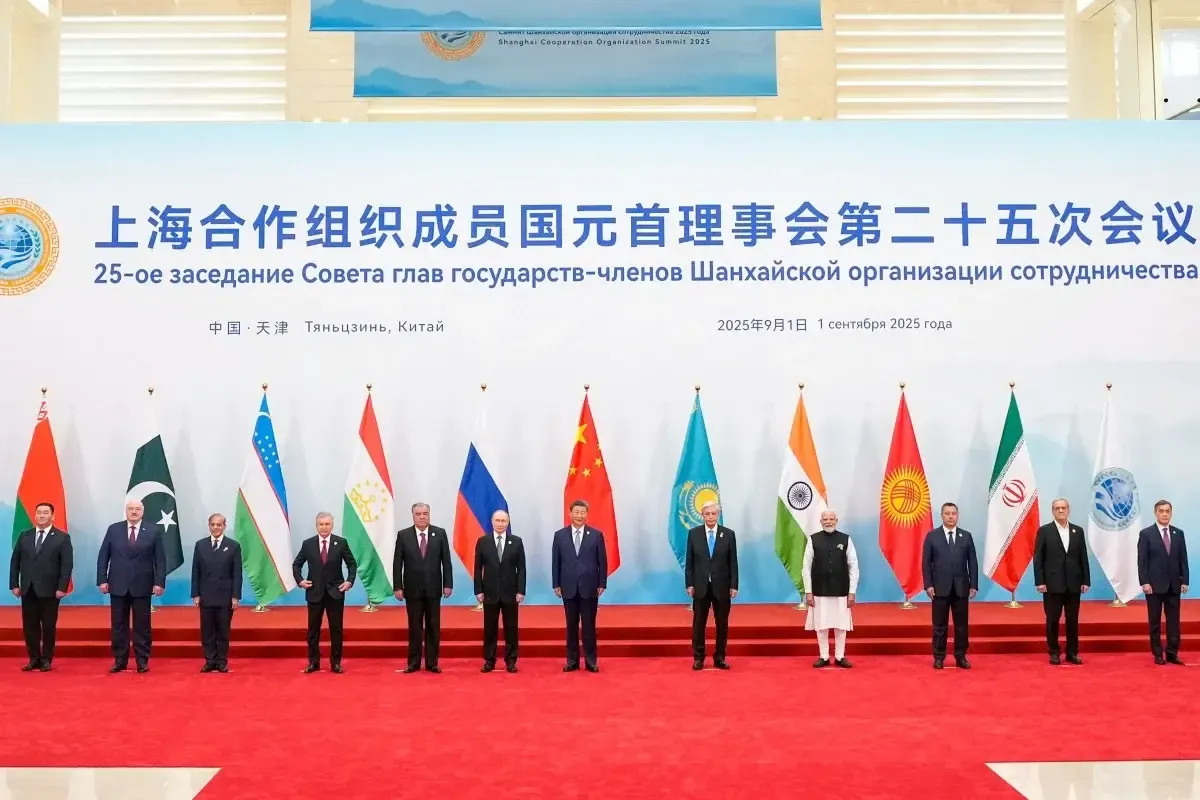
Tehran - BORNA - At the heart of the summit was a shared conviction among member states that the Western model—anchored in U.S. leadership, dollar dominance, and NATO’s military reach—has failed to provide either stability or fairness in global governance. From Beijing to Moscow, from Tehran to New Delhi, leaders voiced a common theme: the need to move beyond a unipolar order dominated by Washington and toward a multipolar system rooted in sovereignty, regionalism, and shared economic security.
The SCO, once dismissed in Western capitals as a talk shop, has grown into a formidable institution. Its membership now includes not only China, Russia, and Central Asian states but also India, Iran, and increasingly engaged observers such as Turkey and Saudi Arabia. Collectively, these states represent nearly half of the world’s population and a significant portion of global GDP. The symbolism is hard to ignore: countries spanning Eurasia are explicitly aligning against unilateral coercive measures such as sanctions, while exploring new financial, trade, and security mechanisms that exclude Washington’s influence.
What makes this moment historically significant is not simply the rhetoric of leaders but the tangible steps being taken. The summit produced commitments to expand local currency trade settlements, to strengthen alternative financial platforms independent of SWIFT, and to broaden defense cooperation under the banner of “regional stability.” Such measures speak directly to the vulnerability of U.S. power: the weaponization of the dollar and the overreach of sanctions, which once cemented American dominance, are now accelerating the search for alternatives.
The Failure of American Strategy
For decades, Washington assumed that economic coercion, military deterrence, and alliances like NATO would guarantee its supremacy. Yet the U.S. strategy of “maximum pressure” has proven counterproductive. Sanctions imposed on Russia after the Ukraine war pushed Moscow deeper into Beijing’s orbit. Similarly, Washington’s unilateral withdrawal from the Iran nuclear deal in 2018 and subsequent military strikes in 2025 only emboldened Tehran to cement ties with China and Russia while rallying Global South countries against the perceived hypocrisy of Western diplomacy.
The SCO summit made this backlash visible. Iranian President Masoud Pezeshkian, for instance, emphasized in Tianjin that Iran’s cooperation with Russia and China is not just tactical but strategic, aimed at resisting the very architecture of coercion designed by the West. His message was echoed by Russian President Vladimir Putin, who stressed that Moscow and Tehran were in “constant contact” on global issues, including nuclear policy, and highlighted the illegitimacy of unilateral sanctions.
India’s position is equally telling. Once courted by Washington as a counterweight to China, New Delhi has resisted aligning fully with U.S. strategic goals. Instead, it has deepened economic ties with both Moscow and Tehran, purchasing discounted Russian oil and pursuing connectivity projects like the International North-South Transport Corridor. The U.S. trade war measures against India in previous years—tariffs, technology restrictions, and threats of secondary sanctions—failed to alter this trajectory. Rather, they convinced Indian leaders that long-term national interests lie in hedging against, if not outright rejecting, American dominance.
The summit also underlined Europe’s diminishing influence. While Washington pressed its allies in London, Paris, and Berlin to invoke the snapback of U.N. sanctions on Iran, SCO states uniformly condemned the move as illegitimate. China’s foreign ministry issued statements highlighting the illegality of the mechanism, while Russia went further by drafting a U.N. resolution to delay any punitive action. This demonstrates that U.S. power, once bolstered by automatic European alignment, now faces coordinated resistance across Eurasia.
The American narrative—that military might and financial sanctions can indefinitely preserve its primacy—is losing credibility. The SCO summit showed how Washington’s reliance on coercive tools has instead galvanized efforts to bypass U.S. structures altogether, from payment systems to security alliances.
Eurasian Alternatives to U.S. Hegemony
The SCO summit revealed that the multipolar transition is not just rhetorical but institutional. China and Russia are building parallel systems that directly challenge U.S.-dominated structures.
Financial and Economic Architecture
One of the central themes in Tianjin was financial sovereignty. Member states reiterated commitments to expand trade in national currencies and accelerate the creation of a clearing system independent of SWIFT. For Iran, locked out of Western banking channels for decades, these initiatives represent both survival and leverage. For China and Russia, they are essential to insulating their economies from dollar-based sanctions. The presence of India—an economy projected to surpass $5 trillion by the end of the decade—further strengthens the legitimacy of this alternative system.
Energy and Connectivity
Energy cooperation was another highlight. Iran and Russia discussed new infrastructure projects such as the Rasht-Astara railway, linking the Persian Gulf to Russia’s northern ports. Simultaneously, China’s Belt and Road projects were endorsed as complementary to regional energy corridors. These initiatives are more than commercial—they symbolize a geopolitical choice to deepen interdependence within Eurasia while reducing vulnerability to U.S.-controlled maritime chokepoints and sanctions regimes.
Security and Military Coordination
Although the SCO is not a military alliance in the NATO sense, joint military exercises and security consultations showcased a growing willingness to coordinate against perceived external threats. Leaders emphasized the illegality of U.S. unilateral strikes—particularly the June 2025 attacks on Iran’s nuclear facilities—and stressed the need for collective resilience. Russian Foreign Minister Sergey Lavrov even warned that NATO’s militarization of Europe risked creating a “Fourth Reich,” framing the SCO as a defensive counterbalance to Western escalation.
Political Legitimacy and Norms
The SCO also advanced a narrative of political legitimacy. By condemning “weaponized” human rights campaigns and “politicized” IAEA reports, the bloc positioned itself as a defender of sovereignty against intrusive Western agendas. Iran’s case was central: SCO leaders argued that Tehran’s nuclear program remained within the framework of the NPT, and that the true violators of international law were those who launched military strikes during ongoing negotiations.
Taken together, these steps represent not only resistance but the embryonic construction of a new order. What was once hypothetical—an alternative to U.S.-led globalization—is now materializing in agreements, corridors, and institutions spanning Eurasia.
The Accelerating Decline of U.S. Hegemony
The Tianjin summit of the Shanghai Cooperation Organization (SCO) underscores a reality Washington has long sought to deny: U.S. hegemony is no longer uncontested. The 20th-century order, built on American military power, dollar dominance, and transatlantic political unity, is eroding. Unilateral U.S. actions—from the Iraq war to the abandonment of the JCPOA—have undermined the credibility of Washington’s leadership. The June 2025 strikes on Iran further confirmed to many states that U.S. power is not a stabilizing force but a destabilizing one.
By contrast, the SCO offers a platform where grievances against U.S. dominance are transformed into collaborative agendas. For Russia, China, Iran, and even increasingly India, the logic is straightforward: multipolarity is no longer a choice but a survival mechanism.
Shifting Power Balances
If the Cold War was defined by a bipolar contest between Washington and Moscow, the current moment is defined by a multidimensional chessboard. China is the economic engine, Russia the military counterweight, Iran the ideological and strategic disruptor, and India the swing power. Together within the SCO framework, they present a coalition too large to be isolated, too integrated to be ignored, and too determined to be coerced.
This does not mean that the U.S. is irrelevant. It remains the strongest single military power and retains deep alliances in Europe and Asia. But its margin of dominance is shrinking. Every summit that produces new non-dollar trade agreements, every corridor linking the Caspian to the Indian Ocean, and every joint statement rejecting Western sanctions chips away at the monopoly Washington once enjoyed.
The Role of Europe
Europe’s position is particularly precarious. By aligning itself with Washington in activating the snapback mechanism against Iran, the EU has reinforced perceptions of its subordination to U.S. strategy. Even European leaders such as Germany’s Friedrich Merz have framed Israeli aggression against Iran as “dirty work on behalf of all of us,” eroding Europe’s claim to moral authority. The more Europe ties itself to U.S. policies, the more it risks marginalization in a multipolar world where Eurasian actors are building new rules without it.
The Iranian Factor
Iran occupies a central role in this transformation. Once treated as a pariah, Tehran is now a full member of the SCO, a critical energy supplier, and a test case of Western double standards. By resisting sanctions and military strikes while maintaining cooperation with partners like Russia and China, Iran has repositioned itself as both a symbol and a driver of multipolar defiance. The more Washington and Brussels escalate against Tehran, the more firmly Iran is pulled into the heart of Eurasia’s emerging architecture.
A World in Transition
The SCO summit in Tianjin was more than a diplomatic gathering—it was a declaration that the post-Cold War era of U.S. unipolarity is ending. Multipolarity is not a slogan but a lived reality, reflected in infrastructure, finance, security, and ideology.
For Washington, denial may be comforting, as shown by President Trump’s dismissive remarks about a potential China-Russia “axis.” Yet the facts on the ground tell another story: the U.S. is no longer the sole architect of global order. For Europe, clinging to the coattails of American policy risks irrelevance. For Eurasia, the task is to consolidate multipolarity into a sustainable order.
History rarely announces its turning points in real time. But Tianjin may well be remembered as one: a moment when the balance of the international system shifted decisively away from unipolarity and toward a multipolar world, accelerating the passage into a new century defined not by American supremacy, but by contested pluralism.
End Article