UN at 80: From the ideals of peace to the deadlock in New York
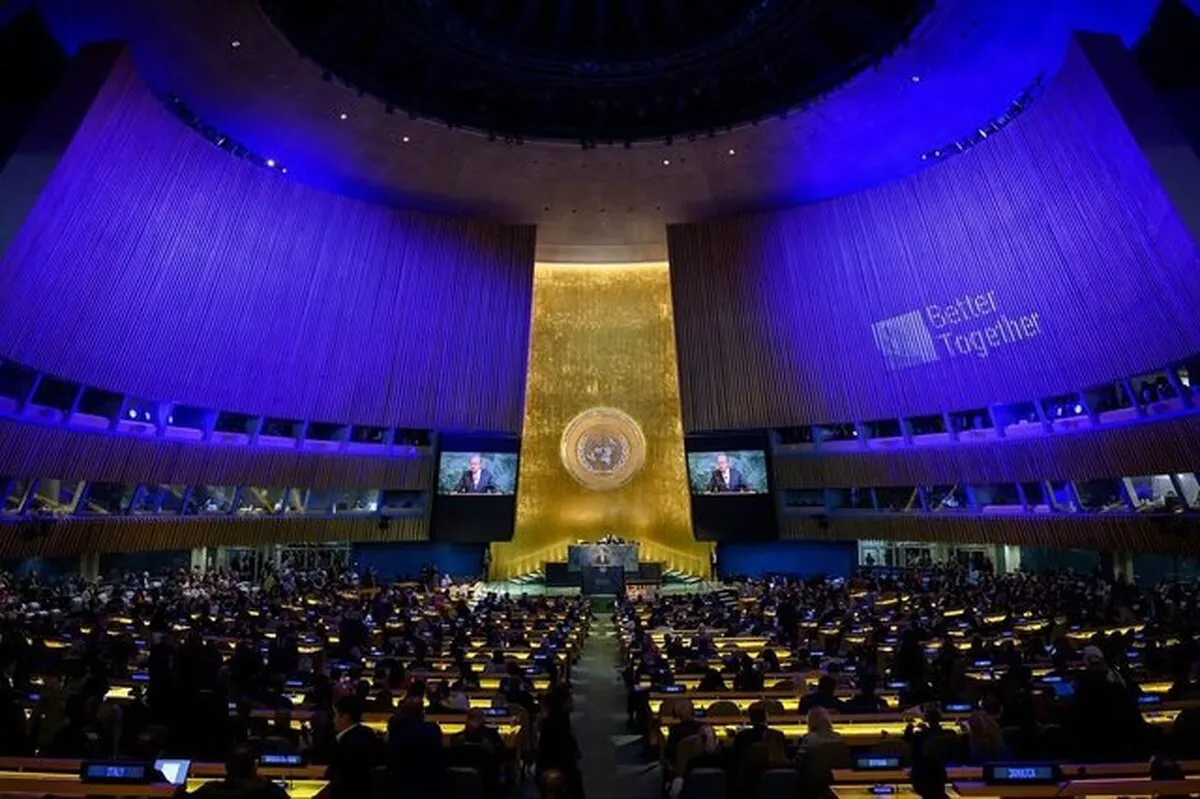
Tehran - BORNA - As the United Nations marks its 80th anniversary, the institution finds itself in sharp contrast with the lofty ideals of its founding. Born from the ashes of World War II with a mandate to preserve peace, prevent aggression, and foster cooperation among nations, the UN now faces accusations of paralysis, politicization, and failure to uphold its most basic responsibilities.
From the League of Nations to the United Nations
The idea of an international body to prevent global conflict predates the UN. In 1920, the League of Nations was formed after World War I, championed by U.S. President Woodrow Wilson as the first serious attempt at collective security. But structural weaknesses, the absence of key powers, and its inability to act against aggressors doomed the League. It collapsed as World War II erupted, serving as a cautionary tale that shaped the birth of the United Nations.
In the midst of World War II, the Allied powers—the United States, Britain, and the Soviet Union—recognized the need for a stronger institution. In 1942, 26 countries signed the “Declaration by United Nations,” pledging to fight the Axis powers. Later, at the 1944 Dumbarton Oaks Conference in Washington, the blueprint for the UN was drafted, establishing the General Assembly, Security Council, and other organs.
At Yalta in February 1945, leaders Roosevelt, Churchill, and Stalin agreed on the crucial detail of veto power for permanent members. Just months later, 50 countries gathered in San Francisco to finalize the UN Charter. Signed on June 26, 1945, and ratified by the five permanent Security Council members and a majority of signatories, the UN officially came into being on October 24, 1945.
Ambitions vs. reality
The UN’s charter set forth sweeping ambitions: maintaining international peace and security, developing friendly relations among nations, cooperating on global challenges from poverty to health, and promoting respect for human rights. For decades, the UN symbolized hope for a war-weary world.
Yet, 80 years on, questions remain: to what extent has the UN lived up to its mission? Observers note some notable achievements—in humanitarian relief, standard-setting on human rights, and promoting sustainable development. But in addressing wars and political crises, the organization’s record is deeply troubled.
The Security Council’s veto system lies at the heart of the problem. Intended to ensure consensus among great powers, it has instead enabled paralysis. The five permanent members often wield the veto to shield allies or advance their own agendas, leaving conflicts unresolved and undermining the legitimacy of the UN as a universal body.
Gaza: the clearest example of paralysis
The war in Gaza has become the starkest reminder of the UN’s failure. Israel’s ongoing assault has left at least 65,000 Palestinians dead and thousands more wounded, with starvation policies compounding the humanitarian catastrophe. Despite overwhelming international support for a ceasefire, repeated U.S. vetoes in the Security Council blocked binding resolutions. For much of the world, the UN’s inability to act in the face of genocide exposes the limits of an institution dominated by power politics rather than moral responsibility.
Why New York? The UN’s headquarters under U.S. shadow
The choice of New York as the UN’s permanent headquarters reflected both geopolitics and convenience. After temporary sessions in London and New York, member states sought a neutral, permanent site. War-torn Europe was deemed unsuitable, and the U.S.—geographically removed from devastation and increasingly central in global affairs—was chosen.
In 1946, the General Assembly decided on New York. A decisive factor was the Rockefeller family’s $8.5 million donation of land in Manhattan, where the headquarters was built between 1948 and 1952, designed by an international team including Le Corbusier and Oscar Niemeyer.
Officially, the UN complex is international territory. In practice, however, Washington’s role as host state has given it leverage to impose restrictions on delegations it disfavors. In recent years, Iranian representatives have faced unprecedented visa delays and mobility restrictions in violation of the UN Headquarters Agreement. Iranian Foreign Ministry spokesman Esmail Baghaei called these measures “unprecedented” and a breach of U.S. obligations, which require visas to be issued promptly and without political interference.
Such restrictions highlight the contradiction of an institution meant to embody international equality but headquartered in a country that applies its domestic politics to constrain multilateralism.
Structural flaws and calls for reform
Beyond the U.S. role as host, the UN suffers from deeper structural imbalances. The concentration of power in the Security Council has long been criticized by developing nations, who argue that it reflects a post-1945 world order that no longer exists. Africa, Latin America, and much of Asia remain excluded from permanent representation, while vetoes by the U.S., Russia, and others perpetuate deadlock.
Recent crises, from Iraq and Syria to Ukraine and Gaza, have exposed these flaws. Repeated failures to enforce international law or protect civilians have fueled calls for comprehensive reform, with many nations demanding an expanded and more representative Security Council.
The UN at a crossroads
As the UN marks its 80th anniversary, its legacy is a paradox: it has provided a stage for dialogue, a framework for development, and relief for millions in need—but it has also failed in its most vital task, preventing war and upholding justice. For countries like Iran, the UN remains both a necessary forum and a compromised institution, constrained by power politics and manipulated by the very states entrusted to uphold peace.
If the UN is to remain relevant in its second century, fundamental reform is unavoidable. Without it, the institution risks being remembered not as the guardian of peace it aspired to be, but as the symbol of a world order trapped in deadlock, unable to deliver on the ideals proclaimed in San Francisco eight decades ago.
End Article