Baghaei: No Decision Made Regarding Second Round of Islamabad Talks
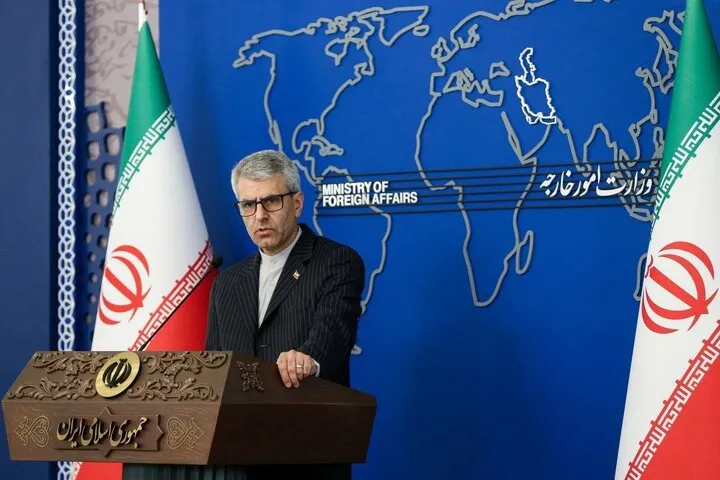
Tehran - BORNA – At the beginning of his weekly press conference, Foreign Ministry Spokesperson Esmaeil Baghaei congratulated "Girls' Day," noting: "This year, this day is accompanied by a heavy grief for us, as a number of Iranian female students were martyred at the Shajareh Tayyebeh School in Minab due to the attacks by the United States and the Israeli regime."
He also referred to the photograph of Makan Nassiri, one of the students of the Shajareh Tayyebeh School who went missing following the U.S.-Israeli strikes, and honored the memory of all the martyrs of the "Third Imposed War."
In response to a question regarding the next round of negotiations between Iran and the U.S. and reports that the American delegation has headed to Islamabad for these talks, the spokesperson stated: "Up to this moment, we have no plan for a next round of negotiations, and no decision has been made in this regard."
Baghaei continued, responding to a question regarding the recent ceasefire violations by the United States, including the ongoing naval blockade of Iran and yesterday's attack on an Iranian merchant vessel: "In such a situation, we see that the behavior and rhetoric of the Americans regarding diplomacy are not consistent with one another, and these actions intensify the suspicion of Iranians toward the intentions of the Americans in this process."
Baghaei emphasized: "Iran will make the necessary decisions in this process with precision and by taking its national interests into account."
Attack on two Indian ships is under investigation
In response to a question regarding reports of an attack on two Indian ships in the Strait of Hormuz and the claims made by Indian officials against Iran, leading to the summoning of our country’s ambassador in New Delhi, the Foreign Ministry Spokesperson said: "The sole cause and reason for what is happening in the Persian Gulf and the Strait of Hormuz these days is the military action of the U.S. and the Israeli regime against Iran, as the situation in the Strait of Hormuz was not like this prior to this attack."
At the same time, Baghaei noted that competent authorities in the country are investigating whether this incident was truly carried out by our forces or not.
If the U.S. and Israel commit a new adventure, our armed forces will carry out the necessary and appropriate response
The Foreign Ministry Spokesperson, in response to another question regarding the nearing expiration of the two-week ceasefire while negotiations between Iran and the U.S. have reached no conclusion, stated: "We do not believe in deadlines or ultimatums for securing Iran's national interests."
He added: "We did not start this war; we acted in defense of Iran's sovereignty and declared that we will continue to defend our interests for as long as Iran's interests require. Undoubtedly, if the U.S. and Israel commit a new adventure against Iran, our armed forces will also carry out the necessary and appropriate response and are vigilantly monitoring the issues."
The proposed U.S. plan, conveyed to Tehran during the Pakistani Army Commander's visit to Iran, is under review
In response to a question regarding media reports about a new plan presented by the Americans and conveyed to Tehran by the Pakistani Army Commander, as well as a new 15-point plan from Iran to the U.S., the Iranian Foreign Ministry Spokesperson said: "After the Americans presented a 15-point plan, we also presented our proposal in 10 points."
Stating that these plans were discussed and reviewed during the Islamabad negotiations, he noted: "It is natural that during a negotiation process, viewpoints are expressed by both parties and they present proposals to one another. Therefore, it is not accurate for us to use the word 'new' proposal."
This Foreign Ministry official emphasized: "Unlike the other side, our positions are clear. The other side constantly changes its demands, but our positions and views in the negotiation process are fixed; we know exactly what we want and have stated from the beginning which data-x-items are unacceptable to us, and persistence from the other side regarding them will not change our positions."
The Foreign Ministry Spokesperson continued: "The issues raised in the media regarding the details of the proposals cannot be confirmed and are media speculations."
Baghaei also stated: "Our review of the proposed U.S. plan, which was conveyed to Tehran during the Pakistani Army Commander's visit to Iran, is currently underway."
Pakistan is the sole mediator between Iran and the U.S.
The Iranian Foreign Ministry Spokesperson, continuing the press conference in response to a question on whether Egypt is also a mediator in the negotiations between Iran and the U.S., rejected this and said: "The only mediator in these negotiations is Pakistan. Of course, other countries also exercise 'good offices' and are making efforts in this regard, but as I mentioned, the mediator at present is Pakistan."
He added: "It is certainly important for the mediator that its credibility is maintained in this process. In the two recent cases, the U.S. betrayed the diplomatic process, and in this process, the credibility of the mediating party is also called into question, which is certainly not good for the mediator, international law, or the related processes."
The diplomatic spokesperson, in response to a question regarding the volume of Iran's oil sales during recent developments, including the naval blockade imposed by the U.S., noted: "Ask this question of our friends in the Ministry of Petroleum, but generally, we are utilizing all our capacities in this regard to continue the normal activity of our oil industry and our oil sales, an issue that our colleagues in the Ministry of Petroleum have been following since the beginning."
In response to a question stating that Trump's strange and unbalanced media behavior in recent days has created many ambiguities, including his claim that he spoke in a shouting and harsh tone in a phone call with the Iranian side—specifically whether such statements, especially the recent claim, are true or should be viewed as part of a media narrative—he said: "It is a media narrative, because essentially such an opportunity has neither been provided nor will be provided for someone to be aggressive or shout at the Iranian delegation."
In response to a question on whether, assuming Iran wished to grant concessions to the other side, it might negotiate with the U.S. regarding its missile capability, the spokesperson addressed the reporter: "How did this question even come to your mind? We have declared many times that we essentially do not hold any dialogue regarding our defensive capability."
Mr. Araghchi’s tweet was part of the understanding agreed upon during the ceasefire between Iran and the U.S.
Baghaei, regarding the Foreign Minister's Friday tweet concerning the reopening of the Strait of Hormuz given the realization of the ceasefire in Lebanon, and some of the side issues and comments about that message and the attacks on the Minister and the Foreign Ministry in several media outlets and cyberspace, said: "In principle, the Foreign Ministry, as the diplomatic apparatus, takes no action without coordination with higher-level institutions. We convey our views with precision to the decision-making bodies, and ultimately, decision-making, especially regarding such important matters, is done in coordination with higher-level institutions."
He further referred to Trump's contradictory tweets on Friday regarding the reopening of the Strait of Hormuz, stating that the tweets of an individual known for contradictions and seeking to sow division are not a basis for the diplomatic apparatus.
Baghaei emphasized: "Mr. Araghchi’s tweet did not represent a new understanding; rather, it was part of the understanding that had been agreed upon during the ceasefire between Iran and the U.S."
In response to another question regarding the belief held by some that the contradictory positions of U.S. officials and their behaviors, including toward Iran, stem from internal and political conflicts in that country, the spokesperson noted: "There is no doubt that U.S. internal disputes are one of the main determining factors in the behavior of American officials. A large segment of American society opposes the illegal actions of U.S. statesmen, as we have witnessed marches and demonstrations by the people in this regard, and we see this issue in the positions taken by personalities and the media of that country, as they emphasize that the path being taken by the U.S. government is not in the interest of the American people."
This senior diplomat of our country noted: "What we observe is the external manifestation of internal disputes in that country, visible through the contradictions and behaviors stemming from the confusion of American officials; this is one of the issues we have witnessed from the U.S. in the diplomatic process over the past year, and it is itself a factor in damaging the process of diplomacy."
In the current situation, we are facing a violation of the ceasefire
The Foreign Ministry Spokesperson, continuing the session in response to the question of whether Iran would set preconditions for the next round of negotiations as it did previously, and whether lifting the naval blockade could be one of our options as a precondition for potential future talks, said: "You may call it a precondition or a condition, but our position is very clear and reasonable. Our basis is Iran's national interests. We demand nothing beyond the national rights and interests of Iran from anyone, and we do not allow Iran's national rights and interests to be violated due to the bullying of others."
He continued: "Regarding the current situation, we are facing a violation of the ceasefire; during the period this pause was supposed to be established, we witnessed a violation of the ceasefire in Lebanon, their claim of a naval blockade of Iran was raised, and an assault on a merchant vessel occurred. All these cases are both a flagrant violation of international law and the UN Charter, and an explicit violation of the ceasefire. In such circumstances, the question is truly raised: how can one trust the U.S. claim regarding compromise and diplomacy?"
International law is not a convenient tool to be used whenever your interests require
In response to the question, "Did you mock the request of Ms. Kaja Kallas, the EU Foreign Policy Chief, for respect for international law and the reopening of the Strait of Hormuz?", the Foreign Ministry Spokesperson noted: "Our language is not one of mockery; our language is very serious and reasoned. What we highlighted in response to the EU Foreign Policy Chief’s request for Iran to observe international law and reopen the Strait of Hormuz was to draw their attention to the flagrant violations of international law that, unfortunately, many European countries and the EU itself have committed."
Baghaei noted: "The issue is that you cannot use international law as a convenient tool; to accuse other countries of violating international law wherever your interests require, and to easily ignore the violation of international law or become complicit in it yourselves wherever your interests require."
This Foreign Ministry official noted: "Regarding the European Union, their performance over these past two or three years in relation to international law is clear. What was their position toward the horrific genocide in Gaza? What was their position toward the attack by the U.S. and the Zionist regime on Iran? Or toward the war crimes committed by the U.S. and the Zionist regime in Iran, and the crimes they are committing in Lebanon?"
He added: "Regarding the Strait of Hormuz as well, the European Union cannot reproach Iran merely out of concern for fuel prices, while it knows the U.S. was the agent and instigator of this situation. Therefore, our request to the European Union is to comment and take positions based on facts, and not merely in line with pleasing the U.S. government."
The U.S. Insists on Unreasonable and Unrealistic Positions
In response to a question on whether the Ministry of Foreign Affairs considers this ceasefire period a deception and ultimately a return to war, the Ministry Spokesperson said: "We certainly cannot forget the very costly experience we have had over the past year; not even for a moment. We cannot forget that the U.S., on two occasions in less than nine months and during negotiations, betrayed diplomacy, violated international law in the most severe manner possible, attacked Iran’s sovereignty, martyred a large number of our elites and Iranian citizens, and damaged Iranian assets. Therefore, all components of Iran are vigilantly following every process with all their being. In diplomatic processes, just as much as—and perhaps more than—during wartime, we must be wary of the enemy's conspiracies. In my opinion, this is the wise duty of the negotiating team and the entire governing body."
Regarding the U.S. demand for "zero enrichment," Baghaei stated: "Unfortunately, the U.S. hardly learns from past experiences. The U.S. insists on certain unreasonable and unrealistic positions despite having tested them before. We Iranians say, 'To test the tested is an error,' but apparently, the opposing parties insist on repeating this error once more; naturally, they will not receive a response different from previous cases."
Answering a question on how optimistic one can be about the future of this process given the contradictory positions of U.S. officials, he said: "We are certainly not optimistic; we are realistic. The experiences of the last 60 to 70 years have made us intensely realistic to the point of extreme pessimism regarding U.S. approaches." He emphasized that being pessimistic toward the enemy is the very essence of wisdom.
The U.S. Lacks Seriousness in the Diplomatic Process
Regarding the violation of the ceasefire in Lebanon by the Zionist regime in the last two or three days despite the agreement, this Iranian diplomat stated: "This is another example that everyone is witnessing. The other side constantly shifts the blame game toward Iran; meaning instead of—though we cannot have expectations—stating its own faults, it covers them up and accuses Iran of violating the ceasefire. From the very beginning of the ceasefire, the U.S. had a very manifest failure in implementing an important part of the ceasefire, which was the cessation in Lebanon. In these few days, despite the agreement on Friday for the Lebanon ceasefire to be established and subsequently for the Strait of Hormuz to be restored—based on the April 8th (19 Farvardin) ceasefire understanding with all the specified coordinates, meaning with the coordination of Iran's armed forces to ensure safe transit—we saw that the U.S. immediately announced it would continue the naval blockade of Iran."
He continued: "In response to an understanding where one part was the ceasefire in Lebanon and the other part was Iran fulfilling its commitments regarding the Strait of Hormuz, we saw that the U.S. insisted on bad faith and violating the ceasefire. All these instances prove that the U.S. apparently lacks seriousness in the diplomatic process."
In response to a question on the increased diplomatic movements of Beijing and Moscow alongside the process leading to the temporary ceasefire and the Islamabad meeting, and whether signals were received from these partners regarding a more serious role as mediators or security guarantors, Baghaei emphasized: "I previously said that the exclusive security guarantor of Iran is the people of Iran." He explained: "All countries, according to the UN Charter and international law, are responsible for their obligations, and there is no doubt about this; the responsibility of the permanent members of the UN Security Council is greater in this regard."
We Are in Contact with China and Russia
He continued: "We thank Russia and China for their responsible action in vetoing the resolution regarding the Strait of Hormuz, which was truly a completely anti-peace resolution contrary to reality. We are in constant contact with both China and Russia, and we believe it is ultimately in the interest of the entire international community that the U.S. and the Zionist regime be held accountable for the high-consequence lawbreaking they have committed in our region. This accountability can take place within the framework of the United Nations and the Security Council, as well as in other regional frameworks like BRICS and the Shanghai Cooperation Organization (SCO), where both Russia and China can play a very important role."
Regarding a recent statement by an Emirati official claiming that following Iran's attacks, the main strategic threat to the UAE and Gulf countries is Iran, not Israel, Baghaei called this analysis "100% wrong" and in need of correction, saying: "We cannot pretend to be asleep and ignore the facts. The Islamic Republic of Iran has no enmity toward any of the regional countries, and this has been proven in practice."
Some Regional Countries are Pretending to be Asleep!
Baghaei emphasized: "What happened in the last 40 days was Iran's defense of its sovereignty against the overt military aggression of the U.S. and the Zionist regime; unfortunately, in this process, some regional countries also actively cooperated. The official mentioned, or any other official, cannot ignore the fact that the military and logistical facilities and capacities of some regional countries were used by the two aggressors against a regional country. Therefore, for some countries to pretend to be asleep and imagine that the Zionist regime will observe any boundaries in its path of hegemony and expansionism is a fatal analytical error; an error whose consequences all regional countries will see if it continues."
Regarding economists' views that Trump's lies on Friday were market manipulation, he said: "This makes our job somewhat difficult and easy at the same time. Difficult because sometimes domestic media take these words seriously and criticize the diplomatic apparatus instead of following facts. Easy because it has become completely clear to our people that in the last two years, U.S. officials' statements have been so contradictory that they show no honesty or seriousness regarding their claims about the Iranian people, diplomacy, and similar subjects."
In response to a foreign media question about Iran's conditions for reopening the Strait of Hormuz and what the U.S. must do, he said: "In any discussion about the Strait of Hormuz, the context of this situation must be considered. Until February 28th (9 Esfand) and the start of the U.S. and Zionist military aggression, there was no problem in the Strait of Hormuz, and the cause of the current situation has been the U.S. and the Zionist regime. We are still in a state of war. Although a ceasefire has apparently been announced, this ceasefire has faced repeated violations by the U.S. from the start, and by announcing threats toward targeting Iran's ports and ships, they have made the situation more complex. Therefore, as long as this situation exists, one cannot speak one-sidedly about the normalization of transit in the Strait of Hormuz; not just because of measures taken by Iran as the coastal state, but because ships, cargo owners, and insurance companies themselves are unwilling to pass through this region due to concerns over existing conditions."
Baghaei continued: "Another point is that Iran cannot allow this situation to repeat in the future. Therefore, the bitter experience of this U.S. and Zionist military action has led the Islamic Republic of Iran to the conclusion that to ensure the safe transit of ships through the Strait of Hormuz, specific protocols must be set. This is a responsible approach by the Iranian government as the coastal state to best ensure the safety and security of this waterway in the future."
On Pakistan's mediation while dealing with its own conflict with Afghanistan, he said: "Iran is a peace-seeking country. In the Supreme Leader's New Year message, one issue he considered was the conflict between Pakistan and Afghanistan, and Iran's readiness to help establish peace was announced. Therefore, the Islamic Republic of Iran will provide any help in its power to reduce tensions and strengthen stability between Pakistan and Afghanistan."
Regarding the four-way meeting in Antalya with Turkey, Egypt, Pakistan, and Saudi Arabia and their claims about the Strait of Hormuz, he stated: "Our contacts with these countries continue constantly. Regarding the Strait of Hormuz, Iran's actions have been completely in line with international law. The reason is clear: Iran was attacked by the U.S. and the Zionist regime, and the U.S. used military bases located on the opposite side of the Strait of Hormuz to coordinate, execute, and support the military aggression against Iran."
He emphasized: "In conditions of military assault, the coastal state is permitted to take measures to prevent the continuation of aggression by hostile countries. Also, it must be considered that a major part of the Strait of Hormuz lies within Iran's territorial waters; therefore, the actions taken were in the interest of Iran's national interests and not as aggressive behavior, but within the framework of self-defense." He added that while many countries are affected, the way to face this is not to blame Iran, but to hold the U.S. and the Zionist regime accountable.
The "Neither War Nor Peace" Status Benefits the Zionist Regime More
In response to the analysis that a "neither war nor peace" situation benefits the Zionist regime more, he said: "Yes."
I Did Not Say Enriched Uranium is Sacred
Regarding reports that he called enriched uranium sacred, he clarified: "If you watch the clip of my talk, I did not say it that way. I said that Iranian soil is sacred and important to us, and enriched uranium is also significant to us. In my view, both the Iranian life and the Iranian asset are sacred. Anything that is the product of the thought, sweat, psyche, and spirit of an Iranian is valuable and sacred to us. Nuclear science and achievements are symbols of the Iranian effort to conquer scientific peaks. If it weren't valuable, our enemies wouldn't commit such crimes to take it from us. The fact that universities and scientific centers were main targets in this imposed war is not accidental."
On whether the U.S. signature can be trusted in a potential agreement, he said: "Trust is not our basis. Naturally, in negotiations with the U.S., trust does not exist. We decide based on our interests. Regarding any potential understanding, we must act in a way that our own levers and capabilities guarantee the implementation of that understanding."
Repeated Signs of a Lack of Seriousness from the Americans are Observed
Regarding reports of a U.S. delegation traveling to Islamabad, Baghaei said: "Whether they have traveled or said they intend to travel is their own business. But as I said, because we see no serious sign of U.S. determination—and on the contrary, observe repeated signs of a lack of seriousness—one cannot speak of advancing diplomacy in its true and conventional sense, but rather a diplomacy of dictation."
On rumors about J.D. Vance's presence and changes in the negotiating teams, he stated: "I have no comment on possibilities and hypotheses. What is clear is that we will not allow any issue unrelated to the essence of negotiations to distract us from our national interests." Regarding reports that Vance lacked sufficient authority and was in contact with Washington and the Zionist regime during talks, he said: "It wasn't media speculation; they themselves announced that they reported to Israeli officials during or after the negotiations."
Baghaei concluded by stating that no decision has been made on whether a next round of talks will occur, or when and how. "If such a decision is made, procedural matters and details will naturally be discussed at the proper time."
On the "Strait of Hormuz Management Law" in Parliament, he noted: "Undoubtedly, all components of the establishment, including the Parliament, the Supreme National Security Council, military forces, and the Foreign Ministry, perform necessary actions. Regarding the bill you mentioned, the Foreign Ministry will follow the parts related to it in coordination with the Parliament and the diplomatic apparatus."
End Article