Ghalibaf: We must always be ready for battle, utilize diplomatic tools
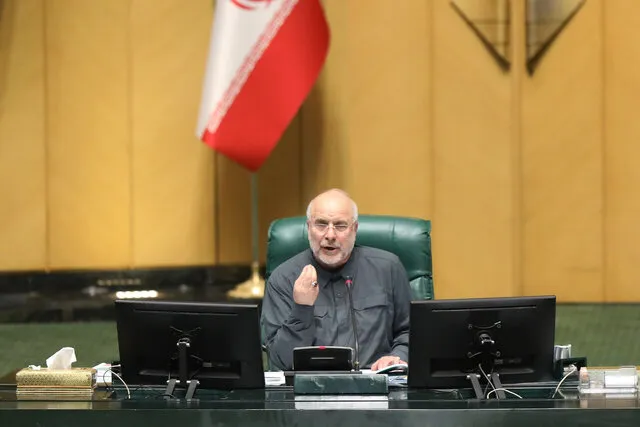
Tehran - BORNA - In an explanatory statement addressed to the public regarding the war and current domestic developments, Mohammad Baqer Ghalibaf, the head of Iran's negotiating team and speaker of parliament, expressed his condolences over the recent casualties in the country's south.
"I deem it necessary at the very outset to offer my condolences on the martyrdom of a number of our dear compatriots in southern Iran by the terrorist .U.S. military," Ghalibaf said. "These days, as the flames of war have flared up once again, questions are being asked among the public and various groups, and everyone answers them according to their own perspective."
Ghalibaf initially raised several questions: "Are we seeking war? Will the shadow of war end? Can we achieve our goals through negotiations? When dealing with a promise-breaking United States, what is the point of negotiating at all? And finally, how do we claim our rights and emerge victorious in this war?"
He explained that clear, precise, and accurate answers can be reached if the issue is viewed through the lens of national interest and security, free from factional bias.
An Existential Conflict with the United States
"First, we must understand that we are in an essential and existential war with the United States," Ghalibaf said. "Beyond overthrowing the holy system of the Islamic Republic of Iran as the main institution of the righteous front, the enemy's goal is to partition our beloved country. This strategy of the enemy has not changed."
"Second, as I have stated repeatedly before, the United States will seek to strike Iran and advance its interests whenever possible, and this is not limited to war, negotiations, or just the current .U.S. president," he continued. "Thus, our perspective on war or negotiations must be realistic, long-term, and based on national interests and security. Therefore, we have no choice but to rely on our own capabilities and grow stronger."
Ghalibaf added that the unified resistance of the Iranian nation and the armed forces disrupted the enemy's sinister plot during the recent 40-day war, forcing them to request a ceasefire and enter negotiations, though it has not changed their flawed strategy.
"The United States always maintains its arrogant nature and will never accept a strong Iran," he noted. "Based on these premises, the aforementioned questions must be answered: we have never welcomed war and never will, but we must always be ready for battle and stand to the death to protect our security and national interests. Alongside this, we must also use the tools of diplomacy and negotiation to realize and stabilize our national interests."
An 'Eye for an Eye' Policy
The parliament speaker emphasized that a memorandum of understanding only holds meaning when its clauses are valid and being implemented.
"Otherwise, if the Islamic Republic of Iran is not to benefit from this text, we have no reason to adhere to such an agreement, based on the 'an eye for an eye' policy I have previously outlined," Ghalibaf warned. "As we are witnessing these days, our armed forces enjoy complete freedom of action to counter enemy aggression, just as they always have."
He contrasted the recent conflict with past events, noting that Iran correctly closed the Strait of Hormuz during the 40-day war, unlike during the previous 12-day war, because it was causing insecurity and endangering national security.
"Today, our national security lies in maintaining 'Iranian arrangements' over the Strait of Hormuz and ensuring the maximum safe and harmless passage of commercial vessels through this waterway, so that it creates security for Iran," Ghalibaf said.
He questioned what process Iran went through to achieve this position, explaining that with the start of the third imposed war in March, the armed forces asserted control over the strait.
"During the negotiations, we also solidified the Iranian arrangements of the Strait of Hormuz in Clause 5 of the memorandum of understanding, using it as leverage to secure the implementation of four other clauses of our gains from the agreement," Ghalibaf said. "Now that we have reached the implementation phase, the United States—which is empty-handed legally and diplomatically—wants to weaken these Iranian arrangements through force, but we must stand firm on the achievements we secured in the memorandum to realize the rights of the nation. The enemy is applying pressure to compensate for its defeat, but Iran, relying on its own power, will not allow the enemy's will to be imposed."
Negotiation Is Part of the Resistance Strategy
Ghalibaf stressed the need to coordinate military and diplomatic methods, stating that the nation should fear neither war nor negotiations.
"Negotiation at this stage, as I have repeatedly declared, is not equivalent to compromise; rather, alongside war, it is part of the strategy of resistance and safeguarding national interests," he said. "This coordination and the comprehensive use of diplomatic and defensive tools to protect our beloved Iran is not only a duty but an unavoidable necessity. Separating these two methods or choosing only one as the sole solution is a strategic error."
He added that Iran is facing a complex war with the world's greatest material power and has achieved great honors, requiring its thoughts and actions to be equally grand, complex, and resilient.
Ghalibaf noted that this example can be extended to Lebanon, the lifting of sanctions, the future of .U.S. bases in the region, and avenging the blood of the martyred leader of the Islamic Revolution and other martyrs of these two imposed wars.
"Therefore, the path to victory and realizing the nation's rights in this sensitive situation lies in following the guidelines of the leadership and moving according to a precise roadmap based on resistance, rationality, and the smart use of all defensive and diplomatic capacities to impose our will on the enemy and minimize the economic consequences of the war on the people," he stressed.
Ghalibaf pointed out that the boundary between war and negotiations with the enemy is determined by national security and interests, adding that the supreme leader and commander-in-chief holds the authority to decide when to employ either tool.
"We all have a duty to strive for war, diplomacy, or both, in accordance with the duty specified by the deputy of the Wali al-Asr," Ghalibaf said, calling on the Iranian nation to maintain unity in obedience to the supreme leader and to make their presence felt on the field to defy the enemies.
Avenging the Martyred Leader's Blood
"Do not pay attention to the news published by some to make you regret the path traveled, make you despair of the future, or make you distrust the servants of the nation," Ghalibaf warned. "The enemy is banking on despair, fear, division, and mutual distrust. Your support and trust in the soldiers of defense, diplomacy, and service will give them the upper hand against the enemy."
He emphasized that Iran's current strong stance in the Strait of Hormuz is a direct result of the strength generated by the people on the ground.
"It is certain for us that we will avenge the blood of our martyred leader, and the enemy must know that we will not compromise in pursuing our demands," Ghalibaf said.
Reflecting on his personal role, Ghalibaf noted that during the third imposed war, he was present both on the defensive field and in countering the enemy's media warfare.
"After that, with full knowledge of all the difficulties and character assassinations, I entered the diplomatic front and have never shirked my responsibilities," he said. "My goal is the elevation of our beloved Iran under the guidance of the supreme leader. I have spent my life fighting the enemy and have no fear of war, slander, threats, or destruction. My wish is to join my comrades and my martyred leader on this path."
Addressing the residents of southern Iran directly, the speaker said: "To the people of my country’s south, who are currently on the front lines: since my youth, I have stood shoulder-to-shoulder with you, bearing arms and fighting. You are the very soul of Iran. We have pledged our lives to defend this country, and by God's grace, Iran's victory is near."
Ghalibaf concluded by calling on the Iranian public to remain confident that their unity on the ground will guarantee victory.
"We not only do not fear threats and war with the enemy, but under the guidance of the supreme leader, we will deliver a decisive response to these crimes of the criminal enemy," he said. "And another favor which you love: help from Allah and a speedy victory. And give glad tidings to the believers."
End Article