Baghaei: No negotiations with US at this time; Hormuz shipping route talks with Oman are temporary
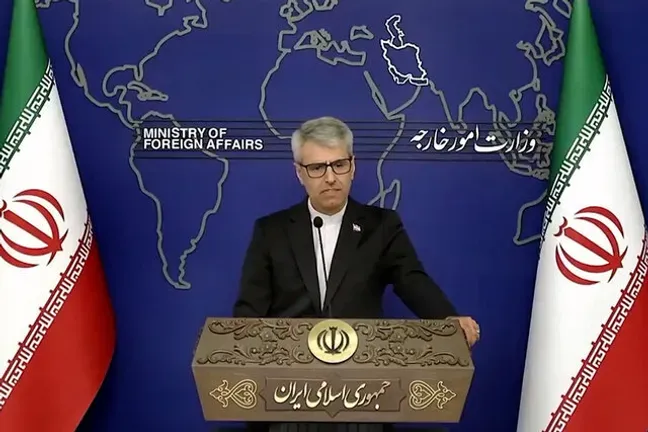
Tehran - BORNA - Esmail Baghaei opened his weekly press briefing on Monday by commemorating the Arbaeen pilgrimage, noting that this year's occasion was different for Iranians as the first pilgrim was the martyred leader, who embodied the example of Imam Hussein.
Baghaei said the US once again sent its "aid" to Iran, this time targeting a taxi driver in Qeshm along with his wife and two-year-old child. A bomb weighing over 1,000 kilograms struck their home, leaving two teenagers orphaned. "Now all Iranian mothers and fathers are the parents of these two children," he said.
The spokesman also noted that US crimes extended to Iraq last week, where several Iranian citizens were martyred in a US airstrike with its allies. He also honored Nima Moradi, a 23-year-old Iranian taekwondo athlete and the son of a former prisoner of war, who was martyred in the cowardly Ukrainian attack on an Iranian commercial vessel.
Hormuz shipping route talks with Oman are temporary
Baghaei said that over the past seven to eight days, talks with Oman on the Strait of Hormuz have continued seriously. In recent days, Iran's Foreign Minister has also been in contact with counterparts in the region and beyond to prevent further insecurity and secure Iran's interests.
Asked about consultations with mediators on reviving the memorandum of understanding and Iran's conditions, Baghaei said: "We are not negotiating with the US at this time. Our talks are with Oman, focused on reaching an understanding on a safe shipping route through the Strait of Hormuz. We are trying at the earliest opportunity, in consultation and cooperation with Oman, to determine a temporary route to ensure safe passage. These are bilateral talks between the two littoral states. Others can appear constructively or destructively, but the matter concerns Iran and Oman. As for what happens in the next stage, that decision will be made later."
Baghaei said that an agreement on a safe shipping route is a necessary but not sufficient condition for reopening the strait. The strait was closed not because of disagreements between Iran and Oman, but due to US and Zionist regime military aggression. "As long as US aggression and the naval blockade continue, no significant change will occur in the strait's situation. Our talks with Oman are about the strait, and on matters concerning Iran and the US, we will have to see how the situation develops."
Iran's deterrence, not regional efforts, stopped US aggression
Asked whether Saudi efforts or Iran's decisive response prevented the US attack, Baghaei said: "It is a good thing that all regional countries consider themselves part of the region's situation and future. The US war is not just against Iran — it is against the security of the entire region. US military presence and its use of southern Gulf countries' territory has intensified insecurity for the entire region. It is natural that regional countries want to prevent escalation, and we appreciate those efforts. But experience has proven that what stops the enemy from mischief is nothing but Iran's strength and deterrence."
All Iranian negotiators are in Iran
Baghaei dismissed Trump's claims about negotiations starting today, saying: "Mr. Araghchi is traveling for the Arbaeen pilgrimage today, and all our negotiator friends are in Iran."
No new mediator added
Responding to reports of Chinese mediation, Baghaei said: "Pakistan is the mediator in Iran-US matters, with Qatar assisting when needed. We have friendly relations and close cooperation with China. China shares our concern about the escalation of destructive US unilateralism and the intensification of conflict and insecurity in the region. Chinese friends are using their good offices to prevent escalation. In this regard, China is helping like a number of other countries, but we have not added a new mediator to the existing mediators."
Spokesman's role in wartime
Responding to criticism that he speaks more like a military spokesman than a diplomatic one, Baghaei said: "I don't think it's appropriate to speak about myself. Regardless of the person, the spokesman's office is currently in a situation where the spokesman is in wartime and cannot speak outside the realities of war. On the other hand, the positions I express are not my personal views but the positions of Iran's Foreign Ministry."
He added: "These discussions have been ongoing for some time, and we respect all different views and critics. But as I mentioned, the spokesman and the entire diplomatic apparatus are not allowed to create a fantasy image of war. We are in a wartime situation, which has its own requirements that we must adhere to. The Foreign Ministry is not allowed to adopt positions contrary to national interests to please various factions or under the influence of political factions — all of whom we respect — and must act based on national interests."
Regional people increasingly oppose US presence
Baghaei said there are many cases of people, figures, and elites in regional countries expressing opposition to US military presence. "People in the region know this is a war against a Muslim country and are aware of its consequences. They know Iran has no hostility toward regional countries and that Iranians are peace-loving and seek peaceful coexistence with all neighbors. They are watching the situation closely and know that everything that has happened over these five months, including Iran's defensive response to US and Zionist regime aggression, has been not against regional countries but against the source of aggression."
He added: "It is natural that the people of the region increasingly protest US military presence and demand their governments remove US bases and prevent US exploitation of their national sovereignty to attack a Muslim country in the region."
Yemen's actions are not Iran's responsibility
Baghaei dismissed attempts to link Yemeni and Iraqi resistance operations against Saudi Arabia to Iran, saying: "I am sure those who raise this are knowingly trying to distort reality. Five months is not long enough for people to forget. Five months ago, on February 28, we faced the crime of US and Zionist regime military aggression. Did Iran open a new front? From the very first day of the imposed war, the US and Zionist regime used the territory and facilities of regional countries to act against Iran. Did we expand the fronts?"
Baghaei added: "The issue of Yemen concerns the Yemenis. We have stated our position on Yemen. Yemen has been under a cruel blockade for a long time. We have repeatedly said that Yemen's solution must come through dialogue and based on a roadmap agreed upon long ago between the relevant parties. So linking every issue to the war imposed on Iran is merely a pretext to avoid accountability and a sign of desperation. They started the problem themselves. The fire they ignited is contagious. You cannot start a fire against a country and then expect the fire to remain limited to your desired target."
He stressed: "Responsibility for everything happening in the region and beyond rests solely with the US as the initiator of this military aggression, and with all those who unfortunately decided to act as accomplices to the aggressors."
Israeli crimes continue against the entire region
Baghaei said Israeli regime crimes continue against the entire region, with aggression against Gaza continuing as genocide. In the 10 months since the ceasefire, at least 1,200 Palestinians have been martyred. Border violations in Lebanon also continue. "This situation is not just about the regime's nature but also about US support and cooperation. The responsibility of the entire region and the international community is clear. Unfortunately, the UN and various governments have so far remained passive in the face of open genocide, and this normalization of crime is shameful."
Baghaei also referred to the responsibility of the Organization of Islamic Cooperation and regional countries in this regard.
Iran-Venezuela relations
On the latest status of Iran-Venezuela relations following the summoning of Iran's ambassador, Baghaei said: "These relations have always been based on mutual respect and shared interests. The history of bilateral relations confirms this. Misunderstandings may sometimes arise with any country, which are typically clarified. These issues cannot negatively affect relations between two countries that have a long and respectful history."
Iran should not copy others' rhetoric
Asked about criticism that the Foreign Ministry does not respond to US rhetoric at the same level and speed, Baghaei said: "Let us remain Iranian. We have our own character, and I don't think we need to copy others' words and behavior."
No foreign delegations expected this week
Baghaei said: "We are not hosting any foreign delegations this week, nor are we visiting anywhere."
Iran-Ukraine vessel attack
In response to an question about whether Ukraine's explanation regarding the drone attack on an Iranian vessel in the Caspian Sea was convincing, Baghaei said: "Ukrainian officials, both in direct contact with the Foreign Minister and in messages sent to us, have emphasized that this action was unintentional. But the evidence, including Zelensky's explicit statements, suggests it was deliberate. We have heard their explanations and are waiting to see if they take any action confirming their claim that this crime was unintentional."
He added: "We will certainly take any necessary action to hold Ukraine accountable and ensure such a crime is not repeated."
US attacks on civilian areas have become a habit
Baghaei said US attacks on residential areas have become a habit, adding that this is not the first time. "The US began the imposed war by attacking civilian and residential targets. The attack on our leaders' residence was not legitimate. US actions against Iran constitute war crimes."
He added: "On February 28, alongside the attack on Tehran and the leaders' residence, the Shajareh Tayyebeh school in Minab and the Lamerd stadium were also attacked. All of these are civilian and residential areas. These actions have continued over five months — attacks on the Chabahar watchtower and civilian facilities show US insistence on destroying all international law norms. I draw your attention to the explicit admission by US officials that they will not consider any rules. This means intent to commit war. The international community and each government have a responsibility regarding gross violations of international humanitarian law. What the US is doing constitutes war crimes, and all countries are obligated to hold war criminals accountable. We will certainly use all international tools in this regard."
Iran-Oman talks on shipping route
Baghaei said talks with Oman are focused on a safe shipping route. "Whether this stage can connect to another process leading to de-escalation remains to be seen. Any understanding on shipping will address all matters related to national sovereignty and maritime services."
Iran-China military cooperation
Baghaei said Iran and China cooperate in various fields based on their 25-year comprehensive cooperation agreement, and new understandings are reached when needed.
US actions against Iranian shipping constitute piracy
Baghaei said US actions against Iranian shipping constitute piracy, adding that "the US has admitted its actions resemble pirates and takes pride in it. These actions show US hostility toward the Iranian people and its insistence on confrontation despite claims about the importance of diplomacy. Iran will take any necessary action to secure its interests."
Trump's comments on Venezuela, Greenland
On Trump's tweets about Venezuela, Greenland, and other countries, Baghaei said: "These behaviors follow a pattern of classical colonialism practiced by some countries before World War I using concepts like the white man's burden. After the two world wars, the international community was supposed to choose a different path, and the UN Charter was drafted based on the rejection of colonialism and the use of force. These claims by US officials contradict all UN Charter principles and international law. All UN member states should take a responsible position and express their opposition to such actions."
Ukraine-linked groups arrested in Iraq
Responding to reports of Ukraine-linked groups arrested in Iraq for sabotage and attacks on oil facilities, Baghaei said: "This is concerning. A party engaged in a four-year conflict elsewhere and known for unconventional actions raises concern that it may engage in false flag operations in our region. This is a warning for all regional countries. We are in contact with Iraqi friends on this matter because any insecurity in Iraq, whether against its national security or neighboring countries, could affect the entire region, including Iran."
Iran's contacts with regional countries
Baghaei said Iran has been in regular contact with regional countries since the first days of the imposed war. "Regional leaders know that security in this region is indivisible, and insecurity in any country will inevitably spread to others. They have also realized that US military presence does not create security but causes instability. Naturally, all those sincerely seeking security try to prevent escalation, but as I said, what ultimately protects us is our own capability and deterrence."
The ball is in America's court
On the status of the Islamabad Memorandum, Baghaei said: "We did not violate the memorandum; the US did. On July 7-8, the US responded disproportionately to an unproven claim and declared it would not implement any of its commitments. The situation is clear. We have never been the first to violate any understanding. If we want to use a football analogy, the ball has been in America's court for some time."
Iran-Oman talks progressing
Baghaei said talks with Oman on a new route have been progressing well. "We have had good discussions with Oman in recent days. Maps have been exchanged with cooperation from experts and relevant authorities, and discussions have been held on this matter. We hope both regional and outside actors appreciate this responsible approach and try to be constructive and allow the Iran-Oman dialogue to proceed rationally."
Israel-Lebanon negotiations
On negotiations between Israel and Lebanon, Baghaei said: "In any engagement with the Zionist regime, one can only adopt a pessimistic approach, because experience has shown it has never adhered to any agreements or commitments."
Caspian Sea Convention ratification
Baghaei said the Caspian Sea Convention was signed and finalized in 2018 among the five littoral states. "We have conducted very precise legal, political, and other reviews over this period. It was approved by the government on July 22 and sent to Parliament. We are trying to have it ratified at the earliest opportunity. When joining an important international document with legal, political, and security dimensions, we must decide carefully considering all aspects."
He added: "We believe ratification will provide grounds for cooperation among Caspian littoral states and prevent exploitation by actors outside the region. The convention prohibits any military presence of foreign countries in the region. Some concerns raised in public opinion, such as maritime boundary determination and baseline issues, are not addressed in this convention. The baseline issue will be discussed in another framework. We believe Iran's ratification will bring the convention into force — requiring all five littoral states to ratify — and will provide a good basis for cooperation and trust among the five members."
US-Saudi attack on Iraq condemned
Baghaei said Iran condemned the US-Saudi attack on Iraq and expressed strong protest to Saudi Arabia through diplomatic channels. "Saudi Arabia has provided explanations and claimed it did not participate, but what is certain is that this crime resulted from a joint operation with the US, and several Iranian citizens were martyred. The security of Iraq, the protection of its sovereignty, and the lives of Iraqi citizens are important to us, especially during Arbaeen when many pilgrims are traveling. This crime shows the US has a problem with what is sacred to us, just as it previously targeted the railway route to Mashhad."
Iran joins World Artificial Intelligence Organization
Baghaei said Iran's membership in the World Artificial Intelligence Organization, signed by Iran's ambassador in China, will help break the monopoly in one of the most important areas affecting all aspects of human life. "We will use this opportunity and framework to strengthen cooperation with China and other member states."
Saudi coalition against Yemen
On reports of a Saudi-led naval coalition against Yemen, Baghaei said: "What has been reported about a coalition is not new — such a coalition was formed ten years ago and proved ineffective. Yemen's issue will not be solved by such coalitions. It is a humanitarian issue related to a country's national sovereignty. We should strive for peace coalitions, not coalitions to harm Islamic countries. We have repeatedly said Yemen's issue must be solved through dialogue and based on the agreed roadmap, and we have always been ready to advance this process."
Hamas weapons handover reports
On reports of Hamas agreeing to hand over weapons, Baghaei said: "Reports are conflicting, and you have seen the conditions and positions of Palestinian resistance. The Zionist regime has never adhered to any treaty or understanding and has used agreements reached through mediation to continue genocide. Consider the three years of genocide statistics. Israel insists on the colonial elimination of occupied Palestine. In such conditions, Palestinian resistance and the Palestinian people have no tool but resistance to secure their right to self-determination."
Iran does not attack regional countries
Baghaei said Iran does not attack any country but defends itself. "Iran's defensive strikes are against bases and sources of attack. I emphasize we have no hostility toward any regional country and respect their territorial integrity and sovereignty. But regional countries must fulfill their responsibilities and not allow their territory to be used for attacks against Iran. We hope the five-month experience has taught everyone that continued US military presence in these countries will only produce insecurity, division, and discord among regional countries. Ultimately, as permanent neighbors, we must decide to create a mechanism ensuring security for all regional countries through mutual trust and constructive cooperation."
End Article