Iran Foreign Ministry works in full coordination with top security council, spokesman says
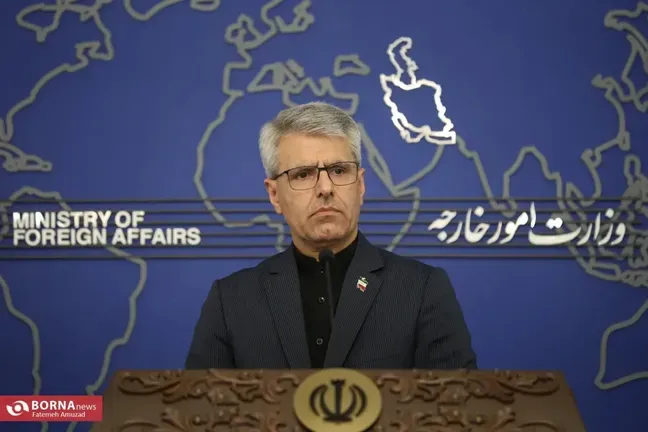
Tehran - BORNA - Speaking during his weekly press conference, Esmaeil Baghaei congratulated reporters on Iranian Journalist Day and commemorated the diplomats martyred in Mazar-i-Sharif. He also paid tribute to journalists killed in Palestine and Lebanon over the past two to three years by the Zionist regime.
Mecca Pact reflects shift in regional security perception
In response to a question regarding the Mecca Agreement ("Defense Pact between Pakistan, Saudi Arabia, and Turkey") and the perspectives and analyses raised in this regard, the Foreign Ministry spokesman stated that from one perspective, this topic demonstrates a shift in how regional countries perceive security. He noted that following the developments of the past three years, regional states have realized that security is not a commodity to be bought from false security brokers, and Iran’s principled policy has always maintained that regional countries must cooperate to achieve endogenous security without relying on extra-regional actors.
He added that another point is that after the developments of October three years ago and the crimes of the Zionist regime in Gaza and Lebanon, regional countries reached the conclusion that the Zionist regime is the greatest threat to the stability and security of regional nations and the global community. The ambitions of the Zionist regime are fully evident, including the disgraceful "Greater Israel" scheme that targets the national sovereignty and territorial integrity of several regional countries.
The Iranian Foreign Ministry spokesman said that this scheme represents a threat to regional countries, including those participating in this trilateral understanding, which reinforces the strengthening perception that regional nations can no longer rely on claims of providing security made by the United States—a United States that is itself part of creating insecurity in the region.
The Foreign Ministry official continued that Iran believes security in the region is indivisible, and any plan rooted in the region's historical and geopolitical realities that is comprehensive and correctly identifies the enemy and threat stands a chance at strengthening regional security and preventing instability.
Closure of Iranian school in Kuwait is a political decision
In response to a question about the Kuwaiti government's action in closing the sole Iranian school in that country and the situation of four detained Iranians there, the spokesman for the Ministry of Foreign Affairs of the Islamic Republic of Iran stated that regarding the Iranian citizens, follow-ups have continued, but the Kuwaiti government has withheld consular access without regard for international obligations. He emphasized that this is a legitimate and lawful request from Iran, expressing hope that the Kuwaiti government will reconsider its decision.
He added that regarding the Iranian school, this is another strange action. Retaliating against the most innocent segments who use this school to gain education cannot be justified under any circumstances. This school has a long history, operating for decades without any issues, and it appears this decision is political. Iran's embassy is following up on the matter, and he expressed hope that the issue will be resolved.
Baghaei stated that Iran's expectation from regional countries and Kuwait is that instead of projecting blame, they refrain from placing their territory and assets at the disposal of aggressive actions against Iran. He noted that this is not a high expectation and aligns with good-neighborliness and the commitments of the Kuwaiti government.
Regarding the requests of Venezuela and Chad to withdraw from the International Criminal Court (ICC), he stated that these two countries are not the only ones to submit such requests, as four or five countries had previously raised similar demands. This is a sign of the international community's disappointment with a court established with the goal of ending impunity, but which failed to emerge successfully from tests in recent years due to pressure from the U.S. and its allies on the tribunal. Baghaei noted that the world witnessed U.S. threats against the prosecutor and judges of this court. All of this led countries to the conclusion that they face selective justice, where the ICC's mission is to pursue justice in cases where the interests of certain powers require it, while exhibiting entirely different behavior in other cases. This situation has dealt a serious setback to the multi-decade plan that began after the World Wars to combat the most severe international crimes, with responsibility resting on the United States and countries that remained indifferent to the crimes of the Zionist regime.
Prior communication on the Mecca Pact
Continuing his remarks on the Turkish Foreign Minister's comment that Iran was informed prior to the signing of the Mecca Agreement among Saudi Arabia, Pakistan, and Turkey, the Foreign Ministry spokesman stated, "Yes, more or less."
Furthermore, in response to a question regarding the President's potential trip to New York to attend the United Nations General Assembly and the President's plans during this visit, he stated that discussions should take place as the dates for the General Assembly draw closer.
Presidential attendance at UN General Assembly depends on conditions
Stating that a definitive decision has not yet been taken in this regard, Baghaei noted that Iranian presidents usually attend the United Nations General Assembly—which is the most important UN meeting—to express the views and positions of the Islamic Republic of Iran, and this year Iran intends to utilize this opportunity, though it naturally depends on circumstances and conditions.
He noted that further information regarding this matter would be announced in the coming weeks.
In response to a question regarding statements by Turkish and Pakistani officials that other countries could join the Mecca Agreement—with some referring to it as an "Islamic NATO"—and asking for Iran's view on joining this agreement given that Iran itself presented proposals like the "Hormuz Peace Endeavor" in recent years, as well as why these plans were not pursued over the years and whether that was due to lack of follow-up from Iran or lack of reception from regional countries, Baghaei pointed out that as noted earlier, Iran was a pioneer in this field and emphasized pursuing endogenous regional security mechanisms without the intervention of extra-regional actors.
Referring to Iran's proposals in this regard, Baghaei said that cooperation frameworks still exist and can be updated according to current developments.
He continued that Iran remains in contact with neighboring and regional countries, expressing hope that all regional states, by learning from recent developments, will adopt the best path toward strengthening collective security in the region.
No reason to be concerned about the Mecca Pact
In response to another question regarding the Mecca Agreement and analyses suggesting potential Iranian concern over it, the diplomatic spokesperson stated that Iran shares deep religious, historical, and civilizational bonds with Turkey, Pakistan, and Saudi Arabia, so there is no reason to be concerned that this pact is directed against Iran. The intertwined cultural ties among the nations of Iran, Pakistan, and Turkey are completely clear. This development is an important signal that regional countries have concluded they cannot rely on security claims made by the U.S. and certain other actors outside the region, and are attempting to test another method by relying on their own capabilities and perspectives independent of destructive foreign interventions.
Decision on Caspian Convention rests with Parliament
Regarding the timing selected for referring the Caspian Convention to Parliament for ratification and the analyses raised in this context, Baghaei stated that whenever chosen, one can analyze whether the timing for ratifying an international document is suitable or unsuitable. In any case, since its signing in 2018, various dimensions of this document have been discussed and evaluated—not only in the Ministry of Foreign Affairs, but across other competent authorities as well.
He added that the Islamic Republic of Iran decides independently regarding its national interests and concerns, expressing that further explanation is unnecessary as Iran has shown that decisions regarding membership in international instruments are made exclusively by considering the country's interests.
Baghaei continued that this document has 5 members, and 4 other countries have signed it. The desire of a country or countries for this document to enter into force sooner stems from the fact that until all 5 countries accede to it, it cannot be implemented, which is entirely natural. In any case, countries that decide to draft a document to secure their common interests or counter shared concerns prefer that the document becomes enforceable. From this perspective, it is completely natural that the other four countries are inclined toward the early entry into force of this document.
Stating that "we consider our own interests regarding the Caspian Sea," he noted that it appears over the past 7 years a final conclusion had not been reached to send this document to Parliament. Linking this matter to developments related to the imposed war lacks much foundation. Views differ, and Iran respects them.
The Foreign Ministry spokesman added that ultimately, the decision rests with the Islamic Consultative Assembly. In accordance with the Constitution, the Foreign Ministry as the diplomatic apparatus has performed its duties, and moving forward along this path it must continue to clarify and explain while listening to various viewpoints. However, determining the final status of this document after seven to eight years naturally rests with the Islamic Consultative Assembly, which will hopefully be accomplished.
Foreign Ministry acts in full coordination with top security council
In response to a question regarding changes within the Supreme National Security Council and whether Foreign Minister Araghchi or newly appointed SNSC Secretary Mohsen Rezaei would lead negotiations, Baghaei remarked that he believes the entire world, especially over the past year and a half, has clearly seen that Iran is a nation of institutions rather than individuals. If Iran has been able to navigate existing challenges over the past year and a half, it is because decisions and policy-making are carried out within institutions, and the processes for decision-making are completely clear.
Congratulating Mohsen Rezaei on his appointment as Secretary of the Supreme National Security Council, he stated that the Foreign Ministry will certainly make every effort, just as in the past, to move and work in complete coordination with the Supreme National Security Council to advance the nation's interests and concerns.
Joint Iran-Oman statement regarding the Sea of Oman under review
Regarding a query about whether maritime transit fees between Iran and Oman will be divided or belong exclusively to Iran, the Foreign Ministry official stated that such details are not being discussed at this stage. As stated previously, discussions are ongoing. Regarding the transit route map, an agreement has been reached, and concerning the joint statement, certain technical points remain under review, though negotiations are proceeding very smoothly and constructively. Regarding these details, there is no discussion at present. What is clear is that mechanisms will be established to monitor safe transit through the Strait of Hormuz while arranging measures for environmental matters, cooperation in providing maritime services, and combating crime. Naturally, when maritime services are provided, corresponding fees must be collected in return. Naturally, decisions on these details will also be made in due course within the framework of agreements.
Invitations received for Araghchi and Ghalibaf to visit Pakistan
In response to a question regarding news published about Pakistan extending invitations to Mr. Araghchi and Mr. Ghalibaf to visit the country and the objectives behind these invitations, the Foreign Ministry spokesman stated that exchanges between two neighboring countries with very close and expanding relations occur routinely, as evidenced by several Pakistani officials visiting Iran recently and Iranian officials making reciprocal visits to Pakistan, including visits by Iran's Minister of Industry, Minister of Economy, and Minister of Interior.
The senior diplomat of the Islamic Republic of Iran noted that invitations for visits by Mr. Araghchi and Mr. Ghalibaf to Pakistan have been received, and whenever suitable grounds are established, the trips will take place.
He noted that these visits primarily concern bilateral relations, as ties between the two countries are important and have grown even more important over the past seven to eight months, reiterating that such exchanges between Iran and Pakistan are entirely natural and a normal part of bilateral relations.
Adapting diplomatic tools to audience and situation
In response to a question regarding the language used when responding to the enemy, Baghaei stated that in confronting the enemy, Iran utilizes all its assets, including its rich literary, cultural, and civilizational heritage. He noted that he does not believe Iran has deviated from its longstanding approach, but the important point is that practical requirements of the field sometimes necessitate using different expressive tools to clarify positions.
He cited an English thinker, noting, "For instance, to quote an English thinker—I believe George Bernard Shaw—who said: 'When you wrestle with pigs, you shouldn't expect not to get muddy.' This shows that getting muddy is sometimes part of the nature of a struggle that has been imposed upon us. This change in tone does not mean departing from principles, but rather using all communicative and cultural capacities intelligently when facing new conditions. In essence, we remain steadfast in our principles, but we adjust our tools of expression to suit the audience and the situation in order to convey our message clearly."
This Item Is Being Updated