Iran dismisses claims Strait of Hormuz is open as psychological, media warfare
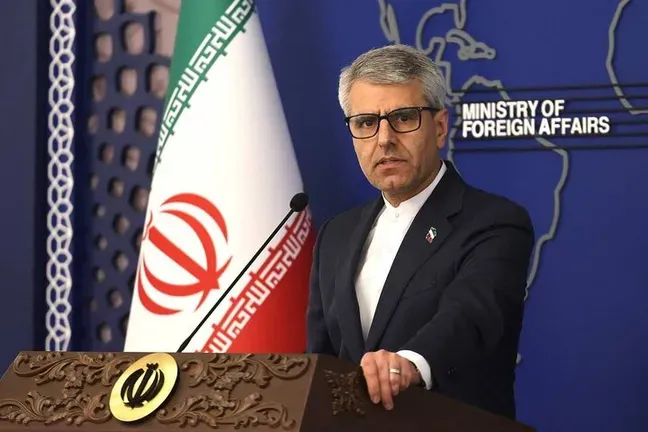
Tehran - BORNA - Asked about the reports and the figures cited for oil shipments through the strategic waterway, Baghaei said, “Those with discernment will understand. Just look at the discrepancy between the figures being cited—from 5 million to 16 million.”
“This is part of the psychological and media warfare campaign launched by the opposing sides. That is simply not the case,” he said.
“The Strait of Hormuz was closed because of the insecurity that the United States and the Israeli regime have imposed on the region and the strait since February 28,” the spokesman added.
Baghaei made the remarks during his weekly press conference on Monday, in which he reviewed the latest foreign policy developments and answered reporters’ questions.
At the beginning of the briefing, he marked the approaching Islamic Unity Week and paid tribute to Iranian government officials who lost their lives in the line of service.
Referring to the anniversary of the August 25, 1941 occupation of Iran during World War II despite the country’s declared neutrality, Baghaei said such historical events carried important lessons.
“Nothing but national strength and the reinforcement of national security can deter other countries from committing aggression and encroachment,” he said.
“The Islamic Republic of Iran has learned this lesson well in safeguarding the country’s strength. As we see today, despite all their conspiracies, the enemies have failed to achieve their intended objectives against our country.”
Foreign Ministry among top-performing government bodies
Asked about the Foreign Ministry’s administrative reforms, Baghaei said the ministry had begun implementing a 17-point package of measures in May 2024 to improve its procedures and performance.
He said a dedicated committee had been established and that the process had already produced results in several areas, including consular services.
“Many of these improvements were evident during the Arbaeen pilgrimage. Significant progress has also been made in visa services and other services provided to Iranians inside and outside the country,” he said.
Baghaei added that the ministry had conducted diplomacy under crisis conditions over the past year and a half amid the extraordinary circumstances created by two wars imposed on the country.
“You witnessed our achievements in public diplomacy and in conveying Iran’s rightful position to the world,” he said. “According to the assessment of government bodies, the Foreign Ministry ranked among the top-performing institutions in the areas evaluated.”
Proposals raised for regional collective security talks
Responding to an question about an Al Mayadeen report suggesting that Iran had been invited to join the Makkah Agreement—a military pact involving Pakistan, Saudi Arabia and Türkiye—Baghaei said Tehran had received no formal invitation.
“We have not received an official invitation in this regard,” he said. “There have, however, been proposals for talks among regional countries to examine a mechanism for establishing collective security in the region.”
Bulgarian cooperation with U.S. amounts to participation in aggression
Asked about reports that Iran would target U.S. bases in Europe if the war resumed, as well as the departure of American aerial refueling aircraft from Bulgaria, Baghaei said Tehran had already made its position clear.
“We have also heard that several U.S. refueling aircraft have left Bulgaria,” he said. “From the outset, as many Bulgarian citizens and politicians also stated, this action was contrary to international law and amounted to supporting the aggression by the United States and the Israeli regime against Iran.”
“Under international law, such participation constitutes an act of aggression,” he continued. “We hope other countries that made their bases and facilities available for the crime of aggression will also take the necessary measures.”
“No country has any reason to be concerned about Iran unless it has placed its bases, facilities and equipment at the disposal of the aggressors for the commission of an illegal act,” Baghaei said.
“Iran has the right to target the points from which any act of aggression originates. This right is recognized under international law, and as we have demonstrated, we will show no leniency in defending Iran.”
Iran and Afghanistan working to expand trade
Asked about the president’s call to remove border and customs obstacles to greater cooperation with Afghanistan, Baghaei said both sides needed to work toward strengthening commercial exchanges.
He referred to a meeting in Tehran in July between Afghanistan’s deputy prime minister for economic affairs and the Iranian president.
“One of the issues raised by the president at that meeting was facilitating economic and commercial cooperation between the two countries through the removal of border and customs obstacles,” he said.
“Positive measures have since been placed on the agenda, and several ministers have traveled to Afghanistan in this connection. We hope these exchanges and efforts will lead to an increase in bilateral trade as soon as possible.”
Omani foreign minister’s visit unrelated to Pakistani army chief’s trip
Baghaei also addressed the purpose of the Pakistani army chief’s visit to Tehran and whether it was connected to a planned visit by the Omani foreign minister.
“The Pakistani army chief’s visit is taking place today within the framework of the very good relations between the two countries,” he said.
“Our bilateral relationship is experiencing one of its best periods, and both sides are determined to draw on the various bonds between the two countries to expand relations in all fields day by day.”
He added that Pakistan had used its good offices over the past several months to help reduce regional tensions.
“The Omani foreign minister’s visit has no connection with this matter. The two visits have merely coincided in terms of timing,” Baghaei said.
He said Omani Foreign Minister Badr Al-Busaidi was scheduled to visit Iran on Tuesday for talks on bilateral relations, the Strait of Hormuz and maritime transit routes.
War will not end on aggressor’s terms
Asked about the president’s recent statement that it would be better to end the war while Iran was in a position of strength, Baghaei rejected interpretations suggesting that Tehran was prepared to accept the aggressor’s conditions.
“Officials of the Islamic Republic of Iran made their seriousness and resolve in defending Iran’s borders clear from the outset,” he said. “We will show no leniency toward the aggressors.”
“As you noted, the Islamic Republic of Iran did not start the war. It has been defending its rights, territorial integrity and national sovereignty. Naturally, the aggressor must be held accountable,” he continued.
“We certainly did not start the war, but we will not allow it to end on terms set by the aggressor.”
Baghaei said the president had repeatedly and unequivocally stressed that Iranians would not surrender in the face of coercion or the aggressors’ drive for domination.
“It would not be appropriate for me to assess the performance of the president and the government here, as I am the Foreign Ministry spokesman,” he said. “However, everyone clearly saw how the government and all pillars of the Islamic Republic stood united in defense of Iran during the past 40 days and, before that, throughout the 12-day military aggression.”
“Statements must be viewed in their entirety rather than in isolation,” Baghaei added.
“There is no doubt that the Iranian state, at every level, is determined and resolute in defending Iran and will under no circumstances surrender to the aggressor’s excessive demands.”
Chile’s embassy closure does not mean severance of diplomatic relations
Asked about Chile’s decision to close its embassy in Iran and whether Tehran was considering a similar measure, Baghaei said Chilean officials had attributed the decision to financial considerations.
“They have apparently taken similar measures in several other countries as well,” he said.
“We sometimes see countries make such decisions, and as the Chilean authorities have stated, this does not mean the severance of diplomatic relations.”
France’s expulsion of Iranian diplomats was illegal
Baghaei also addressed France’s decision to expel two Iranian diplomats, saying Iran had previously taken action over the conduct of two French diplomats in Tehran.
“Some time ago, two French diplomats in Iran carried out activities beyond the scope of their lawful duties,” he said. “We issued the necessary warnings, summoned the French ambassador to the Foreign Ministry and conveyed Iran’s protest.”
“Unfortunately, the other side attempted to portray the facts differently. The activities of the two French diplomats violated international diplomatic conventions, and within that framework, we announced that they could not return to Iran.”
Baghaei described France’s subsequent expulsion of two Iranian diplomats as an illegal response to Iran’s lawful measure.
“It certainly does not contribute to bilateral relations,” he added.
Iran did not start the war, Baghaei says amid economic concerns
Asked whether Iranian policymakers were considering the country’s economic conditions, including rising currency and gold prices, and whether there was a determination to end the war and the prevailing uncertainty, Baghaei expressed surprise at the question.
“All these issues are taken into consideration by policymakers. Did we start this war?” he asked.
“Over the past two years—and I do not intend to recount the history of Iran-U.S. negotiations and American breaches of commitments—Iran’s goodwill has repeatedly been met with bad faith. The JCPOA and the Islamabad understanding are clear examples. In many cases, arrangements were reached, only for the American side to violate them.”
Baghaei said even U.S. allies, including Canada, had raised questions about the credibility of Washington’s commitments.
“They said the United States signs its commitments in pencil,” he said. “It would be unfair to blame ourselves regarding Iran.”
“Iran did everything it could through diplomacy over the past year and a half to prevent war and protect its national interests. The other side did not even wait a month. Only 21 days after signing the understanding, it violated all its commitments.”
“We should therefore not blame ourselves for the continuation of a war that we did not start.”
Baghaei said Tehran understood the economic difficulties imposed on the Iranian people, describing them as part of the pressures the United States had applied against Iranians for decades.
“We must use every available tool to alleviate the people’s suffering. That is the responsibility of the government, and efforts are underway,” he said.
He pointed to the damage inflicted on energy infrastructure, oil and gas facilities and refineries during what he called the illegal war, saying much of it had been repaired through the efforts of the Iranian people while attempts had been made to minimize the pressure on the public.
“We share in all the difficulties endured by the people,” Baghaei said. “However, every patriotic Iranian understands that we must withstand hardship to prevent the enemy from coveting our country and to protect Iran against its hostile actions.”
“In every analysis of war and peace, we must remember that we did not start this war or welcome it. On the contrary, we used every available means to end it, but the other side repeated its longstanding pattern of breaking commitments.”
Iran has been playing both chess and poker
Asked whether Iran had shifted from a model of strategic patience and chess toward one resembling poker—characterized by greater risk-taking, crossing previous red lines and carrying out retaliatory threats—Baghaei said Tehran was now using a combination of the two approaches.
“We have long been chess players. In recent years, we have also become poker players, and for some time now, we have been playing a combination of the two,” he said.
Iran-Iraq security interconnected
Commenting on Parliament Speaker Mohammad Bagher Ghalibaf’s recent visit to Iraq, Baghaei described it as highly significant.
“Iran and Iraq are two neighboring countries connected in many different ways, and they must further expand their relations,” he said.
“The security of Iran and Iraq is interconnected. It is important that we turn the two countries’ borders into borders of security and friendship. Both sides are pursuing this approach.”
He said useful discussions had taken place during the visit and expressed hope that the process would continue in the interests of both countries.
Iranian nationals in U.S. chose to return voluntarily
Asked about Iranian nationals in the United States and U.S. media reports of coordination between Tehran and Washington over their return, Baghaei said the coordination likely referred to Iran’s Interests Section in Washington.
“We are obliged to assist Iranians wherever they encounter difficulties around the world,” he said.
“These Iranian citizens were subjected to harassment under various pretexts. It was clear that this treatment reflected a discriminatory and politically motivated approach, particularly because it began after the new U.S. administration took office.”
“The Iranian nationals themselves decided to return to their country, and our office facilitated the process,” Baghaei continued. “It is the right of Iranians to return to their homeland whenever they choose. Nevertheless, the United States’ human rights violations cannot be overlooked.”
British ambassador and embassy staff return to Tehran
Commenting on the status of the British Embassy in Tehran, Baghaei said the British ambassador and embassy staff had returned to the Iranian capital two weeks earlier.
“They had apparently been on holiday,” he added.
Foreign Ministry holding talks over winter energy supplies
Asked about damage to Iran’s energy facilities during the war and preparations to meet the country’s winter energy needs, Baghaei sought to reassure the public.
“Rest assured that all necessary efforts will be made,” he said. “The specialized body responsible for these measures is the Oil Ministry, and we will also make efforts through diplomacy.”
“Trust ourselves and those working to provide services. Despite the damage sustained over the past five or six months, we have seen how efforts were made in various sectors and how many issues, including fuel supplies and other energy-related matters, were addressed.”
Baghaei said the Foreign Ministry had already begun talks with parties capable of supplying energy to Iran if necessary.
Iran’s opposition to Israeli occupation of Syria remains unchanged
Asked why Iran continued to condemn Israeli attacks on Syria despite critical remarks by the Syrian foreign minister toward Tehran, Baghaei said Iran’s principled positions did not depend on which group or faction governed an Islamic country.
“We oppose the Israeli regime’s occupation, and as I have said, this is a principled policy of Iran,” he said.
“Opposition to the Israeli occupation of Syria is a shared position among all Islamic countries. In line with the region’s interests and in solidarity with Islamic countries, we have opposed the continuation of this occupation and the Israeli regime’s aggression, and we will continue along this path.”
Iranian ambassador meets four Iranian captives in Kuwait
Addressing the situation of four Iranian nationals held in Kuwait and three Iranian pilots in Qatar, Baghaei said the 1949 Third Geneva Convention had been violated in both cases.
“The Kuwaiti side, in particular, must be held accountable,” he said.
“We are pleased that, after extensive efforts, our ambassador was able to meet the four Iranian captives in Kuwait. The ambassador of the Islamic Republic of Iran held the meeting on August 18 and confirmed that they were in good health.”
Baghaei called for their immediate release and return to Iran.
“Regarding Qatar, as I have previously stated, our demand will remain in place until the fate of the three brave Iranian pilots is clarified,” he said. “We will use every bilateral and multilateral avenue available to determine their fate.”
New U.S. sanctions expose hostility toward ordinary Iranians
Commenting on new U.S. sanctions against Iran, Baghaei invoked the Iranian saying that there is no point in trying what has already failed.
“It appears that, according to the logic of the U.S. administration, repeating failed approaches is not only acceptable but appropriate,” he said.
“Repeating methods that have already proved unsuccessful will produce no different result. It will only demonstrate the extent of the United States’ hostility toward every Iranian, as Washington is well aware that the effects of these sanctions reach ordinary Iranian citizens.”
Baghaei said Iran would use all available multilateral mechanisms to counter the economic sanctions and had made the necessary preparations.
“These measures, which the Americans themselves describe as ‘economic warfare,’ also expose the erosion of free trade among countries and the damage being inflicted on their national sovereignty,” he said.
“Compelling or intimidating other countries, without any legitimate basis in international law, to terminate or restrict their commercial relations with another state amounts to violating a fundamental foundation of international relations and a central principle of the United Nations Charter: respect for national sovereignty.”
“This conduct should serve as a warning to every country,” he added.
Baghaei said many governments had condemned the U.S. approach in bilateral discussions with Iran and were concerned that it would undermine the rules governing international trade.
He also referred to Washington’s treatment of its own allies, particularly Canada’s recent criticism of what it viewed as U.S. lawlessness and excessive demands during negotiations.
Iranian diplomacy continuously adapting to new conditions
Asked whether Iran needed to modify its diplomatic conduct and whether the Foreign Ministry had warned other countries about Washington’s threats to isolate Iran economically, Baghaei said diplomatic methods were continually being adapted.
“If modifying diplomatic conduct means adapting our approaches and performance to current conditions, this is something that is constantly taking place, as it should,” he said.
“In view of regional and international developments, we must be able to take appropriate and proportionate action to safeguard our national interests and security.”
“We certainly cannot conduct today’s diplomacy using the same methods and approaches as a year ago,” Baghaei added.
“Just as we have learned from past events in the field and in defending the country, and must grow stronger and better prepared each day, diplomacy must also evolve. This is entirely natural.”
U.S. sanctions amount to economic terrorism and warfare
Baghaei said Washington had previously called its measures economic sanctions but was now openly describing them as economic warfare.
“We repeatedly said these measures constituted economic terrorism and economic warfare, but they attempted to justify them using other terms,” he said.
“I believe there can no longer be any doubt that the United States—the America that was supposedly going to help Iranians—is using every available instrument to punish them for one reason alone: their insistence on preserving their national sovereignty, independence, dignity and honor.”
Baghaei said Tehran had issued and would continue issuing the necessary warnings to other countries.
“Any complicity with the United States in advancing its aggressive actions against Iran will have consequences,” he said.
“The current maritime blockade of Iran is itself an act of aggression. Any escalation of this situation will carry consequences of its own.”
“We are not powerless in the face of such aggressive actions,” he continued. “Under international law, other countries are not permitted to cooperate with or assist the United States, since these measures violate international law and human rights.”
Iran sees no reason to view regional defense pact as hostile
Commenting on a defense agreement among Pakistan, Türkiye and Saudi Arabia, Baghaei said Iran had no reason to believe that a pact among three Islamic countries was directed against Tehran.
He said the agreement nevertheless reflected regional disappointment and concern over U.S. conduct.
“Regional countries have concluded that the United States’ sole concern in the region is protecting the Israeli regime’s illegitimate interests,” he said.
“They have also concluded that protecting the region against Israeli expansionism requires efforts to establish regional mechanisms and mutual understanding. This is a positive development.”
U.S. warships should leave region and return home
Asked about Iran’s proposed solution to the difficult situation facing U.S. warships and their sailors in the region, Baghaei replied: “They should leave the region and return home.”
Persian Gulf’s name cannot be changed by transient political waves
Asked about controversy surrounding the use of an incorrect name for the Persian Gulf by the Iraqi parliament speaker during Ghalibaf’s visit to Iraq, Baghaei said the waterway’s historical name would not be affected by transient political rhetoric.
“The Persian Gulf is too magnanimous and generous for its name to be altered by temporary waves or political wave-riding, particularly at a time when it is disciplining foreign aggressors who have trapped themselves in a situation of their own making,” he said.
“The people of Iran and Iraq are certainly too mature and discerning to be influenced by such attempts at creating controversy.”
Baghaei said geographical names formed part of the shared heritage of Iran and other regional countries and should be used to bring nations closer together and strengthen their bonds, rather than create division.
“We must focus on the priorities that matter to Iran and Iraq and avoid unnecessary distractions,” he added.
Israeli attacks violate Syria’s sovereignty and territorial integrity
Commenting on new Israeli attacks against Syria, this time under the pretext of countering Türkiye, Baghaei said the strikes completely violated Syria’s national sovereignty and territorial integrity.
“The pretexts presented for these attacks do not justify lawbreaking or continued aggression,” he said. “They demonstrate the Israeli regime’s drive for domination and should prompt regional countries to think more seriously about the threat.”
Baghaei said Syria had the right to strengthen its military capabilities to defend its territorial integrity.
He added that Israel’s actions in Syria followed the same pattern as its conduct in Gaza, the West Bank, Lebanon and elsewhere, as it pursued illegal ambitions associated with the concept of a “Greater Israel.”
U.N. secretary-general selection losing significance for many countries
Asked about the selection of the next United Nations secretary-general, Rafael Grossi’s candidacy and Iran’s position, Baghaei said the process had already begun, with informal consultations underway in the Security Council and among U.N. member states.
“The reality is that this selection process is no longer particularly attractive or significant to many countries,” he said.
“Over recent years, the United Nations as a whole, its founding philosophy and the rules enshrined in its Charter have been gravely violated and disregarded. The functioning of both the Security Council and the organization itself has effectively been called into question.”
Baghaei said many countries were consequently asking what difference it would make who took the helm of the organization.
“This is a United Nations that took no meaningful action in the face of an evident genocide in Gaza,” he said.
“It is an organization that, because of U.S. influence, failed even to issue a simple statement condemning the two wars imposed on Iran by the United States and the Israeli regime, and one that has remained silent in the face of crimes committed across our region, including in Lebanon, Syria and Palestine.”
Baghaei said countries should use the selection process to warn against allowing the United Nations to suffer the same fate as the League of Nations.
“The most important reason the League of Nations met that fate was indifference toward violations of international law by major powers—the same phenomenon we are unfortunately witnessing today,” he said.
U.S. economic threats reflect desperation
Asked about U.S. Treasury Secretary Scott Bessent’s announcement of an approaching “economic day of reckoning” for Iran and new sanctions described as an economic and commercial offensive, Baghaei said the terminology should not obscure the policy’s underlying objective.
“Look at the history of the past five decades. We should not be deceived by labels,” he said.
“From ‘crippling sanctions’ and ‘maximum pressure’ to ‘economic warfare,’ they have all pursued the same objective: forcing into submission a nation that has decided to stand on its own feet, refuses to surrender its rights and understands that these waves—whether in the form of war, terrorism or economic sanctions—all serve the same purpose.”
“They have failed in all these areas,” Baghaei said. “The Iranian people will once again demonstrate that they remain determined and steadfast in defending their rights.”
He described the U.S. rhetoric as a sign of Washington’s desperation after it fell victim to miscalculations and the influence of malign actors who believed military aggression could bring the Iranian people to their knees.
Emphasizing what he called the instability and inconsistency of U.S. policymaking, Baghaei added: “The assertion that Iranians are untrustworthy at the negotiating table could not be further from the truth. The entire world has repeatedly seen that it is the American side whose word cannot be trusted and whose commitments cannot be relied upon.”
End Article