Baghaei: US confused over Iran; Asim Munir carried neither positive nor negative message
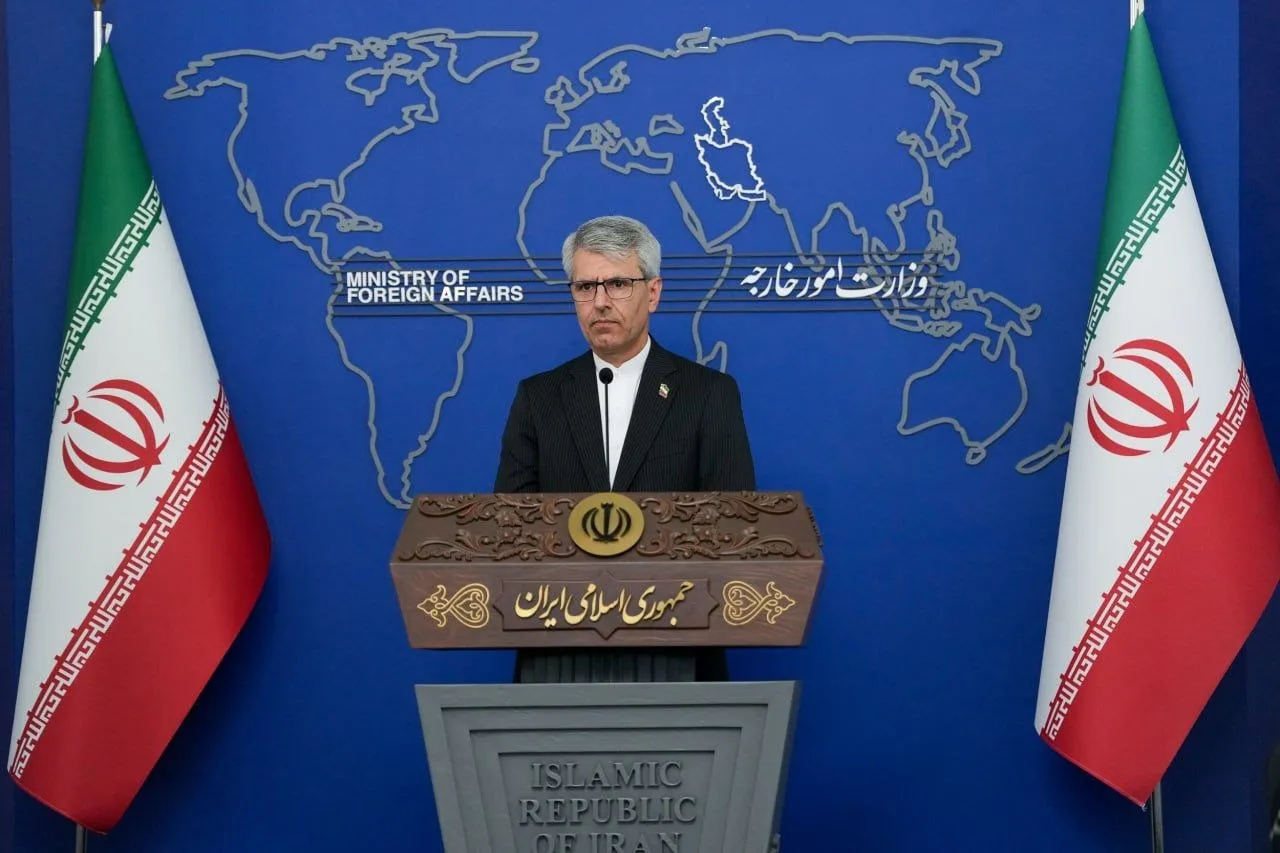
Tehran - BORNA - Baghaei made the remarks at his weekly press briefing on Tuesday, answering reporters’ questions on Iran’s foreign policy and the latest regional and international developments.
At the beginning of the briefing, Baghaei referred to the Foreign Ministry being selected as a top-performing government institution at the Shahid Rajaei Festival, saying the recognition reflected the tireless work of Iranian diplomats, particularly in recent months.
He also condemned Sunday night’s US attack on Larak Island and paid tribute to three Iranian citizens killed in the strike.
Asked whether Asim Munir had conveyed a US threat to Tehran during his visit last week, particularly in light of the renewed US attacks on southern Iran, Baghaei said: “Asim Munir carried neither a negative message nor a positive one.”
He said Munir’s visit to Tehran took place within the framework of Pakistan’s role as a friendly neighboring country that has used its good offices over the past six months to help reduce tensions in the region.
Baghaei added that similar efforts were also being pursued by several other countries.
Dictation does not work with Iran
Referring to the US attack on Larak Island, Baghaei said such actions were not new to Iran and that Washington had repeatedly resorted to military aggression under various pretexts.
“The United States commits acts of aggression under various pretexts, and it has received the necessary responses from Iran,” Baghaei said.
He said such actions demonstrated US bad faith and reflected Washington’s confusion after becoming trapped in a strategic mistake of its own making.
Baghaei added that US officials were “addicted to excessive demands” and had mistaken negotiations for dictation.
“That does not work with Iran, and as long as they continue acting in this manner, they will achieve no different result,” he said.
Iranian Armed Forces will leave no aggression unanswered
Baghaei stressed that Iran would remain vigilant regarding hostile military movements.
“We must remain fully vigilant regarding the enemy’s movements, and our Armed Forces will certainly leave no act of aggression unanswered,” he said.
Asked about US President Donald Trump’s statement that he placed no value on the Islamabad understanding, Baghaei said the Foreign Ministry evaluates developments based on Iran’s national interests, presents its views and ultimately acts in accordance with decisions adopted by the competent authorities.
He said there was “no doubt” that the US governing establishment was showing instability in its positions, fluctuations in its statements and confusion in its approach.
Baghaei stressed, however, that this would not prevent Iran from using all its capabilities, both in the field and through diplomacy.
He said Tehran would employ diplomatic tools wherever necessary to explain its positions and protect the rights and interests of the Iranian people.
US must answer for violating Islamabad memorandum
Asked whether the Islamabad memorandum signed by Trump remained valid and implementable, Baghaei said any discussion of the agreement had to begin with Washington’s breach of its commitments.
“The United States committed a clear violation of an undertaking made at the highest level of its governing establishment, with the signature of the US president,” Baghaei said.
He said Washington had undertaken commitments under the memorandum but consciously decided to violate them only around 21 or 22 days after it was signed.
“The United States must therefore be held accountable for this flagrant and extensive violation of the Islamabad memorandum,” he said.
Iran to decide future of Islamabad memorandum based on circumstances
Baghaei said Iran would determine how to proceed with the memorandum based on prevailing circumstances and the requirements of the time.
“At the present moment, when US sanctions and the naval blockade — which itself constitutes an act of aggression in practice — continue and the economic war against Iran has intensified, naturally our primary focus is on defense and resistance against US excessive demands,” he said.
Later in the briefing, asked about media reports suggesting that Munir had proposed moving beyond Paragraph 13 of the Islamabad memorandum, Baghaei said most such reports were media speculation.
He reiterated that Munir’s visit to Tehran was part of Pakistan’s efforts over the past several months to prevent an escalation of tensions.
“Under the current circumstances, we fundamentally cannot speak of returning to the memorandum. The reason is clear: the American side violated its commitments,” Baghaei said.
He stressed that responsibility for the current situation rested with Washington.
“It was the United States that started the war. It was the United States that violated the understanding. It was the United States that resumed attacks under a fabricated pretext, and it is now the United States that must answer to the international community for its actions,” he said.
Asked whether he agreed with analyses suggesting that Iran is seeking to raise the political, economic, security and electoral costs of the war for Washington rather than seeking to defeat the United States directly, Baghaei replied: “Yes.”
US economic war targets individual Iranians
Asked about restrictions resulting from US sanctions on international educational services for Iranians, including examinations such as TOEFL, Baghaei said relevant departments at the Foreign Ministry were doing what they could to facilitate matters for students and applicants.
He said the restrictions demonstrated that Washington’s hostility was not limited to the Iranian government.
“The United States, in its hostility toward the Islamic Republic of Iran, treats each and every Iranian citizen in every field as a legitimate target of its hostility,” Baghaei said.
“If there were even the slightest sincerity in its claims of nuclear concern, what possible connection could school examinations or matters related purely to student exchanges have with the nuclear issue?”
Baghaei said the measures showed that Washington’s explicitly declared “economic war against Iran” was targeting Iranian science, knowledge, technology and, in a broader sense, Iranian civilization.
He acknowledged that the restrictions created genuine difficulties but said Iran had no alternative except resistance, learning and developing alternative methods.
“The solution is to find new paths through initiative and creativity and move forward,” he said.
Grossi’s statements should not be influenced by political pressure
Asked about International Atomic Energy Agency Director General Rafael Grossi’s statement that there was no strong evidence supporting allegations of Iranian nuclear activity in the Kuh-e Kolang area, as well as the state of Iran’s contacts with the agency, Baghaei said routine communication with the IAEA was continuing.
He said Iran’s mission to international organizations in Vienna holds discussions with relevant agency officials whenever needed.
“But if by negotiations we mean a new development in relations between Iran and the agency, no, there is no such process underway,” Baghaei said.
He reiterated Iran’s position that no nuclear activity was taking place at the site in question.
Baghaei said inconsistent statements and political positions adopted at different times by IAEA officials, including the director general, had been exploited by Iran’s opponents.
“We continue to have a serious expectation from the agency that it align its conduct with the responsibilities assigned to it under its statute and refrain from entering issues that are clearly influenced by the political approaches of certain member states,” he said.
Baghaei said Grossi’s latest remarks did not establish Iran’s position because Tehran had already repeatedly stated that no nuclear activity was taking place there.
He added, however, that the remarks showed Iran’s position had been correct.
“Our emphasis has always been, and remains, that the director general’s statements must not be influenced by political pressure and that the agency must act on the basis of facts and its technical responsibilities,” Baghaei said.
US has no legitimate argument to win support for economic war
Asked about reports that the US Treasury secretary would use a G20 meeting to encourage other governments to join Washington’s latest sanctions campaign against Iran, Baghaei said the United States had no legitimate argument with which to persuade countries to join its economic war.
“Only those vulnerable to the logic of force may accompany the United States in these measures,” he said.
Baghaei said the US action against Iran was illegal and inhumane and that Tehran would use all available capacities to confront it.
He argued that countries increasingly understood Washington’s campaign was not directed solely against Iran but threatened principles to which UN member states had committed themselves, particularly national sovereignty and independence.
Referring to Iran’s participation in the Shanghai Cooperation Organization summit, Baghaei said Tehran would use such forums to advance its national interests, strengthen multilateralism and present its positions.
Europe warned against blindly following unlawful US orders
Asked about the European Union’s formal support for sweeping US sanctions against Iran, Baghaei said Europe would be “seriously mistaken” if it believed sacrificing Iranian interests would earn it greater respect from Washington.
“Experience has shown that appeasement and complete submission to a United States characterized by a sense of superiority, excessive demands and bullying only increases the American side’s appetite,” he said.
Baghaei said Europe appeared to have lost its ability to learn from its own recent experience.
He pointed to European cooperation with Washington over the “snapback” mechanism, saying the eventual result was that Europe was excluded even from physically participating in subsequent negotiations with Iran.
“If they want respect, they should not humiliate themselves,” Baghaei said.
He advised European countries, based on Iran’s decades of experience dealing with Washington, to avoid “falling into the abyss of complete submission to unlawful US orders.”
Baghaei said the EU had abandoned values it professed to uphold, including respect for the rule of law.
He also pointed to the EU’s own Blocking Statute, arguing that European compliance with US sanctions violated both international law and the bloc’s own regulations.
“The European Union has made itself subordinate to the United States at the cost of abandoning its own independence and the sovereignty of individual member states, and at the cost of violating the rule of law,” he said.
Baghaei added that European countries supporting the measures bore responsibility for their political and legal consequences.
US actions in Minab, Lamerd constitute war crimes
Asked about Western media reports concerning possible US war crimes in Minab and Lamerd, Baghaei said Iran did not need reports by Western publications or foreign experts to establish its position.
“What happened in Minab, Lamerd, Qeshm and many other parts of Iran constitutes clear examples of war crimes,” he said.
Baghaei argued that focusing attention on only one or two incidents could serve to obscure the broader scope of US actions during the conflict.
“From our perspective, every action committed by the United States during its military aggression against Iran constitutes an example of a war crime,” he said.
He said Minab drew particular attention because of the number of children and other civilians killed there, while Lamerd was significant because, according to Baghaei, a prohibited weapon was used there for the first time to increase casualties.
‘Trump publishes a new lie every time’
Responding to an question citing a Washington Post report that senior US military commanders had warned the US secretary of war that sustaining a large-scale war against Iran could undermine American military readiness in Europe, Asia, Latin America and even homeland defense, Baghaei said Washington was struggling with the consequences of its own decisions.
“There is no doubt that the United States has become confused after trapping itself in a situation of its own making, and every time it seeks to escape reality it publishes another lie,” Baghaei said.
He said the United States had been worn down by its strategic miscalculations and its war against Iran.
Baghaei also said there was growing discontent within the US Armed Forces over the administration’s conduct and growing public fatigue with government policy.
“It appears that lying has become part of US public diplomacy for managing the situation they themselves have become trapped in,” he said.
Asked about Trump’s repeated changes to figures he has cited for deaths during unrest in Iran, Baghaei said what was once viewed as occasional dishonesty had increasingly become part of Washington’s public diplomacy.
“Apparently, the international community is reaching the conclusion that lying has become a profitable industry in the United States,” he said.
Trump’s casualty figures aimed at overshadowing Minab, Baghaei says
Baghaei said the numbers cited by Trump had repeatedly increased over recent months, moving from 20,000 to 30,000, 40,000 and then 100,000.
“It would not be surprising if they raise the figure to millions in the coming days and weeks,” he said.
Baghaei stressed that Iran mourned every citizen who lost their life during the unrest, but said Washington had demonstrated through its own military actions that it did not genuinely care about Iranian lives.
“Even if the United States raises the number to one million, the number 168, as a symbol of the Minab crime, will not be erased from our minds, and we will never forget those crimes,” he said.
Baghaei said one objective behind what he termed fabricated statistics and false news was to push US actions in Iran out of public focus.
He also referred humorously to an artificial intelligence application that had reportedly pointed out contradictions in US statements.
“It seems even artificial intelligence — despite many parts of it having been designed under US influence — has become exhausted by their repeated lies,” he said.
Iran remains committed to NPT while a member
Asked about renewed debate over whether Iran should withdraw from the Treaty on the Non-Proliferation of Nuclear Weapons, Baghaei said the question was being raised both among experts and ordinary citizens.
“How can a country remain party to an international instrument while being denied its benefits and, worse, be punished and attacked precisely while fulfilling its obligations?” he asked.
Baghaei said those responsible for undermining the non-proliferation regime should answer that question.
He pointed in particular to the United States as a nuclear-weapon state and supporter of the existing non-proliferation order, saying Washington and its allies must explain how that system had been undermined by US and Israeli actions.
“From the standpoint of the official position of the Islamic Republic of Iran, our position is very clear: as long as we remain a party to this instrument, we consider ourselves bound by its obligations,” Baghaei said.
“Our position has always been consistent and principled.”
Nuclear weapons contrary to Iran’s religious principles
Baghaei reiterated Iran’s position that nuclear weapons are incompatible with its religious teachings.
“These weapons, as the most destructive instruments of mass killing, are in our view both contrary to religious teachings and anti-civilizational and anti-human,” he said.
Asked about media reports discussing the possibility of US use of tactical nuclear weapons against Iran, Baghaei said even raising such a possibility was deeply troubling from the standpoint of humanity, international law and morality.
He said the discussion itself reflected an inhumane mindset among those promoting it.
Baghaei argued that US and Israeli actions had not only harmed people and violated international law but had also seriously endangered the nuclear non-proliferation system.
He warned that normalizing discussion of issues previously regarded internationally as taboo could encourage similar thinking among other nuclear-armed states.
“The United Nations secretary-general and all countries that value peace, international security, humanity and human civilization must remain vigilant regarding this trend,” Baghaei said.
He added that even if such ideas were not being raised officially, discussion of them in certain think tanks should itself serve as a warning about the direction in which humanity was moving.
Iran’s defensive preparations on its own territory ‘no one else’s business’
Asked about a US assertion that it attacked Larak Island because Iranian forces were preparing to lay mines there, Baghaei rejected the explanation.
“The United States is lying,” he said. “Every time it wants to justify a crime, it invents a new pretext.”
Baghaei said US explanations should be viewed as part of a broader pattern rather than in isolation.
“First they invoked an ‘imminent threat,’ then the threat of an Iranian nuclear bomb, which they continue to repeat,” he said.
“There is a consistent pattern: every time, the United States fabricates a new lie to justify its actions.”
Baghaei added: “How we prepare to defend ourselves and make the necessary defensive arrangements within the territory of the Islamic Republic of Iran is no one else’s business.”
He said the US justification was baseless and characterized the incident as an act of military aggression for which Washington must be held accountable.
Iran defended Syria at request of its government
Asked about remarks by the Syrian foreign minister saying Iran should “admit” to its actions in Syria, Baghaei replied: “Yes, we admit that, at that time and at the lawful request of the Syrian government of the day, we assisted the Syrian people against terrorism in every way within our capabilities.”
He said Iran’s involvement took place within the framework of international law and was aimed at preserving Syria’s territorial integrity.
“If there is more to admit, we also should not forget that during that period the Israeli regime did not dare carry out the kind of actions it has committed against the Syrian people over the past one or two years,” Baghaei said.
He expressed regret that a significant part of the Syrian Golan remained under Israeli occupation and condemned continued Israeli military actions against Syrian territory.
Iran expects SCO, BRICS states to defend sovereignty
Asked whether the SCO summit’s condemnation of attacks on Iran and support for Iranian sovereignty could translate into practical technical, military or defense assistance from countries including Russia and China, Baghaei said governments that formally adopt a position also assume responsibility for its implications.
He said Iran expected SCO, BRICS and other regional organizations to recognize that US unilateralism and violations of international law would not remain confined to one country or region.
“Pressure and sanctions against one member country are, in reality, pressure and sanctions against all other countries as well,” Baghaei said.
He said Iran would continue consultations with countries that attach importance to international law, sovereign rights and their own national interests.
Baghaei added that the nature and level of cooperation would depend on mutual political will, practical capabilities and the strategic requirements of the parties involved.
Iran does not view Pakistan-Saudi-Turkey defense arrangement as threat
Asked about a meeting in Istanbul related to the defense agreement among Pakistan, Saudi Arabia and Turkey, Baghaei said Tehran saw no reason to regard the pact as a threat.
“These are three Muslim countries that have repeatedly been directly or indirectly threatened by the Israeli regime,” he said.
Baghaei referred to recent Israeli threats toward Turkey, rhetoric concerning a so-called “Greater Israel” affecting Saudi Arabia, and hostile positions toward Pakistan.
He said those developments showed that Muslim countries in the region were increasingly concluding that they could not base their security on US promises.
“They have realized, on the one hand, that the United States is merely seeking to protect the interests of the Israeli regime and, on the other, that they must rely on cooperation and mutual trust with one another to safeguard their security,” Baghaei said.
He added that Iran remained in dialogue with the countries involved and described Turkey as a highly important neighbor with which Tehran maintains good relations.
UN chief urged to use his ‘voice’ against US actions
Asked about UN Secretary-General António Guterres’ remarks concerning the limits of his powers, Baghaei said the UN Charter was not written merely to prevent wars between major powers.
“The United Nations was established to prevent war in the general sense,” he said.
Baghaei warned that reducing the organization’s purpose to preventing war among great powers would constitute a dangerous interpretation of the UN Charter.
Turning to the US war against Iran, he said the fact that the conflict may have revealed the limitations of military powers could not justify overlooking what Iran considers a clear act of aggression.
“We expected, and continue to expect, the United Nations and the secretary-general personally to take a firm position regarding an action they know was unlawful, violated Article 2(4) of the UN Charter and constituted an act of aggression,” Baghaei said.
Regarding Guterres’ comment that he possessed at least a “voice,” Baghaei said: “Then use that voice.”
“That voice should be used to convey realities to the people of the world,” he added.
Baghaei stressed that, in any case, the UN Charter grants the secretary-general significant authority.
Iran backs China’s Global Governance Initiative
Asked about China’s Global Governance Initiative, introduced by President Xi Jinping at the 2025 SCO summit in Tianjin, Baghaei said Iran supports initiatives aimed at promoting international peace and security, multilateralism, the UN Charter and international law.
He described China as a major trade partner and friendly country with which Iran maintains a strategic partnership.
“China is a permanent member of the UN Security Council, and we have consistently sought to use this capacity to strengthen multilateralism and build solidarity among countries of the Global South,” Baghaei said.
He also praised Chinese efforts over the past year to help improve conditions in the region amid heightened insecurity.
“We believe all of us must intensify our efforts and create greater synergy to prevent further insecurity in the region and the weakening of multilateralism,” he added.
Message to Iraq was not related to Iran-US talks
Asked about reports that Iran’s ambassador to Baghdad had delivered a message from Foreign Minister Seyed Abbas Araghchi to Iraq’s foreign minister in connection with Iran-US negotiations, Baghaei said that was not the case.
He said the message concerned bilateral Iran-Iraq relations, strengthening border security and expanding cooperation between the two countries.
US actions increase insecurity in Strait of Hormuz
Asked whether the US attack on Larak and attempts to interfere with traffic through the Strait of Hormuz constituted a violation of freedom of navigation, Baghaei said US actions would further increase insecurity in the strategic waterway.
“The Strait of Hormuz became insecure because the United States and the Israeli regime began their military aggression last March,” he said.
Baghaei added that the continued naval blockade, economic war and attacks against Iranian facilities and territory, including Iran’s southern coastline, would further destabilize both the strait and the wider region.
He said some regional countries had earlier assured Tehran that their territory and facilities would not be used by the United States to attack Iran but had failed to prevent such use.
“As you saw in the reports, some of the attacks against Larak originated from certain regional countries,” Baghaei said.
“The Islamic Republic of Iran, in response, struck the points of origin of those attacks in defensive actions.”
EU statement ‘disappointing’
Asked whether Germany’s growing concern over energy prices, inflation and government borrowing costs had altered Berlin’s calculations about the war, Baghaei said Tehran hoped European countries would recognize that many of their current economic and energy problems stemmed from US actions.
“They have understood this reality for some time, but they need a degree of moral courage to say it openly,” he said.
Baghaei called the latest EU statement “unfortunately disappointing.”
“They know where the problem originates, yet they have again chosen to pretend not to hear or see it,” he said.
“Instead of addressing the root cause, they have preferred appeasement and attempts to satisfy the aggressor. This approach will certainly not work.”
Iran says armed groups still using Iraqi Kurdistan territory
Asked about implementation of the Iran-Iraq security agreement and activities by anti-Iran groups near the border, Baghaei said Tehran expected the Iraqi government and the Kurdistan Regional Government to intensify their efforts.
He said some groups operating in the region had become tools of actors outside the region, including the Israeli regime.
“If I am to speak frankly, there is still more work to be done,” Baghaei said.
“We continue to witness some terrorist groups exploiting areas in the Kurdistan Region to plan and prepare disruptive actions against Iran.”
He said Tehran had raised those cases with officials in Baghdad and the Kurdistan Region and hoped ongoing consultations would eliminate threats to security on both sides of the border.
Venezuela oil agreement cannot solve US-created energy crisis
Asked whether a US oil agreement with Venezuela was intended to compensate for restrictions in the Strait of Hormuz ahead of the US midterm elections, Baghaei said Venezuelans themselves were best placed to judge the merits of the arrangement.
He noted that there was considerable debate over whether the agreement was compatible with international law and Venezuela’s national interests.
Baghaei also referred to commentary comparing the agreement with Iran’s 1901 D’Arcy concession, though he said that was ultimately a matter unrelated to Tehran.
He argued that talking about billions of barrels of oil still underground could not resolve immediate energy problems.
“The ‘just hang on until spring comes’ tactic cannot solve the problems the United States has created for itself, our region and the world in the energy sector,” Baghaei said.
He noted that oil still deep underground would require years of time and investment before it could be brought into production.
“The only solution to the problems they have created is for them to change course as soon as possible, because the current path will only take them deeper into the quagmire,” he said.
Baghaei rejects argument that nuclear issue caused US hostility
Asked whether the nuclear issue was the root cause of US hostility toward Iran and whether a different Iranian nuclear policy could have prevented sanctions and war, Baghaei rejected that argument.
“The idea that we should regard ourselves as the party at fault is fundamentally a very mistaken view,” he said.
Baghaei said US-Iran tensions long predated the nuclear dispute and pointed to the 1953 coup against the Iranian government.
“When the United States shot down an Iranian passenger aircraft over the Persian Gulf, was there even such a thing as an Iranian nuclear dispute?” he asked.
“Did US support for Saddam’s regime during the 1980s have anything to do with the nuclear issue?”
Baghaei said Washington had used various pretexts over the decades, with the nuclear program being only one of them.
He also questioned whether uranium enrichment could ever constitute a legitimate justification for one country to attack another.
‘We should not diminish the enemy’s crimes’
“We should not diminish the wrongdoing and crimes of the enemy,” Baghaei said.
“The party that committed aggression and illegal actions against Iran is the American side. During these five decades, we have defended ourselves.”
Baghaei also pointed to US policies toward Cuba and Venezuela, saying neither country possessed an enrichment program comparable to Iran’s.
He then quoted a verse by late Iranian poet Hossein Monzavi: “Darkness spoke to you plainly; therefore do not speak to the night in metaphor and allusion.”
Iran considers itself bound by international law, UN Charter
Asked about remarks by a former Foreign Ministry spokesperson suggesting that international law had been reduced to little more than a piece of paper, Baghaei said the intended point was likely that US conduct had undermined the value of international norms.
“International law, the United Nations and the UN Charter are valuable to us,” Baghaei said.
“The Islamic Republic of Iran considers itself bound by international rules and regulations.”
He pointed to Iran’s conduct during the recent conflict as evidence of that position.
“Iran considers itself committed to international law and the UN Charter, and our demand has always been that the international community hold those who continuously violate international law accountable,” he said.
Baghaei said the declining credibility of international organizations and international norms stemmed from the selective approach and double standards of the United States, the Israeli regime and their European allies.
“They invoke international law whenever it serves their interests, but whenever they believe it obstructs those interests, they simply cast it aside,” he said.
End Article