Iran's president holds series of bilateral meetings on sidelines of UN General Assembly
Tehran - BORNA - Pezeshkian and Swiss President Guy Parmelin discussed recent regional and international developments and the need to strengthen diplomatic mechanisms to reduce tensions.
Outlining Tehran's position on recent developments, Pezeshkian stressed the importance of respecting the fundamental principles of international law and expressed Iran's readiness to expand relations and cooperation with countries based on mutual respect.
He said the recent US and Israeli acts of aggression against Iran, including attacks on the country's infrastructure and civilian facilities and the targeting of the Leader, officials, commanders, scientists and citizens, were contrary to fundamental principles of international law, humanitarian standards and obligations arising from international documents and treaties. He stressed the need for all parties to respect national sovereignty and territorial integrity, the prohibition on the use of force, and the settlement of disputes through dialogue and peaceful mechanisms.
Pezeshkian said Iran was prepared to expand its relations and cooperation with all countries based on mutual respect, shared interests, good-neighborly relations, sovereign equality and accepted international principles and rules. He added that Iran would resist pressure, threats and policies based on force while defending its national rights and interests, stressing that disputes could only be resolved through dialogue, diplomacy and adherence to international commitments, and that lasting stability and security could not be achieved through coercive, unilateral measures.
Pezeshkian presented Parmelin with a copy of "In the Name of HELP," a book containing the names and photographs of Iranians killed in the recent war, intended to draw attention to what he described as false claims of assistance made by the United States and its allies.
Parmelin, for his part, referred to the longstanding relations and good ties between Iran and Switzerland and stressed the importance of maintaining dialogue and using diplomatic channels to manage regional crises. He recalled Switzerland's role in previous diplomatic efforts and initiatives, as well as its history of representing US interests in Iran, describing relations between Tehran and Bern as important and longstanding.
Parmelin also expressed concern over the situation in the region and said Switzerland was prepared to use its diplomatic capacity to help reduce tensions, facilitate dialogue and create the conditions to move beyond the current situation, stressing the need to end the cycle of tension and conflict and to pursue political and diplomatic solutions aimed at restoring stability and preventing further escalation.
Iraq
Reviewing the current state of bilateral relations and the progress of joint agreements and projects, Pezeshkian and Iraqi Prime Minister Ali al-Zaidi stressed the need to accelerate the implementation of understandings reached between Tehran and Baghdad.
Pointing to the vast potential in relations between the two countries, the two sides underscored the need to expedite joint agreements and projects, remove existing obstacles, and fully leverage opportunities in the economic, trade, energy, transportation and infrastructure sectors, along with other areas of mutual interest.
The two sides also exchanged views on the latest regional developments, examining the consequences of the recent military aggression by the United States and the Israeli regime against Iran and its impact on regional stability and security.
Pezeshkian and al-Zaidi stressed the need to strengthen regional cooperation and make use of regional states' capabilities to manage crises, de-escalate tensions and establish homegrown security mechanisms, describing the presence of foreign military forces and external interference as factors that complicate the security environment and fuel insecurity in the region.
The two leaders also stressed the importance of continued political and diplomatic consultations between Tehran and Baghdad, as well as close coordination on regional and international developments.
Bangladesh
Pezeshkian and Bangladeshi Prime Minister Tarique Rahman reviewed the latest regional and international developments and stressed deepening friendly Tehran-Dhaka relations, expanding economic cooperation, and holding the two countries' sixth joint commission.
Referring to the longstanding friendly relations between Iran and Bangladesh, Pezeshkian stressed the extensive potential for deepening and expanding joint cooperation across various fields. He also thanked Bangladesh's parliament speaker for attending the funeral ceremony for Iran's martyred Leader, describing it as a sign of solidarity and the depth of friendly relations between the two nations.
Referring to ongoing regional developments and the consequences of the US and Israeli attack on Iran, Pezeshkian said Iran will not bow to pressure or force, while continuing to pursue engagement with all countries based on mutual respect and seeking to expand relations and constructive cooperation with the international community.
Rahman, for his part, expressed pleasure at meeting with Pezeshkian, stressed the favorable level of relations between the two countries, and thanked Iran for its support of Bangladeshi nationals during the recent crisis. He also expressed condolences over the martyrdom of Iran's Leader, condemned the recent aggression against Iran, and stressed the need to uphold the principles of peace, stability and respect for the sovereignty of states.
The two sides went on to review the latest state of bilateral relations and ways to strengthen joint cooperation, stressing the need to hold the two countries' sixth joint economic cooperation commission in the near future.
European Union
Meeting with European Council President António Costa, Pezeshkian criticized European passivity toward the United States, saying European actions on the snapback mechanism and the JCPOA, and their alignment behind hostile measures, have pushed them outside the cycle of influence in international developments.
Referring to remarks by NATO's secretary-general on European countries' support for the US during the recent war, Pezeshkian said: "We expect European countries to reconsider their conduct and preserve their independence. In the recent war, we saw inaction from some countries, but we did not see neutrality."
Pezeshkian described ensuring regional security as the responsibility of regional countries, saying Western governments' interference has affected not only regional security but the security of the entire world. "Anyone looking for the cause of recent events should look closely at the conduct of Western governments," he said.
Costa, for his part, called for a role for the EU on regional issues during the meeting. Pezeshkian responded that by falling in line behind the United States, Europeans have deprived themselves of that very role.
Armenia
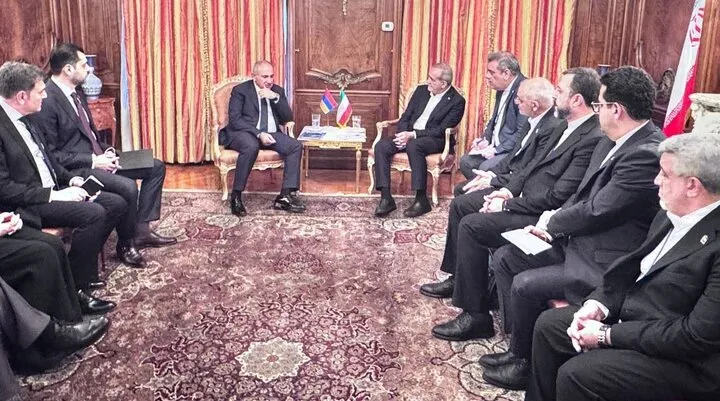
Meeting with Armenian Prime Minister Nikol Pashinyan, Pezeshkian said expanding cooperation with regional and neighboring countries is Iran's firm policy, and that the government is using every effort to implement agreements in this regard.
Pezeshkian stressed that pursuing bilateral agreements, particularly on regional transit routes, is at the top of the government's priorities, and that Iran insists on implementing these agreements. "Expanding cooperation with regional and neighboring countries is Iran's firm policy, and the government is using every effort to implement agreements in this regard," he said.
Pashinyan, for his part, stressed the need to accelerate the implementation of these agreements, saying they would contribute to the development of regional countries and to building peace.
End Article