Two nuclear powers failed to impose their will on Iran, Zarif says
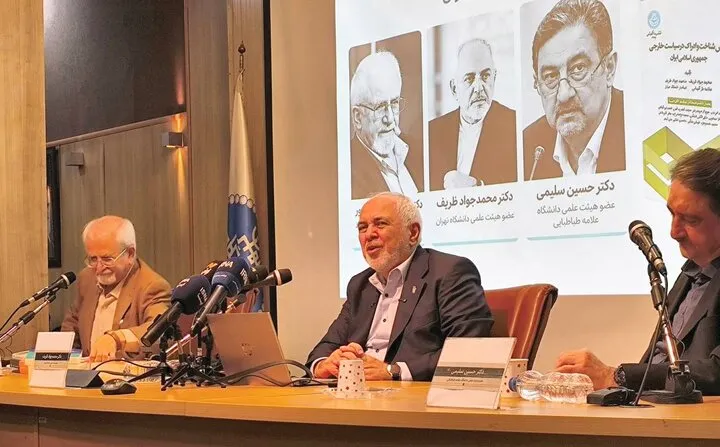
Tehran - BORNA - Speaking at a launch event for his three new books hosted by the Faculty of World Studies at the University of Tehran on Saturday, Zarif reflected on the recent turbulent years. "We witnessed two aggressions, the martyrdom of our dear leader and many loved ones. On the other hand, we witnessed the people's resistance and the failure of two nuclear powers to impose their will on Iran," he said.
Noting his departure from the government in the Iranian calendar year 1403 (2024), Zarif said the newly found free time allowed him to focus on writing. He announced the upcoming publication of two more books, including one detailing the Joint Comprehensive Plan of Action (JCPOA) negotiations and its developments, co-authored with Seyed Abbas Araghchi and Majid Takht-Ravanchi.
The former top diplomat highlighted the impact of US sanctions on his work, stating he was sanctioned for supporting the martyred leader and the Quds Force, with Washington dubbing him Iran's "tongue" abroad. Consequently, he noted, Western publishers refuse to print his books, leading his latest work to be published by Dar al-Hashem in Beirut.
Zarif recounted a "surreal" experience from last Monday, where the Foundation for Defense of Democracies (FDD) and monarchists led by Saeed Ghasseminejad launched a campaign against Amazon for selling his book, labeling him an "IRGC mercenary."
"On that same Monday in Tehran, a group gathered outside my office in the 'Payab' building, harassing the residents and demanding to know why this 'US mercenary' is working here and not being put on trial," he said, citing a poem by Sohrab Sepehri to describe his situation.
Moving to geopolitical analysis, the university professor identified a "cognitive imbalance" as the root cause of ongoing conflicts. "This cognitive imbalance leads the US to mistakenly believe it can force Iran to surrender through threats," he noted.
Pointing to US atrocities, he cited a strike on Lamerd involving four missiles, each carrying 180,000 submunitions, effectively targeting children with 720,000 fragments. "If you go to Lamerd today, you will see that, unlike many Iranians, the people there are now opposed to negotiations. The Americans failed to understand this: Iranians will resist threats and pressure," Zarif emphasized. "Threats have always backfired. The Americans are not foolish; rather, they suffer from a lack of perception."
He argued that US actions, including withdrawing from the JCPOA and launching wars, stem from this flawed perception. Zarif stressed that Iran has the potential to influence and correct global mindsets, much like how Benjamin Netanyahu dragged the Americans into a "dangerous vortex."
Critiquing domestic discourse, Zarif lamented a lack of listening and difficulty in defining national interests. He criticized a fallacy popularized by Henry Kissinger—that a nation must choose between being a "state" and pursuing an "ideal" or cause. Zarif recalled telling Kissinger in New York that this dichotomy is a fallacy, arguing that even in realism, national interests inherently encompass national ideals.
"Survival is the greatest national interest," he asserted, adding that prioritizing survival during existential threats is what ultimately guarantees national development.
Emphasizing the need for internal dialogue, understanding, and self-belief, Zarif recalled the words of the martyred leader, stating that after 200 years, Iran has finally proven that "the era of hit-and-run is over."
"We suffered many losses, but we showed that whatever they hit, they will be hit back, and both nuclear powers suffered great damage. Where else have you seen a regional power stand up to a global power, strike its bases, and force that global power to evacuate them? We must believe in ourselves and know that we can engage in discourse with the world from our own stance," Zarif concluded.
End Article