Islamic states can present global model of justice, development through shared capacities
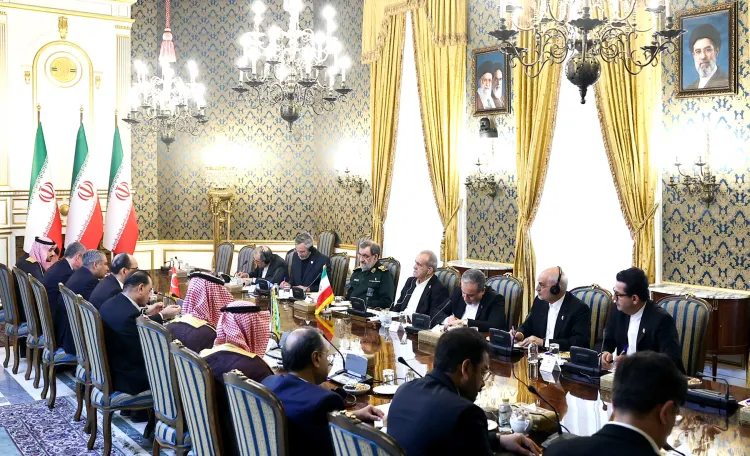
Tehran - BORNA - President Pezeshkian made the remarks on Monday afternoon during a joint meeting with Saudi Defense Minister Prince Khalid bin Salman, Pakistani Army Chief General Asim Munir, and Turkish Intelligence Chief Ibrahim Kalin.
Expressing satisfaction with the ongoing dialogues among Islamic nations, the Iranian president pointed to the fundamental commonalities of the Islamic world, noting, "It is our core belief that Islamic countries should place the principles of brotherhood and unity at the forefront of their relations, based on the teachings of the Holy Prophet of Islam (PBUH)." He added that Muslims must stand united against threats targeting Islamic nations, asserting that adhering to this fundamental principle would eliminate the grounds for disputes and problems among Islamic countries.
Highlighting Iran's principled stance on strengthening Islamic solidarity, Pezeshkian stated that the 14th administration has emphasized the unity of the Islamic world since its inception. He condemned the extensive crimes and violent acts committed by the Zionist regime in the region over the past years, noting that the regime, backed by the United States and relying on state terrorism, commits numerous atrocities while accusing others of terrorism.
Condemning the Israeli regime's crimes in Gaza, Lebanon, and other regional countries, the president recalled that these aggressions also extended to the Islamic Republic of Iran, resulting in the martyrdom of Iranian leaders, commanders, scientists, and even students. "These actions lack any legal, humanitarian, or rational justification and further highlight the necessity of adopting a united approach by Islamic countries to counter aggression and insecurity," he stressed.
Pezeshkian underscored the failure of enemies to achieve their objectives against Iran, stating that their belief that pressure and aggression could lead to the collapse of the Islamic Republic was flawed. "The result of these actions was the strengthening of internal unity and the increased solidarity of the Iranian nation. Despite the inflicted damages and hardships, our people defended their land with strength and steadfastness. The notion that the Iranian nation can be forced into submission is an incorrect and invalid assumption," he declared.
Reaffirming Iran's commitment to international law, the president emphasized that the Islamic Republic demands its legal rights and will decisively defend the legitimate interests of the Iranian nation based on these principles.
Expressing hope for the effective role of major Islamic countries in enhancing regional stability, Pezeshkian said, "I hope the presence of representatives from significant and influential Islamic countries in this meeting will pave the way for further consolidation of regional unity. We must not allow the Zionist regime to assassinate or attack anyone or any country at will." He expressed confidence that a coordinated stance by Islamic countries would prevent the recurrence of such actions.
The president highlighted the shared religious and cultural bonds among Islamic nations—worshipping the same God, following the same Holy Book, and sharing the same Qibla—as a solid foundation for resolving differences and expanding cooperation. He reiterated Iran's sincere readiness to develop these collaborations, stating that the belief in brotherhood with Islamic countries is deeply rooted in the shared interests of the region's nations, not merely a diplomatic formality.
Calling for a collective movement toward progress and prosperity, Pezeshkian stated, "Our goal is for all nations in the region to pursue growth and excellence in an environment full of peace, security, prosperity, and equal opportunities." He noted that linking the region's rich natural resources, vast economic capacities, and capable human resources could turn the region into a successful global model of humanity, justice, and fairness.
The president emphasized the need to translate political understandings into practical actions, urging Islamic countries to reach a shared understanding of their goals and pursue the implementation of agreements until tangible results are achieved, rather than leaving decisions merely as written documents.
Pezeshkian called for aligning words with actions in regional relations, advocating for joint efforts to unlock the region's scientific, economic, cultural, and security potentials. "We must develop communication routes, facilitate interactions, turn borders into opportunities for cooperation, and connect the universities, scientific centers, and businessmen of Islamic countries," he said.
He further noted that developing multilateral cooperation paves the way for sustainable security, arguing that expanding scientific, cultural, and economic ties across borders is one of the most effective strategies to eliminate terrorism and insecurity while consolidating collective regional security.
Reiterating Iran's support for constructive understandings among Islamic countries, Pezeshkian said any agreement enhancing regional unity and cooperation would receive serious and comprehensive support from the Islamic Republic.
Warning against the interventionist and divisive policies of the US and the Zionist regime, the president stated that their objectives include weakening regional countries and creating rifts among Muslim nations. He called for mutual support to prevent regional countries from facing isolated pressure and threats.
Pezeshkian also addressed efforts to create economic pressure in the region, asserting that Islamic countries should rely on constructive interaction and economic cooperation to meet each other's needs. "The idea that nations can be forced to surrender through pressure and sanctions is an illusion. The deeper and broader the cooperation among regional countries, the greater their ability to manage problems and counter external pressures," he added.
Touching upon Iran's nuclear activities, the president reaffirmed the country's principled stance, stating that the Islamic Republic is not seeking nuclear weapons and, as a member of the NPT, wishes to continue its peaceful nuclear activities within the framework of international rights and obligations. He criticized double standards, calling the use of the nuclear issue as a pretext for pressure and attacks on facilities while simultaneously claiming readiness for negotiations a contradictory and unconstructive approach that undermines trust.
Concluding his remarks, President Pezeshkian stressed the necessity of solidarity and joint action by Islamic countries to counter threats and achieve shared goals. "Our intention in developing interactions with Islamic countries is to strengthen the brotherhood, solidarity, and dignity of the Islamic Ummah. Our goal is to consolidate brotherly relations, ensure the dignity and pride of the region's Muslims, and put an end to the Zionist regime's atrocities against oppressed Muslim nations," he stated, expressing hope that shared resolve would bring peace, security, and justice to the region.
End Article