Two Major Outages in 48 Hours Raise Questions Over US Infrastructure Security
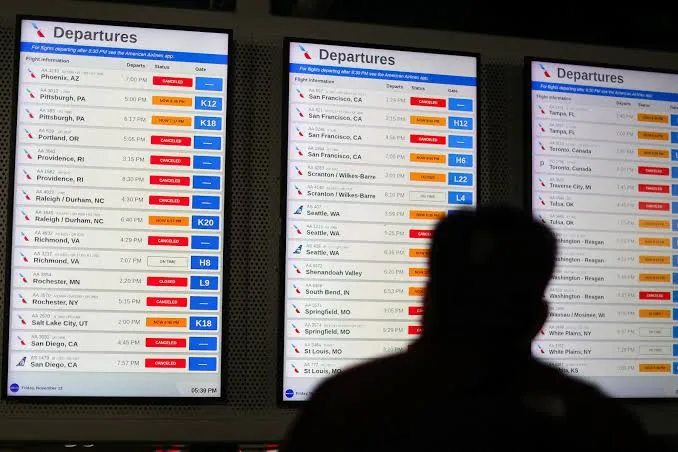
Tehran - BORNA - The United States experienced two major infrastructure disruptions on November 12 and 13, as a widespread Microsoft 365 outage was followed by a nationwide suspension of departing flights ordered by the Federal Aviation Administration (FAA).
The incidents disrupted communications across government institutions, businesses and essential public services before bringing much of the American aviation system to a temporary standstill.
Although US authorities and Microsoft have attributed the failures to technical problems and reported no evidence of malicious cyber activity, the scale and proximity of the incidents have drawn attention to the vulnerability of systems on which millions of people depend.
The central question is whether the disruptions were entirely unrelated technical failures or whether further investigation could reveal a more complicated security dimension.
First Disruption: Microsoft Outage Hits Government and Essential Services
The first major disruption emerged on Thursday, November 12, when users began reporting widespread problems accessing Microsoft 365 services, including Exchange Online, Outlook, Microsoft Teams and other cloud-based applications.
The outage quickly extended beyond ordinary business communications, affecting organizations that rely on Microsoft's infrastructure for essential daily operations.
Government agencies, judicial institutions and public services were among those reporting difficulties.
In the United States, the disruption affected communications at the House of Representatives and interfered with email access at judicial institutions.
The consequences were also felt internationally. In Britain, courts, hospitals, police services and other public institutions experienced disruptions, demonstrating how a technical failure involving a single technology provider can affect essential services across national borders.
Microsoft initially reported elevated infrastructure loads and server connectivity problems before identifying a fault introduced during an earlier network capacity upgrade that became apparent following subsequent network changes.
The company maintained that the disruption was technical and unrelated to cyberattacks or artificial intelligence systems.
Nevertheless, the incident exposed the extent to which government institutions and critical services have become dependent on centralized digital infrastructure.
A failure affecting a relatively limited number of underlying systems was capable of disrupting communications across multiple sectors and countries.
The wider implications extend beyond the immediate technical explanation.
If an internal configuration problem can produce such extensive consequences, the potential impact of a deliberate attack targeting comparable infrastructure warrants serious consideration.
Second Disruption: Nationwide Flight Ground Stop Shakes US Aviation
Less than 24 hours later, another crisis unfolded.
On Friday afternoon, November 13, the FAA ordered a nationwide ground stop for departing aircraft after telecommunications failures disrupted the stability of communications and radar systems used by air traffic controllers.
The extraordinary measure recalled previous nationwide aviation shutdowns, including the unprecedented closure of American airspace following the September 11, 2001 attacks.
US Transportation Secretary Sean Duffy acknowledged that the problems affected the communications infrastructure supporting the country's 22 regional air traffic control centers.
The resulting instability created inconsistencies in radar information and communications with aircraft, prompting authorities to suspend departures as a precautionary measure.
More than 3,500 aircraft were already airborne when the ground stop was imposed.
Authorities subsequently reported that the aircraft were brought safely to the ground.
The FAA lifted the nationwide restriction at 8:15 p.m. Eastern Time, but the consequences continued well beyond the immediate shutdown.
Thousands of flights were canceled or delayed, disrupting travel plans and leaving passengers stranded at airports across the country.
By late Friday, the number of canceled flights had approached 10,000, with additional disruptions continuing into the following day.
Duffy attributed the incident to overloaded telecommunications equipment and acknowledged the vulnerability of the country's aging air traffic control infrastructure.
In a subsequent briefing on November 14, he indicated that maintenance work involving the transition from copper telecommunications lines to fiber-optic systems may have triggered the failure.
According to the transportation secretary, investigators were examining whether faulty equipment or errors during the installation process caused excessive connection attempts that overwhelmed other components of the network.
The explanation highlighted another troubling possibility: a technical failure originating from routine maintenance at a remote facility could destabilize a nationwide aviation communications system.
Coincidence or Coordinated Cyber Operation?
The proximity of the two incidents raises an obvious question: Could the disruptions have been connected?
Both affected systems essential to the functioning of a modern state.
The Microsoft outage disrupted digital communications across government institutions and other organizations, while the FAA failure interfered with the infrastructure responsible for managing air traffic.
In modern cyber conflict, communications networks and transportation infrastructure are among the systems whose disruption could have far-reaching economic and security consequences.
A coordinated attack against such systems could, in principle, cause widespread paralysis without requiring conventional military force.
However, the occurrence of two major failures within a short period does not itself establish evidence of a coordinated cyber operation.
Determining whether malicious activity was involved would require technical evidence, including forensic analysis of network traffic, system logs, unauthorized access attempts and the mechanisms that caused the failures.
US authorities have maintained that investigators found no evidence indicating a cyberattack.
Homeland Security Secretary Markwayne Mullin said no evidence of malicious activity had emerged, while Duffy stated that the restoration of FAA systems after technicians isolated the apparent source of the disruption supported the technical-failure explanation.
Microsoft has likewise attributed its outage to an internal infrastructure problem.
These explanations provide potential causes for the incidents, but they also raise a separate question about the resilience of systems whose failure can generate disruption on such a scale.
The Question of Transparency and Public Confidence
The immediate rejection of cyberattack scenarios by US officials has also drawn attention to the importance of transparent investigations.
Major infrastructure failures involving sensitive government communications or national transportation systems require detailed technical assessments to establish their causes and determine whether security weaknesses were exploited.
The absence of publicly disclosed evidence of a cyberattack is not equivalent to proof of a concealed operation.
Nevertheless, official assurances alone cannot substitute for comprehensive technical findings.
The implications of a confirmed coordinated cyberattack against American critical infrastructure would extend far beyond the technology sector.
Such an incident could undermine public confidence, intensify financial uncertainty and raise questions about the government's ability to protect essential national systems.
These potential consequences demonstrate why transparency surrounding the investigation matters.
At the same time, the incidents themselves have exposed vulnerabilities that would remain significant even if no malicious activity were ultimately identified.
The ability of a technical malfunction to disrupt government communications or force the suspension of nationwide aviation operations raises serious questions about infrastructure redundancy, emergency preparedness and decades of dependence on aging or centralized systems.
A Warning for Washington
As Microsoft services have returned to operation and US aviation authorities have resumed flights, the immediate emergencies have subsided.
Yet the broader questions remain.
How could technical failures produce such extensive disruption across systems essential to government operations, public services and national transportation?
How effectively could those same systems withstand a deliberate, coordinated cyberattack?
And what guarantees can Washington provide that similar failures will not occur again?
For now, there is no verified evidence establishing that the two incidents were connected or resulted from a cyberattack.
But their consequences offer a warning about the fragility of critical infrastructure in an increasingly interconnected environment.
Whether the events of November 12 and 13 ultimately prove to have been unrelated technical failures or reveal additional security concerns, they have demonstrated how quickly disruptions in digital communications and transportation networks can affect the functioning of the United States.
The most immediate threat exposed by these incidents may not be a hidden adversary, but the vulnerability of systems whose reliability has long been taken for granted.
End Article