Baghaei: E3 Activated Snapback at the Request of the U.S. and Israel
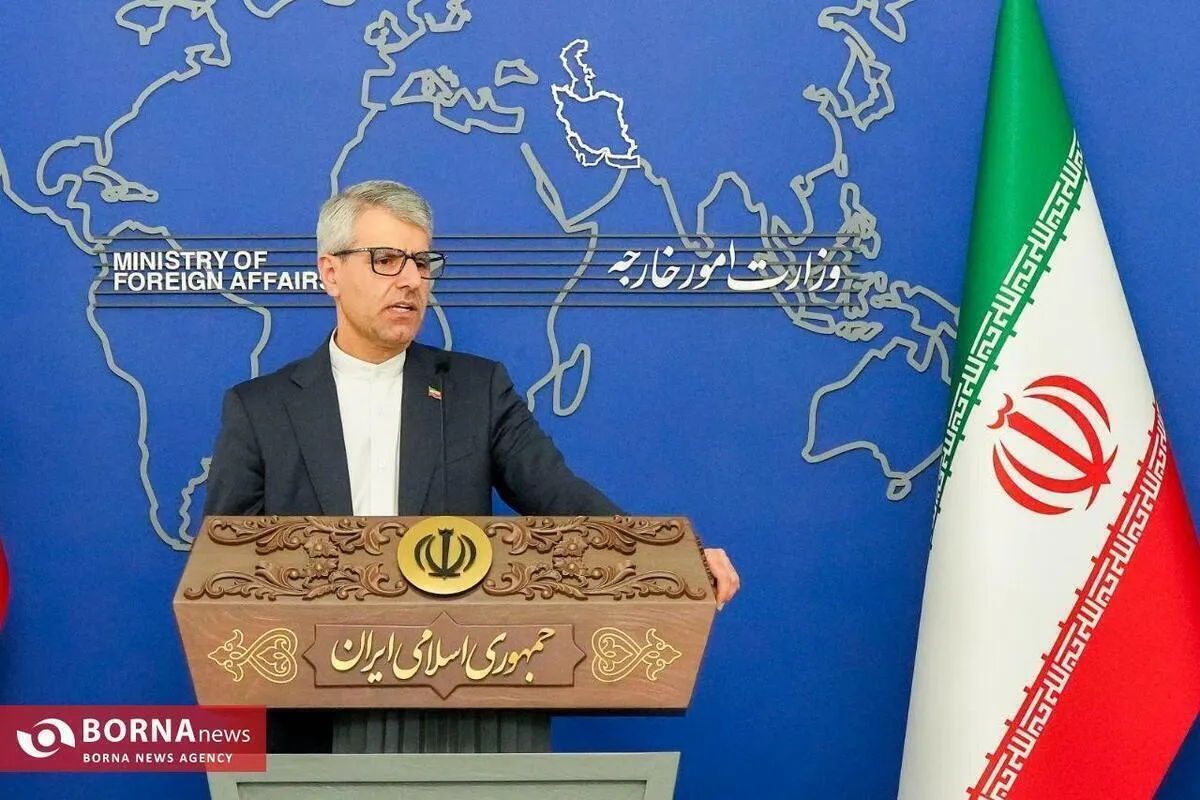
Tehran - BORNA - Foreign Ministry Spokesperson Esmaeil Baghaei opened Tuesday’s press conference by condemning the assassination of Yemen’s prime minister and several cabinet members by the Israeli regime. He described the attack as a terrorist act and a blatant violation of international law and humanitarian principles, expressing solidarity with the people of Yemen.
Baghaei criticized the international community’s inaction over Gaza, stating that the UN and global institutions, under U.S. protection of Israeli crimes, have failed to take meaningful steps to stop atrocities and deliver justice.
On Iran’s diplomatic track, Baghaei confirmed that President Pezeshkian’s visit to China for the Shanghai Cooperation Organization summit would continue until Wednesday.
Turning to the European move on the snapback mechanism, he called the U.S. Secretary of State’s statement welcoming the measure “scandalous,” noting that it explicitly confirmed the action was carried out on direct instructions from the U.S. president. “Reports in recent days show this move was carried out at the request of Washington and Tel Aviv,” he said.
The spokesperson rejected European claims that Iran failed to uphold its JCPOA obligations while Europe did, describing them as “hypocritical and ill-intentioned.” Responding to U.S. conditions for talks with Iran, Baghaei stressed: “Such preconditions only demonstrate bad faith. We have faced U.S. and Israeli attacks in the midst of diplomacy; past experience proves Washington never acted in good faith.” He recalled America’s withdrawal from the JCPOA and coordinated Israeli attacks on Iran during negotiations, underscoring U.S. intent to undermine diplomacy from the outset.
Baghaei also condemned Israeli plans to forcibly displace Gaza’s population: “What is unfolding in Gaza is a continuation of genocide—rendering 90 percent of the Strip uninhabitable and imposing famine to expel its people. Any actor complicit in this conspiracy of collective eradication will be deemed an accomplice to war crimes.”
On Iran’s relations with the IAEA, Baghaei said no decision had been made yet regarding further rounds of talks. “The European move will have consequences across different areas. Two rounds of negotiations have been held with no final outcome. Two IAEA inspectors recently entered Iran only to load fuel at the Bushehr nuclear reactor, a routine procedure under regulations. Currently, no inspectors are present in Iran. Contacts continue at the representative level, but a framework for future engagement has not been finalized following the latest developments and attacks on our nuclear facilities.”
Meeting with Chinese President
Foreign Ministry Spokesman Esmail Baghaei said that President Pezeshkian will meet his Chinese counterpart this afternoon local time. Referring to the BRICS summit statement, Baghaei noted: “A similar declaration condemning the U.S. and Israeli attack on Iran was also issued there. Today, in the afternoon session, the President will hold talks with the Chinese President.” He added that President Pezeshkian will also attend a special program in China on Wednesday related to World War II commemorations.
Outcomes of the SCO Summit
Baghaei emphasized the importance of the SCO summit’s resolutions, particularly regarding responses to emerging challenges and cooperation in banking and financial sectors.
Iran-China Cooperation
On Iran-China relations, Baghaei said: “We have cordial ties with China. The 25-year cooperation agreement, which includes the energy sector, continues unaffected by external issues. Both Russia and China opposed Europe’s snapback move. As members of BRICS and the SCO, we expect interactions to proceed without outside pressures or illegal measures. We remain optimistic about the strength and expansion of bilateral ties.”
Clarification on Mediation Claims
Addressing reports of a possible Egyptian mediation between Iran and the IAEA, Baghaei said: “Recent talk about a new mediator, particularly concerning Iran-IAEA relations, is inaccurate. We maintain direct contact with the Agency. Two rounds of talks have already been held, and Iran’s representative at the Agency remains active.”
Regional Diplomacy
He added: “Iranian diplomacy is active, and we use it as a tool to advance national interests. Recently, our diplomatic engagement with regional countries has intensified. These nations also seek regional stability and security, applying their efforts to prevent further escalation. We appreciate and welcome any action that strengthens peace and stability in the region.”
Criticism of U.S. Policy
On U.S. positions, Baghaei criticized Washington’s stance: “The United States is not serious about diplomacy or negotiations. Rubio, the Secretary of State, represents a government that, just two days before scheduled talks, joined Israel in attacking Iran. To use sanctions and military aggression against a UN member state while claiming commitment to diplomacy is nothing but hypocrisy and bad faith.”
Dismissal of False Claims
Responding to claims that the Chinese President gave only five minutes for talks with President Pezeshkian, Baghaei dismissed them as false: “This requires media maturity. We should not accept or spread every baseless claim so easily. Today, bilateral meetings will be held according to established protocols. Such reports are simply not worth responding to.”
No Good Faith from the Three European States in Proposing Conditions to Halt Snapback
Foreign Ministry spokesperson Esmail Baghaei, responding to a journalist’s question regarding a quote attributed to Iran’s deputy foreign minister in an opposition media outlet, dismissed the claim that “Iran had sent messages to the Americans through several intermediaries, but Washington did not respond and showed no willingness to negotiate.” Baghaei said: “This statement has no validity. It was propagated by the Zionist regime’s media apparatus as part of a psychological warfare campaign against Iran.”
He added: “We see no good faith from the three European countries in proposing conditions for halting the activation of the snapback mechanism. Likewise, based on our experience and the developments of the past few months, we see no genuine goodwill from the Americans either.”
Baghaei pointed out that European states had previously floated the idea of “zero enrichment,” but when it became clear this demand violated their own commitments under the JCPOA—where enrichment is recognized as an explicit right of Iran—they attempted to justify and walk back their stance.
European States Must Review Their Positions Honestly and Responsibly
The spokesperson stressed: “European states must honestly and responsibly review their positions, taking into account their past negotiations and the commitments they themselves accepted under UN Security Council Resolution 2231. They must adopt an independent approach, free from the influence of the two destructive actors—namely the Zionist regime and the United States.”
Iran Welcomes Resumption of Diplomatic Relations Between Pakistan and Armenia
In response to a question about the decision by Pakistan and Armenia to resume diplomatic relations, Baghaei said: “We have good relations with both Pakistan and Armenia, and both are our neighbors. We view this development positively.”
He added: “We hope the establishment of diplomatic ties between the two countries will strengthen understanding among regional states, particularly in the South Caucasus."
Authority for Technical Extension of Resolution 2231 Belongs to the UN Security Council
Addressing speculation about a possible temporary extension of the JCPOA framework, Baghaei said: “We are in close contact with Russia and China. Both countries have clearly opposed the decision by the three European states to reinstate the canceled Security Council sanctions.”
He referred to the joint letter sent yesterday by the foreign ministers of Iran, China, and Russia to the UN Secretary-General and the Security Council president, stating: “All three countries share the view that the EU and its three members lack the legal authority to invoke the dispute resolution mechanism, which in reality amounts to initiating the snapback of canceled UN resolutions.”
Baghaei continued: “Accordingly, any discussion of extending the agreement must be seen in this context. At the same time, the technical extension of Resolution 2231 is an issue that falls under the jurisdiction of the UN Security Council. We are coordinating with China and Russia to ensure that Iran’s national interests are safeguarded.”
Iran Will Decide on UN Secretary-General Candidacy at the Proper Time
When asked about Tehran’s stance regarding the reported candidacy of Rafael Grossi for UN Secretary-General, Baghaei said: “It is still too early to comment. A considerable portion of the current Secretary-General’s term remains.”
He emphasized: “The Secretary-General must be nominated by the UN Security Council with nine affirmative votes and no veto from the permanent members, and then confirmed by the General Assembly. Iran, like all member states, holds one vote in the General Assembly, and we will decide in due course, based on our evaluation of the multiple candidates expected to present themselves.”
Baghaei highlighted the legal and institutional importance of the UN Secretary-General’s role: “As the highest-ranking official in the UN administrative hierarchy, the Secretary-General carries major responsibilities under the Charter. The Charter outlines clear criteria for this position, including competence, integrity, and independence from external pressures or influences in handling sensitive international issues.”
He concluded: “These criteria will certainly play a central role in shaping Iran’s decision when the time comes.”
Europeans Need Greater Moral Courage and Responsibility
In response to remarks by the German foreign minister, who claimed that the activation of the snapback mechanism against Iran was intended to prevent Tehran from obtaining nuclear weapons and that “the ball is now in Iran’s court” with 30 days to find a negotiated solution, Foreign Ministry spokesperson Esmaeil Baghaei said: "Diplomacy is not a ball game. Europeans constantly use the word ‘ball’ and act as if they themselves have been credible, good-faith negotiators in this process.”
He added: “The reality is that Europeans need to strengthen their moral courage and sense of responsibility, commensurate with their position, in order to play a constructive role in diplomatic processes.”
Criticizing the European move to activate the snapback, Baghaei stressed: “What the three European countries did was essentially handing over all their sovereign rights on this matter to the Americans. The fact that the Europeans, as remaining members of the JCPOA and part of Resolution 2231, conditioned one of the key requirements for not restoring UN sanctions on Iran’s talks with another actor clearly shows irresponsibility and lack of good faith.”
He continued: “If the American side were a trustworthy negotiating partner, it would have used this opportunity in recent months rather than blowing up the negotiating table with the help of the Zionist regime in the middle of talks. For the Iranian people and global public opinion, it must be clear that such statements and behavior by European and American officials plainly demonstrate their lack of good faith and disbelief in diplomacy.”
U.S. Cannot Claim Moral Standing
In response to reports that U.S. envoy Tom Barrack had suggested Iran was part of negotiations related to Lebanon, Baghaei said: “I have not heard such a statement.” He added: “Experience has proven to us that the U.S. is not impartial. For years, it has acted as part of the Zionist regime, unilaterally imposing that regime’s demands and positions on the region. Therefore, Washington lacks the moral standing to comment on others.”
Iran’s Cooperation with IAEA Will Follow Parliament Law and SNSC Decisions
On a question regarding recent remarks by IAEA Director General Rafael Grossi that Iran should not impose restrictions on inspections, Baghaei replied: “Iran’s interaction with the Agency will be conducted within the framework of the parliamentary law and under the guidance of the Supreme National Security Council. Apart from what happened last week with the Bushehr nuclear reactor, no other developments have occurred regarding inspections.”
U.S. Military Buildup Near Venezuela
On another question about U.S. military threats against Venezuela under the pretext of combating drug trafficking and the concerns of Latin American states, Baghaei said:
“Last week we made our position clear. The developments in Latin America represent a return to the U.S.’s raw colonial policies in the region. American interference here is nothing new, but today it is more blatant and overt.”
He added: “The U.S. military buildup near Venezuela under the pretext of fighting drugs is unjustifiable. We condemn U.S. interference and warn against any use of force against Venezuela and its impact on Latin America. The claim of combating drug trafficking and transnational organized crime is merely a cover for unlawful interventions. Considering the existing information on links between certain U.S. officials and figures like Jeffrey Epstein—who ran a major human trafficking ring, particularly targeting women and girls—it is obvious that such claims are only an excuse to justify illegal meddling in regional countries, including Venezuela.”
Global Public Opinion and Human Conscience Mobilized to Break Gaza Blockade
Foreign Ministry spokesperson Esmaeil Baghaei, commenting on the departure of the “Samoud” global flotilla—comprising dozens of ships carrying humanitarian aid and hundreds of activists from 44 countries—toward Gaza to break the blockade, said:
“These developments are very significant and reflect the serious demand of international public opinion on their governments to act in this regard.”
He added: “Unfortunately, the international community has failed to play an effective role because the United States and some Western countries have used international mechanisms to grant ongoing impunity to the Zionist regime for its crimes. However, this does not mean that global society is numb or indifferent to the atrocities taking place. On the contrary, this initiative and previous examples show that international public opinion and human conscience are deeply pained and are using available tools to break the blockade of Gaza.”
Baghaei stressed: “The fact that representatives from at least 40 countries are participating in this initiative demonstrates that the issue of occupied Palestine and stopping the genocide in Gaza has become a universal and global demand. This also increases the responsibility of the media to inform and mobilize global action to stop the genocide in Gaza.”
Water Issue a Standing Item in Talks with Afghanistan
In response to a question about the inauguration of the “Pashdan Dam” in Afghanistan in late August and its potential impact on water access in northeastern Iran, especially Mashhad, Baghaei said: “The water issue—whether concerning our rights from the Helmand River or other inflows from Afghanistan—is a permanent item on the agenda in our negotiations with Afghan counterparts.”
He emphasized: “Both the Ministry of Energy, as the authority on the issue, and the Ministry of Foreign Affairs, as responsible for diplomacy, use every opportunity and platform to express our concerns and to work toward solutions that can at least mitigate the problems arising from these issues.”
He continued: “I can assure you that this matter is being followed both through our embassy in Kabul and by other means.”
Response to GCC Statement on Three Islands and Arash Gas Field
Baghaei also responded to a question about the claims made in the final communiqué of the Gulf Cooperation Council meeting regarding the three Iranian islands and the Arash gas field. He referred to the Foreign Ministry’s statement issued earlier today, which outlined Iran’s firm position and rejection of such claims.
End Article