Russian Envoy to UN: Claim of ‘Reimposing Sanctions on Iran’ Contradicts UN Charter
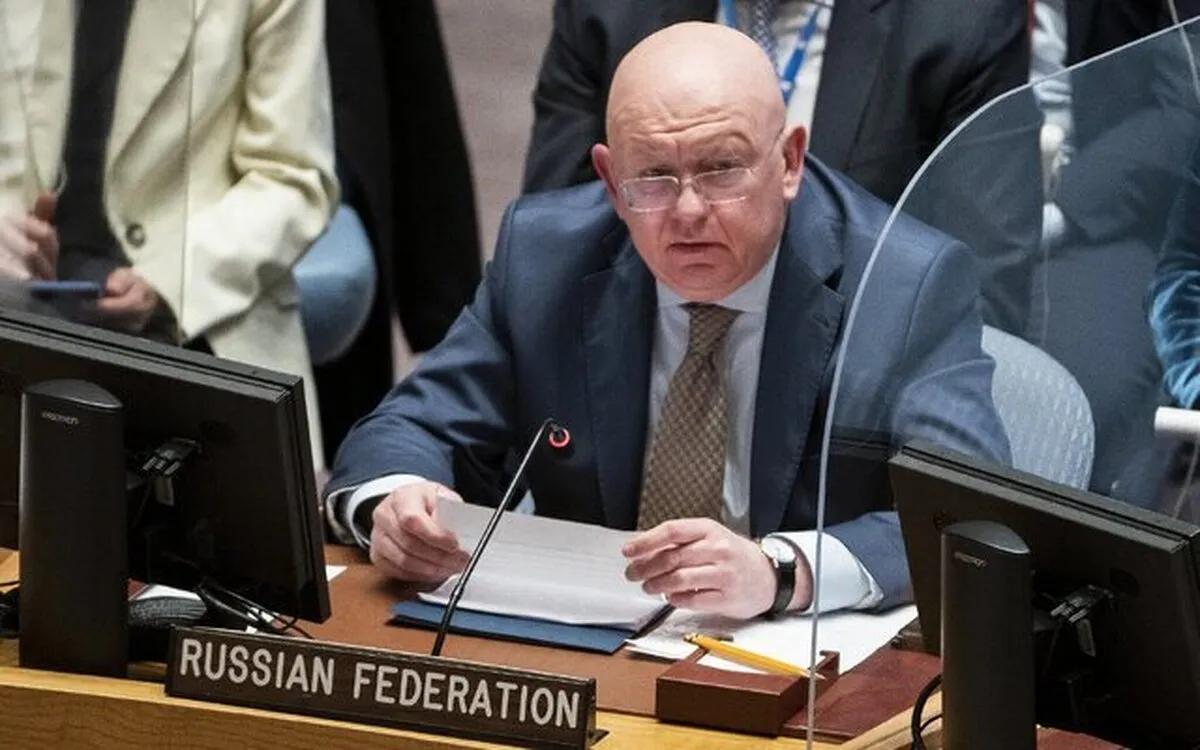
Tehran - BORNA - Russia’s Ambassador to the United Nations has strongly criticized recent moves by certain Western countries and the UN Secretariat over the alleged “reimposition” of previous Security Council sanctions on Iran, describing them as legally baseless, contrary to the UN Charter, and in violation of binding Security Council resolutions.
In a detailed letter addressed to the UN Secretary-General and the Security Council, Vassily Nebenzia, Russia’s Permanent Representative to the UN, stated that the Secretariat’s declaration on the “re-application” of resolutions 1696, 1737, 1747, 1803, 1835, and 1929 was not only unfounded but amounted to a blatant distortion of Council decisions and a clear violation of Resolution 2231.
He recalled that the draft resolution submitted by South Korea to extend the termination regime of sanctions, as well as the joint Russia–China draft to extend the validity of Resolution 2231, were both blocked by the United States, the United Kingdom, and France. Nebenzia stressed that these three Western states, with the support of some non-permanent members, chose confrontation and escalation over dialogue and negotiation on the Iranian nuclear issue.
The Russian envoy rejected as entirely invalid the European troika’s (UK, France, Germany) claim to have triggered the so-called “snapback” mechanism on August 28, 2025.
He underlined that the three European countries had not observed the dispute resolution process required by the JCPOA, which forms an integral part of Resolution 2231, and that their repeated violations disqualified them from invoking the mechanism. “Accordingly, the notification to initiate the snapback process carries no legal weight and cannot be considered a valid notification under operative paragraph 11 of Resolution 2231,” he wrote, noting that the foreign ministers of Russia, China, and Iran conveyed the same position in a joint letter to the UN Secretary-General and the Council on August 28.
Nebenzia further argued that the draft resolution put to a vote on September 19, 2025, clearly did not meet the requirements of Resolution 2231, and its outcome cannot be interpreted as the revival of past sanctions. “It follows that the entire alleged snapback process is null and void, and any attempt to portray it otherwise is merely a political and unilateral effort to legitimize blatant violations by the three Western states,” he emphasized.
He also pointed to the October 18, 2025, expiry date for restrictions under Resolution 2231, underscoring that “from that date onward, all measures related to Iran’s nuclear program will lapse. Therefore, the UN Secretariat has no legal or procedural basis to reinstate defunct sanctions lists or revive the 1737 (2006) Sanctions Committee.” He described the Secretariat’s recent steps — including republishing sanctions lists, reactivating the committee’s website, and issuing related notices — as “illegal, unconstructive, and damaging to the Council’s credibility.”
Expressing deep regret over the Secretariat’s conduct, Nebenzia said such actions contravened Article 100 of the UN Charter and the impartiality required of the body, warning that their continuation could seriously undermine the authority of the Security Council. He stressed that there is no legal basis for re-establishing the 1737 Committee or any of its activities, including appointing experts or designating a chair.
In conclusion, Russia’s Permanent Representative demanded that the Secretariat immediately withdraw its recent note, cancel the reinstated sanctions list, shut down the website of the 1737 Committee, and refrain from any further steps serving the interests of a handful of Western governments. He requested that his communication be circulated as an official Security Council document.
End Article