Baghaei: US and Some Allies Are the Biggest Violators of the UN Charter
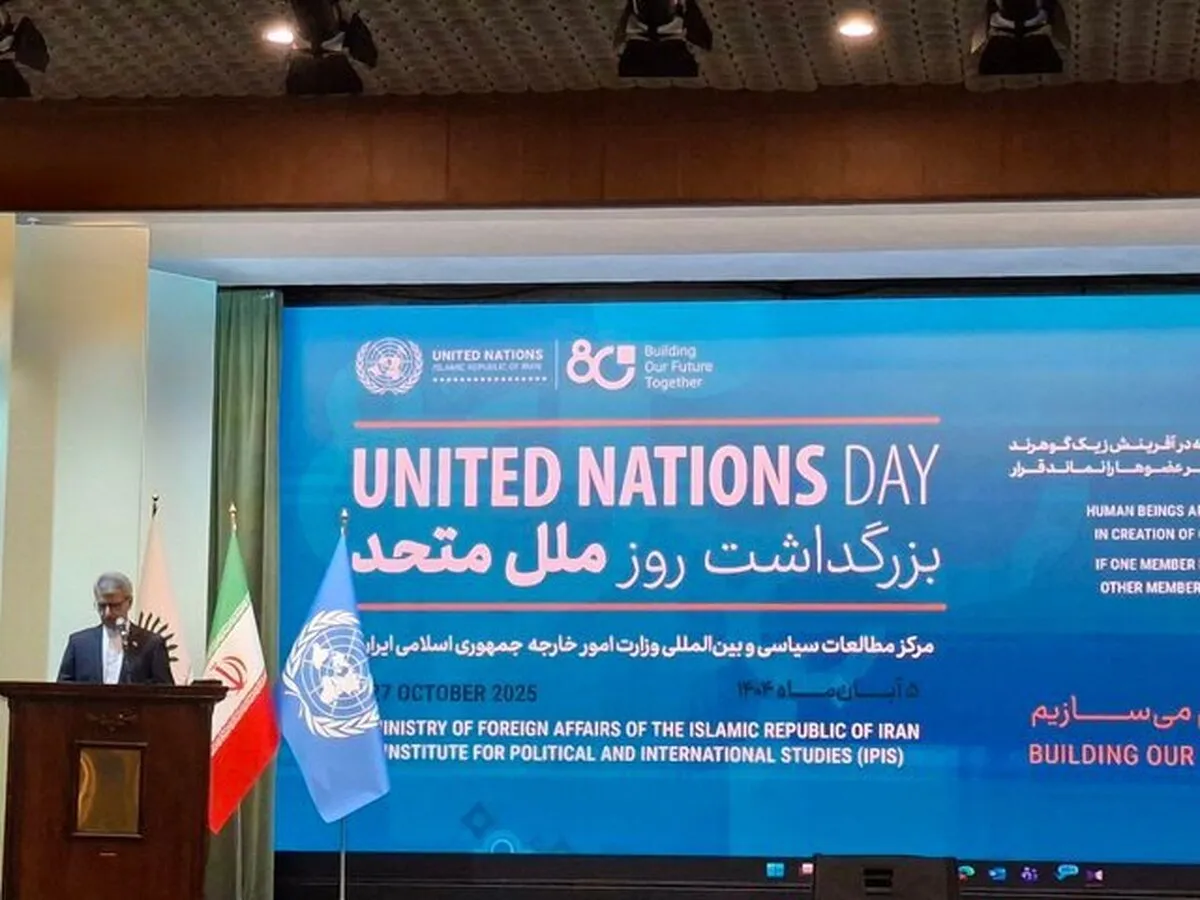
Tehran - BORNA - Esmaeil Baghaei, speaking on Monday morning at a commemoration event for United Nations Day and the upcoming 80th anniversary of the UN’s founding, held at the Center for Political and International Studies of the Iranian Foreign Ministry, pointed to the non-adherence of some governments to the principles and Charter of the United Nations.
"Unfortunately, from the very early years of the UN’s establishment, its goals and Charter have been repeatedly subjected to encroachment, arbitrary interpretations, and abuse by those who have failed to free themselves from the mentality and perception of past self-superiority," the spokesperson stated.
The senior diplomat of the Islamic Republic of Iran asserted: "The United States and some of its allies are the biggest violators of the United Nations Charter."
The UN as a Symbol of Learning from Past Pains
Baghaei further stated in his address: "The United Nations is not only simply the largest and the only universal symbol for safeguarding peace and strengthening cooperation, and promoting development and prosperity on the global stage, but it is also a clear symbol of humanity’s learning from past pains and sufferings."
He emphasized that Iran is a steadfast supporter of peace and stability and a defender of the UN Charter, acting as a responsible and influential member in upholding it.
"We believe in a United Nations that truly represents all nations," Baghaei added.
Focus on Recent Violations and US Complicity
Continuing his remarks, Baghaei pointed to the repeated violations of the UN Charter by certain governments, especially in recent years, and noted: "It must be explicitly stated that the United States and some of its allies are the biggest violators of the principles and objectives of the UN Charter."
"It is enough to consider the actions of this country [the US] and the party which, by the explicit admission of the U.S. President, is considered its proxy," he added. "Over the past two years, concurrently with the commission of the biggest continuous genocide in history in occupied Palestine, the Zionist regime has launched military attacks against several countries, committed terrorist acts, and occupied the territory of two countries."
Baghaei stressed that "all these flagrant violations of the principles and objectives of the Charter have been accompanied by the support and complicity of the United States and some European parties, creating a kind of absolute impunity for the occupying regime." He further pointed out that the U.S. has even proceeded to "sanction and threaten the judges of the International Criminal Court (ICC) and the International Court of Justice (ICJ)" for addressing the crimes committed in Gaza.
Full Text of the Foreign Ministry Spokesperson's Speech Is As Follows:
Distinguished Attendees,
Today, we have gathered on the occasion of the 80th anniversary of the adoption of the United Nations Charter to recall the lofty principles and goals of the United Nations. While appreciating all the collective achievements of the Organization, some of which Mr. Prizner mentioned, we must also reflect on the current dire situation and the alarming trends unfolding at the international level. This situation is the result of the non-adherence of certain powers to the most important principles and goals of the United Nations—a trend that could jeopardize all of humanity's achievements in restraining force, violence, and aggression.
Distinguished Attendees,
The United Nations is not merely the largest and only universal symbol for interaction and cooperation aimed at safeguarding peace, strengthening collaboration, promoting respect for human rights and dignity, and advancing the development and prosperity of nations. It is also a symbol and sign of humanity’s learning from the pains and sufferings of the past.
The UN was founded upon the ashes of a devastating world war, drawing lessons from the failed experience of its predecessor, the League of Nations, which itself was an attempt to prevent the recurrence of the First World War catastrophe. It is no coincidence that "to save succeeding generations from the scourge of war" was enshrined as the most important philosophy and function of the United Nations at the head of the Charter. "Maintenance of international peace and security", alongside "developing friendly relations among nations based on respect for the principle of equal rights and self-determination of peoples," were set as two of the Organization's main goals. Furthermore, fundamental rules such as the "prohibition of the threat or use of force," the "commitment to respect international obligations and agreements," and the "commitment to the peaceful settlement of disputes" were incorporated into Article 2 of the Charter.
Respect for the equal rights of individuals and nations, which is embodied in the fundamental principle of the right to self-determination of peoples as a foundational principle of international law, necessitates the prohibition and rejection of any foreign interference in the internal affairs of states, especially respect for the national sovereignty and territorial integrity of governments.
Dear Friends,
Regrettably, the goals and principles of the UN Charter have, since the very inception of the Organization, been subjected to violations, encroachments, arbitrary interpretations, and repeated abuses by parties who, even today, have failed to free themselves from the colonial mindset and illusion of "self-superiority." And so it is that now, only eight decades after the founding of an organization encompassing the human aspiration for peace, justice, and human dignity, our world faces the nightmare of endless wars, injustice is rampant in various dimensions, and human dignity is sacrificed to avarice and racism.
If we review the last hundred years of international relations and briefly reflect on the current situation—from West Asia to the Caribbean and Latin America—we see that flagrant lawlessness and violations of international law, which have caused great human catastrophes and devastating wars, have always originated from powerful actors who consider themselves to be above the rules of international law. In the last decade, they have even replaced the "principles and rules of international law" with arbitrary, self-serving, and fluid arrangements, coining the fabricated concept of a "rules-based order" (RBO).
The "aggressive unilateralism" that now guides the actions of the United States and its allies in international relations—which has plunged the world into unprecedented insecurity and chaos—has no basis other than these "fabricated rules" that merely serve illegal desires and interests. In a world governed by these "rules," the use of force, threats, and intimidation becomes normalized; disrespect for international legal agreements and obligations carries no consequences for the violators; gross violations of human rights and the commission of the most severe international crimes—even to the extent of genocide and the mass annihilation of a nation—are supported; and, in a word, all the principles and ideals of the United Nations are simply ignored.
Distinguished Attendees,
It is no exaggeration to claim that the principles and goals of the UN Charter and its institutional framework—which is based on respect for international law and foundational principles like respect for the self-determination of peoples, respect for the national sovereignty and territorial integrity of states, the prohibition of the use of force, and the prohibition of intervention in internal affairs—have never been subjected to such pressure, distortion, and violation by powers that are, ironically, mandated within the UN Security Council to safeguard international peace and security.
It must be explicitly stated that the United States and some of its allies are the biggest violators of the principles and objectives of the UN Charter. It is enough to consider the actions of this country [the US] and the party which, by the explicit admission of the U.S. President, is considered its "proxy": Over the past two years, concurrently with the commission of the biggest continuous genocide in history in occupied Palestine, the Zionist regime has launched military attacks against several countries, committed terrorist acts, and occupied the territory of two countries. All these flagrant violations of the principles and objectives of the Charter have been accompanied by the full support and complicity of the United States and some European parties, creating a kind of absolute impunity for the occupying Israeli regime. Furthermore, the U.S. has even proceeded to sanction and threaten the judges of the International Criminal Court (ICC) and the International Court of Justice (ICJ) for addressing the crimes committed in Gaza.
On the other side of the world, in the Caribbean and Latin America, the U.S., under pretexts that have been repeatedly tested in that same region, is targeting the national sovereignty and the right to self-determination of Venezuela and some other independent countries. Worse still, it has turned the territory of neighboring countries into a base for organizing and preparing the use of force against another country, which disrupts friendly relations and good neighborliness among nations that would otherwise live peacefully and respectfully together.
Undoubtedly, the provocative actions and continuous threats by the U.S. against Venezuela, Cuba, Colombia, Nicaragua, Brazil, and other countries in the Caribbean and Latin American region are condemnable and constitute a violation of international peace and security.
Honorable Attendees,
Iran is a steadfast supporter of the path toward peace, justice, human dignity, and friendly relations among nations, which are the foundational principles of the UN Charter.
It is true that both devastating World Wars started in the West by Europeans, but the circle of fire encompassed the entire world, and our country, despite declaring neutrality, was not only not immune to its consequences but perhaps even suffered more than the initiating and involved parties.
For this reason, Iran has strived with genuine concern and a hopeful outlook to shape a world that prevents the recurrence of bitter war experiences. Regarding the League of Nations, the victorious parties of the war prevented Iran's presence and participation at the Versailles Peace Conference, although Iran subsequently became a member of the League.
However, Iran played an important role in the negotiations for drafting the UN Charter and specifically worked to restrain the freedom of states to resort to force, demanding a clear definition of the concept of "aggression" in Article 39 of the Charter.
Over these eight decades, despite the obvious biases witnessed within the UN Security Council and some of its other components, Iran has always acted as a responsible and influential member working to safeguard the principles and goals of the Charter. Although the UN, under the influence and abuse of the U.S. and some of its friends, effectively sided with the aggressor during Saddam's 8-year war against Iran, subsequently issued illegal and oppressive resolutions against us in the following decades, and just a few months ago evaded issuing even a simple statement condemning the blatant aggression of the U.S. and the Zionist regime against Iran—and despite repeatedly issuing incorrect resolutions and reports against Iran on human rights pretexts over the past five decades—we have never torn up the UN Charter as a sign of disrespect for its principles and goals. We have not described the Organization as an ineffective body, threatened the judges of international courts, or labeled the Secretary-General as persona non grata. This is the behavior of a deeply rooted, insightful, honorable, and powerful nation that distinguishes between the authenticity of human, ethical, and legal principles, and their abuse. This nation understands that in a world where shared ethical and human principles for peaceful coexistence and respect for human dignity—the very principles codified in the Charter's goals and principles—are marginalized, insecurity, chaos, and immorality will cast a shadow everywhere.
As the Secretary-General mentioned in his message, now is not the time for retreat or passivity.
We believe in justice. We believe in a United Nations that truly represents the rights of nations.
On this day, let us not merely settle for ideals, but renew our commitment to realize them. Let us build a United Nations that can save the current and future generations from the scourge of war today.
In conclusion, I would like to express my deep thanks and appreciation to Mr. Prizner, whose mission is concluding after four years of serious effort and service to the United Nations and enhancing cooperation between the Islamic Republic of Iran and various UN agencies.
Mr. Prizner has provided very valuable cooperation with my colleagues, both at the Foreign Ministry level and outside the Ministry, with a professional and dedicated approach throughout these years.
We sincerely wish him the very best and hope he continues to be impactful and successful in whatever responsibilities he undertakes after his role as the UN Resident Coordinator in Iran.
End Article