Ballistic vs. cruise missiles: What's the difference?
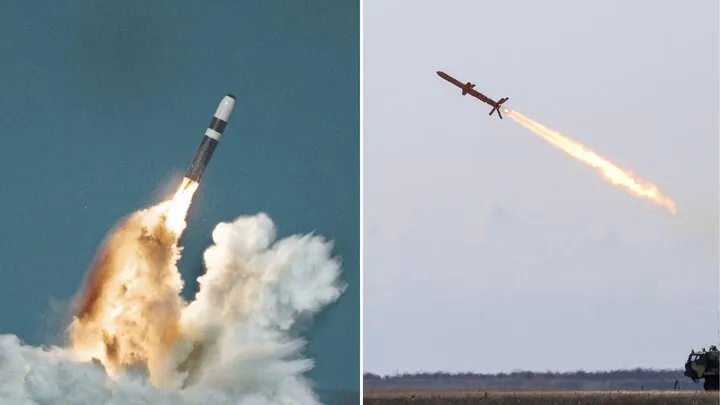
Tehran - BORNA - Comparing ballistic and cruise missiles is not just about which one is more powerful. Their use depends on what each military wants to achieve — whether it is strategic deterrence, battlefield strikes, surprise attacks, precision targeting, or penetrating enemy air defenses. Looking at five key parameters reveals the differences.
1. Flight path
The biggest difference between the two is how they move. A ballistic missile follows a high-arcing trajectory. It is powered during its launch phase, then largely moves under gravity and momentum before descending toward its target at very high speed. Ballistic missiles with longer ranges can leave the atmosphere before re-entering the final stage.
A cruise missile behaves more like a drone. It stays within the atmosphere, uses aerodynamic lift, and maintains propulsion for most or all of its flight. Instead of going up and coming down like a ballistic missile, a cruise missile can fly at low altitude and follow a more controlled path to its target.
Cruise missile wins this category because its flight path is more flexible and harder to predict.
2. Speed
This is where ballistic missiles excel. Due to their steep trajectory and re-entry phase, ballistic missiles can reach extremely high speeds, particularly in their final stage. This leaves defenders very little time to react. Even if detected early, they are difficult to intercept due to altitude, speed, and the potential use of decoys.
Cruise missiles are generally slower. Many fly at subsonic speeds, although some newer systems can be supersonic. Their advantage is not speed but survivability through low-altitude flight, path planning, and stealth.
Ballistic missile wins this category, as speed is one of its strongest advantages.
3. Accuracy and targeting
Cruise missiles are typically better suited for precision strikes. Because they are powered and maneuverable for most of their flight, they can be programmed to follow complex routes and strike specific targets with high accuracy. This makes them useful against military bases, radar stations, command centers, ships, and infrastructure where precision matters.
Ballistic missiles can also be accurate, especially modern systems with advanced guidance, but their traditional strength lies more in range, payload, and speed rather than precise maneuvering throughout the flight.
Cruise missile wins this category, offering better control and targeting flexibility.
4. Range and payload
Ballistic missiles have the advantage when the mission is long-range strategic attack. Intercontinental ballistic missiles can travel thousands of kilometers and carry large conventional or nuclear warheads. This is why ballistic missiles are central to nuclear deterrence. Their purpose is not just to hit a target but to convince the enemy that any major attack will be met with devastating retaliation.
Cruise missiles can also have long ranges, but they are generally more limited in terms of fuel, engine type, and flight profile. Their lower-altitude paths may help them avoid detection but also require more sustained propulsion.
Ballistic missile wins this category, due to its strategic range and payload capacity.
5. Detectability and survivability
This parameter is more complex. Ballistic missiles are easier to detect once launched because they move at high altitude and produce a clear thermal signature. However, once detected, they remain very difficult to stop because they move so fast and descend from such high altitude.
Cruise missiles present the opposite challenge. They are slower to track and easier to intercept once detected, but they are harder to detect in the first place. Low-altitude flight allows cruise missiles to take advantage of terrain masking, radar gaps, and complex flight paths.
Experts say cruise missiles are harder to detect, while ballistic missiles are easier to detect but harder to intercept. This category is a draw, as intercepting ballistic missiles is more difficult, while detecting cruise missiles is more difficult.
Final verdict
There is no clear winner, as both are designed for different missions. But if one had to be chosen as the more versatile weapon, the medal goes to the cruise missile.
Ballistic missiles are better for speed, strategic deterrence, long-range strikes, and delivering nuclear weapons. Cruise missiles are more adaptable in conventional warfare. They can fly low, change course, strike with precision, and pose serious problems for air defense systems.
The clearest answer is that ballistic missiles are better for deterrence, while cruise missiles are better for actual battlefield use.
End Article