Gharibabadi: Strait of Hormuz Will Not Return to Pre-War Arrangements; Leaving NPT No Longer Taboo
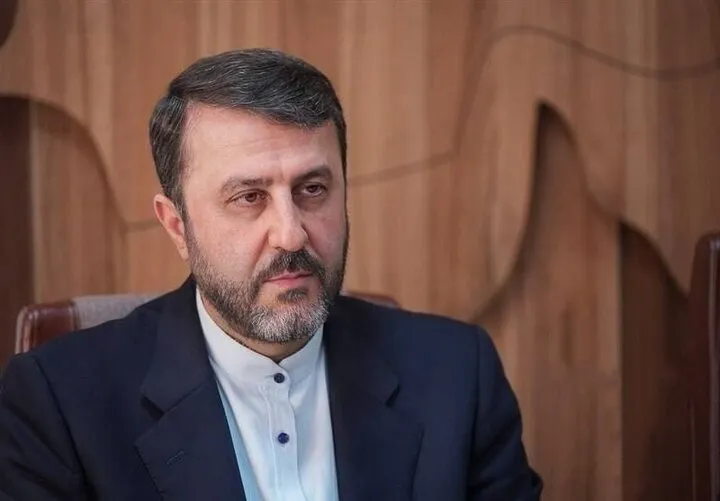
Tehran - BORNA - Emphasizing the need for the strict implementation of the Islamabad Memorandum of Understanding (MoU), Iran’s Deputy Foreign Minister for Legal and International Affairs Kazem Gharibabadi said, "When a text is negotiated and agreed upon, all its dimensions must be implemented exactly as agreed, and neither party can shirk the exact execution of the text under the pretext that the appearance of a process does not seem logical."
Referring to Article 5 of the Islamabad MoU, Kazem Gharibabadi noted that this clause is dedicated to the Strait of Hormuz, and its first section explicitly states that the Islamic Republic of Iran will make its utmost effort to provide the necessary arrangements solely for the safe and cost-free passage of commercial ships for 60 days. According to him, this text has no ambiguity or possibility of different interpretations, and the U.S. side cannot substitute a process outside the arrangements anticipated by Iran.
Stating that if Article 5 had not been agreed upon, the core of the Islamabad MoU would not have been formed, he clarified, "The Strait of Hormuz will no longer return to pre-war arrangements, and this is the definitive policy of the establishment."
The deputy foreign minister for legal and international affairs added that the responsibility for demining lies with Iran.
Pointing to actions by the U.S. and Oman in creating a southern route for ship transit, Gharibabadi said, "The Americans, in cooperation with Oman, created a route in Oman's internal waters and even forced ships to pass through this route using drones and threats, paying no attention to Iran's warnings to return to the northern route."
He added that while the daily passage of 20 ships through the southern route might not seem highly significant at first glance, the action was a clear violation of Article 5 of the MoU and, if continued, would have practically neutralized the Islamic Republic of Iran's effective sovereignty over the Strait of Hormuz.
Gharibabadi emphasized that Iran's decisive action conveyed a clear message to the U.S. that the Islamic Republic fears no action to consolidate its legal sovereignty over the Strait of Hormuz, even if it comes at the cost of resuming an all-out war. "Of course, this does not mean warmongering, but it indicates that national sovereignty and international commitments are a red line for Iran," he said.
He also described the Strait of Hormuz as Iran's "powerful balancing tool against enemy sanctions and pressure tools."
Stating that the Strait of Hormuz is the main indicator for evaluating Iran's victory in the war, the deputy foreign minister said, "The arrangements that will be applied to the Strait of Hormuz from now on will complete the victory of the Islamic Republic of Iran in this war. If the conditions of the strait return to the pre-war status, Iran's success in this battle is not complete."
In another part of his remarks, Gharibabadi announced Iran's opposition to the presence of any third country in demining operations and said, "The Europeans, by forming a coalition consisting of 30 to 40 countries, sought to intervene in demining, but we explicitly warned them that any warship or military equipment approaching the Strait of Hormuz under this pretext would be a legitimate target for Iran's armed forces."
He added that even when Oman intended to invite a third country to demine the southern route, Iran did not agree, because according to Article 5 of the Islamabad MoU, the responsibility for demining and security arrangements for the Strait of Hormuz lies solely with the Islamic Republic of Iran.
Stating that the violation of even one clause of the Islamabad MoU prevents the initiation of its subsequent stages, the deputy foreign minister said, "If even one clause of this understanding faces a problem, it is impossible to start the next negotiations, and one cannot say the negotiation process should continue just because a few other clauses have been implemented properly."
Kazem Gharibabadi added that the U.S. had accepted important commitments under the MoU, and it cannot be claimed that this agreement was doomed to fail from the beginning. According to him, the Islamabad MoU was progressing in its implementation path for about 20 days after its signing, but then two major problems arose.
He linked the first problem to the issue of Lebanon, stating that based on U.S. commitments, the war in Lebanon had to end. Given the clause included in the text regarding respect for Lebanon's territorial integrity and sovereignty, the withdrawal of military forces should have also begun, but the U.S. did not fully implement this commitment.
Gharibabadi continued, "Although the level of conflict in Lebanon decreased, Marco Rubio simultaneously initiated another parallel track with Lebanon and the Zionist regime, which was also a violation of the first clause of the MoU."
He explained that during the four-party delegation talks in Zurich, it was agreed to form a 'conflict prevention unit in Lebanon' with the presence of representatives from the U.S., Lebanon, Iran, and Pakistan. However, creating a trilateral mechanism outside this agreement contradicted the provisions of the MoU.
The deputy foreign minister clarified that the Islamic Republic of Iran never began negotiations regarding Article 13 and other subsequent stages of the understanding. Despite some economic measures being underway—including the suspension of certain sanctions, oil exports, and negotiations on how to spend financial resources—Iran made the start of new negotiations conditional on the full implementation of the other party's commitments.
Gharibabadi cited the disruption in implementing Article 5 of the Islamabad MoU as the second problem. He noted that contrary to some claims, Article 5 did not face problems from the beginning and its implementation proceeded properly in the first days. However, in the second week and the beginning of the third week, a clear violation of this clause occurred with the creation and official announcement of the southern route by the opposing side.
He added that a limited one-day clash also occurred a few days before the start of the new conflicts, which became a stopping point for the MoU.
Emphasizing that the Islamic Republic of Iran has not submitted any request for negotiations or a ceasefire to the U.S., the deputy foreign minister said, "We do not accept anything as a ceasefire. In the MoU, the decision to temporarily halt military actions was taken with the aim of providing the groundwork for reaching an understanding and ending the war, not based on Iran's request for negotiations."
Kazem Gharibabadi stated that during the two-day talks with Oman in Tehran, the U.S. side announced it would not take any new military action, and consequently, the Armed Forces of the Islamic Republic of Iran also decided not to take military action.
Rejecting recent claims by the U.S. president that Iran had requested negotiations, he clarified, "As the official in charge of this dossier, I announce that the Islamic Republic of Iran, over the past 16 to 17 days coinciding with the start of the new round of conflicts, has sent no request or message for negotiations with the U.S., and has made no request for a ceasefire."
Gharibabadi added, "On the contrary, it was the U.S. that sent messages starting about 10 days ago to de-escalate tensions and end the conflicts."
According to Gharibabadi, these messages proposed that if the source of the dispute is the Strait of Hormuz issue, Iran and Oman should reach an understanding on it to prevent the expansion of conflicts and military actions.
The Iranian diplomat further stressed in his televised interview that the Islamic Republic of Iran made no such request to the U.S., and the country's principled policy in this regard has not changed, although the ultimate decision on how to end the cycle of conflict rests with the relevant officials.
Referring to recent developments, the deputy foreign minister said that in the new round of conflicts, the U.S. military action is not merely considered a violation of the first clause of the Islamabad MoU by the Islamic Republic of Iran, but rather it is deemed a new military aggression, and from a legal perspective, it goes far beyond the violation of a single clause of the agreement.
"It is an oversimplification if these actions are seen only as a violation of the first clause of the MoU, because their nature is a blatant military aggression against the Islamic Republic of Iran," he added.
Pointing to recent regional developments, the deputy foreign minister said Iran has dealt heavy blows to U.S. bases, and the actual death toll of American forces is significantly higher than the figures announced by Washington.
Gharibabadi said that in this round of conflicts, U.S. bases in the region, particularly in Jordan, were subjected to heavy and message-bearing attacks.
"The Americans censor their casualty figures and speak of three or four dead, but based on reliable information in Iran's possession, the enemy's casualties and loss of life are far beyond the announced figures," he added.
Stressing that the Islamic Republic of Iran is not in a passive position, he stated, "If the U.S. strikes twice, it will receive four slaps and retreat."
Referring to the options facing the Islamic Republic of Iran in the current situation, Gharibabadi said there are currently two main scenarios before the country, the decision for which lies with the highest-ranking authorities of the establishment. The first scenario is the continuation of the status quo, including hybrid warfare, the continued closure of the Strait of Hormuz, and a decisive response to the blockade. The second scenario involves reviewing the conditions for halting conflicts and starting talks if the opposing party returns to its commitments.
He added that any decision taken at the highest level of the establishment will be the basis for action, and in the event of any new action by the enemy, the preemptive and preventive strategies of the armed forces will paralyze the opposing side's operational capability.
The deputy foreign minister also stressed that economic pressures and blockades play no role in Iran's decision to accept proposals for dialogue, saying, "The experience of Venezuela showed that some countries collapse under U.S. pressure within 48 hours, but the Islamic Republic of Iran has withstood these pressures for 45 years."
Regarding the consequences of a closed Strait of Hormuz, Gharibabadi stated, "The closure of the Strait of Hormuz creates pressures on a global scale, but Iran's goal is to defend itself against U.S. aggression."
He recalled that the Indian prime minister has also introduced an economic austerity plan following the strait's closure.
He also dismissed some Western media reports, saying, "The figures cited by media outlets like The Guardian and Reuters regarding $120 billion to $500 billion in revenues from the new Strait of Hormuz arrangements are exaggerated and lack a precise basis."
Pointing to the consultations between Tehran and Muscat, Gharibabadi added that negotiations with Oman continue while the Strait of Hormuz remains completely closed. Iran has informed the Omani side that an understanding must first be reached on the new arrangements before any decision is made regarding the reopening of the strait.
He clarified, "The Islamic Republic has explicitly announced that it does not recognize the southern route of the Strait of Hormuz for even a single hour, and the new round of conflicts also began due to the illegal passage of ships through this exact route."
"If the route we proposed is not accepted, no other formula will be accepted either," he stressed.
The deputy foreign minister said that from the perspective of the Islamic Republic of Iran, the Strait of Hormuz has two different legal regimes in conditions of war and peace, and in the current situation, the rules governing war conditions are applied to this waterway.
Emphasizing that making a decision about the future of the Strait of Hormuz and how to manage the crisis falls within the jurisdiction of the country's highest decision-making levels, the deputy foreign minister said determining whether the Strait of Hormuz remains closed or enters a crisis management process is a macro and strategic decision.
Kazem Gharibabadi stated, "The decision on whether the Strait of Hormuz will remain closed or if we will enter a crisis management process is not a decision to be made by a single individual, the foreign minister, or even the president alone. Rather, all its political, security, and strategic dimensions are being reviewed in the high-level meetings of the establishment."
He also pointed to the recent war, clarifying, "In the 12-day war, the Zionist regime eventually requested a ceasefire, and in the 40-day war, despite the support of the U.S., European countries, and some regional actors for Israel, this coalition failed to defeat the Islamic Republic of Iran."
Gharibabadi added that after 40 days of conflict, the opposing side was forced to ask for a ceasefire, noting that comparing Iran's performance with other regional wars indicates that the Islamic Republic is in a position of power and has achieved a strategic victory.
The deputy foreign minister for legal and international affairs emphasized that discussing the continuation of Iran's membership in the Treaty on the Non-Proliferation of Nuclear Weapons (NPT) should not be considered a forbidden topic, saying that reviewing a withdrawal from the treaty requires a careful assessment of jurisprudential, religious, legal, security, and strategic dimensions.
Kazem Gharibabadi stated, "Withdrawing from the NPT is not a simple or zero-sum issue, and a decision cannot be made about it without examining all aspects."
Pointing to the halt of Iran's safeguard cooperation with the International Atomic Energy Agency (IAEA), he added, "Under the current circumstances where the agency's inspections are completely halted, it must be examined how much more deterrence an official withdrawal from the NPT would create for Iran."
Gharibabadi cited international precedents, saying, "North Korea withdrew from the NPT and subsequently acquired nuclear weapons, while India, Pakistan, and Israel were not members of this treaty from the beginning."
The deputy foreign minister clarified, "If a country withdraws from the NPT but does not move toward producing nuclear weapons, it must be examined whether this action will strengthen national security and increase that country's bargaining power and negotiating cards, or conversely, create more risks."
He emphasized, "The issue of staying in or leaving the NPT should no longer be a taboo, and it is necessary for elites, academics, and expert centers to discuss and exchange views on it without haste and by examining all dimensions, so the groundwork is laid for making a precise decision based on national interests."
Emphasizing that there is currently no plan to negotiate with the U.S., the deputy foreign minister said the Islamic Republic of Iran is currently only pursuing a step-by-step consultation process with Oman.
Gharibabadi stated, "The U.S. should not be habituated to this routine of taking military action whenever it wants and sitting at the negotiating table whenever it desires. Therefore, under the current circumstances, there is no plan to negotiate with the U.S., and consultations are continuing only through the Oman channel."
He also spoke about Iran's relations with China and Russia, saying, "The Islamic Republic of Iran's relations with China and Russia are strategic, and China, in particular, has had a good performance in trade, economic areas, and countering sanctions."
At the same time, the deputy foreign minister stressed, "In the diplomatic arena, every country ultimately acts based on its national interests, and one should not expect China or Russia to solve all of Iran's problems."
End Article