Iran women's volleyball emerges from the shadows in historic step toward Asia's elite
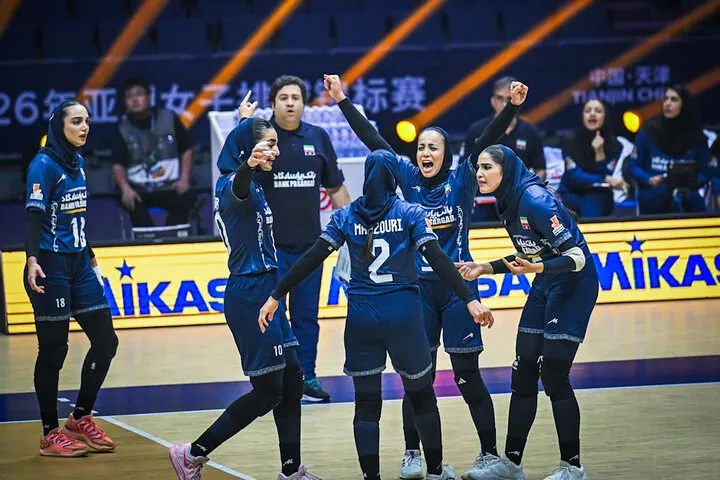
Tehran - BORNA - At the 2026 Asian Championship, Iran reached the semifinals for the first time in its history and ultimately finished fourth. Though the result came with a loss to Japan in the third-place match, the fourth-place finish signaled more than just a ranking — it reflected a broader shift in the level of Iran's women's volleyball on the continental stage.
In the preliminary round, Iran defeated Chinese Taipei and Iraq but lost to China. The team then beat Indonesia in the quarterfinals to reach the Asian semifinals for the first time, where it again faced China before playing Japan in the third-place match and finishing fourth.
Although China and Japan — two of Asia's volleyball powers — ultimately defeated Iran, the team's performance against both was closer than in the past. In the third-place match against Japan, the final set was decided 26-24 in Japan's favor, a result suggesting that the gap between Iran's women's team and the continent's top sides is narrowing, at least in terms of on-court competitiveness. A team that had mostly struggled to compete with Asia's powers now shows it can hold its own and close the gap.
An overhaul aimed at a single goal
This result cannot be separated from the development program the Volleyball Federation launched for women's volleyball starting in 2024. The project, aimed at bringing Iran into Asia's top four, entered a new phase with the hiring of South Korean coach Lee Do-hee.
Investment in women's volleyball increased over this period, with greater attention paid to youth development and building a young roster. As a result, Iran's women's team climbed significantly in the world rankings — from 79th before the program began to 39th after securing several official results.
Volleyball Federation President Milad Taghavi credits the progress to a fundamental shift in approach. In an interview with ISNA, Taghavi described the change as an "overhaul," saying: "Women's volleyball needed an overhaul — one that was very difficult and came at a considerable material and moral cost. Many people and experts didn't believe in this overhaul; some even opposed the federation and thought this approach wouldn't produce results. But the federation persevered and had the courage to follow the path it believed in."
According to Taghavi, increasing the budget for women's volleyball over the past year or two — particularly at the youth level — alongside hiring a foreign coach, were among the federation's key steps. On Lee Do-hee's role, he said: "Ms. Lee Do-hee worked extremely hard for this team over the past two years. This very young team learned a great deal under her guidance, and their belief in themselves changed."
From Ms. Lee to Mr. Tolouian
One of the most significant changes to the national team's coaching staff came a few months before the Asian championship, when Alireza Tolouian — a well-known figure in Iranian volleyball with experience on the coaching staff of the men's senior national team as well as in the Premier League — took over as head coach of the women's team. From the outset, this change appeared capable of helping the federation achieve its goals for women's volleyball.
The federation president announced that Tolouian will continue coaching the women's national team for two more years — a decision that could signal an effort to build technical stability and continue on this same path.
Players who believed they could
Despite all the planning and changes, much of the credit for this success belongs to the players themselves. A young generation, alongside a handful of experienced players, delivered Iran's first-ever appearance in the Asian championship semifinals. Reaching Asia's top four no longer looks like a distant goal to them.
This achievement, however, should not be the end of the road. Iran's women's volleyball team has now realized its dream of reaching Asia's top four. The closely contested matches against China and Japan showed that this is not merely a historic climb in the standings — the level of competitiveness of Iran's team is genuinely changing. If this trajectory continues — with sustained investment, stability in the coaching staff, attention to youth development and continued participation in international competitions — this fourth-place finish could prove to be not a peak, but the first step on a path toward bigger goals, such as competing in the Nations League. A distant path, but one that is within reach.
End Article