Iran's president: Iran has never been an aggressor
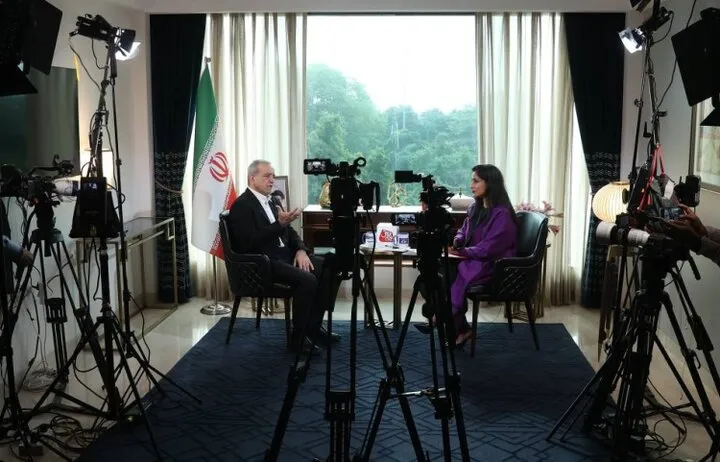
Tehran - BORNA - Pezeshkian gave the interview to India's India Today television network on the sidelines of the BRICS summit. Stressing the historical and cultural bond between Iran and India, the president spoke about steadily improving relations with India's prime minister and the importance of Chabahar as a regional transit hub, describing BRICS as a mechanism for countering US unilateralism and unilateral sanctions, and calling for independent cooperation among member states on trade, investment and regional security.
Pezeshkian described Iran's relations with its neighbors — including the UAE, Saudi Arabia, Pakistan, Qatar, Russia and China — as friendly, saying the core problem lies with US bases in the region. He said Iran has never started a war and has only defended itself against US and Israeli aggression.
The president also rejected claims that Iran is building a nuclear weapon, stressing Iran's commitment to the NPT and its readiness for dialogue within the framework of international law. He described the assassination of leaders and scientists and attacks on infrastructure as crimes, saying Iran does not seek war but will not surrender to sanctions, blocked medicine and food routes, or pressure on its people — adding that the only way forward is an end to US aggression and unilateralism.
The full text of Pezeshkian's interview with India Today is as follows:
India Today: Let's begin with your bilateral meeting with Prime Minister Narendra Modi. One of the symbolic images from that meeting shows the prime minister holding your hand and walking you through the gallery. You also had a 45-minute conversation. Can you tell us what actually took place and what the main focus of that conversation was?
Our relationship with India's prime minister has grown better by the day since I took office. The truth is that because of the deep, ancient cultural bond between us, India and Iran share a cultural and historical connection going back several thousand years — a bond that does not fade with time. Naturally, we are working to strengthen these ties day by day and to rebuild on the foundations of that deep culture, and to help each other stand strong in the region against the drive toward domination taking shape in the world today.
India Today: That's a very important point. But we're talking about a country currently at war, and India has significant strategic interests in Iran, with Chabahar port being one of the most important. Given the war, the conflicts and the attacks we've seen on Chabahar, how reliable and how significant do you consider Chabahar to remain for India?
We did not start this war — the criminal actions of the United States and Israel did. Looking at this through the lens of international law or basic human principles, they attacked our country without any legal framework, martyred our leader, martyred our commanders, martyred innocent children at a school in a single day, assassinated our scientists, and destroyed our infrastructure. Unfortunately, this conduct is inconsistent with international law and basic humanity. As a result, in the face of this campaign, we have only defended ourselves.
Regarding Chabahar and the connectivity we can offer India, Iran occupies a geopolitical position that could make it a crossroads linking south to north and east to west in terms of transport and regional connectivity — the easiest, most economical and most convenient route to help countries in the region build economic, cultural, political, scientific and social ties. This has long been the case; Iran was a route along the Silk Road, and cultural exchange took shape through these very paths. This can be revived again. We are fully prepared to bring this route back to life and work together on it. Naturally, this will allow experience, skills and cultures to build much better relations with one another.
India Today: Mr. President, was the issue of Indian investment in Chabahar port raised during your talks with the prime minister?
Through our discussions, we covered the full range of approaches and directions on this. Our friends can invest there — they already have investments underway. They can come and work in partnership, or we can establish bilateral partnerships to engage with one another on various matters. This is something we are ready to pursue across every relevant issue.
India Today: Mr. President, you also spoke at the economic and business forum. How attractive and reliable is Iran for investors, given that you face sanctions — not international sanctions, but US sanctions and unilateral sanctions from a single country that, legally, other countries should not have to follow — yet these sanctions exist nonetheless? Under these conditions, how can Indian companies and business figures operate in or cooperate with Iran?
The purpose of BRICS is to put an end to the process the US started, in which it sanctions any country it wishes, and to end this drive toward domination. Within BRICS, our trade, transactions and cooperation are meant to operate independently of any single country's ability to sanction whichever country it chooses; we can engage with one another on that basis. We have gathered here to help each other, find a path forward and support one another so we can stand against this domination and unilateralism. This is the purpose of the summit we are holding here with major world powers such as China, Russia and India — to find this path, to pull the US out of unilateralism, and to be able to engage with one another. This is the mission and responsibility of the BRICS summit.
India Today: But BRICS's success will also depend on issuing a joint statement, and it appears that disagreements between the UAE and Iran have become a serious obstacle to reaching such a joint statement.
We have no problem with the UAE. We have no problem with any country in the region. Our problem is with the bases the US maintains in these countries, which it uses to attack our country. The UAE and other countries in the region are all our brothers. We have lived together for a lifetime, traded together for a lifetime, and helped each other for a lifetime. It is the United States that has established bases there and uses them to martyr our children, strike our infrastructure, and bomb our leaders, scientists and people. The real problem is that friends and neighbors should not allow enemies to use their soil to attack another country.
We currently have good relations with the UAE, and we can build on that, and the same is true with other countries. We would like to have close relations with all of them, but it is the United States that does not want this to happen. That's why it doesn't want this to happen — the US takes the region's oil, mines and mineral resources, and in exchange gives countries weapons, missiles and aircraft to frighten us against one another, or to pit us against each other so we fight amongst ourselves. They take the region's wealth while also destroying its security and peace. We ourselves are capable of joining hands with our neighboring countries to establish peace and security in the region, help our own people, and revive economic and cultural development.
India Today: Very well. What is your honest assessment of Iran's situation after six months of confrontation? Is Iran militarily, economically and strategically weaker today, or stronger?
Regarding BRICS, the process currently underway is getting better by the day. I believe we can work together on all of these existing issues. The new BRICS bank that has been established exists to support member states in "joint investments" and "supporting investors who work together," and to help build development there. Naturally, this depends on considerations that countries themselves currently hold with regard to the United States. Through the process it has pursued so far, the US has made every country in the region economically dependent on itself. Efforts are gradually taking shape to improve this dependency on the US economy and the US dollar over time, and it will take time to reach a desirable point — but the whole effort of these countries is aimed at reaching a stage where we can eliminate unilateralism, ensure the world is not unipolar, and be able to engage with one another comfortably, with every country conducting its affairs independently of dependency.
India Today: So you're raising a very important point here, because the West believed it could break Iran. Is Iran more united and cohesive today?
Developing countries have their own particular problems, and we too have had, and continue to have, our own problems — but what the US did made us more united. It even made the people of the region more hostile toward the US because of what it did, since we were the ones wronged. They attacked our country for no reason, simply because they have the power, and they assumed they could come in, as they did in Venezuela, and effectively occupy our entire country within 24 hours and install their own agents in the country. They did not believe that everything they did in Syria would be repeated here. They thought that within two or three days, by martyring our commanders, officials and ministers — and most importantly, the Supreme Leader — the country would collapse. Not only did that not happen, but the people came out in force. For more than 190 days now, people have been in the streets, and our military forces have stood, with sacrifice and devotion, against their technology and equipment superiority, resisting with strength — and despite all their efforts to topple the government, the government, with the help of the people and the support of the forces, has been able to resolve these problems.
This resistance was unimaginable to them, and because of it, we have grown more united by the day. Even those inside our country who were dissatisfied or had grievances stood together to preserve the country's integrity, defended Iran's territorial integrity, and protested the aggression carried out by the US and Israel. Even a large number of Iranians who were abroad returned to Iran. Despite all the problems we have, this was unimaginable.
India Today: Are you seeking to acquire a nuclear weapon? Is nuclear enrichment non-negotiable for Iran? What is Iran's position on this, particularly since this is exactly the issue President Trump repeatedly emphasizes?
You know what the US did — first it tried to seize control militarily, and it couldn't. Then it struck our infrastructure, and that didn't work either. Now it has blocked the import of goods, medicine, food, and even trade, and has closed off the sea route. It wants to close the land routes as well. It claims to champion human rights, while trying to starve our sick and our people, or let them die out of fear of disease, or create problems to force us to surrender. This is not humane; it is the most savage thing possible that they are doing. They block the path of medicine and food — we trade on our own, and they won't even let our own money be returned to us. By what logic do they do this? Whoever wants to fight, fights on the battlefield. They claim to champion human rights. What kind of human rights doesn't allow people in a region with no connection to war to be denied medicine, food and life itself?
They talk about human rights. What exactly are they fighting for? What have we done to deserve this treatment? This is a catastrophe. They tell the world we are seeking nuclear weapons and weapons of mass destruction. Are we the ones seeking mass killing? Or is it these countries that kill innocent people every day in Gaza, Palestine, Syria, Lebanon and Iran? Unfortunately, the world looks at their polished image and believes what they say.
India Today: But what is the actual purpose behind this? Is this about Israel? What is the goal of the claim that Iran has, or is on the path to acquiring, nuclear weapons?
America's actions against Iran are pure propaganda. They had the highest level of monitoring over Iran's nuclear activities and any nuclear effort. We were ready, and they came every day to inspect and review. We operated, and continue to operate, within the framework of international law. If we were seeking a nuclear weapon, we would not have joined the NPT. These are all pretexts to justify attacking our territory. Our martyred leader held a position of the highest standing in leadership, and he repeatedly stated that we are in no way seeking a nuclear weapon. In what language must we say we are not seeking a nuclear weapon? What documentation have they found showing we are building a nuclear weapon that gave them license to attack our country like this? They are lying, just like all the lies they always tell people from behind their podiums.
India Today: Mr. President, I've been following developments in the Iran-US conflict for a long time. Please give me your assessment of the state of the war. Are we still in a state of war, or is the war suspended, given that both the ceasefire and the negotiations have failed?
Do you really think Israel wants Iran to not pursue a nuclear weapon?! Why isn't Israel a member of the NPT? It has as many atomic bombs as it wants. Why don't international organizations protest against Israel? Why did you build an atomic bomb, and why aren't you a member of international bodies? More than 70,000 people are being bombed every single day. What awakened human conscience would accept such treatment of innocent people? They have cut off water, food and medicine for these people. The whole world sees this and understands it. Why does no one confront Israel? What kind of savage world is this, where some can freely kill people — women and children, hospitals and universities — while everyone watches and even defends it every day? It is a catastrophe.
We oppose Israel's oppressive conduct and the oppressive conduct shown by the United States. We say they must not oppress and kill innocent people, and we oppose this. Should we be killed too? That would be even more unjust. The world and its people see this — they just watch. Occasionally, they express sympathy.
India Today: That's an important point. But again, President Trump continues to say he is in contact and in dialogue with Iran's new leaders. What does he mean by Iran's new leaders? Who exactly is President Trump talking to in Iran?
We held talks to end the war and reach a ceasefire. We held talks multiple times. When they carried out their first attack, and during the 12-day war, we were at the negotiating table. After that, we returned to the negotiating table again. We were again close to a final agreement, and again they attacked. Then, after all the aggression and savagery they inflicted on us, we reached an understanding and signed it. Trump simply came out and said he didn't accept it, and tore it up again. How can we negotiate again and trust these commitments, when we don't know whether they will honor them or not? They write something down and then tear it up as easily as drinking a glass of water. What kind of world is this, where we cannot sit down together and hold talks and stand by them? This is the problem we face. Right now, we have no problem. We are not seeking war. Iran has never been an aggressor. You cannot look back over the past several hundred years and find an instance of Iran attacking another country.
India Today: But negotiations mediated by Pakistan did take place, and there was even a memorandum of understanding, though its deadline expired on Aug. 17. Given that the Pakistan-mediated talks failed to reach a result, has Oman entered the mediation and negotiation process?
We don't know which of these statements Trump makes we should ultimately accept and rely on. Pakistan is our friend, brother and neighbor, and has made great efforts on this front to help us establish peace and security in the region. Qatar was also working to help the understanding reached in Pakistan succeed. I don't know what the problem is with what we put in writing in Pakistan, that the US now wants us to sit down and talk all over again. What unreasonable statement did we make there? What position did we take that fell outside the logical, legal and scientific frameworks recognized around the world, that we must now talk about it all over again? Our position remains what we already said: that the US must lift its sanctions, abandon unilateralism, stop trying to negotiate with us through force, and open the pathways so we can live like the rest of the world. We are ready to engage with everyone within the framework of international law and based on logical relations in the world. We didn't attack anyone. So the aggression must stop. Let them not attack us, and we will not attack them. We have not attacked anyone. They attacked us, and we defended ourselves. What more needs to happen for them to say, for example, that they want us to reach a resolution? On the nuclear issue as well, we are prepared to sit down together, again within the framework of the NPT and the same international laws. We are ready for dialogue.
India Today: If Trump were to call for direct talks with Iran without preconditions, would you be ready for such negotiations?
We cannot make such a decision right now. Think about it — they martyred our leader. On what grounds? And now the very people who came and martyred our leader want to speak with us directly? Someone comes and commits martyrdom, and then expects it to be that simple? People are deeply upset by what happened, and this catastrophe inflicted on our country will not simply leave their minds so easily. It is very difficult. The leader was not just a leader; he held a place in the hearts of the Iranian people. It is very difficult for all our people to simply accept what was done and move past it that easily. It is very difficult. No, it isn't that simple. We put it in writing, and they signed it. We signed it. That atmosphere of trust needs to be repaired. We need to believe that what they say is true and that they will stand by the framework they've agreed to. Since the beginning of the revolution, we have stood firm, while they have continually tried to bring down our country.
India Today: What is Iran's reaction to the Mecca pact?
We are not at war with Saudi Arabia, and the Houthis have their own separate issues. All countries in the region should come together to establish peace and security in the region. There is no logic or reason for us to be at war or in conflict with one another. How is it that European countries, despite hundreds of years of war among themselves, now sit together, have their own rules for engagement, open pathways to one another, and trade together? Our own countries in the region could adopt these same principles. Every country can hold its own tastes, ideas and beliefs, but we should sit down together within a framework of regional relations and security and talk. Fighting is not the right path. A human being should not kill another human being. A human being should not, in effect, deprive another human being of life and development. It is barbaric to act this way.
We seek to bring together not just Saudi Arabia, but Turkey, Pakistan and all countries in the region so we can sit together, preserve our security, build a dynamic regional economy, and ensure everyone living in the region enjoys a healthy, good life. There is no reason we shouldn't build unity and cohesion in the region.
India Today: We've heard talk of retaliation against the US and attacks on Middle Eastern countries. Isn't this exactly what the West wants — to divide you from one another and create fractures and disagreements across the region?
Do you have any doubt about this? The entire strategy of the US and Israel is divide and rule. Inside our own country, regarding the unrest that took place on Jan. 8 and 9 [18th and 19th of Dey], Trump himself announced that they had armed and equipped efforts to topple the government. Right now, they are trying to pit different ethnic groups within our country against one another, to sow division and create problems inside our country. Neighboring countries are experiencing the same thing. If you look at their own published writings, their intent is clear: to unite Arab countries against Iran so that we fight one another — and when we fight, they take our oil and resources, while providing weapons in exchange for what they've taken. This forces us to arm ourselves, to turn against each other, to kill one another, while they go about their business undisturbed. What logic is there in every country in the region arming itself to the point that we fear one another? Do people naturally fear each other? As a result, everything the US does is aimed at creating division and enmity.
Since I took office, my entire effort has been to build unity and cohesion within our country, to prevent the natural differences that exist among people from turning into enmity, and to extend a hand of friendship to our neighboring countries, establishing a bond of affection and humanity. This is the effort we are making. They do not want us to achieve this goal.
India Today: So why doesn't Iran, Mr. President, move closer to the Arab world? This region is part of the Islamic world. Why don't you work to end the Shia-Sunni rift that has developed and that the West has long fueled?
We have spoken — from the very first day, both during Nowruz and during the holy month [of Ramadan], which are special times for Muslims, we spoke by phone with all the region's leaders and held discussions. The problem is that the US has built bases on Arab countries' soil. They attack us from those very bases. It's not acceptable for us to be attacked from the same location day after day. We didn't attack them. We targeted the source of the aggression against our country. Naturally, this has created some resentment toward regional countries. Is this resentment reasonable? They should feel resentment that they allowed an enemy to establish itself on their soil and martyr our innocent people, while we simply stand by and do nothing?
India Today: Very well, but the result of this situation is a blockade or closure of the Strait of Hormuz, and the world is suffering because of it. India certainly feels the consequences of this closure as well. What is the current status of the Strait of Hormuz? President Trump has said he wants to rename it the Trump Strait. So what is the status of Hormuz? And has the war, with the help of the Houthis, Hezbollah and Hamas, spread to Bab-el-Mandeb as well? What is the current situation, Mr. President?
Neither Hezbollah nor Hamas — I do not believe they were the ones who initiated the attacks. They are defending themselves. Which of them attacked first, unprovoked? They are being attacked, and they are defending themselves in response. Why? The US comes and blocks off our living space, and when it blocks our route, we're expected to have no reaction? Through this very route — our route — they bring in weapons, resources and conspiracies, and they don't allow security and calm to exist in the region. What do you think we should have done? Naturally, this is the reaction we're showing in response to the aggression carried out against us. We are compelled to act. If we don't respond at some point, we would be as good as dead. We are alive, and we respond. The US must abandon its blockade and sanctions. Sanctions mean killing patients, rising unemployment, spreading poverty, fueling discontent — thousands of problems. If they want to fight, let them fight the military — why target innocent people? Why are they doing this to ordinary people, and then claim it is Iran doing this? We are not doing this. Under sanctions, they are carrying out the worst and harshest measures possible to keep our people trapped in poverty, hunger, illness and various hardships, in order to intensify internal divisions — and having failed to achieve their goals through war, they now hope to achieve them through internal discord. We will not allow that to happen.
BRICS is among the platforms that can help open this route that has been closed, and the connections and neighbors we have represent pathways through which we can conduct our trade and relations. The sea is not our only lifeline. Of course, the sea route is the easy path, but it is not the case that if they close the sea route, we will surrender. This is the very fantasy they have nurtured for a lifetime — that by closing routes and imposing sanctions, they can force Iran to surrender. They will not succeed.
India Today: Did you offer any guarantees regarding the safety of Indian sailors or ships passing through the Strait of Hormuz during your meeting with India's prime minister? India is facing a serious energy crisis and is certainly feeling the consequences of this situation.
We held talks on this with Oman. We reached an understanding on a specific framework for this route. On Monday, foreign ministers from the very Arab countries they wanted us to fight with are set to meet in Oman to reach an understanding on the Hormuz route together and to announce this arrangement to the relevant international maritime organization. Within that framework of international law, the route will remain open — provided the US abandons its aggression and cowardly acts of hostility.
India Today: Another accusation consistently raised by the West is that Russia and China continue to support Iran militarily, strategically and technologically — and it's even said that this support includes real-time intelligence and data sharing. What is your response to this claim? What kind of assistance are Russia and China providing to Iran?
Russia and China are our friends and neighbors, and we have relations with them. With your country as well, as in past times, we seek to improve and deepen our ties. They don't want us to have relations with one another. Technology and tools are in the hands of the US and Europeans. They can do whatever they want with their satellites and spies. What they cannot analyze is how the Iranian people stood up against such power. It is unimaginable to them. It is the people who stood firm, not technology; in reality, they came and struck however they pleased, and the people stood their ground, finding their own ways, through various means, to overcome the problems they created. Since they cannot defeat us, they assume someone from outside must be helping us. They know exactly what tools and technology we possess — but what has created this steadfastness and resistance is not equipment; it is the unity, cohesion and solidarity that exists in this country.
India Today: Very well. I cannot end this conversation without addressing one more important issue. A great deal of reporting and misinformation has been published about Iran's new leader. Mr. President, what is his condition?
With the very data they have, they assassinated most of our leaders, commanders and scientists along with their families — no human framework permits such savagery. As a result, this is the mindset they're creating. Thank God, our leader is alive, his communications are active, and he is carrying out his duties. They spread rumors and imagine they can do to our leader what they've already done to others. The bitter truth is that with the technology they possess, they are the real terrorists. Look at it — Israel and the US are no different. In Syria, Lebanon, Gaza, Iraq, Qatar, Iran — wherever they wish, they strike, they leave, then they assassinate, and tell everyone else that these people are terrorists. Did we target a terrorist? It is a strange world. They kill freely — wiping out an entire family because of one person, bringing down an entire building because of one person — and then call that person a terrorist. This is a new method; in truth, it is killing and committing crimes. They are state terrorists. They write and circulate their own lists of people to kill. Is the leader of a society a terrorist? Is a society's scientist a terrorist? Are ordinary people, schoolchildren, terrorists? Is a bridge or a factory a terrorist target? Yet they do this, and then promote in their media that they are fighting terrorists. It's a strange new logic.
Naturally, in our country's system, it is the leadership that makes the final decision. This has always been the case, and it remains so now. Naturally, he will be the one to make the final decisions. They know that certain actors in the world seek domination and do not want other countries to have healthy relations with one another and live comfortably. Anyone who does not bow to them must be removed through various means. We stand firm, and we will not allow them to remove us.
End Article