Iran cannot be coerced into surrender through war; open to dialogue: Pezeshkian at UNGA
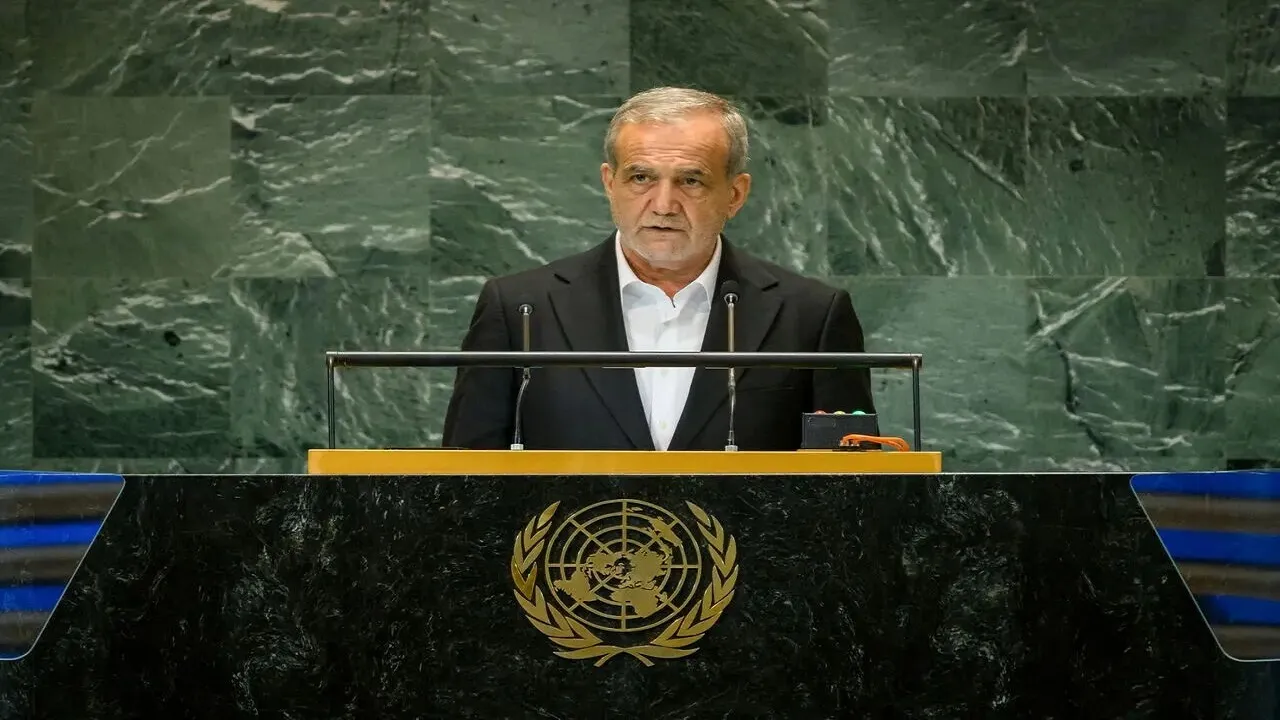
Tehran - BORNA - Speaking Wednesday, Oct. 1, at the 81st session of the UN General Assembly, Pezeshkian said Iran does not view its neighbors as security rivals and wants them to be strong.
"We come from a country where a school was bombed"
Opening his remarks while holding up photographs of students killed in the US attacks on Minab and Lamerd, Pezeshkian said: "Yesterday the president of the United States told us we are terrorists. We are the victims of terrorism. I come from a country whose leader was assassinated without any reason or justification. I come from a country where a school was bombed and children were killed, with American and Israeli weapons. They had committed no crime. Lamerd is a small Iranian town where they bombed the children's sports hall."
He said the attack on Lamerd used cluster munitions that broke apart into thousands of fragments, adding that the US and Israel bombed and killed Iranian scientists, women and children, all of whom were innocent.
"Those who call us terrorists are terrorists themselves"
"Those who call us terrorists are the ones who are themselves terrorists, and who train terrorists," Pezeshkian said. "We are not terrorists — we are defending ourselves." He said the Iranian people were the target of a cowardly attack imposed on them, and that Iran defended itself against the most advanced American and Israeli technology used against it, standing firm without bowing, striking back but never targeting civilians.
"Equipped to attack schools, hospitals, bridges"
Pezeshkian said the US and Israel came equipped to strike Iranian schools, hospitals, bridges and infrastructure, and did so, in violation of international law. He recalled that on the first day he took office, Ismail Haniyeh was assassinated in Tehran, saying Israel bombs and assassinates in any country or region it chooses. He said Israel has massacred more than 80,000 innocent people in Gaza and displaced several hundred thousand more, carrying out what he called genocide with the technology at its disposal, while branding others as terrorists and sources of instability.
"Are we, who simply want to live independently and refuse to bow, the source of instability?" he asked. "We want nothing more, and we have found our answer. We need the strength we require, because a nation that cannot defend itself will be crushed. Today's world is one where the powerful, instead of thinking about people, humanity, justice and democracy, are agents of destruction — and they label anyone they wish to destroy a terrorist."
"We want power to defend ourselves, not to commit aggression"
Pezeshkian said Iran has not attacked another country in 200 years and has always acted in self-defense, yet is accused today of being terrorists and a source of regional insecurity. "This is what has led us to choose our strategy: we want power to defend ourselves, not to commit aggression," he said.
"We want nuclear energy for development, not to build a bomb"
"We want nuclear energy for development — not to build a bomb, destroy or threaten society. We want it to contribute to security," Pezeshkian said. Referring to the seven months during which Iranians took to the streets nightly to defend the country and prevent those armed and incited by the US from sowing insecurity at home, he said: "They are our strength, and it is with the strength of our people that we have stood firm."
"Iran must be powerful enough that its survival is never threatened"
Pezeshkian said Iran must be powerful enough that no one can threaten its survival and progress, responsible enough never to use power for domination, and farsighted enough never to seek its own security in the insecurity of its neighbors.
"We seek no one's permission to defend our country"
On Iran's defense capabilities, Pezeshkian said Iran built its defense systems so that no one would imagine the bombing of Iranian cities could go unanswered. "Iran's military power exists for defense, but let us be clear: we seek no one's permission to defend our country," he said.
"Neither nuclear weapons nor deprivation of nuclear knowledge"
On Iran's nuclear program, Pezeshkian said Iran wants nuclear energy for development. He said for years, discussion of Iran's peaceful nuclear program has been conducted in the language of centrifuges, enrichment, sanctions and bombs, but that for the Iranian people, nuclear technology is part of their right to development — offering treatment for patients, security for agriculture, technology for industry and a foundation for future electricity. He said Iran does not accept that nuclear knowledge should be the exclusive privilege of a handful of countries, and does not consider nuclear weapons a source of security, but will not give up its right to peaceful science, industry and energy. "We say clearly: neither nuclear weapons, nor deprivation of nuclear knowledge," he said.
"The solution to the nuclear issue is agreement, not war"
Pezeshkian stressed that Iran's nuclear issue cannot be resolved on the battlefield. "The solution is an agreement that gives the world credible assurance that Iran's program is peaceful, and gives the Iranian people assurance that their rights will be preserved," he said. He said Iran does not view its neighbors as security rivals, that regional security cannot be built on the instability of coastal states, and that Iran lives in a region where war knows no borders and a crisis in one country spreads to its neighbors. "That is why Iran does not see its neighbors as rivals to its security. We want our neighbors to be strong," he said.
"We cannot accept that everyone benefits from Hormuz while its historic guardian is deprived"
On the Strait of Hormuz, Pezeshkian said: "We cannot accept that everyone benefits from this waterway while its historic guardian, under unjust sanctions, is deprived of freedom of navigation — even in its own waters. They close the way to us, and then move weapons, explosives, missiles and the means to destroy nations through that same waterway. This is not acceptable."
"I cannot accept that this is being done, and we will not allow this to happen to our country," he continued. "The permanent presence of hostile fleets does not bring security through the expansion of war. Security cannot be achieved by disrupting the security of coastal states."
"Palestine remains a wound on the conscience of the international community"
Turning to Palestine, Pezeshkian said Palestine remains a wound on the conscience of the international community, and that Gaza remains a symbol of the failure of international mechanisms to prevent the suffering of civilians. "For decades, resolutions have been issued, yet occupation and violence continue. We cannot speak of peace while ignoring Palestine. Lasting peace in West Asia will not endure without justice for Palestine," he said.
"As long as occupation and injustice exist, resistance will continue"
"As long as occupation, aggression and injustice exist in the world, resistance will continue," Pezeshkian said. "If one form of it is damaged, it will reemerge in other forms — perhaps even stronger ones. Gaza, despite relentless killing and widespread destruction, revealed the people's conviction that resistance cannot be forced into submission through bombs and siege. This is human nature. If a person is driven from their land, they will resist. If a person's home is bombed, they will resist."
He continued: "What should resistance do instead? Accept being bullied? Accept being driven from their homes and sit silently in the face of this aggression? And if they choose to defend themselves, be called terrorists? This is the new vocabulary of the world we live in today."
"Regional issues must be resolved within the region, by regional countries"
Pezeshkian stressed that regional issues clearly have the opportunity to be resolved within the region and by regional countries, rather than becoming a pretext for wars waged by distant powers. "Strategic independence means that relations with no foreign power should ever translate into the possibility of war against a neighbor," he said.
"Iran cannot be forced into submission through war"
Addressing all those responsible for deciding, planning and carrying out the attack on Iranian territory, Pezeshkian said: "Our nation experienced firsthand the military power and consequences of their destructive decisions. They have tested Iran's resilience, and now know well that Iran cannot be forced into submission through war. Iran has never started a war, and has always shown its commitment to the negotiating table."
"Iran seeks no special privilege — only equal rights"
"War was imposed on us, but we proved that we do not fear war in defending ourselves, and we do not shy away from negotiation for peace," Pezeshkian said, stressing that the Iranian people stand ready to defend their beloved Iran to their last breath.
Referring to this year's General Assembly theme, "rebuilding trust," Pezeshkian said trust is not built through words, but requires abandoning double standards. "The atomic bomb and other weapons of mass destruction in this region are in the hands of the Israeli regime, yet Iran is the one asked to submit to inspections," he said. "Israel massacred 70,000 people in Gaza, yet Iran was bombed at the negotiating table."
He noted that Israel possesses nuclear weapons, is not a member of the NPT, and has never in its shameful existence allowed a single inspector onto its territory. "Yet Israel receives billions of dollars in free weapons as a reward, and enjoys impunity to bomb any capital it wishes," he said.
"The bomb is in Israel, but the inspectors are in Iran"
"The atomic bomb is in Israel, but the inspectors are in Iran," Pezeshkian said. "Israel kills, but Iran is sanctioned. This is a tragedy. Whoever says 'I will break the rules' is rewarded — they kill, and we are sanctioned. And after sanctions, it is the poor, the sick and innocent people who are targeted."
"Human rights must not be a tool of geopolitical rivalry"
On sanctions, Pezeshkian said this is what the US seeks to do to countries, and to Iran in particular — sacrificing people for its own goals and policies. "If we seek justice, friend and rival must be judged by the same standard. Human rights must not be a tool of geopolitical rivalry," he said. "Iran seeks no special privilege; it wants equal rights, and accepts the responsibility that comes with it." He said Iran has learned one clear truth throughout its long history: a world without power is dangerous, but a world that understands only the language of power will never have lasting security.
He added: "If international law is enforced only when it suits the interests of the powerful, more countries will conclude that they must rely solely on their own strength for their security — and that would mark the beginning of a more dangerous world for all of us."
"Force must not take the place of diplomacy"
"We must not allow the 21st century to become an era of returning to the rule of the powerful and the strongmen," Pezeshkian said. "We must not build a world in which military power replaces legitimacy, sanctions replace diplomacy, assassination replaces politics, and war replaces dialogue."
"Iran extends its hand of cooperation to the world"
"We call on the world not toward another war, but toward peace and justice — not out of weakness, but out of confidence in our own strength and the understanding that no one in this region will have security alone. Either we build security together, or we endure insecurity together," Pezeshkian said. He said Iran is committed to building a future in which security, justice and human dignity are inalienable rights for all nations — a future in which no nation is marginalized, no voice is lost in the noise of power, and no power has the right to determine the future of others in their place.
"An order befitting the international system must be built on the equality of nations, justice, fairness and humanity's shared will," he continued, "because a peace that is not for everyone is not peace, and a justice that does not include everyone is not justice."
"Threats make our nation more united and our resistance stronger"
In the closing part of his address, referring to remarks made the previous day by the US president, Pezeshkian said: "Yesterday's remarks by the president of the United States, in the eyes of world public opinion, thinkers, politicians and legal scholars, are a clear sign of bullying and the logic of force, and a blatant violation of the [UN] Charter. Let them know that threats only make our nation more united and stronger, and increase Iranians' resistance. The Iranian people will not bow to force, and will make the aggressors regret it. This is something Trump and those who wish to bully us must understand. We are ready for dialogue, but they must know we will not accept the language of force."
End Article