Mr. Director’s Acts: From Moves Against Iran to the Dream of UN Secretary-General
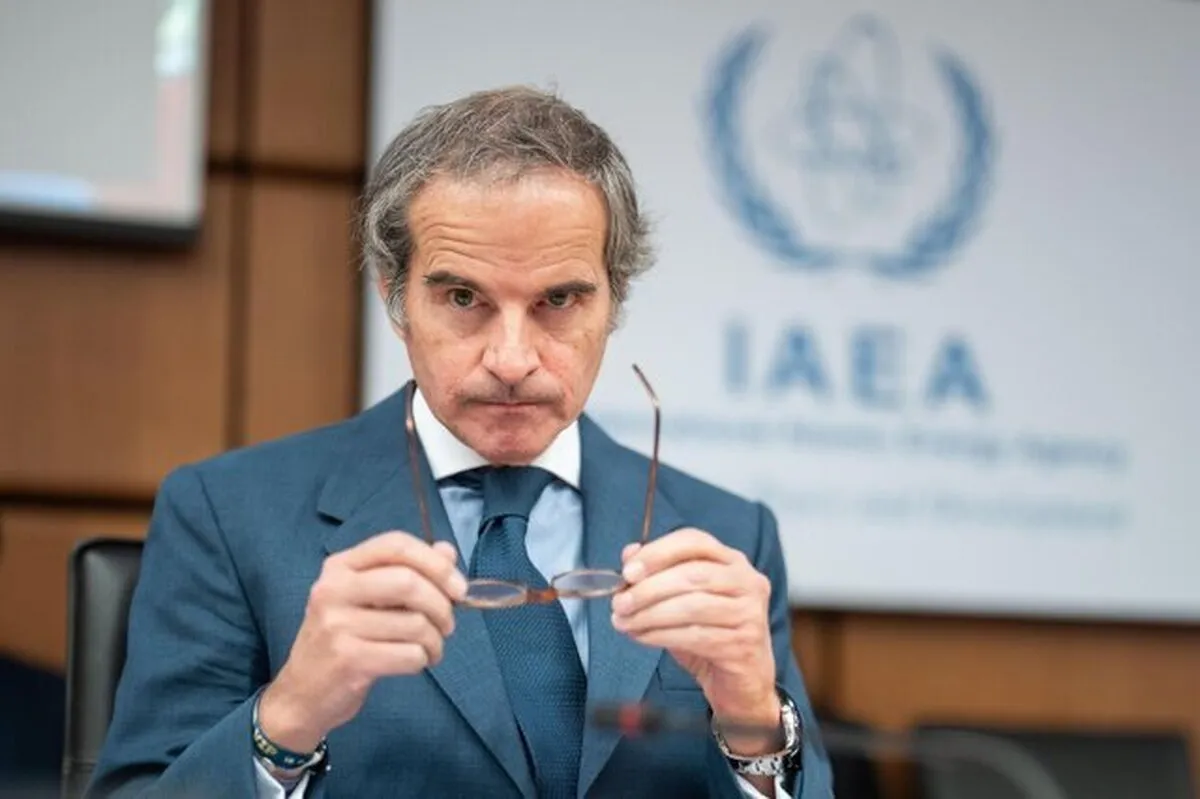
Tehran – BORNA – Rafael Grossi, Director General of the International Atomic Energy Agency (IAEA), has increasingly acted less like a neutral technical official and more like a political figure with clear biases. Observers argue that this approach not only undermines the Agency’s independence but also reveals Grossi’s personal ambition to secure Western backing on his path toward a higher position — the post of Secretary-General of the United Nations.
Over recent years, Grossi has repeatedly issued statements and reports that cast doubt on Iran’s peaceful nuclear activities, providing political and media ammunition for Western and Israeli outlets. Many of these claims later proved baseless, were walked back by the Agency, or were quietly contradicted by Grossi himself. Nevertheless, these one-sided positions elevated him in Western capitals as a “like-minded partner” — a figure who could maintain pressure on Tehran while simultaneously courting support from the U.S. and Europe for his own political future.
Grossi and the Deviation from the IAEA’s Technical Mandate
The IAEA is fundamentally a technical body tasked with monitoring the peaceful use of nuclear energy and enforcing the Nuclear Non-Proliferation Treaty (NPT). Under Grossi’s leadership, however, the Agency has often veered into overtly political territory. During critical moments of Iran’s nuclear file, the IAEA under his watch aligned itself with Western powers rather than playing the impartial role expected of it.
A clear example was Grossi’s politicized quarterly report issued just before the 12-day imposed war on Iran. Analysts argue that the report provided justification for Israel and the United States to launch military strikes against Iranian nuclear facilities. Instead of emphasizing Iran’s ongoing technical cooperation, Grossi amplified minor issues and even reopened files closed since the early 2000s, stripping the Agency of its technical credibility and reducing it to a political tool for Western agendas.
The Political Calculus
Analysts note that Grossi is fully aware that ascending to the UN Secretary-General’s post requires Western consensus, particularly the joint approval of the United States and Europe. To secure this, he has repeatedly adopted anti-Iran positions, positioning himself as the “trusted man of the West.”
In doing so, Grossi has ignored the fact — acknowledged even by the IAEA itself — that Iran remains one of the most heavily inspected countries in the Agency’s history. Instead of highlighting this transparency, he chose language that cast suspicion, aligning his rhetoric with Western political narratives rather than the technical realities of Iran’s compliance.
Several of his reports were timed to coincide with Western pressure campaigns. After U.S. and Israeli strikes on Iran’s Fordow and Natanz nuclear facilities, Grossi stated: “I cannot guarantee that Iran’s nuclear program is entirely peaceful.” This phrase reverberated across Western media as a justification for aggression. Yet weeks later, Grossi admitted in Vienna that “there is no credible evidence of a weapons program in Iran.”
Such contradictions illustrate the political nature of his actions: claims made to serve immediate Western narratives, later diluted when the political usefulness has expired.
Serving Washington’s “Maximum Pressure”
Grossi’s role extended beyond individual reports. For years, the U.S. sought technical-legal justification to intensify its “maximum pressure” campaign. Grossi provided exactly that by issuing ambiguous reports laden with terms such as “unanswered questions,” “ambiguities,” and “insufficient cooperation.” These phrases became political catalysts for European efforts to trigger the JCPOA’s snapback mechanism and restore UN sanctions on Iran.
Notably, Grossi never explicitly condemned U.S. or Israeli attacks on Iran’s nuclear facilities — actions he himself admitted were illegal. Instead, he merely remarked, “Nuclear facilities should not be attacked,” a statement far short of a firm condemnation.
Denial After Political Use
A pattern has emerged: after Western governments and media exploit Grossi’s reports, he quietly retracts or modifies his claims. For example, he once suggested Iran might have transferred enriched uranium to unknown locations. Western media seized on this to depict Iran as an imminent threat. Later, Grossi admitted: “There is no evidence Iran moved enriched material; Iran has told us it has not.”
Such retractions highlight that the original claims were more political than technical, serving temporary propaganda needs rather than factual oversight.
Iran as Grossi’s Stepping Stone
According to Western sources, Iran’s nuclear file has been Grossi’s “golden opportunity.” Each time the U.S. or Israel required justification for aggressive actions, the IAEA under his leadership supplied it. Critics describe this as part of his campaign to win Western backing for his UN ambitions.
Iran has repeatedly protested this politicization, stressing that such behavior not only undermines diplomacy but also directly emboldens U.S. and Israeli aggression. Nevertheless, with explicit Western support, Grossi has escalated his approach.
Open Western Support
Recent months have seen growing praise from Western officials. The U.S. State Department has described Grossi’s stance as “realistic” — a euphemism for alignment with Washington’s maximum pressure policy. Israeli media have lauded him as “one of the few international officials who truly understands the Iranian threat.”
This open support underscores that Grossi has sacrificed impartiality to advance his personal ambitions. His rhetoric often mirrors U.S. and European political statements rather than the technical neutrality the IAEA is supposed to embody.
Consequences for the IAEA’s Credibility
The greatest casualty of Grossi’s ambition has been the IAEA’s institutional credibility. Founded in 1957 to act as a neutral technical body during the Cold War, the Agency was meant to prevent the politicization of nuclear energy. Grossi’s conduct has compromised this mission, raising questions even among Non-Aligned Movement states and developing nations in Africa and Latin America.
Many now ask: if tomorrow the West needs a pretext against another independent state, will the IAEA again serve as its political instrument? Such doubts undermine the very legitimacy of the Agency, which depends on impartiality to function effectively.
In the words of critics, Grossi is “dancing for the UN Secretary-General’s chair.” But the cost of his dance is the erosion of trust in one of the most sensitive institutions of global governance. By prioritizing personal ambition over institutional neutrality, he risks transforming the IAEA into little more than a Western political club — and weakening the credibility of the United Nations itself.
End of Report