Russia expresses interest in cooperation with Iran on new orbital station
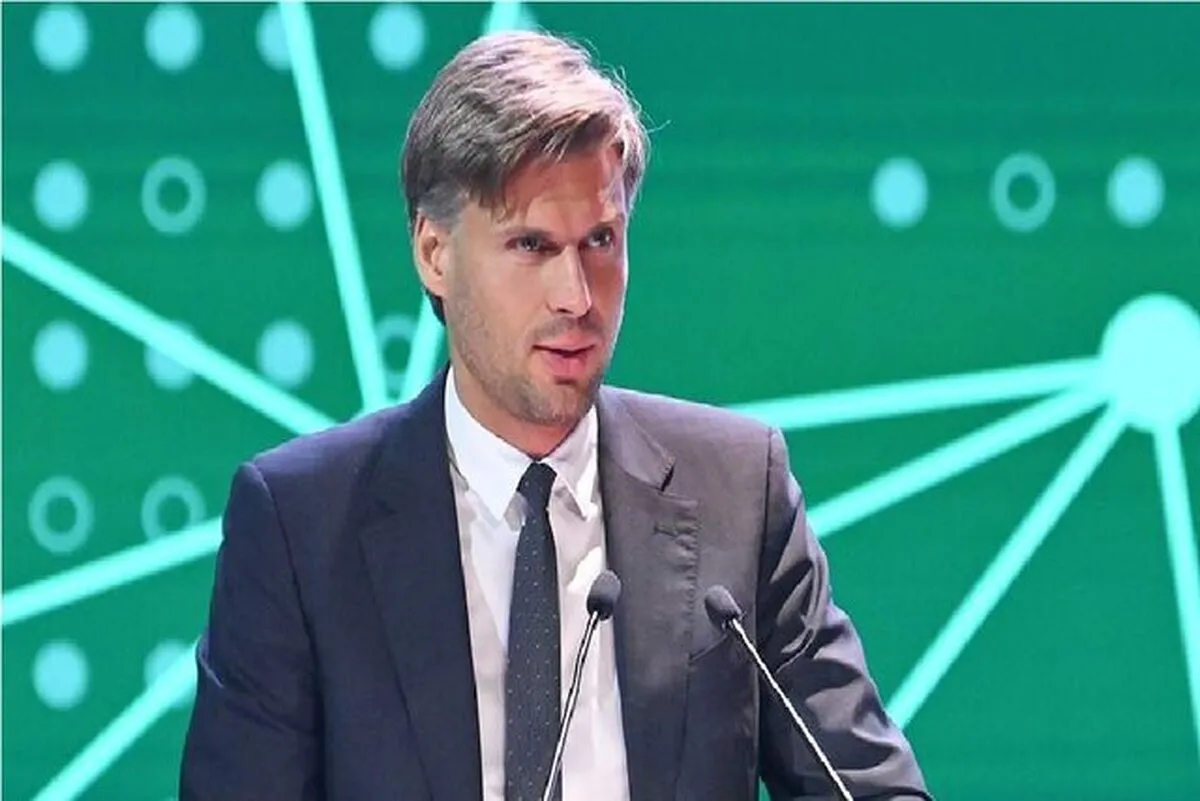
Tehran - BORNA - Dmitry Rogozin Bakhanov, Head of the Russian Space Agency (Roscosmos), sent a video message to the opening ceremony of World Space Week held Thursday morning at Iran’s Ministry of Information and Communications Technology. In his remarks, he expressed delight over Iran’s hosting of the event and said attending the ceremony was an honor for him.
Bakhanov noted that the event begins each year on October 4, the day in 1957 when scientists and engineers of the former Soviet Union launched the world’s first artificial satellite, marking the dawn of the space exploration era.
“This year’s World Space Week is dedicated to life beyond our planet,” he said. “The great achievements in human spaceflight and ensuring human life beyond Earth’s atmosphere are a source of national pride for us.”
The Roscosmos chief highlighted Russia’s pioneering legacy in space: “We were the first to send a human beyond Earth, to launch a spacecraft with a woman onboard, to perform a spacewalk, to dock two spacecraft, and to learn how to build and launch orbital stations.”
He emphasized that space exploration is an extremely complex and costly scientific field, and major projects cannot be carried out without close international cooperation and joint governmental efforts.
“The most prominent example of such collaboration,” he added, “is the ongoing International Space Station (ISS), a unique laboratory where astronauts from different countries have continuously worked together for the past 25 years. Meanwhile, humanity continues to utilize low-Earth orbit — where, in addition to the ISS, our Chinese colleagues are permanently operating the Tiangong orbital station. India and the United States are also pursuing programs to build new stations.”
Bakhanov continued, “We are currently developing a new Russian orbital station, and we would be pleased to welcome foreign partners interested in joining this project. Russia is ready to provide equal conditions for all participants — both for equipment modules and for conducting experiments aboard the station.”
He added, “We would be especially happy to see our Iranian friends involved in this endeavor. Preliminary discussions have already begun with the Iranian Space Agency.”
The Roscosmos chief explained that as part of the new station project, technologies will be developed for assembling interplanetary systems, including manned spacecraft and lunar landing systems.
Bakhanov emphasized that leading space powers are now preparing for full-scale lunar exploration, with Russia, the United States, China, India, and several other nations advancing their own missions.
“Russia and China, recognizing the complexity and significance of this mission, have begun joint work on creating an International Lunar Scientific Station, which now includes 13 member countries,” he stated.
He added that the Moon is humanity’s first step beyond low-Earth orbit, and ideas for manned missions to Mars are already under study. “This requires solving a series of technical challenges, which scientists and engineers around the world are actively working on. We are also ready to cooperate with Iranian scientists and engineers in this field,” he said.
Bakhanov concluded by expressing hope that nations will continue to collaborate effectively in advancing peaceful space exploration in the future.
End Article