Baghaei: Our Cooperation with the IAEA is Based on Parliamentary Law
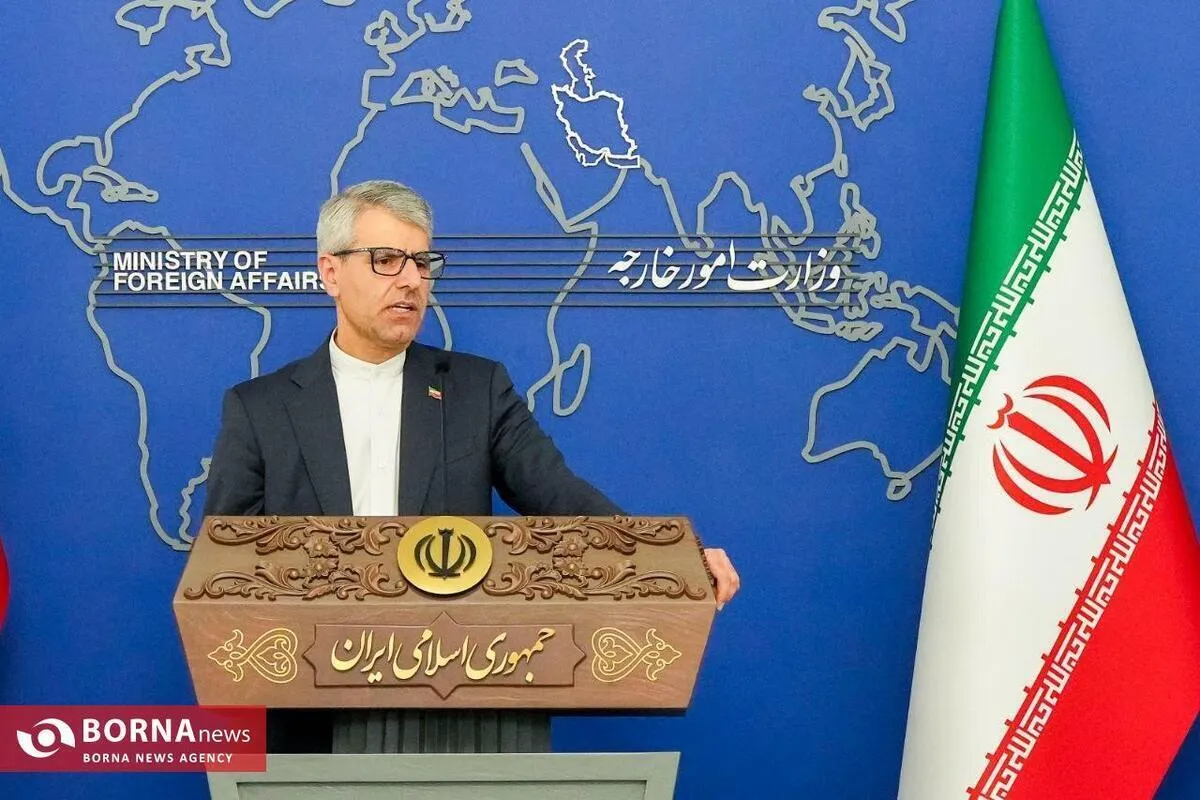
Tehran - BORNA - Esmaeil Baghaei, at the beginning of his press conference today (Tuesday), mentioned: "Last week, the Foreign Ministry, in line with economic diplomacy, held the second provincial diplomacy meeting in Mashhad." He added: "Our goal is to facilitate economic interactions with target countries, including neighboring countries."
He continued: "At the regional level, we are still dealing with the issue of Palestine and regional developments. If we previously spoke about the continuation of genocide by the Zionist regime in Palestine, today we are witnessing the repeated violation of the ceasefire by the Zionist regime in Gaza."
The Zionist Regime's Goal is to Counter Any Economic Development in Lebanon
Baghaei stated: "In recent days, we have also witnessed terrorist acts by the Zionist regime in Lebanon," noting: "The Zionist regime's objective in these actions in Lebanon is to counter any economic development and reconstruction there. Regarding the issue of Gaza and Lebanon, the guarantors of the ceasefire have an important role and must fulfill their duties in this regard."
The Foreign Ministry Spokesperson also said: "Today, the ECO Interior Ministers meeting is being held in Tehran, which is an important meeting."
We Await the Next Court Session for Mahdieh Esfandiari
In response to a question regarding the latest status of the case of Mahdieh Esfandiari, the Iranian citizen detained in France, he said: "As you know, Ms. Esfandiari was conditionally released late last week after the court session. In fact, a monitored release order was issued for her, and she is currently residing outside the prison. We are awaiting her next court session."
Baghaei stated: "We welcome the recent court ruling for her monitored release," adding: "As we have stated before, we emphasize that there was no justified reason for her arrest, and we hope the issued verdict leads to her final freedom and return to the country."
The Foreign Ministry Spokesperson noted: "The Iranian Embassy in France is still following up on her case," saying: "The follow-ups are aimed at paving the way for her complete freedom as soon as possible."
Interior Minister of Oman and Deputy Interior Minister of Iraq are Special Guests at the ECO Meeting
In response to an question regarding the Omani Interior Minister's visit to Iran and his meeting with Ali Larijani, Secretary of the Supreme National Security Council (SNSC), Baghaei said: "This trip was made in line with the good cooperation between Iran and Oman. During this trip, he held bilateral meetings with our country's officials, including a meeting and consultation with the SNSC Secretary, and he will also meet with the President."
He continued: "The Interior Minister of Oman has participated as a special guest in the ECO Interior Ministers meeting."
Baghaei also said: "A delegation from Afghanistan is also present at the ECO Interior Ministers meeting being held today in Tehran, and the Deputy Interior Minister of Iraq and the Interior Minister of Oman have participated as special guests in this meeting."
Syria's Security is Important for Iran and the Whole Region
In response to another question about the visit of the Russian Special Envoy for Syria to Tehran last week, and whether any change has recently occurred in Iran-Syria relations, the Foreign Ministry Spokesperson said: "This trip is a continuation of the cooperation and consultations we have had with our partners, including Russia, on the issue of Syria for a long time, and this visit was conducted within the same framework."
Referring to the fluid developments underway in Syria, Baghaei said: "As we have stated many times, Syria is an important country in the region. Syria's security is important for Iran and the whole region, and it is natural for us to consult and confer with our regional partners and other countries involved in the issue of Syria, and this trip was conducted within that framework."
The Iranian Foreign Ministry Spokesperson, in response to a question claiming that [Rafael] Grossi alleged that behind-the-scenes negotiations were underway to resume inspections in Iran, said: "I did not hear such a phrase from Mr. Grossi."
The Basis for Our Cooperation and Interaction with the Agency is the Law Ratified by the Parliament
He added: "In general, following the developments that occurred in June, the basis for our cooperation and interaction with the Agency is the law ratified by the Islamic Consultative Assembly (Parliament). We remain a member of the NPT Treaty and are committed to the Safeguards Agreement. In implementing these obligations, we advance our interactions with the Agency, taking into account the parliamentary resolution that introduced the Supreme National Security Council (SNSC) as the custodian of this matter."
Referring to some aspects of Iran's cooperation with the Agency, Baghaei said: "Some cooperation with the Agency is routine cooperation that aligns with our national interests. For example, issues related to fuel exchange for the Bushehr nuclear power plant or monitoring the performance of the Tehran research reactor, which supplies essential medicines for patients, are among the cases that are naturally carried out in line with the country's interests."
He emphasized: "As previously mentioned, the basis for our cooperation with the Agency in the current circumstances is the Parliament's law, and any request from the Agency must be reviewed on a case-by-case basis, and necessary actions will be taken based on the decision of the Supreme National Security Council."
Baghaei, continuing his weekly press conference, referred to the recent trip of Kazem Gharibabadi, Deputy Foreign Minister for Legal and International Affairs, to Kabul and explained the objectives of this trip.
Gharibabadi’s Trip Was to Address Several Standing Issues on the Iran-Afghanistan Agenda
The Foreign Ministry Spokesperson said about the Deputy Foreign Minister's trip to Kabul: "Mr. Gharibabadi's trip was made to address several standing issues on the agenda of Iran-Afghanistan relations. These issues included border security, water rights (Haq'abe), and judicial and legal cooperation, which were specifically discussed in meetings with relevant Afghan officials."
He added: "Regarding the plan for renovating border markers, which had been halted for some time, it was agreed that the implementation of this understanding would resume. Good discussions were also held about combating unauthorized border crossings, drug trafficking, human trafficking, and transnational organized crimes in general."
The Foreign Ministry Spokesperson continued: "In the field of judicial cooperation, negotiations were also held on the transfer of convicted persons, the extradition of criminals, and other related examples of judicial cooperation. We hope the continuation of these consultations will help facilitate exchanges in various fields, especially in areas overseen by the Foreign Ministry's international section."
Documentation of Evidence and Crimes from the 12-Day War Continues
The Foreign Ministry Spokesperson, in response to a question regarding the Foreign Ministry's international actions to pursue the crimes committed by the U.S. and Israel against Iran, stated: "The first action for any legal work at the international level is the documentation of evidence, reasons, and indications related to the commission of a crime or offense. We have done this regarding the 12-day war, and this process continues."
He added: "The Foreign Ministry's international section has been collecting and documenting evidence and reasons from the very first days—meaning from the day the Zionist regime's aggression began and it started committing crimes—and this has been published in the form of a volume."
Baghaei said: "The Foreign Ministry is one of the institutions working on this issue; the legal section of the Presidency plus the Judiciary also have responsibilities in this regard."
Addressing the inquiring journalist, he said: "You can ask the Judiciary Spokesperson about the follow-ups to this matter in its criminal dimensions inside the country, so that he can explain the actions taken in this regard."
He emphasized: "The follow-up of this issue in the international arena is a continuous process, and at the Non-Aligned Movement (NAM) summit in Uganda, we managed to include one or two specific paragraphs in the final statement of the meeting condemning these attacks, and 120 countries condemned these attacks."
He added: "Our documentation in this regard continues, and simultaneously we are reviewing which institutions are competent to address the violation and crime committed by the U.S. and the Zionist regime."
The Framework of Our International Obligations is Clear
The Spokesperson of the Ministry of Foreign Affairs of the Islamic Republic of Iran, in response to another question about the status of Iran's cooperation with the International Atomic Energy Agency (IAEA) and the perception that this relationship is undecided, emphasized: "The minimum and maximum level of our cooperation is determined by international laws and obligations. We have a treaty called the Non-Proliferation Treaty (NPT) and also the Safeguards Agreement, and these two are the basis of our interaction with the Agency, just like any other non-nuclear weapon state."
Referring to UN Security Council resolutions, he added: "Resolution 2231 of the Security Council stipulates that after the end of the 10-year period, Iran will be treated like other non-nuclear states. As long as this resolution was in force, we accepted a set of voluntary commitments aimed at confidence-building and creating transparency beyond safeguards obligations, in exchange for the lifting of unjust sanctions."
Baghaei continued: "The situation is now clear, and the framework of our international obligations is defined. The matter is completely clear. As I mentioned earlier, we will continue the path of cooperation with the Agency based on our obligations within the framework of the NPT Treaty and the Safeguards Agreement, taking into account the resolution of the Islamic Consultative Assembly."
Whenever Negotiation Serves the Interests and Rights of the Iranian Nation, We Will Not Hesitate to Use Diplomacy
In response to a question during his weekly press conference about the possibility of resuming negotiations with the opposing parties, he said: "Whenever we reach the conclusion that the necessary conditions and grounds are available for a negotiation that secures the interests and rights of the Iranian nation, we will not hesitate to use the tool of diplomacy."
Iran's Nuclear Issue Should Not Be Discussed at the Security Council or Multilateral Levels
The Spokesperson of the Ministry of Foreign Affairs, in response to a question regarding the position of the nuclear issue in the country's foreign policy, said: "We in the Foreign Ministry and the diplomatic apparatus have extensive activities and have not paused waiting for one or more negotiation processes. The Foreign Ministry has thousands of missions, and all of them are being carried out."
Emphasizing that "the nuclear issue is one of the working axes of the Foreign Ministry," he added: "As I mentioned earlier, the entire nuclear issue was, in a way, imposed upon us. This issue should not have been placed on the agenda of the UN Security Council from the beginning."
The Foreign Ministry Spokesperson further clarified: "In our view, both in the past and now, the Iranian nuclear issue should not be discussed at the Security Council or at multilateral levels. This matter should be pursued within technical and legal frameworks, not political and security ones."
Our Growing Relations with China Will Continue Strong
In response to a question from a Chinese reporter about the upcoming meeting between the Chinese and U.S. presidents and the possible impact of this on Tehran-Beijing relations, Baghaei said: "Our relations with China are strong, and we have interactions and exchanges with China at various levels of bilateral and international relations, as well as at the level of international organizations such as BRICS and Shanghai."
He added: "Our growing relations with China will continue strongly, regardless of potential developments or influence attempts by some other countries."
Implementation Process of Iran-Iraq Security Understanding is Acceptable
The Foreign Ministry Spokesperson, in response to a question about the Iraqi National Security Advisor's visit to Iran and the latest status of the implementation of the Iran-Iraq security memorandum, said: "The process for implementing this understanding is acceptable."
He continued: "This issue requires the care of both sides so that this memorandum is implemented in the best possible way."
Larijani’s Trip to Russia Was a Continuation of Ongoing Consultations Between the Two Countries
In response to a question from an American media outlet about the recent trip of Iran's SNSC Secretary Ali Larijani to Russia and whether the trip was related to receiving arms from Russia, the Foreign Ministry Spokesperson said: "The recent trip of the Iranian National Security Council Secretary to Russia was not the first trip, and it was conducted as a continuation of ongoing consultations between Iran and Russia, where a wide array of issues were reviewed."
Referring to the Treaty on Comprehensive Strategic Partnership between Iran and Russia, the senior diplomat of the Islamic Republic of Iran said: "Discussions and consultations during this trip related to the executive process of this document and other issues where the two countries share common interests and concerns."
Our Armed Forces Are in Full Readiness, Learning from Previous Developments
In response to another question from the same reporter regarding whether Iran confirms that Israel has sent messages via Russia to reduce tensions, he noted: "This issue was raised in the media, and Russia announced that such a matter was raised by the officials of the Zionist regime."
Stating that "we hear contradictory messages from various parties," he continued: "We have learned through experience that, regardless of these messages, we must always be prepared. Our armed forces are in full readiness, having learned from previous developments. Based on experience, we know that the promises of the Zionist regime cannot be trusted. Therefore, our focus is on strengthening the country's national and defensive capabilities in various fields."
As Long as the Zionist Regime Enjoys Immunity, It Will Continue Its Crimes
Referring to the recent advisory opinion of the International Court of Justice (ICJ) regarding the Palestine issue and the Zionist regime's effort to question the ruling, the spokesperson for Iran’s diplomatic apparatus said: "The International Court of Justice is the official dispute settlement body of the United Nations, and its position is completely clear and accepted."
He criticized the reactions of the U.S. and the Zionist regime to the ruling, adding: "After the issuance of this ruling, we witnessed the U.S. and the Zionist regime, in a coordinated and targeted manner, target both the ICJ and the International Criminal Court (ICC), trying to question the legitimacy of these institutions."
Baghaei emphasized: "The U.S.'s stance against these institutions is aimed at the continuation and perpetuation of the Zionist regime's impunity (bīkīfarmānī). The fact that the U.S. government shows a threatening reaction against any criticism by the international community and international organizations regarding the performance of the Zionist regime, and tries to humiliate these organizations, is a sign of complicity in committing crimes."
He continued: "As long as the Zionist regime enjoys immunity and is assured that it will not be held accountable before the international community, it will continue its crimes."
Referring to the importance of the recent ICJ ruling, the Foreign Ministry Spokesperson said: "This ruling, in continuation of previous advisory opinions, declared the occupation completely illegal and considered the actions of the Zionist regime in Gaza over the past two years a flagrant violation of human rights and humanitarian law."
He concluded his answer by noting: "In terms of the judgments issued and the expression of the international community's view on the severity of the crimes committed in Gaza and the West Bank, there is no vacuum. The international community has clearly announced its position. The main problem lies in the immunity that the U.S. and some Western countries have granted to the Zionist regime, and this issue has caused the continuation of crimes in the region."
Iran Will Remain Steadfast in Its Adherence to the One-China Principle
In response to a question about the 1971 UN General Assembly resolution emphasizing the One-China principle, Baghaei said: "The position of the Islamic Republic of Iran in this regard is completely clear. We have always emphasized the territorial integrity of China and respect for the One-China principle."
He added: "This position has been repeatedly declared both in our official correspondence with international organizations and in verbal stances. Respect for China's integrity, within the framework of the resolution mentioned, is considered a principle for us."
The Foreign Ministry Spokesperson emphasized: "The Islamic Republic of Iran will certainly continue this policy and will remain steadfast in its adherence to the One-China principle."
There is No Doubt About U.S. Support for the Zionist Regime
Referring to regional developments and the role of the Zionist regime, Baghaei said: "Everything that happens in our region, from crimes against the Palestinian people to military aggressions against regional countries and occupation in Syria and Lebanon, is written in the name of the United States, because there is no doubt about U.S. support for the Zionist regime."
He added: "This support includes providing military and arms aid, offering diplomatic and political cover, and preventing any action in the Security Council to restrain this regime. These behaviors confirm the theory that there is no distinction between the Zionist regime and the U.S."
The Foreign Ministry Spokesperson emphasized: "For every crime committed by the Zionist regime, the U.S. also bears responsibility. Furthermore, the continuation of this regime's impunity has made it more difficult to restrain its behavior, even for its supporters."
Baghaei noted: "The international community must, in addition to pressuring the Zionist regime, place pressure on its main supporters, especially the U.S., to prevent the continuation of this regime's policy of impunity at the level of the UN Security Council and other international institutions."
Multiple Instances of Ceasefire Violation Have Been Observed in Both Gaza and Lebanon
In response to a question regarding the continuation of ceasefire violations in Gaza by the Zionist regime, the Foreign Ministry Spokesperson noted: "Regarding the ceasefire in Gaza, from the very beginning, in the statements we issued, while welcoming the cessation of genocide in Gaza, we expressed our concern about the ambiguities in the plan and also the repeated violation of the ceasefire by the Zionist regime. This concern continues; as we have witnessed in recent weeks, the Zionist regime has repeatedly failed to adhere to its commitments. Multiple instances of ceasefire violation have been observed in both Gaza and Lebanon, and this situation makes the responsibility of the ceasefire guarantors in both regions heavier."
The Absolute Evil and Real Devil in Our Region and the Global Arena is the Zionist Regime
In response to a question from a Russian "Russia Today" reporter claiming that The Washington Post had obtained documents indicating that a number of Arab countries expanded their cooperation with the Israeli army during the Gaza war, with one of the documents referring to Iran and its allied groups as the "Axis of Evil," and asking why each of these countries increased cooperation with Israel, especially when there was seemingly a common consensus among Arab countries regarding the Gaza issue, he clarified: "It is not customary for me to comment on media reports, many of which are contradictory and are purposefully designed to create disagreement and deviation in regional public opinion regarding the Zionist regime."
The senior diplomat of the Islamic Republic of Iran continued: "What is clear is that the Zionist regime is the only entity at the international level that has been rightfully accused of committing the crime of genocide. No similar case can be found in contemporary history. Both the ICC and the ICJ have issued a form of indictment against the Zionist regime. The issue of committing the crime of genocide is still under investigation at the ICJ, and human rights bodies have also explicitly stated that what happened in Gaza is a clear example of genocide."
Baghaei added: "Therefore, there is no doubt that the absolute evil and real devil in our region and the global arena is the Zionist regime."
U.S. Military Movements in the Caribbean Region Are a Flagrant Violation of International Law and UN Charter Principles
In response to a question about U.S. military movements in the Caribbean region and its threats against Venezuela, the Foreign Ministry Spokesperson noted: "This issue is a cause for concern for the entire international community. We are facing a process of unilateralism which, at the international level, indicates a growing disregard for the principles of the UN Charter and the fundamental rules of international law. One of the most important principles of international law, also stipulated in the UN Charter, is the prohibition of the use of force or the threat of use of force and the necessity of respecting the sovereignty and territorial integrity of states. Unfortunately, these principles are being violated by the U.S. in various parts of the world, including in some Latin American countries, under various pretexts, including the fight against drug trafficking."
Emphasizing that "these developments must be considered an action against international peace and security," Baghaei noted: "Similar pretexts are raised in different regions of the world, and in this case, the pretext of 'fighting drug trafficking' is being used to exert pressure on a sovereign country."
He added: "We consider these military movements a flagrant violation of international law and the principles of the UN Charter and evaluate it as a dangerous development against regional peace and security. In this regard, the role of the United Nations, especially the Security Council, is highly prominent, as these institutions must fulfill their responsibilities to safeguard international peace and security."
The Judge in the Case of the Two French Nationals Detained in Iran Has Issued Rulings Regarding Their Crimes
He continued: "Regarding the two French nationals detained in Iran, the judge of the case has issued rulings concerning their crimes. Regarding the future path and how the court will ultimately rule, we, as the Foreign Ministry, cannot make any substantive entry [interference], as the Judiciary in Iran is an independent institution. The Ministry of Foreign Affairs will carry out everything necessary within the framework of human and humanitarian issues."
UN Secretaries-General Are Chosen Based on a Type of Geographical Rotation, According to UN Practice
In response to a question regarding the process of selecting the UN Secretary-General and the influence of the geographical perspective on this choice, the Foreign Ministry Spokesperson said: "The selection of the UN Secretary-General is subject to rules stipulated in the UN Charter. I believe Articles 97 to 99 of the UN Charter address the matter of the Secretary-General's selection. This selection must take place through a specific process; meaning the proposed candidate must be approved by the UN Security Council and then, in a way, confirmed and validated by the UN General Assembly."
The senior diplomat of the Islamic Republic of Iran noted: "Based on a practice that has been implemented in the United Nations for several decades, the Secretaries-General of the organization are selected based on a type of geographical rotation from various regions of the world. It seems that the collective view of the UN member states is also based on the continuation of this practice."
He emphasized: "This process can, to some extent, help observe fairness and justice in the selection of Secretaries-General from diverse geographical regions."
The Zionist Regime Has Spared No Effort to Strike Iran and the Iranian People
In response to a question regarding a former Israeli intelligence official's statement that the regime failed to achieve its objectives in the 12-day war and that, conversely, the Iranian government's popular standing was strengthened, he said: "Do not expect me to comment on the statement of a former official of the Zionist regime. Generally, it is clear to us that the Zionist regime has spared no effort to strike Iran and the Iranian people. It is completely evident to us and does not require their confession, as it was our nation that stood firm and did not allow the sinister aims of the parties who dared to encroach upon the territory of the Islamic Republic of Iran to be realized."
Baghaei continued: "Therefore, this issue demonstrates the steadfastness and resilience of the Iranian nation, which once again did not allow the greed of foreigners regarding Iran's territorial integrity, national sovereignty, and security to materialize."
Our Continuous Readiness Against Any Aggression is a Sign of Foresight
In response to a question about some interpretations of the previous day's remarks by Deputy Foreign Minister Majid Takht Ravanchi concerning the 12-day war, the Foreign Ministry Spokesperson said: "He did not say such a thing, and his remarks were not correctly conveyed."
He continued: "Generally, the possibility of military aggression has existed at all times, and we cannot deny this due to the experiences we have had previously, such as when, in the final months of Saddam's attack on Iran, we faced the issue of the U.S. directly entering the war and shooting down an Iranian civilian airplane."
Stating that "the U.S.'s actions contrary to international law have a long history, and the Americans repeatedly said 'all options are on the table,'" Baghaei concluded: "Our continuous readiness against any aggression is a sign of foresight."
End Article